Every recruiter has a story about the candidate who looked perfect on paper but turned out to be a disappointing hire, and the one who barely made it past the initial screen but became a star performer. These stories are not just anecdotes. They point to a structural problem in how most organizations evaluate candidates during the earliest stage of the hiring funnel. That problem is bias, and it operates in ways that are far more subtle and damaging than most teams realize.
The conventional response to bias awareness has been to add steps: more reviewers, structured scorecards, blind resume reviews, and diversity checklists. Each of these interventions has merit, but they share a common limitation. They add time to a process that every hiring manager wants to accelerate. The result is a tension that most talent acquisition leaders find impossible to resolve. Either they move fast and accept that bias will slip through, or they move slowly and risk losing candidates to competitors. But this trade-off is a false one, and platforms like Huntlo.ai are proving that AI-powered screening can actually eliminate bias variables while making the process faster, not slower.
The Real Cost of Screening Bias
Screening bias is expensive, and the costs compound across the entire hiring lifecycle. When a recruiter unconsciously favors candidates from familiar backgrounds, prestigious universities, or well-known companies, the shortlist that reaches the hiring manager is already narrowed.
Research from McKinsey has repeatedly demonstrated that companies in the top quartile for ethnic and cultural diversity are 36 percent more likely to outperform their peers financially. Yet the screening stage, where the first and most aggressive filtering happens, is also the stage where bias is least visible and hardest to audit. A recruiter scanning a hundred resumes in an
afternoon is making rapid pattern-matching decisions that are influenced by everything from the candidate’s name to the formatting of their resume to the familiarity of their previous employers. These micro-judgments accumulate into a shortlist that looks reasonable on the surface but systematically excludes high-potential candidates from non-traditional backgrounds.
The financial cost of this exclusion is not abstract. It shows up as higher cost-per-hire because the pool of considered candidates is artificially small. It shows up as longer time-to-fill because the shortlisted candidates, drawn from a biased pool, are more likely to reject offers or fail during later stages. And it shows up as lower retention because biased screening tends to produce homogeneous teams, which research consistently shows are less resilient and less innovative than diverse ones. The hidden cost that nobody measures is the opportunity cost of the candidates who were filtered out before anyone had a chance to evaluate them properly.
Why Traditional Anti-Bias Methods Fall Short
The most common anti-bias intervention in recruiting is the blind resume review. The logic is straightforward: if you remove names, photos, and identifying information, you remove the bias. In practice, blind reviews do reduce some forms of bias, particularly name-based and demographic bias. But they fail to address the deeper problem, which is that bias is embedded in the evaluation criteria themselves, not just in the demographic signals on a resume.
A recruiter who filters for candidates from “top-tier companies” or “prestigious universities” is applying a biased criterion even if the resume is completely anonymized. The bias is in the assumption that certain institutional affiliations predict performance. That assumption has been debunked repeatedly by SHRM research on hiring outcomes, yet it persists because it feels like a reasonable heuristic. Similarly, requiring specific years of experience in a narrow role title excludes career changers, self-taught professionals, and people who acquired equivalent skills through non-linear paths. These are not bugs in the screening process. They are the defaults, and traditional anti-bias methods do not touch them.
Structured interviews and diverse hiring panels help later in the process, but they do not solve the screening problem because they happen after the damage is already done. By the time a candidate reaches an interview panel, they have already survived three or four rounds of filtering, each of which introduced its own bias. Adding more reviewers to a biased shortlist does not produce an unbiased outcome. It produces a more confidently biased outcome. The intervention needs to happen at the screening stage itself, and it needs to change how candidates are evaluated, not just who evaluates them.
What AI Actually Does to Reduce Bias
The core mechanism through which AI reduces screening bias is not magic. It is consistency. A human recruiter evaluating the same candidate twice on the same day might produce different assessments depending on mood, fatigue, the order in which resumes are reviewed, and a dozen other irrelevant factors. An AI screening system evaluates every candidate against the same criteria, in the same way, every single time. This consistency is the single most
powerful bias-reduction tool available, and it is something humans simply cannot achieve at scale. As we’ve explored in our breakdown of what makes an AI platform genuinely agentic, the difference between automation and intelligence matters here. A keyword-matching tool applies rules consistently but applies biased rules consistently. An intelligent screening system evaluates candidates on criteria that predict actual job performance, which is a fundamentally different and far more equitable approach.
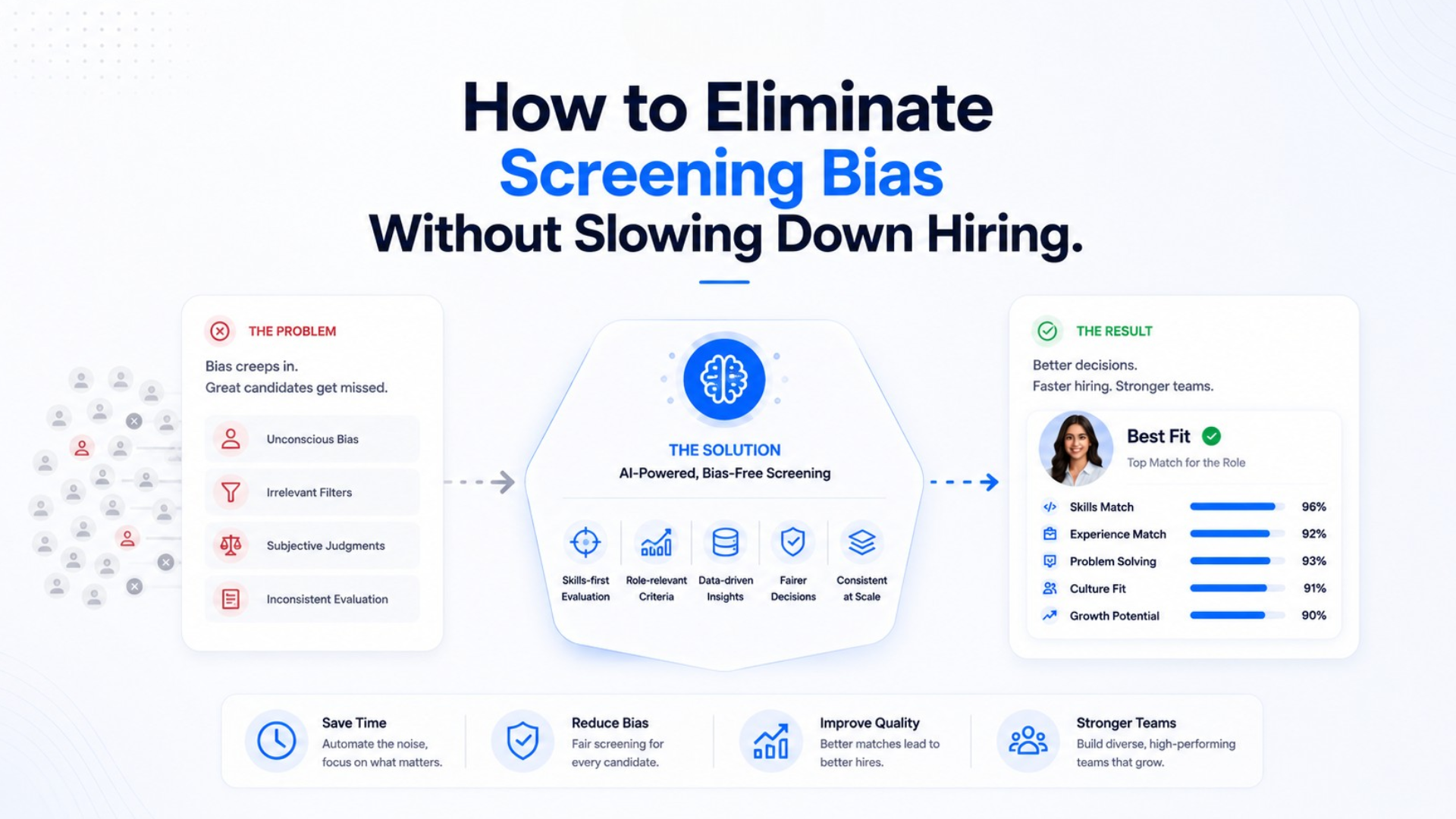
Intelligent AI screening systems work by building detailed candidate profiles from multiple data sources. They assess skills demonstrated through work history, project outcomes, and verified achievements rather than relying on proxy signals like company name or job title. This means two candidates with identical titles but very different actual contributions will be evaluated on what they have done, not where they did it. The system does not know or care whether a candidate attended an Ivy League school or a community college. It evaluates the skills and competencies that the role requires, nothing more. This is the promise of skills-based screening, and it represents a fundamental shift from how recruiting has worked for decades.
It is worth noting that AI itself can introduce bias if it is trained on biased historical data or if its evaluation criteria are not regularly audited. This is why the distinction between automated and intelligent platforms is critical. A system that simply learns from past hiring decisions will replicate past biases. But a system like Huntlo.ai, designed with explicit fairness constraints and transparent evaluation logic, can actually correct for historical bias rather than amplify it. The key is that the evaluation criteria must be defined by what the job requires, not by what successful hires in the past looked like.
The Speed Question: Why Bias Reduction Should Be Faster, Not Slower
One of the most persistent myths in recruiting is that fairness and speed are opposites. The assumption is that taking more time to evaluate each candidate will produce more equitable outcomes. But the evidence points in the opposite direction. When recruiters are under time pressure, they rely more heavily on heuristics and mental shortcuts, which is exactly where bias thrives. A recruiter who has to screen 200 applications in an afternoon is not taking the time to evaluate each candidate’s actual capabilities. They are scanning for familiar patterns and quick rejection signals. The faster they need to go, the more biased the screening becomes. As Gartner’s research on hiring trends has shown, organizations that invest in AI screening tools actually reduce time-to-shortlist by 40 to 60 percent while simultaneously improving the diversity of candidate pools.
AI eliminates the speed-bias trade-off by removing the human bottleneck from the initial screening stage. Instead of a recruiter making rapid, heuristic-driven decisions about hundreds of candidates, the AI evaluates all of them thoroughly and consistently in a fraction of the time. The recruiter’s role shifts from being the primary screening mechanism to being a quality check on the AI’s output. This is a fundamentally different use of human judgment, and it is far more effective. Humans are excellent at nuanced evaluation when they have the
time and context to do it properly. They are terrible at consistent, high-volume pattern matching. AI is the opposite. It excels at consistent evaluation at scale and has no capacity for unconscious prejudice.
The practical implication is that moving to AI-powered screening does not just maintain your hiring speed. It improves it, while simultaneously producing a more diverse and qualified shortlist. Teams that have made this transition report that their recruiters spend less time on manual screening and more time on the parts of the job where human judgment actually adds value, such as candidate engagement, relationship building, and strategic workforce planning. This is the shift we described in our analysis of AI sourcing versus AI recruiting: the technology handles the evaluation, and the humans handle the relationship.
Practical Steps to Implement Bias-Free Screening
Moving from awareness to action requires a structured approach. The first step is to audit your current screening criteria. List every factor your team uses to decide whether a candidate moves forward, and then ask a simple question about each one: does this criterion predict job performance, or does it merely feel like it should? Many common screening criteria, such as specific degree requirements, tenure at previous employers, and industry-specific jargon, have weak or no correlation with actual on-the-job success. They persist because they are easy to check, not because they are good predictors.
The second step is to replace proxy criteria with direct skill assessment. Instead of requiring five years of experience in a specific job title, define the specific competencies the role requires and evaluate whether candidates demonstrate those competencies, regardless of how they acquired them. This is the foundation of skills-based hiring, and it is far more equitable than traditional credential-based screening. A candidate who learned data analysis through a bootcamp and applied it successfully in a non-tech role may be more qualified than someone with a statistics degree who has never worked with real data. Traditional screening would favor the degree holder. Skills-based screening would favor the candidate with demonstrated ability.
The third step is to implement AI screening with explicit fairness constraints. This means choosing a platform that can explain why each candidate was included or excluded from the shortlist, that allows you to inspect and adjust the evaluation criteria, and that provides regular audit reports on screening outcomes across demographic groups. Transparency is the antidote to both human bias and algorithmic bias. If you cannot see how a decision was made, you cannot trust it, and you certainly cannot improve it. The fourth step is to measure outcomes, not just process compliance. Tracking diversity metrics at the screening stage, not just at the offer stage, tells you whether your process is working or whether bias is simply being pushed to a different part of the funnel.
The Data Behind Fairer Screening
The business case for bias-free screening is not based on ethics alone, though that would be
sufficient. It is backed by substantial quantitative evidence. According to Deloitte’s talent research, organizations with inclusive hiring practices generate 2.3 times more cash flow per employee and are 1.7 times more likely to be innovation leaders in their market. These are not marginal improvements. They represent a significant competitive advantage that starts at the very first stage of the hiring process. When screening is biased, every downstream metric suffers. When screening is fair, the entire hiring pipeline becomes more efficient and more effective.
Internal data from organizations that have adopted AI screening tells a consistent story. Shortlist diversity improves by 30 to 50 percent within the first quarter of implementation, not because the AI is applying quotas or lowering standards, but because it is evaluating candidates on criteria that are genuinely relevant to the role. Meanwhile, screening throughput increases because the AI can evaluate thousands of candidates in the time it takes a human recruiter to review dozens. Offer acceptance rates improve because the shortlisted candidates are better matched to the role and more likely to be genuinely excited about the opportunity. First-year retention improves because the hiring decision was based on capability, not convenience.
The data also reveals something important about the candidate data quality that feeds into screening systems. AI screening is only as good as the data it evaluates. Organizations that invest in rich, structured candidate data, such as verified skill assessments, detailed project portfolios, and performance metrics from previous roles, get dramatically better results from AI screening than those relying on traditional resumes alone. The combination of fair evaluation criteria and high-quality input data is what transforms screening from a biased guessing game into a reliable, data-driven process.
Common Concerns About AI and Bias
The most frequent objection to AI screening is the concern that algorithms can be just as biased as humans, and in some cases more so. This concern is valid but often misapplied. It is true that an AI system trained on biased historical hiring data will reproduce those biases. But this is a problem of implementation, not of the technology itself. The question is not whether AI can be biased, but whether the specific platform you are using has been designed to prevent it. As we have discussed in our guide on evaluating AI sourcing tools, the evaluation criteria should include fairness audits, transparency of decision logic, and the ability to adjust scoring weights. A platform that cannot explain its decisions is a platform that cannot be trusted on bias.
Another common concern is that AI screening will produce a homogenized candidate pool, selecting for a narrow set of attributes that the algorithm considers optimal. In practice, the opposite occurs. Human screening tends to favor candidates who resemble the people doing the screening or who match the profile of previously successful hires, which produces a narrow, self-reinforcing pool. AI screening, when properly configured, evaluates each candidate independently on job-relevant criteria, which naturally produces a more diverse pool. The
algorithm does not have a preference for candidates who remind it of itself, because it does not have a self.
A third concern is that removing human judgment from screening dehumanizes the hiring process. This conflates two different things. Removing human bias from screening does not mean removing humans from hiring. It means ensuring that human judgment is applied where it adds value, in interviews, culture assessments, and offer negotiations, rather than being wasted on the mechanical task of initial resume triage. The recruiters who worry about AI replacing their jobs, a topic we’ve addressed in our piece on whether recruiters should worry about AI replacing them, are usually thinking about the wrong part of their job. The part worth worrying about is the strategic, relational, and advisory work that no AI can do. The part worth automating is the repetitive, high-volume screening that no human should have to do.
Why Huntlo.ai Delivers Fairer, Faster Screening
Huntlo.ai was built with a specific philosophy: screening should evaluate what candidates can do, not who they are or where they come from. Every candidate in the Huntlo system is assessed against role-specific competency frameworks that are transparent, adjustable, and designed to predict actual job performance. The platform does not use proxy signals like university prestige, employer brand recognition, or resume formatting quality as evaluation criteria, because these signals have weak predictive value and strong demographic correlations. Instead, Huntlo builds rich candidate profiles from verified work history, demonstrated skills, and measurable outcomes, and matches those profiles against the actual requirements of the open role. As we’ve noted before, more tools often mean the same hiring problems if they are not designed with intelligence and fairness at the core. Huntlo is designed differently.
The result is a screening process that is both faster and fairer than anything a human team can accomplish manually. Huntlo can evaluate thousands of candidates in minutes, producing a ranked shortlist that reflects genuine capability alignment rather than pattern-matching against historical hiring biases. Recruiters can review the AI’s reasoning for each shortlist decision, adjust evaluation criteria in real time, and track diversity metrics across every stage of the funnel. This is not automation that replaces human judgment. It is intelligence that amplifies it. The screening decisions are better, the process is faster, and the outcomes are more equitable by every available measure. For teams that are serious about eliminating bias without sacrificing speed, the question is no longer whether to adopt AI screening. It is how quickly they can implement it.