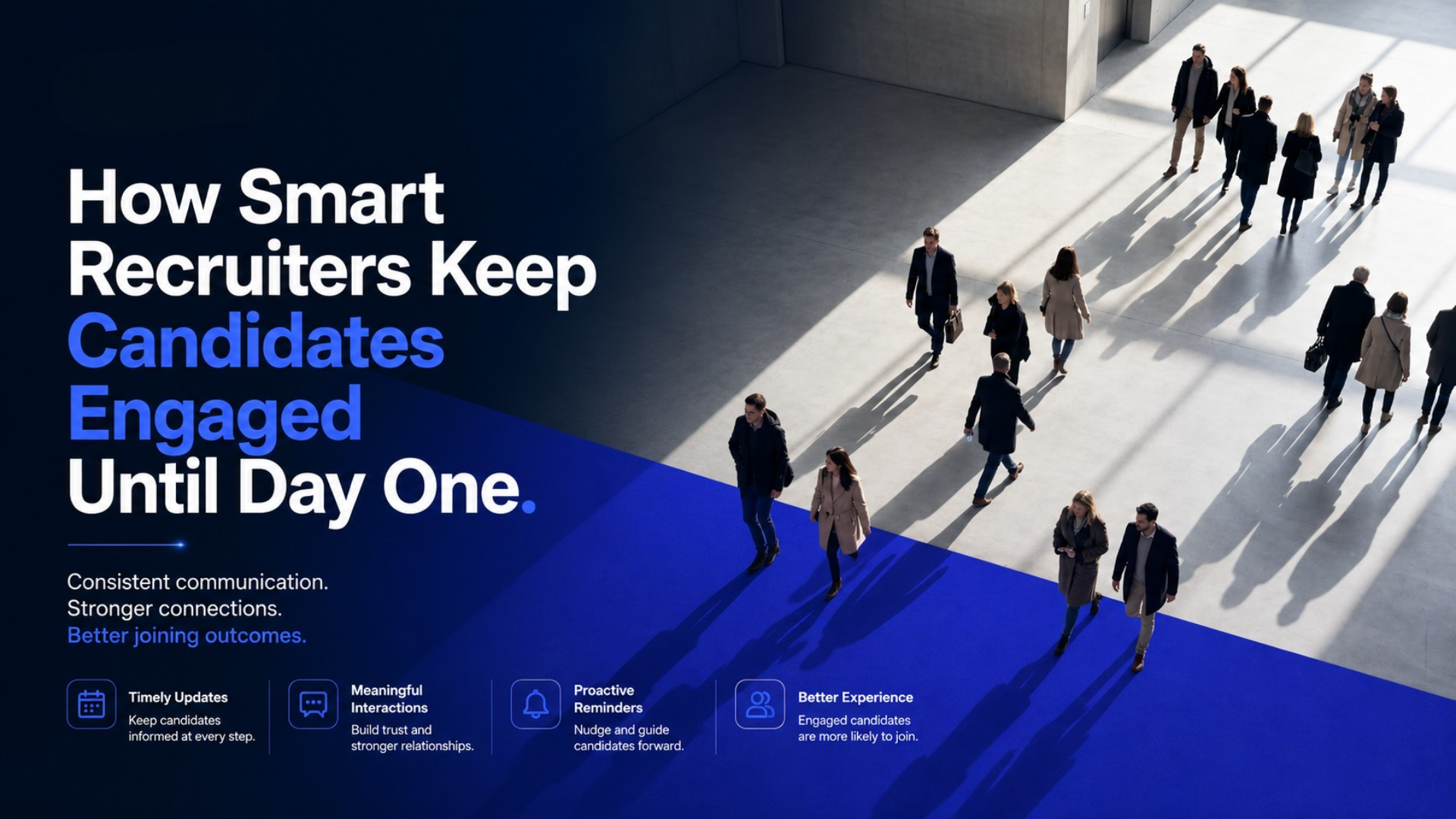
Two recruiters at the same company extend the same offer to equally qualified candidates. One candidate joins on day one, energized and ready. The other ghosts three days before their start date. The difference was not the offer, the role, or the compensation. It was what happened in the weeks between the handshake and the first day. The recruiter who kept their candidate engaged understood something the other did not: acceptance is not the finish line. It is the start of the most vulnerable phase of the entire hiring process, a phase where the candidate’s commitment is tested by doubt, by competing opportunities, and by the simple erosion of enthusiasm that occurs when the organization they just committed to goes silent.
The recruiters who consistently achieve the highest joining rates share a set of behaviors and strategies that distinguish them from their peers. These are not innate talents. They are learnable, repeatable practices that any recruiter can adopt, and they become dramatically more effective when supported by the right technology. According to SHRM’s talent acquisition research, the top quartile of recruiters, measured by acceptance-to-joining conversion, share three characteristics: they maintain a structured communication cadence, they personalize every touchpoint based on what they learned during the interview process, and they monitor engagement signals and intervene proactively when they detect risk. These three behaviors, when executed consistently, produce joining rates that are thirty to forty percent higher than the average. The challenge is consistency. Manual execution works for one or two candidates but breaks down under volume. This is why the most effective recruiters leverage a candidate engagement platform to systematize these behaviors across their entire pipeline.
The First Forty-Eight Hours: Where Engagement Is Won or Lost
The period immediately after offer acceptance is the most critical window for candidate engagement. Research consistently shows that the candidate’s emotional commitment peaks at
the moment of acceptance and then begins a steady decline unless actively reinforced. The recruiters who understand this dynamic treat the first forty-eight hours as a sprint, not a cool-down. Within six hours of acceptance, the hiring manager sends a personal message that references something specific from the interview conversation, expresses genuine enthusiasm about the candidate joining, and sets expectations for what will happen next. This message is not a template. It is a genuine, individually written communication that tells the candidate that the hiring manager is personally invested in their arrival. Within twenty-four hours, the recruiter sends a substantive follow-up that includes practical information about the preboarding timeline, introduces the candidate to their onboarding buddy, and provides a piece of content that is relevant to the candidate’s specific interests, a team update, a project overview, or an article about the market they will be working in. Understanding how many follow-ups one hire actually needs, and front-loading the highest-impact touchpoints in this critical window, is the first practice that separates smart recruiters from average ones.
The second touchpoint in the first forty-eight hours is the onboarding buddy introduction. This is not a formal, HR-orchestrated introduction. It is a casual, peer-to-peer connection between the candidate and someone on their future team who can answer the questions that candidates are often too embarrassed to ask the hiring manager. What is the team culture really like? How does the manager handle conflict? What should I absolutely not do in my first week? These are the questions that cause anxiety during the notice period, and they are the questions that a peer connection answers most effectively. A post-offer engagement strategy that includes a peer introduction within the first two days creates a social anchor for the candidate, a person they already know on day one, which dramatically reduces first-day anxiety and the likelihood of withdrawal. According to LinkedIn’s recruiting insights, candidates who are connected with a future teammate before their start date are three times more likely to report feeling confident in their decision.
The Notice Period Cadence: Maintaining Momentum Without Becoming Intrusive
After the intense first forty-eight hours, the engagement cadence needs to settle into a sustainable rhythm that maintains the candidate’s connection without overwhelming them. The recruiters who get this right follow a simple principle: one meaningful touchpoint per week, delivered by a different stakeholder each time, with content that is personalized to the candidate’s role and interests. The rotating sender model serves two purposes. First, it demonstrates that the candidate’s arrival is anticipated by multiple people, not just the recruiter, which signals organizational investment in their success. Second, it prevents the communication from feeling like a chore imposed by a single person, which can create subtle pressure that undermines the genuine excitement the touchpoints are meant to build. The content of each touchpoint should follow the substance-over-logistics principle. Candidates do not need another link to the benefits portal. They need information that makes them more excited about joining. A brief message from the hiring manager about a recent team win. A note from a future teammate about an interesting challenge the team is working on. A curated article about the industry or market the candidate will be operating in. These are the touchpoints that
build new hire engagement, and they are the touchpoints that distinguish organizations that treat candidates as future colleagues from those that treat them as administrative tasks to be processed.
The cadence also needs to be adaptive. A candidate who responds enthusiastically to every touchpoint may need fewer communications than a candidate whose responses are brief and delayed. A candidate in a high-demand role who is receiving counter-offers may need more frequent and more substantive touchpoints than a candidate in a role with less market competition. A candidate relocating from another city needs practical support and reassurance about the new location. A candidate who expressed concerns about work-life balance during interviews needs proactive messaging about team norms and flexibility. This personalization is what recruitment engagement tools enable at scale, using the intelligence gathered during the interview process to tailor the cadence and content to each individual candidate’s situation. As we have explored in our analysis of why more tools produce the same hiring problems, the value is not in having more tools but in having a system that coordinates them into a coherent experience.
Reading the Signals: How to Know When a Candidate Is Disengaging
The most important skill in candidate engagement is not communication. It is observation. The recruiters who prevent the most drop-offs are not the ones who send the most messages. They are the ones who pay the closest attention to how candidates respond, and who act on the earliest signs of disengagement before the candidate reaches the point of withdrawal. There are five early-warning signals that indicate a candidate may be disengaging. First, increasing response time. When a candidate who previously responded within hours starts taking twenty-four or forty-eight hours to reply, it is a signal that their attention is shifting elsewhere. Second, declining response quality. When a candidate’s replies become shorter, less specific, and more generic, it indicates that they are mentally disengaging from the opportunity. Third, reduced question-asking. Engaged candidates ask questions. They want to know about the team, the project, the tools, and the culture. When the questions stop, it means the candidate has stopped envisioning themselves in the role. Fourth, cancellation or rescheduling of pre-boarding calls or meetings. When a candidate begins avoiding scheduled touchpoints, they are often in the process of disengaging from the opportunity entirely. Fifth, changes in tone. When a candidate’s language shifts from enthusiastic and forward-looking to vague and noncommittal, it is one of the strongest predictors of withdrawal. According to Gartner’s HR trends analysis, these five signals, when detected early, predict candidate withdrawal with over eighty percent accuracy, giving recruiters a window of one to two weeks to intervene.
The intervention itself matters as much as the detection. When a recruiter identifies an at-risk candidate, the response should not be more automated messages. It should be a personal, high-touch intervention from the person the candidate trusts most, typically the hiring manager or the recruiter who built the relationship during the interview process. The intervention should address the candidate’s likely concerns directly, not with generic reassurance but with
specific, relevant information. If the candidate is disengaging because of a counter-offer, the intervention should address the specific factors that make the new role a better long-term fit. If the candidate is disengaging because of anxiety about the role, the intervention should provide concrete details about support, training, and team structure. This is the essence of candidate journey optimization, the ability to detect and address the specific barriers that prevent each individual candidate from completing their journey from acceptance to arrival.
The Final Week: Turning Anticipation Into Action
The last seven days before the start date are when engagement translates into action. The candidate’s anxiety shifts from abstract doubt to practical concern. Will I know where to go? Will I have the right equipment? Will my manager be available? Will I fit in? The smart recruiter anticipates every one of these concerns and addresses them proactively, eliminating uncertainty before it has a chance to grow into a reason to withdraw. The final-week communication sequence has four components. First, a detailed first-day agenda that specifies arrival time, location, parking, dress code, and the name and role of the person who will greet them. Second, a personal call from the onboarding buddy that covers practical questions, shares a personal story about their own first day, and reinforces the social connection. Third, a message from the hiring manager that expresses genuine anticipation, outlines the first-week priorities, and makes the candidate feel that their arrival is important and expected. Fourth, a final confirmation from the recruiter that all logistics are handled, all systems are ready, and nothing is left to chance. Research from McKinsey’s people organization research, shows that candidates who receive all four of these final-week touchpoints are six times less likely to withdraw in the last seventy-two hours before their start date.
The final week is also when the recruiter’s relationship with the candidate pays its final dividend. The trust and credibility built during the interview process and maintained through the notice period give the recruiter the ability to address last-minute concerns with authenticity and specificity that no automated message can replicate. A candidate who trusts their recruiter will share their doubts honestly instead of simply ghosting, giving the recruiter the opportunity to address the concern and save the placement. This is why the difference between AI sourcing and AI recruiting, is ultimately about relationship depth: sourcing finds candidates, but recruiting builds the relationships that keep them. The recruiters who invest in these relationships through the entire journey, from first contact through day one, are the ones who consistently convert accepted offers into arriving new hires.
Scaling Engagement Without Losing Authenticity
The strategies described above work perfectly for a recruiter managing three or four candidates in the preboarding phase. They become unsustainable when the same recruiter is managing fifteen or twenty. The recruiters who maintain high engagement at scale do so by using technology to handle the coordination and personalization while reserving their personal attention for the moments that genuinely require it. A candidate engagement platform that automates the scheduling, tracking, and content curation for the standard touchpoints, while
flagging the at-risk candidates who need personal intervention, is the only way to deliver a consistent, high-quality engagement experience across a large and growing pipeline. The technology does not replace the recruiter’s judgment or their relationship with the candidate. It amplifies it, by ensuring that the foundation of regular, substantive communication is always in place, so that the recruiter’s personal interactions are layered on top of a strong base rather than compensating for its absence. According to Deloitte’s talent research, the recruiters who combine automated communication infrastructure with strategic personal intervention achieve joining rates ten to fifteen percent higher than recruiters who rely on either automation alone or personal effort alone. The combination is synergistic, not additive, because the automated base ensures consistency while the personal interventions provide the authenticity that candidates need to feel genuinely valued.
Why Huntlo.ai Helps Recruiters Keep Every Candidate Engaged
Huntlo.ai provides the engagement infrastructure that smart recruiters need to keep every candidate connected, informed, and excited from acceptance through day one. The platform automates the structured communication cadence, from the first forty-eight-hour sprint through the notice-period rhythm to the final-week ramp, while personalizing every touchpoint based on the intelligence gathered during the interview process. The AI engine monitors engagement signals in real time, detects the five early-warning indicators of disengagement, and alerts the recruiter with specific intervention recommendations before the candidate reaches the point of withdrawal. Every candidate receives a consistent, high-quality experience, and the recruiter’s personal attention is directed to the candidates who need it most. For recruiters who understand that an agentic AI recruiting platform, must own the candidate experience all the way to day one, Huntlo provides the workflow, the intelligence, and the scale to make that possible. One where referrals outperform cold outreach, not because of the channel, but because every candidate receives the same caliber of engagement regardless of how they entered the pipeline. And one where evaluating an AI recruiting tool before buying, means asking whether the platform can sustain candidate engagement through the entire journey, not just through the interview.
For recruiters who are tired of losing accepted candidates to silence, doubt, and disengagement, Huntlo ensures that outdated candidate data in AI recruiting tools, never undermines the engagement experience, because every touchpoint is informed by fresh, accurate intelligence. The result is a hiring process where accepted candidates become arriving new hires, consistently, predictably, and at any scale.