A recruitment agency places a candidate. The client extends an offer. The candidate accepts. The recruiter celebrates, updates the CRM, and starts planning the next search. Three weeks later, the candidate ghosts. No response to calls, no reply to emails, and a brief message arrives on what should have been day one: they accepted a counter-offer from their current employer. The placement falls through, the agency earns nothing for weeks of work, and the client relationship takes a hit. For agencies that operate on placement fees, every dropped joining is not just a frustration. It is directly lost revenue, wasted capacity, and a weakened client partnership that makes the next placement harder to win.
The scale of this problem is larger than most agency leaders admit. Industry data suggests that between twelve and eighteen percent of accepted placements fail to join, depending on the sector and seniority level. For a mid-size agency making two hundred placements per quarter, that means twenty-four to thirty-six candidates who accept but never arrive. At an average placement fee of fifteen to twenty thousand dollars, the revenue impact is between three hundred sixty thousand and seven hundred twenty thousand dollars per quarter. This is not a marginal issue. It is one of the largest controllable revenue leaks in the agency business model. And unlike market downturns or client budget cuts, it is entirely solvable through better process and technology. According to SHRM’s talent acquisition research, organizations that implement structured post-acceptance processes see joining rates improve by thirty to forty percent, and the same principles apply with even greater financial impact in the agency context where each joining directly translates to revenue.
Why Agencies Feel the Joining Problem More Acutely Than In-House Teams
In-house recruiting teams lose time and productivity when a candidate drops out, but the financial structure of their relationship to the hire is fundamentally different from an agency’s. An in-house recruiter is a salaried employee whose compensation does not directly depend on any single hire. An agency recruiter, by contrast, operates in a model where compensation, bonuses, and often job security are directly tied to successful placements. When a candidate drops out after acceptance, the agency recruiter has invested the same effort as an in-house recruiter but earns zero revenue for that investment. This creates a financial asymmetry that makes joining rate optimization not just a best practice for agencies but an existential priority. As McKinsey’s people organization research, notes, the agencies that consistently outperform their peers are the ones that treat the post-acceptance phase with the same rigor and investment they apply to sourcing and candidate development.
There is also a client relationship dimension that amplifies the impact. When an in-house team loses a candidate, it is an internal problem. When an agency loses a candidate, it is a visible failure in front of the client who is paying for the service. The client sees a failed placement, questions the agency’s quality, and may shift future searches to a competitor. The reputational cost compounds over time. Agencies that lose candidates during the preboarding phase find themselves in a downward spiral where lower joining rates lead to weaker client relationships, which lead to fewer searches, which lead to lower revenue, which leads to less investment in the processes that could prevent the drop-offs in the first place. Breaking this cycle requires a systematic approach that does not depend on individual recruiters working harder. It requires a recruitment agency software platform that embeds joining-rate optimization into the agency’s standard workflow.
The Workload Trap: Why Asking Recruiters to Do More Makes Things Worse
The most common response to a joining-rate problem is to ask recruiters to do more: more follow-ups, more check-in calls, more personal messages during the notice period. This approach is intuitively appealing but practically disastrous. Agency recruiters are already operating at or near capacity. They are managing multiple active searches, juggling candidate pipelines across different clients, and handling the administrative burden of scheduling, feedback collection, and offer coordination. Adding manual preboarding tasks to this already-full plate does not improve joining rates. It simply distributes the recruiter’s attention more thinly across more tasks, which means every task gets done less well. The follow-up calls become rushed, the check-in messages become generic, and the overall candidate experience deteriorates. As we have explored in our analysis of why more tools produce the same hiring problems, adding tasks without adding system capacity is a recipe for worse outcomes, not better ones.
The evidence is clear. When agency recruiters are asked to manually manage preboarding for every accepted candidate on top of their existing workload, the result is not higher joining rates but higher recruiter burnout. Recruiters cut corners, prioritize the loudest clients over the most at-risk candidates, and eventually leave for competitors who offer better support. The turnover cost of an experienced agency recruiter, including the loss of client relationships
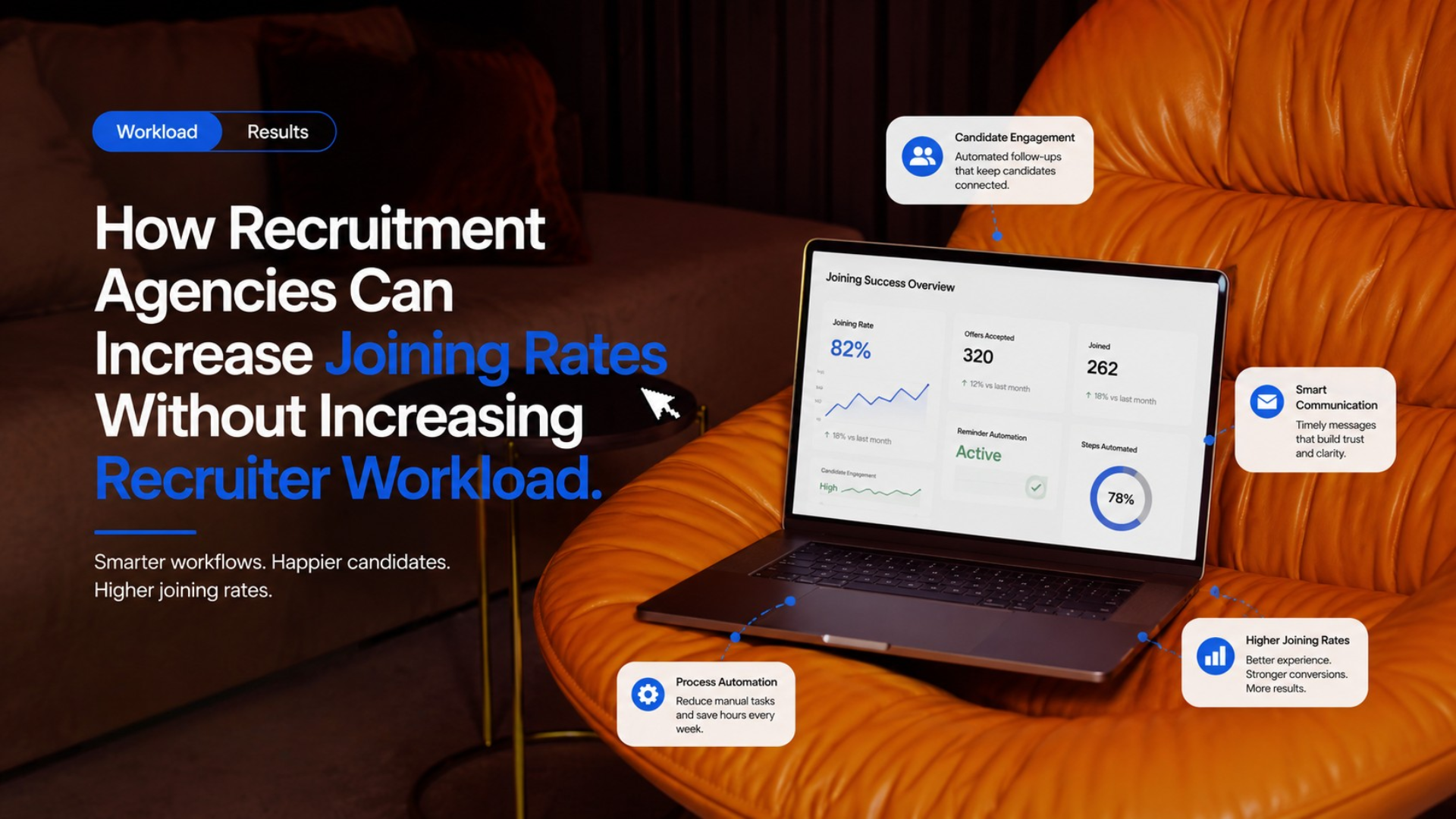
and candidate pipeline knowledge, far exceeds the revenue gained from marginal improvements in joining rate. The solution is not to make recruiters work harder. It is to make the preboarding process work smarter, through automation that handles the routine tasks and intelligence that directs recruiter attention to the candidates who need it most. This is the core value of recruiter efficiency tools, platforms that reduce the manual burden on recruiters while improving the quality and consistency of the candidate experience.
Automating the Preboarding Workflow Without Losing the Human Touch
The preboarding workflow for an agency has a distinct structure that differs from in-house recruiting. The agency does not control the client’s onboarding process, the IT setup, or the benefits enrollment. What the agency controls is the relationship with the candidate during the notice period, and that relationship is the most critical variable in determining whether the candidate joins. The agency’s preboarding workflow should therefore focus on three objectives: maintaining the candidate’s emotional commitment, providing practical reassurance about the role and the client, and detecting risk signals early enough to intervene effectively. Each of these objectives can be largely automated through a staffing agency automation platform, with human intervention reserved for the high-risk situations that genuinely require a personal conversation.
The first objective, maintaining emotional commitment, is achieved through a structured cadence of personalized communications during the notice period. The first touchpoint should come within twenty-four hours of acceptance: a personal message from the recruiter expressing genuine enthusiasm and reinforcing the candidate’s decision. The second touchpoint, within the first week, should introduce the candidate to the client team or provide substantive information about the project they will be working on. Subsequent weekly touchpoints should share relevant content, industry news, or updates about the client organization that reinforce the candidate’s excitement. Understanding how many follow-ups one hire actually needs, and calibrating the cadence to the candidate’s engagement level, is essential for maintaining the right balance between staying connected and becoming intrusive. All of these touchpoints can be automated, with the recruiter reviewing and personalizing only the most critical ones.
The second objective, providing practical reassurance, addresses the anxiety that candidates experience during the notice period. They worry about whether the role is what they were told, whether the client culture will be a good fit, and whether they are making a mistake. The agency is uniquely positioned to provide this reassurance because the recruiter has built a relationship with the candidate over weeks of interviews and conversations. An automated workflow can prompt the recruiter to address specific concerns at the right moment, based on what was discussed during the interview process. The third objective, detecting risk signals, is where automation delivers the most value. By tracking the candidate’s responsiveness, engagement with preboarding content, and the tone of their communications, an AI staffing solution can identify candidates who are disengaging and alert the recruiter before the candidate reaches the point of withdrawal. This is the difference between reactive firefighting and proactive risk management.
The Agency-Specific Joining Rate Formula
Improving joining rates in an agency context requires a formula that accounts for the agency’s unique position in the hiring process. The agency sits between the candidate and the client, which means it has influence but not control. The client controls the offer terms, the start date, the onboarding logistics, and the day-one experience. The agency controls the candidate relationship, the communication cadence, and the risk monitoring. The most effective agencies focus their energy on what they can control and use their influence with the client to improve what they cannot. According to LinkedIn’s recruiting insights, the agencies that consistently achieve the highest joining rates are the ones that actively manage the client’s expectations about the preboarding process, encouraging faster offer delivery, more engaged hiring manager communication, and a structured first-week plan.
The agency-specific joining rate formula has four components. First, speed of offer delivery. The faster the client extends the offer after the final interview, the lower the drop-off rate. Agencies should negotiate offer delivery timelines with clients as part of their service agreement, pushing for offers within forty-eight hours of the final interview. Second, quality of candidate-client matching. When the match is strong, when the candidate’s expectations align with the reality of the role, the likelihood of withdrawal drops dramatically. Agencies that invest in hiring conversion optimization through data-driven matching, rather than relying solely on recruiter intuition, consistently outperform those that do not. Third, structured preboarding communication. The cadence described above, automated but personalized, keeps the candidate engaged during the notice period. Fourth, risk detection and escalation. When a candidate shows signs of disengagement, the agency needs a clear protocol for escalating to the right person, whether that is the recruiter, the agency manager, or the client’s hiring manager.
Building a Client Partnership Around Joining Rates
Most agency-client relationships are structured around the front end of the hiring process: the search brief, the candidate shortlist, the interview schedule, and the offer negotiation. The post-acceptance phase is rarely discussed, and even more rarely formalized. This is a missed opportunity. Agencies that proactively propose a structured preboarding process as part of their service offering differentiate themselves from competitors and create a new source of value for their clients. When the agency can demonstrate that their systematic approach to preboarding reduces candidate drop-offs by thirty to forty percent, that is a compelling commercial argument. The client gets more reliable hiring outcomes, and the agency gets higher placement conversion, which means more revenue from the same number of searches.
The practical implementation involves three steps. First, the agency proposes a preboarding communication plan as part of every search engagement. This plan specifies the touchpoints, the responsible parties, and the escalation protocols for the period between offer acceptance and day one. Second, the agency implements the plan using technology that automates the
routine elements and tracks engagement, ensuring consistent execution across all candidates and all clients. This is where understanding the difference between AI sourcing and AI recruiting, becomes practically relevant: sourcing is about finding candidates, but recruiting is about managing the full relationship through to a successful joining. Third, the agency reports joining rate metrics to the client as part of the regular business review, demonstrating the value of the systematic approach and building a data-driven case for the agency’s service quality. According to Gartner’s HR trends analysis, agencies that provide clients with visibility into joining rate performance retain clients longer and win more searches through referrals and renewals.
Measuring What Matters: Agency Joining Rate Metrics
The metrics that most agencies track, time-to-fill, time-to-submit, and submit-to-interview ratio, all measure the front end of the funnel. Very few agencies systematically track the back end, the conversion from offer acceptance to day-one arrival. This is a significant gap, because you cannot improve what you do not measure, and the post-acceptance phase is where the most impactful improvements are possible. The minimum viable metrics framework for an agency joining-rate optimization program includes four numbers. First, acceptance-to-joining conversion rate, the overall percentage of accepted candidates who arrive on day one, segmented by client, role type, and seniority level. Second, drop-off stage analysis, which identifies where in the preboarding process candidates are withdrawing. Third, time-to-risk-detection, which measures how quickly the agency identifies at-risk candidates. Fourth, intervention success rate, which tracks the percentage of at-risk candidates who are successfully converted after an intervention.
When these metrics are tracked through a centralized platform that provides real-time dashboards and trend analysis, agency leaders gain the visibility they need to identify systemic problems, test solutions, and demonstrate value to clients. The platform should also connect joining rate data to revenue impact, because translating joining rate improvements into dollar figures is the most effective way to build internal support for investing in preboarding capabilities. As Deloitte’s talent research, highlights, the agencies that treat joining rate as a core business metric, not a recruiting afterthought, are the ones that achieve sustainable competitive advantage. This data-driven approach is what distinguishes an agentic AI recruiting platform from a simple automation tool: the platform does not just execute tasks but learns from outcomes and continuously optimizes the process.
Why Huntlo.ai Gives Agencies an Edge in Joining Rate Performance
Huntlo.ai provides the end-to-end platform that recruitment agencies need to increase joining rates without increasing recruiter workload. The system automates the entire preboarding workflow, from post-acceptance communication cadence through engagement monitoring and risk detection, freeing recruiters to focus on the high-value activities that require human judgment. Every candidate in the agency’s pipeline receives a consistent, personalized preboarding experience, regardless of how many placements are in progress simultaneously. The
AI engine tracks engagement signals, predicts which candidates are at risk, and alerts the recruiter with specific intervention recommendations before a withdrawal occurs. This is the capability that evaluating an AI recruiting tool before buying should prioritize for agencies, because it directly impacts the metric that matters most: how many accepted candidates actually join.
For agencies that are ready to stop losing placements to preventable drop-offs, Huntlo provides the technology, the workflow, and the intelligence to build a systematic joining-rate improvement program that operates at any scale. One where why referrals outperform cold outreach, is not just an insight but a principle embedded in every candidate interaction: the quality of the relationship determines the outcome. And one where the question of outdated candidate data in AI recruiting tools, is addressed proactively, because an agency’s preboarding communications are only as effective as the data they are based on. Huntlo ensures that every touchpoint is informed by fresh, accurate intelligence, so every candidate feels valued, connected, and confident in their decision from acceptance through day one.