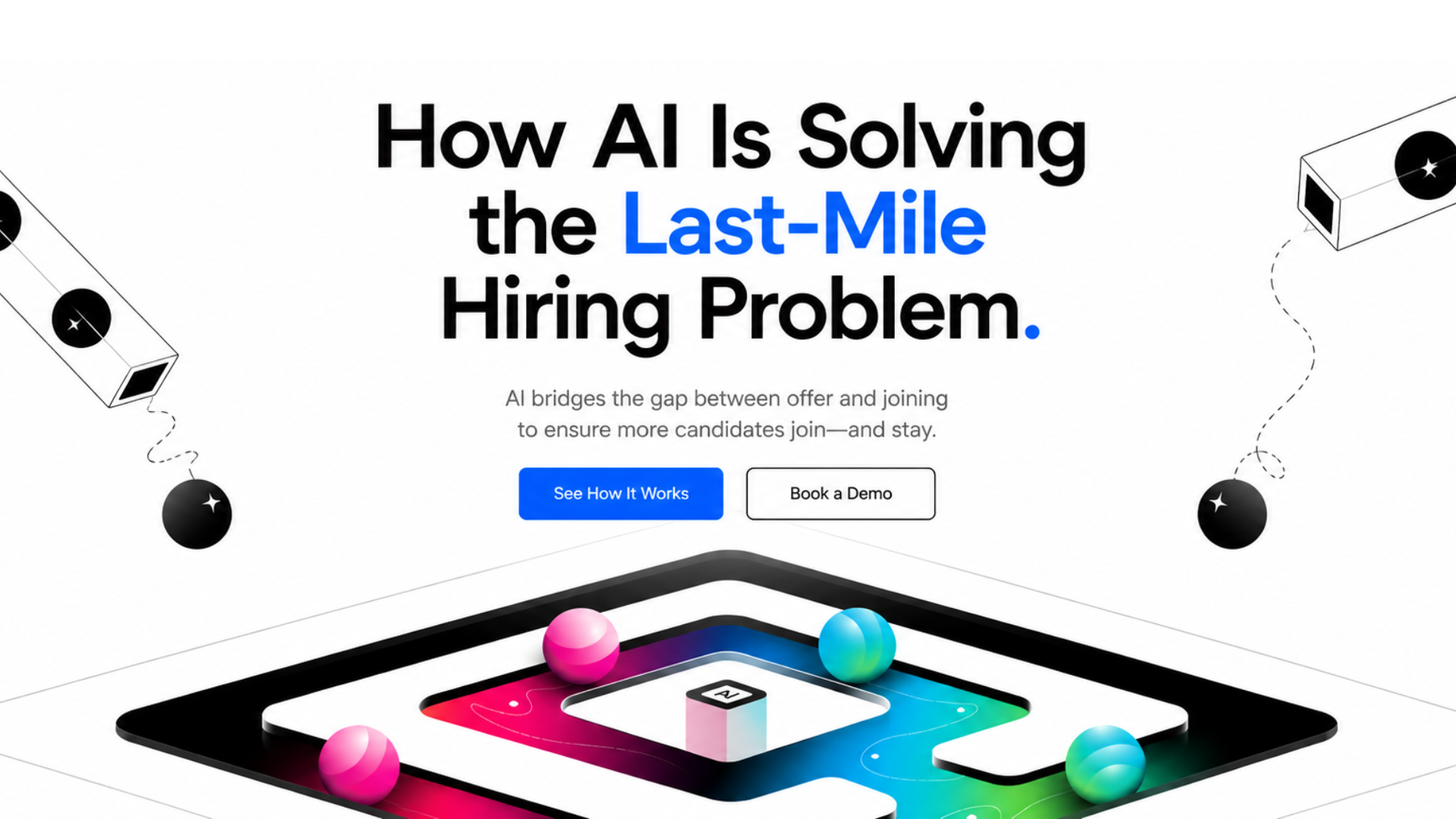
The recruiting industry has invested billions of dollars in solving the front-end challenges of hiring. Sourcing tools identify candidates. Screening platforms evaluate them. Interview scheduling systems coordinate conversations. Offer management tools facilitate negotiations. But the moment a candidate signs an offer, the technology stack goes silent. The most sophisticated recruiting platforms in the world have almost nothing to say about what happens between the signed offer and the first day of work. This silence is not a minor gap. It is the single most expensive gap in the recruiting technology landscape, because the last mile of hiring, the post-offer, pre-start phase, is where more placements are lost than in any other phase of the process. For every dollar spent on sourcing and screening technology, an estimated two to three dollars in placement value is lost to last-mile failures: counteroffers, ghosting, withdrawal, and first-day no-shows. AI is now filling this gap, and the organizations that adopt AI-powered last-mile solutions are seeing joining rates improve by fifteen to twenty-five percentage points within the first quarter of deployment.
The last-mile problem is not new. Recruiters have always known that candidates drop out between offer and start. But until recently, the problem was considered unsolvable at scale. A skilled recruiter with a small caseload could maintain personal relationships with candidates through the notice period, but the moment the caseload exceeded ten or fifteen simultaneous candidates, the quality of post-offer engagement deteriorated rapidly. The recruiter would
forget to follow up, miss warning signs, or simply run out of time. The result was a joining rate that varied wildly from recruiter to recruiter and from month to month, with no systematic way to improve it. According to SHRM's talent acquisition research, the average joining rate across industries is between seventy-five and eighty-five percent, meaning that roughly one in five signed offers never results in a productive hire. The AI last-mile hiring solution changes this equation by making it possible to deliver the same quality of post-offer engagement that an elite recruiter provides manually, but for every candidate simultaneously, regardless of caseload size.
The Six Capabilities AI Brings to the Last Mile
AI solves the last-mile problem through six distinct capabilities that work together to create a comprehensive post-offer management system. The first capability is intelligent communication orchestration. The AI system maintains a structured, personalized communication cadence for every candidate throughout the notice period, ensuring that each candidate receives the right message at the right time. The cadence is not a generic template. It is dynamically adjusted based on the candidate's risk profile, their communication patterns, their responses to previous touchpoints, and the specific characteristics of their situation. A candidate who is relocating for the role receives different touchpoints than a candidate who is making a local move. A candidate whose current employer has a history of aggressive counteroffers receives more intensive support during the resignation phase. Understanding how many follow-ups one hire actually needs, the AI system calibrates the frequency and content of each touchpoint to the individual candidate's needs, eliminating both the gaps that cause disengagement and the over-communication that can feel intrusive.
The second capability is real-time engagement monitoring. The AI system tracks a range of behavioral signals that indicate the candidate's level of commitment and engagement. These signals include response time, response length, communication tone, the number of questions the candidate asks about the new role, and the candidate's initiative in reaching out. When the system detects a shift in any of these signals that suggests declining engagement, it alerts the recruiter with a specific recommendation for intervention. This is AI-driven candidate commitment tracking, and it transforms the recruiter's ability to prevent drop-offs from reactive firefighting into proactive risk management. The third capability is multi-stakeholder coordination. The AI system prompts and coordinates engagement from the hiring manager, the onboarding buddy, and future teammates at strategically chosen moments, creating multiple relationship anchors that reduce the candidate's likelihood of withdrawal. The system tracks whether each stakeholder has completed their assigned touchpoint and escalates missed connections to the recruiter.
The fourth capability is counteroffer preparation and defense. The AI system provides each candidate with a structured counteroffer preparation briefing before their resignation conversation, including specific guidance on how to handle common counteroffer tactics. After the resignation, the system monitors for signs that a counteroffer has been made and prompts the recruiter to intervene immediately with a personalized response strategy. According to
McKinsey's people organization insights, organizations that implement AI-powered counteroffer defense reduce counteroffer losses by thirty to forty percent, because the intervention happens in real time rather than after the candidate has already accepted the counteroffer. The fifth capability is predictive dropout modeling. The AI system uses historical data about past candidate journeys to predict which current candidates are at highest risk of withdrawal, enabling recruiters to allocate their limited time to the candidates who need the most support. This is the core of AI joining rate optimization: using data to focus human effort where it has the greatest impact on the outcome. The sixth capability is joining rate measurement and analytics. The AI system tracks joining rate as a primary metric, with segment-level breakdowns by recruiter, client, role type, and candidate profile, making it possible to identify patterns, set improvement targets, and hold the team accountable for the outcome that matters most.
Why Automation Alone Cannot Solve the Last Mile
It is important to distinguish between automation and AI in the context of the last mile. Automation is the execution of a pre-defined sequence of actions. AI is the ability to reason about a situation, adapt the approach, and make recommendations based on context. The distinction matters because the last-mile problem is inherently contextual. Every candidate's situation is different. Their concerns, their risk factors, their relationship with their current employer, their family circumstances, and their level of excitement about the new role all vary. A system that simply executes a fixed sequence of emails cannot address this variability. It will over-communicate with some candidates and under-communicate with others. It will miss warning signs that require human judgment. It will fail to adapt when the candidate's situation changes unexpectedly. An intelligent post-offer workflow, by contrast, is one that uses AI to continuously assess the candidate's state and adjust the approach in real time. The system does not just send the third email in the sequence on day fourteen. It sends the message that is most likely to reinforce the candidate's commitment on day fourteen, given everything it knows about the candidate's current situation, communication patterns, and engagement level. This is what distinguishes an agentic AI recruiting platform from a simple automation tool: the ability to reason about each candidate's unique situation and recommend the most effective action, rather than simply executing a pre-defined sequence. As we have explored in our analysis of why more tools produce the same hiring problems, the organizations that have tried to solve the last mile with basic automation, scheduled emails and reminder notifications, have seen marginal improvements at best, because the approach does not address the fundamental variability of the problem.
The Data Foundation: What AI Needs to Work Effectively
AI-powered last-mile management is only as good as the data it operates on. The system needs three categories of data to function effectively. The first category is candidate intelligence: the information gathered during the sourcing, screening, and interview process about the candidate's motivations, concerns, priorities, and decision-making criteria. This data is typically captured in recruiter notes, interview feedback, and candidate communications, but
in most organizations it is scattered across multiple systems and not structured in a way that an AI system can use. The second category is engagement data: the real-time signals from the candidate's communications during the post-offer period, including response times, response content, and communication patterns. This data is generated continuously but is rarely captured or analyzed systematically. The third category is outcome data: the historical record of which candidates joined, which dropped out, and why, linked to the engagement patterns that preceded each outcome. According to LinkedIn's recruiting resources, organizations that invest in structuring all three data categories before implementing AI-powered last-mile solutions see significantly faster time to value and higher ROI, because the AI system has the foundation it needs to make accurate predictions and personalized recommendations.
The challenge of data foundation is one of the primary reasons why many organizations struggle to improve their joining rates even when they recognize the importance of the last mile. The data exists, but it is not structured, not centralized, and not connected to the outcome it should predict. Huntlo ensures that outdated candidate data in AI recruiting tools never undermines the last-mile strategy by maintaining a continuously updated candidate intelligence profile that feeds directly into the post-offer management system. This is what makes automated post-offer candidate management effective: not just the automation of communications, but the continuous enrichment of the candidate's profile with fresh, relevant data that enables the AI system to make better recommendations over time. The organizations that achieve the best results with AI-powered last-mile solutions are the ones that treat data foundation as a prerequisite, not an afterthought.
The Recruiter's Role in an AI-Powered Last Mile
AI does not replace the recruiter in the last mile. It amplifies the recruiter's effectiveness by handling the structural elements, communication scheduling, risk monitoring, and stakeholder coordination, while freeing the recruiter to focus on the high-stakes situations that require human judgment, empathy, and relationship skills. The AI system identifies which candidates need attention and recommends what to do. The recruiter decides how to act on those recommendations and delivers the personal touch that builds trust and commitment. In practice, the recruiter's role shifts from being the sole manager of every candidate's post-offer experience to being the strategic leader of an AI-augmented post-offer operation. Instead of trying to maintain personal relationships with twenty candidates simultaneously, the recruiter reviews AI-generated risk assessments, intervenes personally with the five or six candidates who need human engagement, and trusts the AI system to manage the rest. According to Gartner's HR trends analysis, recruiters who work with AI-powered last-mile tools report higher job satisfaction and lower burnout, because they spend less time on repetitive administrative tasks and more time on the relationship-building activities that they find most rewarding. The recruiter's skill set also evolves. The most effective recruiters in an AI-powered last-mile environment are not necessarily the ones who are best at managing large caseloads manually. They are the ones who are best at interpreting AI recommendations, exercising judgment about when to override the system, and building the kind of deep, trust-based relationships with candidates
that no AI can replicate. Understanding the difference between AI sourcing and AI recruiting, the organizations that invest in developing these higher-order recruiter skills alongside their AI technology are the ones that achieve the highest and most sustainable joining rate improvements.
Measuring the ROI of AI-Powered Last-Mile Solutions
The return on investment for AI-powered last-mile solutions is straightforward to calculate and typically compelling. The core formula is simple: the value of each prevented dropout equals the fully loaded cost of replacing that candidate, including sourcing cost, screening cost, recruiter time, interview time, and the opportunity cost of the extended vacancy. For a mid-level role with a total hiring cost of fifteen thousand dollars, preventing five drop-outs per quarter generates seventy-five thousand dollars in direct savings. The AI-powered last-mile solution typically costs a fraction of this amount, producing ROI multiples of three to five times in the first year. But the direct savings are only part of the story. Improved joining rates also produce indirect benefits that are harder to quantify but equally real. Higher joining rates mean more predictable workforce planning, because the organization can rely on its hiring commitments. They mean stronger client relationships for recruitment agencies, because clients experience fewer placement failures. They mean better recruiter morale and retention, because recruiters spend less time managing last-mile crises and more time doing the work they enjoy. And they mean a stronger employer brand, because candidates who have a positive post-offer experience are more likely to refer others, whether they join or not. According to Deloitte's talent research, the total ROI of AI-powered last-mile solutions, including both direct and indirect benefits, typically exceeds five hundred percent in the first year for organizations with joining rates below eighty-five percent. As we have discussed in our analysis of why referrals outperform cold outreach, the compounding effect of positive candidate experiences on employer brand and referral pipeline creates a virtuous cycle that makes the initial AI investment increasingly valuable over time.
Why Huntlo.ai Is the AI-Powered Last-Mile Answer
Huntlo.ai provides the complete AI-powered last-mile solution that transforms joining rate from an unpredictable variable into a systematically managed outcome. The system captures candidate intelligence throughout the hiring process, builds a personalized engagement plan for every candidate at the moment of offer acceptance, orchestrates multi-stakeholder communication throughout the notice period, monitors engagement signals in real time, provides predictive dropout risk scores, and measures joining rate with full segment-level analytics. Every recruiter on the team has access to the same AI-powered orchestration engine, the same risk intelligence, and the same intervention recommendations, ensuring that every candidate receives a consistently excellent post-offer experience regardless of individual recruiter workload or experience level. For recruiting leaders who want to stop losing placements in the last mile, Huntlo provides the technology, the workflow, and the measurement to make it happen. And for organizations evaluating their options, understanding how to evaluate an AI sourcing
tool before buying, means asking whether the platform provides AI-powered last-mile management or whether it stops at the offer acceptance like every other tool on the market.
The last mile of hiring has been the recruiting industry's most expensive unsolved problem for decades. The tools existed to source candidates, screen them, and close them. But the tools to get them from the signed offer to the first day of work, the tools that protect the investment made in every candidate who reaches the offer stage, simply did not exist at scale. AI is changing that, and the organizations that adopt AI-powered last-mile solutions now are building a competitive advantage in recruiting outcomes that will be very difficult for their competitors to close. The last mile is no longer unsolvable. It is simply a question of whether you have the right technology to solve it.