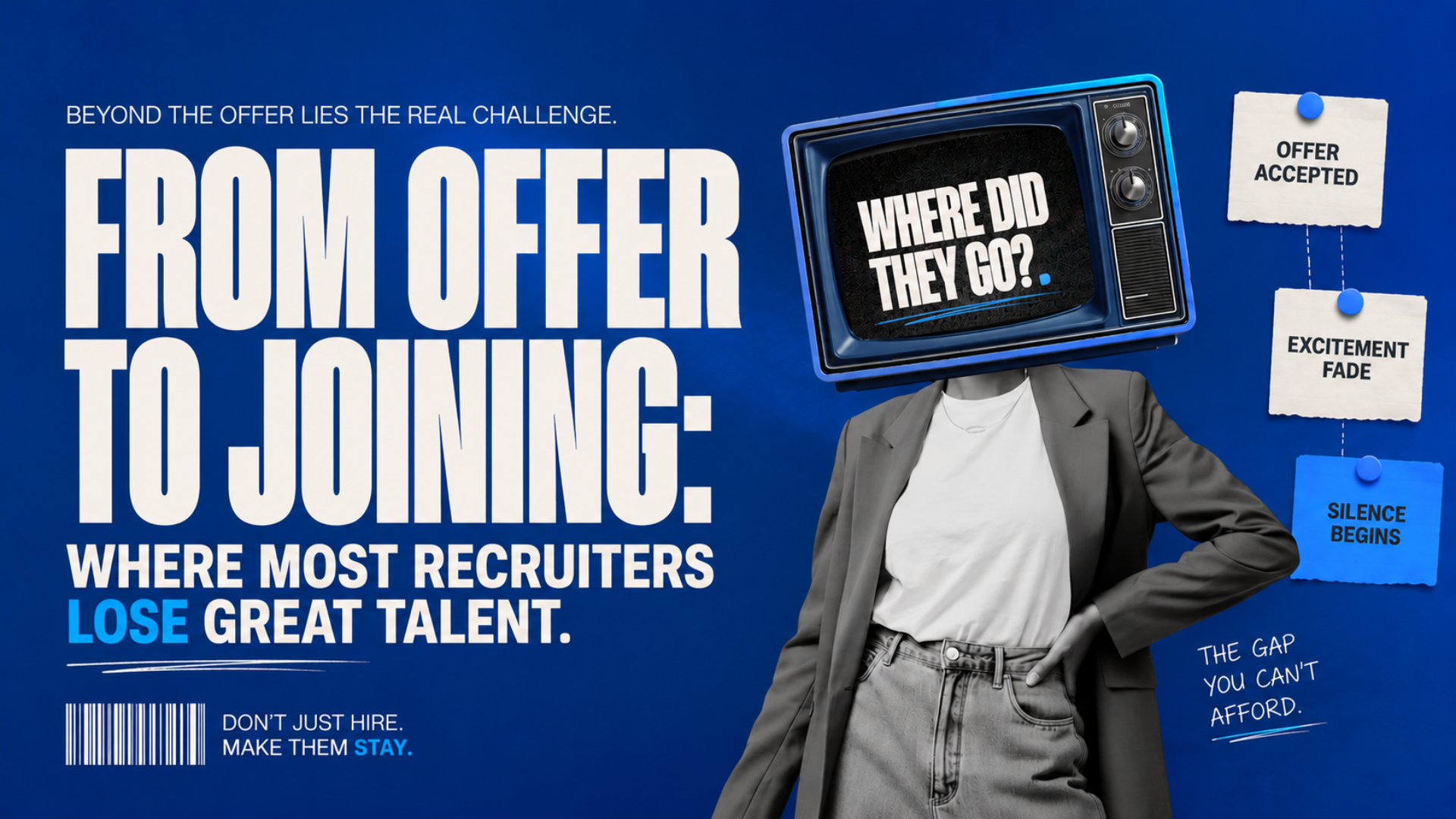
Recruiting teams obsess over the top of the funnel. They measure sourcing volume, screen-to-interview ratios, interview-to-offer rates, and offer acceptance rates with surgical precision. Dashboards track every conversion point, and recruiting leaders can tell you exactly how many candidates entered the pipeline on any given week and where they fell out. But once the candidate signs the offer letter, the measurement stops. The funnel goes dark. And it is in this dark zone, the unmeasured gap between offer acceptance and day one, that between ten and twenty percent of all hires evaporate, silently and expensively, without anyone noticing until it is too late.
This blind spot exists because most recruiting teams treat the offer as the finish line. The candidate said yes. The requisition is marked as filled. The recruiter moves on. But the offer is not the finish line. It is the starting line of the most dangerous phase of the entire hiring process. The candidate has not joined yet. They have merely agreed to join, and agreement is not the same as arrival. As we have explored in our analysis of why more tools produce the same hiring problems, adding sophistication to the top of the funnel while ignoring the bottom does not improve hiring outcomes. It just makes the top of the funnel more efficient at feeding candidates into a leaky bucket.
The Offer-to-Join Funnel: A Stage Most Teams Never Measure
The concept of a recruiting funnel is familiar to every talent acquisition professional. Candidates enter at the top, and hires emerge at the bottom. But the conventional funnel ends at offer acceptance, which means it misses the final and most expensive stage: the transition from acceptance to arrival. To understand where talent is actually lost, you need to extend the funnel to include three post-offer stages: acceptance to resignation, resignation to pre-boarding, and pre-boarding to day one. Each of these stages has its own dynamics, its own risks, and its own intervention points. Without mapping these stages explicitly, recruiting teams are
flying blind through the most critical phase of the hire. According to McKinsey’s people and organization insights, organizations that extend their hiring funnel to include post-offer stages are twice as likely to identify and fix the root causes of pre-joining drop-off.
The data infrastructure required to measure this extended funnel is more sophisticated than what most teams have in place. You need recruitment analytics that tracks not just whether a candidate accepted, but whether they resigned, whether they completed pre-boarding activities, and whether they showed up on day one. You need timestamp data on every candidate interaction, from email opens to call completions, so you can identify engagement decline patterns before they become withdrawals. And you need a system that can aggregate this data across all open requisitions and surface the patterns that indicate systemic problems rather than isolated incidents. Most teams have none of these things, which is why most teams cannot tell you their offer-to-join conversion rate with any precision.
Stage One: The Acceptance-to-Resignation Gap
The first and most overlooked stage of the post-offer journey is the gap between the candidate signing your offer and actually resigning from their current role. Many recruiters assume that acceptance and resignation happen simultaneously, or at least within a day or two. In practice, the gap can be much longer. Candidates who are cautious by nature may wait several days before resigning, using the time to prepare their exit, negotiate their transition, or simply gather the emotional courage to have a difficult conversation with their manager. During this gap, the candidate has not yet committed irrevocably. They still have one foot in their old role, and the possibility of walking back the decision is very real.
This is the stage where counteroffers are most lethal, because the candidate has not yet burned any bridges. Their current manager does not know they are leaving, which means the manager has no reason to make a counteroffer. But once the resignation conversation happens, the counteroffer often follows immediately. The candidate, who was already nervous about the conversation, is now being offered more money, a better title, or a promise of change to stay. This is why how many follow-ups one hire needs is not just about post-acceptance engagement. It is about pre-resignation reinforcement, making sure the candidate’s motivation is strong enough to survive the counteroffer conversation before it even happens. A single well-timed call from the hiring manager in the days between acceptance and resignation can make the difference between a candidate who stays and one who backs out.
The tools that most teams use to manage this stage are inadequate. A standard ATS automation system will send a congratulatory email after the offer is accepted and then go silent until the start date. There is no mechanism for tracking whether the candidate has resigned, no trigger for increasing engagement during the resignation window, and no alert if the candidate becomes unresponsive. This gap in coverage is one of the primary reasons why so many candidates are lost between acceptance and day one. The technology exists to close this gap, but most organizations have not prioritized it because they do not measure the loss.
Stage Two: The Notice Period Black Hole
Once the candidate has resigned, they enter the notice period, typically two to four weeks during which they continue working at their current employer while preparing to transition. This is the longest and most dangerous stage of the post-offer journey. The candidate is still embedded in their current environment. They see colleagues every day, attend meetings, and experience the familiar rhythms of their existing workplace. Meanwhile, their future workplace is an abstraction. They have visited once or twice, met a handful of people, and received documents about benefits and policies. The contrast between the tangible present and the uncertain future is stark, and it creates a psychological environment where doubt thrives. This is also the stage where the problem of outdated candidate data in AI recruiting tools becomes most acute, because the candidate’s professional situation is actively changing. They are handing off projects, completing final deliverables, and saying goodbye to colleagues. Their mindset is shifting from “excited about the new” to “sad about leaving the old,” and no amount of technology can prevent this emotional transition. But the right technology can ensure that the new employer is present and engaged during it.
The notice period is where a hiring CRM proves its value. A hiring CRM that captures every interaction from the interview process, the candidate’s concerns, their motivations, the specific aspects of the role that excited them, and the names of the people they connected with most strongly, gives the recruiting team the raw material to maintain a personalized engagement strategy. Without this data, the notice-period touchpoints are generic and forgettable. With it, they are targeted and meaningful. The candidate who was excited about a specific product initiative receives an update on that initiative. The candidate who was nervous about the team culture receives an invitation to an informal team call. The candidate who is relocating receives practical information about the new city. Each of these interactions reinforces the candidate’s decision and counters the natural pull of familiarity.
Stage Three: Pre-Boarding and the Final Week
The final stage of the offer-to-join journey is the pre-boarding period, typically the last five to seven days before the start date. This is the stage where most organizations make their final impression, and it is often the worst-managed stage of all. The candidate receives a flood of administrative emails: benefits enrollment, tax forms, IT setup instructions, and policy acknowledgments. These are necessary, but they are not engaging. They communicate bureaucracy, not excitement. And they arrive at precisely the moment when the candidate’s anxiety is peaking, because the reality of starting a new job is about to become immediate rather than abstract.
The contrast between how the candidate was treated during the interview process and how they are treated during pre-boarding is often stark. During interviews, they were courted. Hiring managers prepared for their visits, teams made time to meet them, and the recruiter was available around the clock. During pre-boarding, they are processed. They receive autom
ated emails from HR systems, fill out forms, and wait. This落差 is not just a missed opportunity. It is an active risk factor. Candidates who experience a significant decline in the quality of communication between the interview stage and the pre-boarding stage are significantly more likely to question their decision. This is why understanding the difference between AI sourcing and AI recruiting, matters so much in practice. Sourcing is about attracting candidates. Recruiting is about managing the relationship through the entire journey. And the pre-boarding stage is where that relationship is most tested.
The solution is to treat pre-boarding as a dedicated experience, not an administrative afterthought. The best-practice pre-boarding sequence includes a personal welcome call from the hiring manager, an introduction to a designated onboarding buddy, a detailed first-week agenda that shows the candidate what each day will look like, and a clear point of contact for any questions or concerns. Technology plays a critical role in orchestrating this sequence at scale, which is why enterprise recruitment software that includes pre-boarding workflows is increasingly seen as essential rather than optional. According to Deloitte’s talent insights, organizations that invest in structured pre-boarding experiences report twenty-five percent higher new-hire satisfaction and significantly lower no-show rates compared to those that rely on ad hoc processes.
Why Most Recruiting Funnels Stop at the Wrong Place
The reason most recruiting funnels end at offer acceptance is historical, not logical. In an era when offers were handwritten letters and start dates were often within a week, there was little gap between acceptance and joining, and little opportunity for the candidate to change their mind. But that era is over. Notice periods have lengthened. Background checks and visa processes have added delays. And the sheer volume of information available to candidates through employer review sites, social media, and professional networks means that the decision to accept an offer is no longer a final decision. It is a tentative decision that can be, and frequently is, revisited. The recruiting funnel needs to evolve to reflect this reality. When you automate recruitment process steps that cover the full journey from offer to joining, you create visibility into a stage that most teams have never seen. And visibility is the prerequisite for improvement.
The practical implication is that recruiting teams need to start tracking offer-to-join conversion rate as a primary metric, not an afterthought. This metric should be broken down by stage: acceptance-to-resignation, resignation-to-pre-boarding, and pre-boarding-to-day-one. Each stage will have different drop-off rates and different root causes, and each requires a different intervention strategy. The teams that do this well are not necessarily the ones with the biggest recruiting budgets. They are the ones that understand where their funnel is leaking and take deliberate action to plug the holes. As we have discussed in our analysis of whether AI recruiting tools work for niche roles, the platforms that perform best are the ones that cover the full candidate journey, not just the stages that are easiest to measure.
Why Huntlo.ai Covers the Full Journey from Offer to Day One
Huntlo.ai was built on the principle that the hiring funnel does not end at the offer. The platform tracks every candidate from first contact through day one, with dedicated engagement stages for the acceptance-to-resignation window, the notice period, and the pre-boarding phase. Each stage has its own automated touchpoint sequence, its own engagement metrics, and its own escalation triggers. When a candidate’s responsiveness declines, the system alerts the recruiting team with context about why the decline might be happening and what action to take. This is not a platform that treats the post-offer phase as a formality. It treats it as the highest-stakes stage of the entire pipeline, because that is exactly what it is. When evaluating an AI recruiting tool before buying, the single most important question to ask is whether the platform maintains engagement and visibility after the offer is signed. Most cannot. Huntlo does.
For recruiting teams that are tired of losing great candidates in the gap between offer and joining, Huntlo offers a complete solution. One where every stage of the journey is measured, managed, and optimized. One where referrals outperform cold outreach not because of the referral itself, but because the referred candidate receives the same high-quality post-offer experience that every candidate deserves. And one where the recruiting team finally has visibility into the part of the funnel that matters most, the part where the candidate either shows up or does not. The difference between a good recruiting team and a great one is not how many offers they extend. It is how many of those offers actually walk through the door.