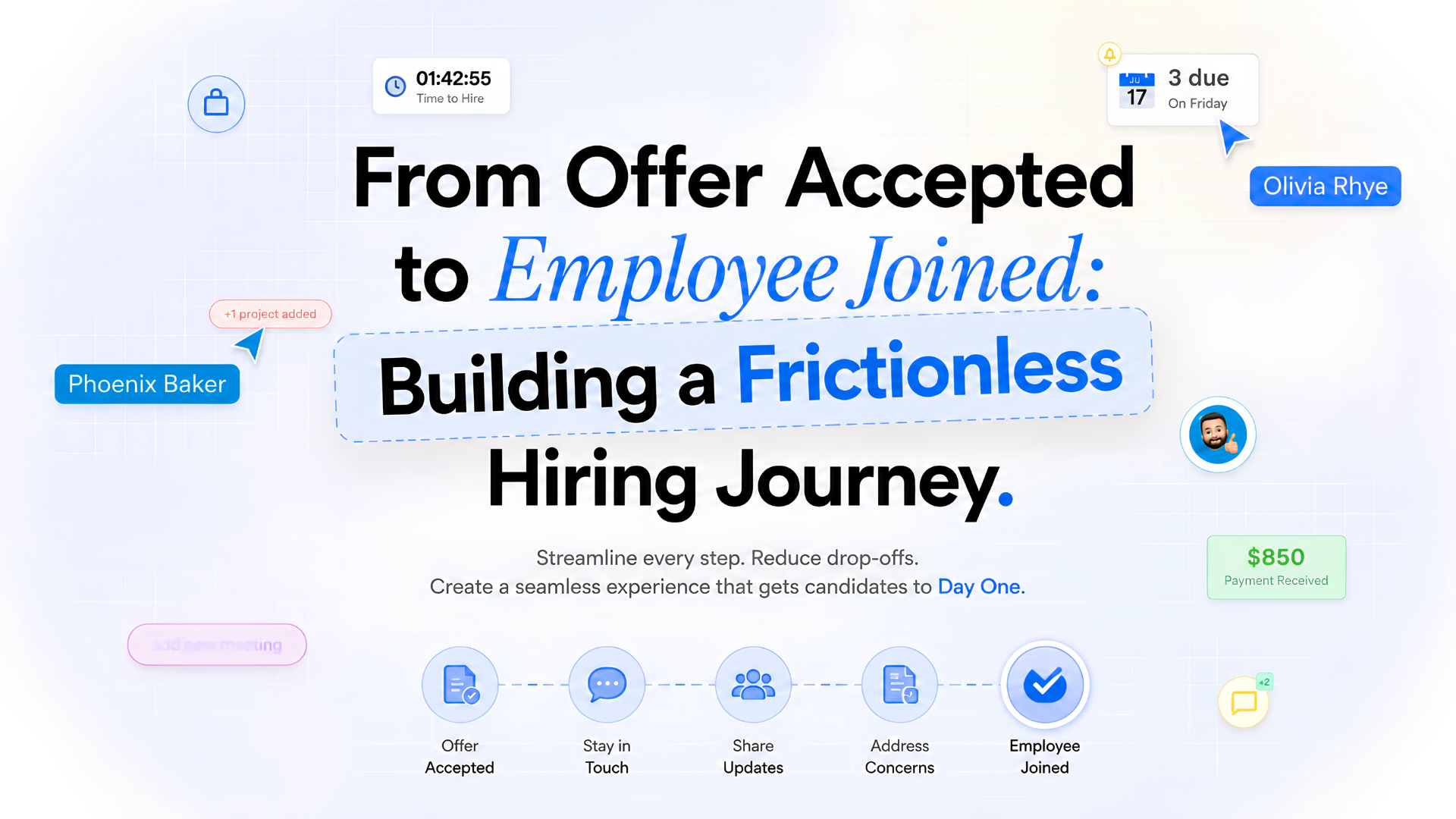
A candidate signs an offer for a senior engineering role at a technology company. The offer package is competitive. The interview experience was positive. The candidate is genuinely excited about the opportunity. Then the post-offer experience begins. The background check takes three weeks instead of the promised two. The HR team sends onboarding paperwork through a portal that does not work on the candidate's mobile device. The hiring manager goes silent for two weeks after the initial welcome message. No one provides information about the team structure, the first-week agenda, or the tools the candidate will need. The candidate's start date is changed twice due to internal scheduling conflicts. By the time the actual start date arrives, the candidate's excitement has been replaced by anxiety, frustration, and a growing suspicion that the disorganization they experienced during the transition is a preview of how the company operates. This candidate did join, but they arrived with a negative first impression that took months to overcome and that contributed to their decision to leave within the first year. The hiring journey from offer acceptance to employee joined was not a journey at all. It was an obstacle course, and every obstacle eroded the candidate's commitment and the organization's return on its recruiting investment.
This scenario is not an edge case. According to research compiled by SHRM's talent
acquisition resources, the average candidate encounters between five and eight distinct friction points between offer acceptance and day one, and each friction point measurably increases the candidate's anxiety and reduces their commitment to joining. The cumulative effect of these friction points is dramatic: candidates who report a high-friction post-offer experience are three times more likely to actively consider withdrawing before their start date, and two and a half times more likely to leave within the first six months if they do join. The post-offer experience is not a secondary concern. It is a primary determinant of whether the organization's investment in sourcing, screening, and closing the candidate produces a productive hire or a costly failure. A frictionless offer-to-joining journey is not a luxury. It is a business requirement, and the organizations that invest in building one are the ones that consistently achieve the highest joining rates and the strongest long-term retention outcomes.
The Seven Friction Points That Break the Hiring Journey
Through analysis of thousands of candidate journeys and post-offer experiences, seven friction points emerge as the most common and most damaging. The first friction point is communication silence. The candidate accepts the offer and then experiences extended periods with no meaningful contact from the organization. The recruiter moves to the next requisition. The hiring manager focuses on operational priorities. The HR team sends automated paperwork reminders but nothing personal. The second friction point is bureaucratic complexity. The candidate must navigate multiple systems, complete redundant forms, submit the same information multiple times, and interact with different departments that do not communicate with each other. Background checks, drug screening, reference checks, and payroll setup each require separate interactions with separate teams, each with their own timelines and requirements. The third friction point is information vacuum. The candidate has questions about the role, the team, the tools, the dress code, the parking situation, and a dozen other practical concerns, but no single point of contact who can provide comprehensive answers. According to McKinsey's people organization insights, the information vacuum is the friction point most strongly correlated with candidate anxiety, because it forces the candidate to fill the gap with speculation, and speculation during a life transition is almost always negative.
The fourth friction point is stakeholder inconsistency. The candidate receives different information from different people. The recruiter says one thing about the start date. The HR team says another. The hiring manager has not been briefed on the candidate's concerns. The onboarding team does not know the candidate's preferred communication channel. Each inconsistency signals a lack of coordination that erodes the candidate's confidence in the organization. The fifth friction point is timeline uncertainty. The candidate does not know when the background check will be completed, when the equipment will arrive, or when they will receive the first-week agenda. The lack of a clear timeline creates a sense of unpredictability that is particularly damaging for candidates who are making significant life changes such as relocation or visa transitions. The sixth friction point is start-date instability. The candidate's start date is changed after it has been confirmed, often due to internal factors that have nothing to do with the candidate. Each change disrupts the candidate's personal planning and
signals that the organization does not respect the candidate's time. Understanding how many follow-ups one hire actually needs, the seventh friction point is the absence of human connection. The candidate's entire post-offer experience is mediated by portals, automated emails, and forms, with no opportunity for a genuine conversation with another human being. Understanding the difference between AI sourcing and AI recruiting, the organizations that eliminate these seven friction points create a seamless hiring completion process that protects the candidate's commitment and the organization's recruiting investment.
The Frictionless Journey Framework
Building a frictionless hiring journey requires a structured framework that addresses every stage of the post-offer experience and every stakeholder involved. The framework has four layers. The first layer is the communication layer: a planned, personalized sequence of touchpoints that delivers the right information at the right time throughout the entire post-offer period. The communication plan is not a generic template. It is personalized to the candidate's risk profile, their specific concerns, and the characteristics of their transition. A candidate who is relocating internationally receives a different communication plan than a candidate who is making a local move. The communication layer is owned by the recruiter and orchestrated by technology, ensuring that no candidate misses a planned touchpoint regardless of recruiter workload. The second layer is the coordination layer: a single point of accountability for managing all the operational elements of the candidate's transition. Background checks, paperwork, equipment provisioning, access credentials, and schedule alignment are all tracked in one place, with clear ownership and deadlines for each element. The candidate does not have to navigate multiple departments or track multiple timelines. They have one contact, one dashboard, and one source of truth. According to Gartner's HR trends analysis, the coordination layer is the single most impactful layer for reducing candidate anxiety, because it replaces the fragmented, multi-department experience that most candidates currently endure with a unified, coherent process. This is the foundation of hiring journey continuity: the candidate's experience flows seamlessly from one stage to the next without the gaps, contradictions, and silos that characterize the typical post-offer experience.
The third layer is the connection layer: facilitated interactions between the candidate and the people they will work with. The hiring manager, the onboarding buddy, the future teammates, and, where appropriate, a senior leader. These interactions are not left to chance. They are scheduled, prepared, and tracked, with clear objectives for each conversation. The connection layer transforms the candidate's abstract commitment to an organization into a concrete commitment to specific people, creating multiple relationship anchors that make withdrawal psychologically costly. The fourth layer is the feedback layer: a systematic process for capturing the candidate's experience in real time, identifying friction points as they occur, and resolving them before they compound into frustration or withdrawal. The feedback layer includes structured check-ins at key milestones, such as one week after offer acceptance, the midpoint of the notice period, and three days before the start date. According to Deloitte's talent research, organizations that implement all four layers of the frictionless journey framework reduce
pre-join attrition by sixty to seventy-five percent and improve new-hire satisfaction scores by thirty to forty percent in the first quarter of deployment, because the framework addresses the root causes of friction rather than treating individual symptoms.
Designing the Candidate Transition Experience
The concept of candidate transition experience design borrows from product design and customer experience disciplines. Just as a product designer maps the customer journey and identifies the moments of truth that determine satisfaction, the recruiting team must map the candidate's journey from offer acceptance to day one and identify the moments that determine whether the candidate arrives excited, anxious, or regretful. The mapping exercise typically reveals that the candidate's journey has three critical moments. The first critical moment is the resignation and its aftermath. This is when the candidate is most vulnerable to a counteroffer and most in need of support. The experience design for this moment includes a pre-resignation briefing, same-day follow-up after the resignation, and proactive monitoring for signs of counteroffer pressure. The second critical moment is the midpoint of the notice period, when the initial excitement of the new opportunity has faded and the practical challenges of the transition have become real. The experience design for this moment includes a substantive check-in that addresses emerging concerns, provides new and useful information about the role, and reinforces the candidate's decision.
The third critical moment is the final week before the start date, when anxiety peaks and the candidate is most likely to experience second thoughts. The experience design for this moment includes a detailed first-week agenda, a personal call from the hiring manager, confirmation that all logistics are in place, and a clear statement of how the organization will support the candidate's success in the first ninety days. Each of these moments requires specific actions from specific stakeholders, and the experience design specifies who does what, when, and how. Without this level of specificity, the critical moments are handled inconsistently, and the candidate's experience depends on which recruiter and which hiring manager happen to be involved. As we have explored in our analysis of why more tools produce the same hiring problems, the organizations that design the transition experience with the same rigor they apply to the interview experience are the ones that achieve consistent, high-quality outcomes across every candidate and every role.
The Role of AI in Eliminating Friction
AI is the technology that makes the frictionless journey achievable at scale. The four-layer framework described above requires a level of coordination, personalization, and real-time responsiveness that is beyond the capacity of any manual process. A recruiter managing twenty simultaneous candidates cannot maintain a personalized communication plan, coordinate across four departments, schedule stakeholder interactions, and monitor feedback for every candidate without technology support. AI provides that support by automating the structural elements of each layer while preserving the recruiter's ability to exercise judgment and build
relationships in the moments that require a human touch. The AI system manages the communication layer by maintaining the personalized cadence for every candidate, sending the right message at the right time and adjusting the content based on the candidate's risk profile and engagement level. It manages the coordination layer by tracking every operational element of the candidate's transition, flagging delays, and escalating issues before they become visible to the candidate. It manages the connection layer by prompting stakeholders at the right moments and tracking whether each interaction has occurred. And it manages the feedback layer by capturing and analyzing candidate responses in real time, identifying emerging friction points, and recommending interventions. According to LinkedIn's recruiting resources, the post-offer experience optimization that AI enables is not incremental. It is transformational, because it shifts the post-offer experience from a fragmented, reactive, recruiter-dependent process to a unified, proactive, technology-supported journey that delivers consistent quality for every candidate regardless of caseload.
The organizations that are leading in frictionless hiring journeys share a common characteristic: they have recognized that the post-offer phase is not an operational afterthought but a design challenge that requires the same attention to experience, consistency, and quality that they apply to every other customer-facing process. As we have discussed in our analysis of why referrals outperform cold outreach, the candidates who experience a frictionless journey become advocates for the employer brand, generating referrals and positive word-of-mouth that reduce the cost of future hiring. The investment in candidate transition experience design pays for itself not only through higher joining rates but through a stronger talent pipeline that compounds over time.
Why Huntlo.ai Builds the Frictionless Journey for Every Candidate
Huntlo.ai provides the complete journey management platform that makes the four-layer frictionless framework operational for every recruiting team. The system builds a personalized journey plan for every candidate at the moment of offer acceptance, orchestrates communication across all stakeholders, tracks every operational element of the transition, monitors the candidate's experience in real time, and measures joining rate and candidate satisfaction with full segment-level visibility. Every recruiter on the team has access to the same journey orchestration engine, the same coordination tools, and the same measurement infrastructure, ensuring that every candidate receives a consistently excellent experience regardless of individual recruiter workload or experience level. Huntlo ensures that outdated candidate data in AI recruiting tools never undermines the journey quality, because every recommendation and communication is based on fresh, continuously updated intelligence about the candidate's current state.
For recruiting leaders who want to build a frictionless hiring journey that protects every placement, Huntlo provides the technology, the workflow, and the measurement to make it happen. And for organizations evaluating their options, understanding how to evaluate an AI sourcing tool before buying, means asking whether the platform manages the complete
post-offer journey or whether it stops at the offer acceptance like every other tool on the market. As we have explored in our analysis of what makes an AI recruiting platform agentic vs. just automated, the organizations that will win the competition for talent in the coming years are the ones that treat every candidate's journey from offer acceptance to day one as a designed experience worthy of the same attention they give to their customer experience, because in the war for talent, the candidate is the customer.