A financial services company completed eighty-two hires last year. Their offer acceptance rate was ninety-one percent, a number the recruiting team was proud to report. What they did not report was that of the eighty-two candidates who signed offers, only sixty-four actually started. Eighteen candidates dropped out between the signed offer and the first day of work. Eighteen hires that required months of sourcing, weeks of screening, dozens of interviews, and significant recruiter and hiring manager time, all of which produced zero business value. When the CFO asked why eighteen placements had vanished, the recruiting team had no systematic answer. Each case was different, they said. Some accepted counteroffers. Some ghosted. Some had personal circumstances change. The team treated each dropout as an isolated incident, a regrettable but unpredictable event. But when the data was analyzed systematically, a clear pattern emerged. Seventy-eight percent of the eighteen dropouts showed at least one identifiable warning signal more than a week before the withdrawal. In most cases, the signal was a change in the candidate's communication behavior: slower response times, shorter messages, or a shift from proactive to reactive communication. The recruiting team had not been monitoring these signals, had not been intervening when they appeared, and had not been tracking the data that would have revealed the pattern. The candidates were not lost to fate. They were lost to inattention.
This pattern is not unique to one company. It is the norm across the industry. According to research compiled by SHRM's talent acquisition resources, the average organization loses between fifteen and twenty-five percent of accepted offers before the candidate starts, and in high-demand talent segments, the rate can exceed thirty percent. What makes these losses particularly frustrating is that the vast majority are preventable. Analysis of thousands of candidate dropout cases reveals that fewer than ten percent of pre-join losses are caused by truly unpredictable events, such as a sudden family emergency or an unforeseen health issue. The remaining ninety percent are caused by factors that the recruiting team could have identified, addressed, or mitigated with a structured post-offer management process. This is the core insight behind preventable candidate joining failure: the recognition that most candidates lost before joining are not lost to circumstances beyond the organization's control but to gaps in the process that the organization has the power to fix.
The Five Causes of Preventable Joining Failures
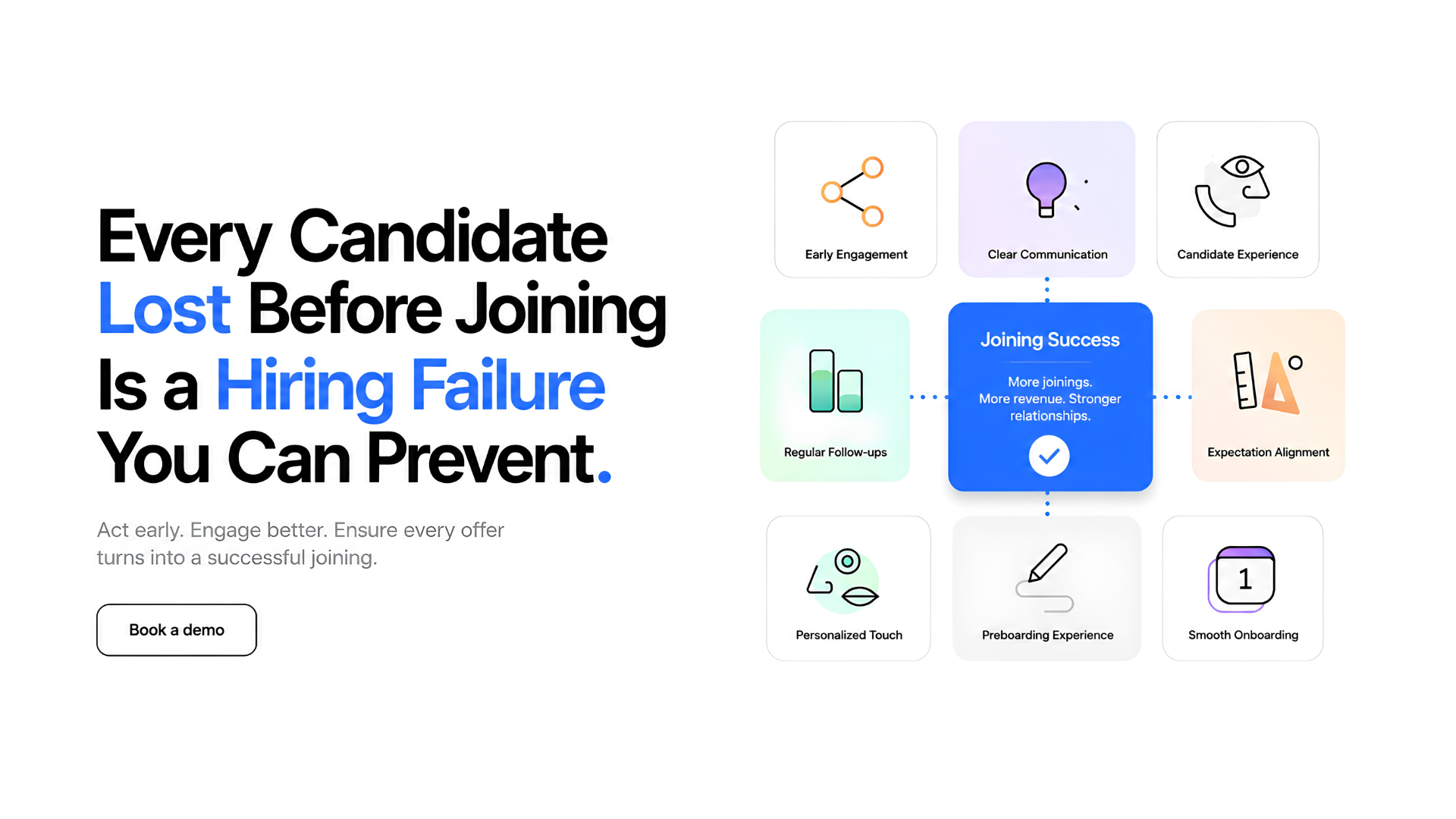
Every preventable joining failure can be traced to one of five root causes. The first cause is communication abandonment. The candidate accepts the offer and then hears nothing meaningful from the organization for days or weeks. The recruiter has moved on to the next requisition. The hiring manager is focused on operational priorities. The HR team sends administrative paperwork but no personal engagement. The candidate's experience during the notice period is one of silence punctuated by bureaucracy. This is the most common cause of dropout and the easiest to prevent, because the solution is straightforward: maintain a structured, consistent communication cadence throughout the post-offer period. Understanding how many follow-ups one hire actually needs, the organizations that maintain a deliberate sequence of touchpoints, each serving a specific purpose such as information delivery, relationship building, or concern resolution, see dropout rates from communication abandonment drop to near zero.
The second cause is unmanaged counteroffers. The candidate resigns, receives a counteroffer, and accepts it because the organization did not prepare the candidate for this predictable moment. No briefing on what to expect during the resignation conversation. No coaching on how to decline a counteroffer. No real-time support during the critical hours after the resignation when the counteroffer is most likely to arrive. According to McKinsey's people organization insights, counteroffers account for roughly thirty-five to forty percent of all preventable joining failures, making them the single largest individual cause. The third cause is expectation misalignment. The candidate arrives on day one and discovers that the role, the team, or the culture is materially different from what was described during the hiring process. The misalignment was not caused by deception but by the absence of a structured process for setting, validating, and reinforcing expectations during the post-offer period. The fourth cause is stakeholder disengagement. The hiring manager, the onboarding buddy, or the future teammates who were enthusiastic and engaged during the interview process become unavailable or unresponsive after the offer is signed, leaving the candidate feeling undervalued and uncertain about their decision.
The fifth cause is logistical chaos. The candidate's transition is poorly managed: visa processing is delayed, background checks take longer than expected, equipment is not ready, or the start date is changed multiple times. Each logistical failure erodes the candidate's confidence in the organization and reinforces any doubts they may already have. While logistical failures may seem like operational issues rather than recruiting failures, the candidate experiences them as part of the hiring process, and they are the recruiter's responsibility to coordinate and manage. According to Gartner's HR trends analysis, organizations that implement a structured post-offer management process addressing all five causes simultaneously reduce pre-join losses by sixty to seventy percent within two quarters, because the causes are interconnected and addressing them together creates a reinforcing system of protection rather than a set of isolated fixes. This is the foundation of pre-start candidate loss prevention: not treating each dropout as a unique catastrophe but recognizing that most dropouts share common root causes that can be addressed through a systematic, repeatable process.
Why Most Organizations Accept Joining Failures as Normal
If ninety percent of pre-join losses are preventable, why do most organizations accept them as a normal cost of doing business? The answer is a combination of measurement gaps, structural incentives, and cultural assumptions that together create a self-reinforcing cycle of inattention. The measurement gap is the most fundamental barrier. Most organizations do not measure joining rate as a distinct metric. They measure offer acceptance rate, which tells them how many candidates said yes, but they do not systematically track how many of those candidates actually started. Without the measurement, the problem is invisible. The recruiting team reports a ninety percent offer acceptance rate, the business celebrates, and nobody notices that fifteen of those accepted offers never resulted in a productive hire. According to Deloitte's talent research, fewer than twenty percent of organizations currently track joining rate as a primary recruiting metric, which means that eighty percent of organizations are managing a problem they cannot see.
The structural incentive problem compounds the measurement gap. Recruiters are typically measured and compensated on placements made and offers accepted, not on candidates who start. When a candidate drops out after accepting an offer, the recruiter's reported metrics do not change. The placement is still counted. The offer acceptance rate is still high. The recruiter has no incentive to invest time in preventing the dropout because the dropout does not affect their reported performance. The cultural assumption is the third barrier. Many recruiting leaders believe that pre-join dropouts are simply part of the business, an unavoidable consequence of a competitive talent market. This belief persists despite the evidence that most dropouts are preventable, because it absolves the organization of the responsibility to address the problem systematically. As we have explored in our analysis of why more tools produce the same hiring problems, the organizations that break this cycle are the ones that start by measuring the problem, then by aligning incentives, and finally by investing in the process and technology to solve it. All three steps are necessary, and partial solutions produce partial results that quickly plateau.
The Systematic Approach to Zero Pre-Join Attrition
Achieving a zero dropout hiring strategy is not an aspiration. It is an operational target that is achievable with the right process, technology, and discipline. The approach has four components. The first component is risk identification. Every candidate who accepts an offer receives a risk assessment that evaluates their likelihood of dropout based on objective factors such as counteroffer risk, relocation complexity, notice period length, and the candidate's communication engagement during the hiring process. This assessment is not a subjective guess. It is a data-driven score that identifies which candidates need the most intensive post-offer support and which candidates can be managed with a lighter touch. The second component is a structured communication plan. Every candidate receives a personalized communication cadence that is calibrated to their risk profile and their individual situation. The cadence includes touchpoints from the recruiter, the hiring manager, and future teammates, each serving a specific purpose and scheduled at the optimal moment.
The third component is real-time intervention. The system monitors the candidate's engagement signals throughout the post-offer period, including response times, communication tone, and the candidate's level of initiative in reaching out. When a signal suggests declining engagement, the system alerts the recruiter with a specific recommendation for intervention. The recruiter does not have to guess whether a candidate is at risk. The system tells them, with supporting evidence, and recommends what to do about it. The fourth component is continuous measurement and improvement. The organization tracks joining rate as a primary metric, with segment-level breakdowns by recruiter, by role type, by client, and by risk factor. Each dropout is analyzed for root cause, and the data feeds back into the risk identification model, making it more accurate over time. According to LinkedIn's recruiting resources, organizations that implement all four components achieve joining rates above ninety-five percent within three quarters, with the strongest improvements coming in the first quarter as the most obvious process gaps are addressed. This is what joining guarantee through process means in practice: not hoping that candidates show up but building a system that makes showing up the most likely outcome of every hiring process.
The Role of AI in Preventing Every Joining Failure
AI is the technology that makes the systematic approach to zero pre-join attrition possible at scale. The four components described above, risk identification, communication planning, real-time intervention, and continuous measurement, all require the kind of continuous data processing, pattern recognition, and personalized recommendation that only an AI system can deliver for a large number of simultaneous candidates. A skilled recruiter can manage the post-offer experience for five or ten candidates at a time with high quality. But most recruiters are managing twenty to thirty candidates simultaneously, and the quality of their attention degrades rapidly as the caseload increases. AI fills this capacity gap by handling the data processing and pattern recognition that the recruiter cannot do manually at scale, while
preserving the recruiter's ability to exercise judgment and build relationships in the situations that require a human touch. Understanding the difference between AI sourcing and AI recruiting, the organizations that achieve the best results are the ones that use AI to augment the recruiter's capabilities rather than replace them, creating a human-AI partnership that is more effective than either could be alone.
The AI system does three things that are critical to preventing joining failures. First, it monitors every candidate's engagement continuously and objectively, without the biases and blind spots that affect human judgment. A recruiter who is managing twenty candidates may not notice that one candidate's response time has increased from two hours to twenty-four hours over the past week. The AI system notices immediately and flags the change. Second, the AI system provides personalized intervention recommendations based on the specific risk factors and communication patterns of each candidate. The recommendation is not a generic follow-up email. It is a specific, contextual suggestion for the most effective action given what the system knows about the candidate's situation. Third, the AI system maintains the measurement infrastructure that makes continuous improvement possible. It tracks joining rate, analyzes root causes, and identifies patterns that no human analysis could detect across hundreds of candidate journeys. This is the essence of pre-join attrition elimination: using AI to detect, prevent, and learn from every signal that indicates a candidate may not show up, turning joining failure from an unpredictable event into a systematically managed risk. As we have discussed in our analysis of why referrals outperform cold outreach, the organizations that invest in AI-powered post-offer management are not just preventing dropouts. They are building a candidate experience that strengthens their employer brand and makes future hiring easier.
Why Huntlo.ai Makes Every Joining Failure Preventable
Huntlo.ai provides the complete post-offer management platform that makes the systematic approach to zero pre-join attrition operational for every recruiting team. The system assesses every candidate's risk profile at the moment of offer acceptance, builds a personalized engagement plan calibrated to that risk profile, orchestrates multi-stakeholder communication throughout the notice period, monitors engagement signals in real time, alerts recruiters to candidates who show signs of disengagement, and tracks joining rate with full segment-level analytics. Every recruiter on the team, regardless of experience level or caseload size, has access to the same AI-powered risk intelligence and intervention recommendations, ensuring that no candidate falls through the cracks. Huntlo ensures that outdated candidate data in AI recruiting tools never undermines the prevention strategy, because every recommendation is based on fresh, continuously updated intelligence about the candidate's current state and engagement level.
For recruiting leaders who are tired of watching placement value evaporate between the signed offer and the first day, Huntlo provides the technology, the workflow, and the measurement to make every joining failure preventable. And for organizations evaluating their options, understanding how to evaluate an AI sourcing tool before buying, means asking
whether the platform provides AI-powered post-offer risk management and joining rate optimization, or whether it stops at the offer acceptance like every other tool on the market. As we have explored in our analysis of what makes an AI recruiting platform agentic vs. just automated, the organizations that will lead the next era of recruiting are the ones that refuse to accept pre-join losses as normal and invest in the systematic approach that makes them history.