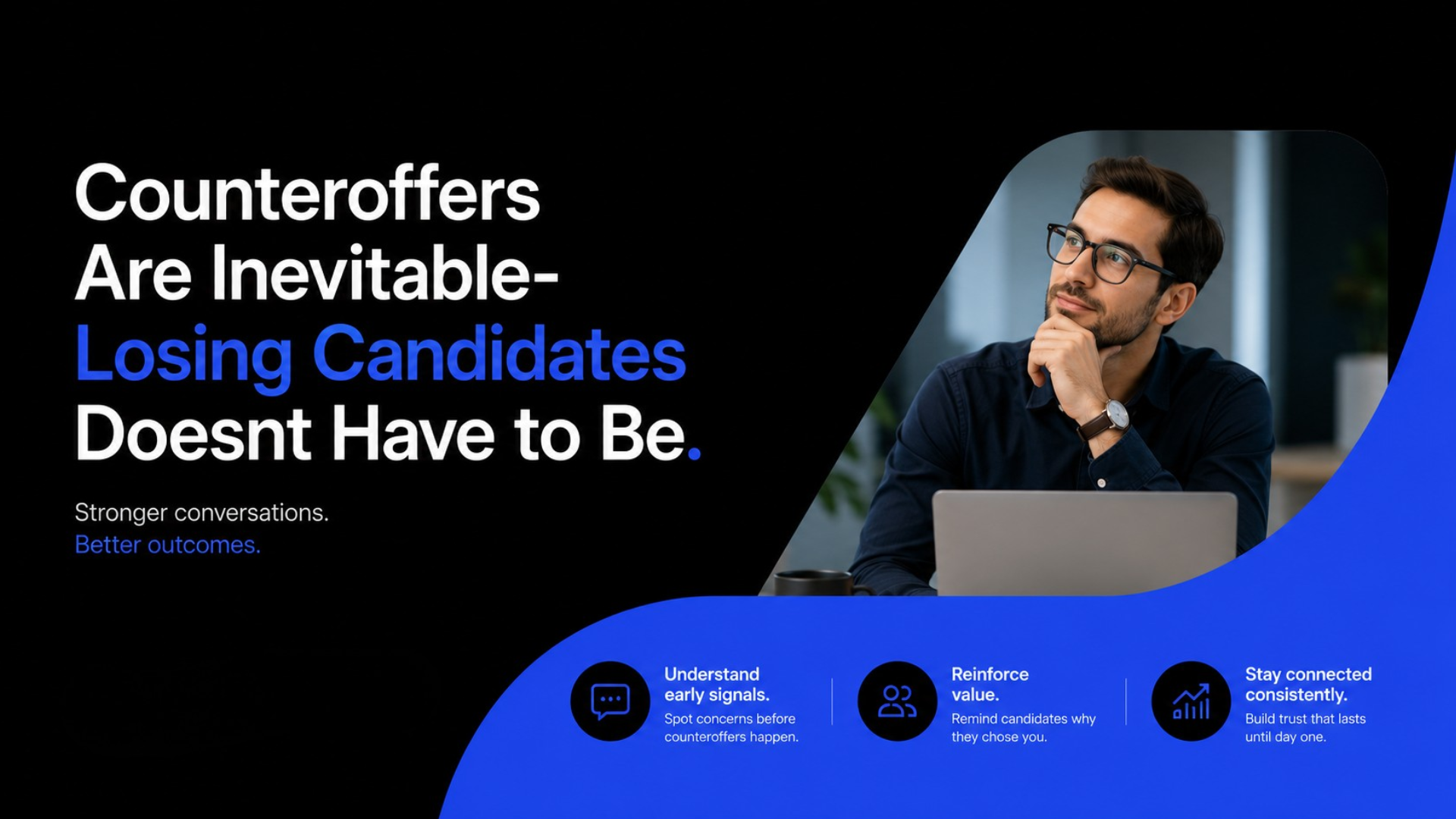
Your candidate accepts your offer on Thursday. On Friday, their current employer responds with a counteroffer that includes a promotion, a fifteen percent raise, and a promise of a new project. On Monday, your candidate calls to withdraw. This sequence costs your organization twenty thousand dollars in wasted recruiting effort, extends the vacancy by another six weeks, and forces the hiring manager back into an interview process they thought was finished. The counteroffer was inevitable. Losing the candidate was not.
Counteroffers are a permanent feature of competitive talent markets. In any sector where skilled professionals are in demand, current employers will fight to retain their departing talent. The question is not whether your candidates will receive counteroffers. They will. The question is whether those counteroffers will succeed. And the answer to that question is determined not by the size of the counteroffer or the generosity of your own offer, but by the depth of the candidate’s commitment to your organization at the moment the counteroffer arrives. According to SHRM’s talent acquisition research, candidates who report a strong emotional connection to their future employer are four times less likely to accept a counteroffer, even when the counteroffer includes a significant financial premium. The organizations that lose the fewest candidates to counteroffers are not the ones that pay the most. They are the ones that build the deepest commitment before the counteroffer ever arrives. This is the foundation of effective counteroffer prevention: building commitment so strong that the counteroffer arrives too late to change the candidate’s mind.
Why Counteroffers Succeed: It’s About Doubt, Not Money
The conventional wisdom about counteroffers is wrong. Most recruiting teams assume that counteroffers succeed because they offer more money. In reality, money is the surface justification. The real reason candidates accept counteroffers is doubt. When a candidate accepts a
counteroffer, they are not choosing the higher salary. They are choosing the certainty of their current situation over the uncertainty of a new one. Their current employer is known, their team is familiar, their commute is established, and their role is understood. Your organization, by contrast, is still largely abstract. The candidate has visited your office once or twice, met a handful of people, and received a written description of the role. But they have not experienced the day-to-day reality of working there. The counteroffer succeeds because it offers a compelling narrative: “You already have it good here. Why risk the unknown?” To defeat this narrative, you need to replace the candidate’s abstract impression of your organization with a concrete, lived experience before the counteroffer window opens. This is the strategic logic behind offer withdrawal prevention, and it is fundamentally different from simply trying to match or exceed the counteroffer’s financial terms.
The doubt that counteroffers exploit is not random. It clusters around three specific areas. First, role doubt: will the job actually be what was described during the interview? Candidates who feel that the interview process oversold the opportunity are the most susceptible to counteroffers, because the counteroffer’s “stay with what you know” narrative directly addresses their fear of being misled. Second, cultural doubt: will I fit in with the team? Candidates who had limited exposure to their future team during the interview process have no social anchor at the new organization, which makes the counteroffer’s promise of familiar colleagues extremely compelling. Third, practical doubt: will the logistics of the transition work out? Candidates who are uncertain about remote work arrangements, relocation support, or reporting structures are vulnerable to a counteroffer that removes the need to deal with any of these uncertainties. According to McKinsey’s people organization research, the candidates who are most resistant to counteroffers are the ones who have had all three of these doubt areas addressed through direct experience, not just verbal assurances, before the counteroffer arrives.
Building Counteroffer Resistance During the Interview Process
The work of preventing counteroffer losses begins long before the offer is extended. It begins during the interview process, when the candidate’s expectations, concerns, and motivations are first surfacing. The interview process has two functions in the counteroffer context. First, it is an opportunity to gather the intelligence you will need to build personalized counteroffer resistance. What does the candidate care about most? What are they worried about? What would make them stay at their current employer? What would make them leave? This intelligence, when captured systematically, becomes the basis for a targeted candidate counteroffer strategy that addresses the candidate’s specific vulnerabilities rather than relying on generic reassurance. Second, the interview process is an opportunity to build experiential commitment. The more direct experience the candidate has with your organization, the less abstract it becomes, and the less powerful the counteroffer’s “stick with what you know” narrative becomes. This means going beyond the standard interview format. It means including a team lunch, a workspace tour, a shadow session with a future colleague, or a brief conversation with a senior leader who is not on the interview panel. These experiences give the candidate
concrete memories and impressions to weigh against the counteroffer, rather than relying solely on the verbal promises made during formal interviews.
The interview process also reveals the candidate’s motivation for leaving, which is the single most important piece of intelligence for counteroffer prevention. Candidates who are leaving for positive reasons, they are excited about your role, your team, your mission, are far more resistant to counteroffers than candidates who are leaving for negative reasons, they are frustrated with their current manager, their current salary, or their current career trajectory. A candidate who is running toward something is much harder to pull back than a candidate who is running away from something. When you understand the candidate’s motivation, you can reinforce it throughout the post-acceptance phase. As we have explored in our analysis of the difference between AI sourcing and AI recruiting, recruiting is fundamentally about building relationships, and the depth of the relationship determines the candidate’s resilience when the counteroffer arrives.
The Post-Acceptance Counteroffer Defense
The period between offer acceptance and the start of the notice period is the most dangerous window for counteroffers. This is when the candidate informs their current employer of their departure, which triggers the retention response. The organizations that defend against counteroffers most effectively treat this window as a planned military operation, with specific objectives, assigned responsibilities, and escalation protocols. The first objective is to flood the zone with positive engagement before the candidate has their resignation conversation. The hiring manager’s personal welcome message, the onboarding buddy introduction, and the first piece of personalized content about the team or project should all arrive before the candidate tells their current employer they are leaving. This timing is critical because it means the candidate enters the resignation conversation already feeling connected to their future team, not standing alone. The second objective is to maintain communication intensity during the first week after the resignation. This is when the current employer’s retention response is most aggressive, and the candidate is most susceptible to it. Understanding how many follow-ups one hire actually needs, and increasing the cadence during this specific window, is a core element of effective counteroffer retention strategy.
The third objective is to prepare the candidate for the counteroffer before it arrives. Most recruiters avoid this conversation because they fear it will plant the idea of accepting a counteroffer in the candidate’s mind. The opposite is true. Candidates who have been briefed on what to expect, including the specific tactics their current employer is likely to use, are far more resistant to those tactics when they arrive. The briefing should cover three points. First, explain that counteroffers are standard practice and that receiving one is a sign of the candidate’s value, not a reason to reconsider. Second, share the data on counteroffer outcomes: research consistently shows that seventy to eighty percent of employees who accept counteroffers leave within twelve months, because the underlying reasons they wanted to leave have not changed. Third, remind the candidate of the specific reasons they chose your organization, referencing the intelligence gathered during the interview process. According to
LinkedIn’s recruiting insights, candidates who receive a proactive counteroffer briefing are fifty percent less likely to accept a counteroffer when one arrives.
What to Do When the Counteroffer Arrives
Despite the best prevention efforts, some counteroffers will arrive, and some candidates will be tempted. The recruiter’s response in this moment matters enormously. The wrong response, defensiveness, guilt-tripping, or immediately escalating the financial offer, validates the candidate’s doubt. The right response is calm, empathetic, and focused on the candidate’s long-term interests rather than the organization’s short-term need to fill the role. The response should follow a three-step framework. First, acknowledge the counteroffer without judgment. “It’s completely natural to consider this. Your current employer clearly values you, and that’s a good thing.” This response disarms the candidate’s anxiety about having the conversation and creates the psychological safety needed for an honest discussion. Second, redirect the conversation from the counteroffer’s terms to the candidate’s original motivations. “When we spoke during the interview process, you told me that the thing you were most excited about was the opportunity to lead a team for the first time. Has anything changed about that?” This brings the candidate back to their own reasons for leaving, which are almost always more compelling than the counteroffer’s financial terms. This is the essence of talent competition: winning on fit and motivation rather than on price.
Third, provide a specific, concrete reinforcement of the candidate’s decision. This is not the time for generic reassurance. It is the time for a specific, actionable response that addresses the candidate’s likely concerns. If the counteroffer included a promotion, arrange a call with the hiring manager to discuss the candidate’s growth trajectory at your organization. If the counteroffer included more money, review the total compensation package including equity, bonuses, and benefits that may not have been fully appreciated. If the counteroffer appealed to the comfort of the known, arrange an additional conversation with the onboarding buddy or a future teammate who can make the new environment feel more familiar and less risky. The key principle is that every counteroffer response should be tailored to the individual candidate’s situation and motivations, not delivered from a script. As we have discussed in our analysis of why more tools produce the same hiring problems, the organizations that handle counteroffers most effectively are not the ones with the most scripts but the ones with the deepest understanding of each candidate’s individual decision-making context.
Building a Systematic Counteroffer Defense Program
Individual counteroffer defenses, no matter how well executed, are not enough for organizations that hire at scale. What is needed is a systematic program that embeds counteroffer prevention into every stage of the hiring process, from the initial interview through the post-acceptance phase. The program has four components. First, intelligence capture, the systematic collection and recording of every candidate’s motivations, concerns, and decision-making context during the interview process. This intelligence is the raw material for every counteroffer prevention action that follows. Second, experiential commitment building, the
structured inclusion of team interactions, shadow sessions, and workspace tours in the interview process to give candidates concrete experience with the organization before the counteroffer window opens. Third, post-acceptance engagement, a structured communication cadence that maintains and deepens the candidate’s commitment during the notice period. Fourth, counteroffer response protocols, documented procedures that guide recruiters and hiring managers through the response process when a counteroffer arrives, including escalation paths, authorized responses, and stakeholder involvement. According to Gartner’s HR trends analysis, organizations that implement all four components of a systematic counteroffer defense program reduce counteroffer losses by forty to sixty percent within the first year.
The technology that enables this systematic approach is not a single-point counteroffer tool. It is a platform that coordinates intelligence capture, communication orchestration, risk monitoring, and response protocol execution across the entire candidate journey. A platform that alerts the recruiter when a candidate enters the high-risk counteroffer window, provides the candidate’s intelligence profile at the moment it is needed, and suggests the most effective response based on the candidate’s specific motivations and concerns. This is the capability that distinguishes an agentic AI recruiting platform from a simple automation tool: the ability to not just execute tasks but to reason about each candidate’s situation and recommend the most effective action. As Deloitte’s talent research, notes, the organizations that treat counteroffer defense as a data-driven, technology-enabled program rather than a recruiter skill that depends on individual experience are the ones that achieve the most consistent and sustainable results.
Why Huntlo.ai Helps You Win the Counteroffer Battle
Huntlo.ai provides the systematic counteroffer defense capabilities that hiring teams need to stop losing candidates to preventable counteroffer acceptances. The platform captures candidate intelligence throughout the interview process, builds personalized engagement plans that maintain commitment during the notice period, monitors for the risk signals that indicate a counteroffer may be under consideration, and provides recruiters with specific, contextual response recommendations when a counteroffer arrives. Every candidate’s motivations, concerns, and decision-making context is available to the recruiter at the moment they need it most, so the counteroffer response is always tailored, relevant, and compelling rather than generic and reactive. For hiring teams that are ready to stop treating counteroffers as bad luck and start treating them as a preventable failure mode, Huntlo provides the technology, the workflow, and the intelligence to build a counteroffer defense that works at any scale. One where referrals outperform cold outreach, not because of the channel, but because every candidate, regardless of source, has been guided through a process that builds the commitment needed to resist a counteroffer. And one where evaluating an AI recruiting tool before buying, means asking whether the platform can systematically prevent the specific failure modes that cost the most money, and counteroffer losses are near the top of that list.
The counteroffer is coming. The only question is whether your candidate will be ready for it. Huntlo makes sure they are, by ensuring that outdated candidate data in AI recruiting tools,
never undermines the counteroffer response, because every recommendation is based on fresh, accurate intelligence about the candidate’s motivations and concerns.