A technology company with three thousand employees was experiencing a first-year attrition rate of twenty-eight percent. The leadership team responded with the standard playbook: improved onboarding, better manager training, more frequent check-ins during the first ninety days, and a mentorship program for new hires. These initiatives reduced first-year attrition to twenty-four percent, a meaningful improvement but still far above the industry benchmark of fifteen percent. When the company finally analyzed the data by time-of-departure, they discovered something that changed their entire retention strategy. Forty-one percent of the employees who left within the first year had made the decision to leave within the first thirty days, and of those, over half had begun forming negative impressions during the period between accepting the offer and starting the role. The pre-employment experience, the weeks or months between the signed offer and the first day of work, was shaping retention outcomes more powerfully than anything the company did after the employee arrived. The company had been investing millions in post-start retention while ignoring the phase where retention was actually being determined.
This pattern is not unique to one company. According to research compiled by SHRM's talent acquisition resources, roughly one-third of all early-tenure attrition, defined as departures within the first twelve months, can be traced back to experiences or perceptions that formed
before the employee's first day. These pre-employment perceptions include unmet expectations about the role, the team, the culture, or the management style; a sense of organizational disorganization during the transition; feeling abandoned by the recruiter or hiring manager after the offer was signed; and a lack of clarity about what success looks like in the new role. Each of these perceptions forms during the gap between offer acceptance and day one, and each one is a strong predictor of early departure. The implication is clear: organizations that invest exclusively in post-start retention are addressing only part of the problem. A comprehensive pre-employment retention strategy is not a nice-to-have addition to the retention playbook. It is a prerequisite for any retention program that aims to bring first-year attrition below the industry benchmark.
The Pre-Employment Window: What Happens in the Silence
The period between offer acceptance and the first day of work is one of the most emotionally intense and psychologically fragile phases of the entire employment lifecycle. The candidate has made a significant life decision, committed to leaving a known environment for an unknown one, and is now navigating a transition that involves uncertainty, anxiety, and vulnerability. During this period, the candidate is not a passive recipient of the organization's messaging. They are actively forming impressions, gathering information, and constructing a narrative about what their future at the new organization will look like. The question is whether that narrative is being shaped intentionally by the organization or left to chance, rumor, and the candidate's own anxious imagination. In most organizations, the answer is chance. The recruiter sends a welcome email, the hiring manager occasionally reaches out, and the HR team sends administrative onboarding paperwork. Between these sporadic touchpoints, the candidate is left alone with their thoughts, their doubts, and the input of every friend, family member, and former colleague who has an opinion about their decision. According to McKinsey's people organization insights, candidates who report a positive and well-structured pre-employment experience are three times more likely to still be employed at the twelve-month mark compared to candidates who report a disorganized or neglectful one. The quality of the pre-employment experience is not a minor variable. It is one of the strongest predictors of candidate retention before day one, and by extension, one of the strongest predictors of long-term retention.
The psychological dynamics of the pre-employment window are well-documented. Cognitive dissonance theory predicts that candidates who experience a gap between their expectations and the reality of their pre-employment experience will resolve that dissonance in one of two ways: by adjusting their expectations downward, which means starting the role with reduced enthusiasm and commitment, or by reconsidering the decision entirely, which means withdrawal, ghosting, or early departure. The organization's job during this window is to ensure that the candidate's experience consistently reinforces and exceeds their expectations, not contradicts them. This requires a fundamentally different approach to the post-offer phase than what most organizations currently employ.
Why Most Onboarding Programs Start Too Late
The typical onboarding program is designed around the first day, the first week, and the first ninety days of employment. It includes orientation sessions, training programs, mentorship assignments, and performance check-ins. These are all valuable activities, but they share a common limitation: they assume the employee arrives on day one with a positive and stable commitment to the organization. In reality, many employees arrive on day one with their commitment already eroded by weeks of silence, disorganization, and unaddressed concerns during the pre-employment period. Research by Gartner's HR trends analysis shows that employees who report a negative pre-employment experience are twice as likely to be actively disengaged by the end of their first month, regardless of the quality of the formal onboarding program they receive. The onboarding program cannot fix what the pre-employment experience broke. It can only build on the foundation that was laid, or failed to be laid, during the weeks before the employee started. This is the core of retention-oriented recruitment: the recognition that recruitment does not end at the offer acceptance, and that the quality of the recruitment experience during the post-offer phase directly determines the effectiveness of every retention investment that follows. Organizations that treat recruitment and retention as separate functions, with recruitment ending at offer acceptance and retention beginning on day one, are leaving a critical gap in the employee experience that no amount of post-start investment can fully close.
The financial impact of this gap is substantial. The cost of losing an employee in the first year ranges from fifty percent to two hundred percent of their annual salary, depending on the role and the level. For a company that hires five hundred people per year with an average salary of eighty thousand dollars and a first-year attrition rate of twenty-five percent, the annual cost of early attrition is between five million and twenty million dollars. If even one-third of that attrition is traceable to pre-employment experiences, as the research suggests, then the pre-employment period represents a one-and-a-half to six-and-a-half million dollar opportunity. Understanding why more tools produce the same hiring problems, the organizations that close the pre-employment gap are the ones that stop treating retention as a post-start problem and start treating it as a full-lifecycle outcome that begins the moment the candidate says yes.
The Five Pre-Employment Retention Signals
Through analysis of thousands of employee journeys and exit interview data, five pre-employment signals emerge as the strongest predictors of first-year retention. The first signal is expectation alignment. Candidates who receive detailed, accurate information about their role, their team, their manager's leadership style, and the day-to-day realities of the position during the pre-employment period report significantly higher satisfaction at the six-month mark than candidates who arrive with vague or idealized expectations. The second signal is relationship anchoring. Candidates who form at least two meaningful connections with future colleagues before their start date, whether through informal conversations, team introductions, or social interactions, show stronger social integration and higher commitment at the
three-month mark. The third signal is organizational responsiveness. Candidates who experience prompt, helpful, and personalized communication from the organization during the pre-employment period develop a sense of being valued and respected that persists well into their employment. The fourth signal is progress visibility. Candidates who receive a clear, structured pre-employment journey, with milestones, information releases, and activities scheduled at regular intervals, report higher confidence and lower anxiety than candidates who experience an unstructured or unpredictable pre-employment period. The fifth signal is concern resolution. Candidates who have their questions, concerns, and logistical challenges addressed proactively during the pre-employment period, rather than having to chase answers or carry unresolved worries into their first week, report significantly higher satisfaction and lower regret at every measurement point during the first year. According to LinkedIn's recruiting resources, organizations that systematically deliver on all five signals achieve first-year retention rates that are fifteen to twenty percentage points higher than organizations that leave the pre-employment experience to chance. This is the essence of early engagement employee retention): building the relational and informational foundation that makes the employee's decision to stay feel natural, obvious, and reinforcing from the very first day.
Building a Pre-Employment Retention Program
A structured pre-employment retention program does not need to be complex or expensive. It needs to be intentional, consistent, and personalized. The program has three layers. The first layer is the communication layer: a planned sequence of touchpoints that delivers the right information at the right time throughout the pre-employment period. This includes a personalized welcome from the hiring manager within twenty-four hours of offer acceptance, a detailed role and team overview within the first week, a logistics and practical information package two weeks before the start date, and a day-before reassurance message that confirms all arrangements are in place. Understanding how many follow-ups one hire actually needs, the communication layer should be calibrated to the candidate's individual risk profile, with candidates who show signs of anxiety or disengagement receiving more frequent and more personalized contact. The second layer is the connection layer: facilitated interactions between the candidate and their future colleagues. This includes an informal introduction to the hiring manager, a virtual or in-person meeting with the onboarding buddy, an invitation to a team event or social channel, and, where appropriate, a conversation with a senior leader who can communicate the organization's vision and values. These connections create the preboarding retention impact that transforms the candidate's abstract commitment into a concrete set of relationships that make departure psychologically costly. The third layer is the preparation layer: structured activities that help the candidate prepare for success in the role. This includes pre-reading materials, access to relevant tools or platforms, a clear outline of the first-week agenda, and a set of success metrics that the candidate can use to evaluate their own progress. According to Deloitte's talent research, organizations that implement all three layers of the pre-employment retention program reduce first-year attrition by an average of eighteen to twenty-two percent, with the strongest impact observed in the first ninety days.
The critical success factor for the pre-employment retention program is not the specific activities but the consistency of execution. A program that is executed perfectly for some candidates and not at all for others will produce unreliable results. The program must be embedded in the hiring workflow, supported by technology, and measured with the same rigor as any other business-critical process. This is where most organizations fall short. They design a thoughtful pre-employment experience but fail to operationalize it, relying on individual recruiters and hiring managers to remember to execute the steps manually. The result is a program that works in theory but fails in practice, producing inconsistent experiences that undermine rather than reinforce the candidate's commitment. As we have discussed in our analysis of the difference between AI sourcing and AI recruiting, the organizations that achieve consistent pre-employment retention outcomes are the ones that embed the program in their technology platform and make it a standard, non-negotiable part of the hiring workflow.
How AI Makes Pre-Employment Retention Scalable
The challenge of pre-employment retention is not the design of the program but the execution at scale. A thoughtful recruiter can deliver an excellent pre-employment experience for five or ten candidates at a time. But when the organization is hiring fifty or a hundred people per month, individual recruiter execution becomes unreliable. Some candidates receive a world-class pre-employment experience, while others receive a bare-minimum sequence of administrative emails. The inconsistency is not a failure of intent. It is a failure of capacity. AI solves this problem by automating the structural elements of the pre-employment program while preserving the human touch for the moments that matter most. The AI system manages the communication layer, ensuring that every candidate receives the right touchpoints at the right time, with content that is personalized to their role, their team, and their individual concerns. It coordinates the connection layer, prompting the hiring manager, the onboarding buddy, and the future teammates at the optimal moments and tracking whether each connection has been made. It supports the preparation layer, delivering the right information and resources at the right time and tracking the candidate's engagement with each element. And it provides the measurement infrastructure that makes the pre-employment program a data-driven discipline: tracking completion rates, measuring candidate satisfaction, and correlating pre-employment experiences with first-year retention outcomes. This is what distinguishes an agentic AI recruiting platform from a simple automation tool: the ability to reason about each candidate's situation and adapt the pre-employment experience in real time, rather than simply executing a fixed sequence of emails.
The organizations that are leading in pre-employment retention are the ones that have recognized a fundamental truth: the pre-employment period is not a gap between recruitment and onboarding. It is the bridge between them, and the quality of that bridge determines whether the employee arrives on day one with confidence, excitement, and commitment, or with doubt, anxiety, and one foot out the door. Understanding why referrals outperform cold outreach, the organizations that invest in building that bridge with the same rigor they invest in sourcing and screening are the ones that will win the war for talent, not by hiring more people
but by keeping more of the people they hire.
Why Huntlo.ai Makes Every Pre-Employment Experience a Retention Builder
Huntlo.ai provides the complete pre-employment retention toolkit that transforms the gap between offer acceptance and day one from an unmanaged risk into a structured, measurable retention-building process. The system captures candidate intelligence during the interview process, generates a personalized engagement plan the moment the offer is signed, orchestrates communication across all stakeholders, facilitates early connections between the candidate and their future team, and tracks the five pre-employment retention signals with full visibility for recruiters and hiring managers. Every candidate, regardless of role level or geography, receives a consistently excellent pre-employment experience that builds the commitment and confidence that drive long-term retention. Huntlo ensures that outdated candidate data in AI recruiting tools never undermines the pre-employment retention strategy, because every recommendation and communication is based on fresh, continuously updated intelligence about the candidate's current state, concerns, and engagement level. For talent acquisition leaders who recognize that retention begins before employment, Huntlo provides the technology, the workflow, and the measurement to make every pre-employment experience a retention advantage. And for organizations evaluating their options, understanding how to evaluate an AI sourcing tool before buying, means asking whether the platform actively manages the pre-employment retention experience, or whether it stops at the offer acceptance like every other tool on the market.
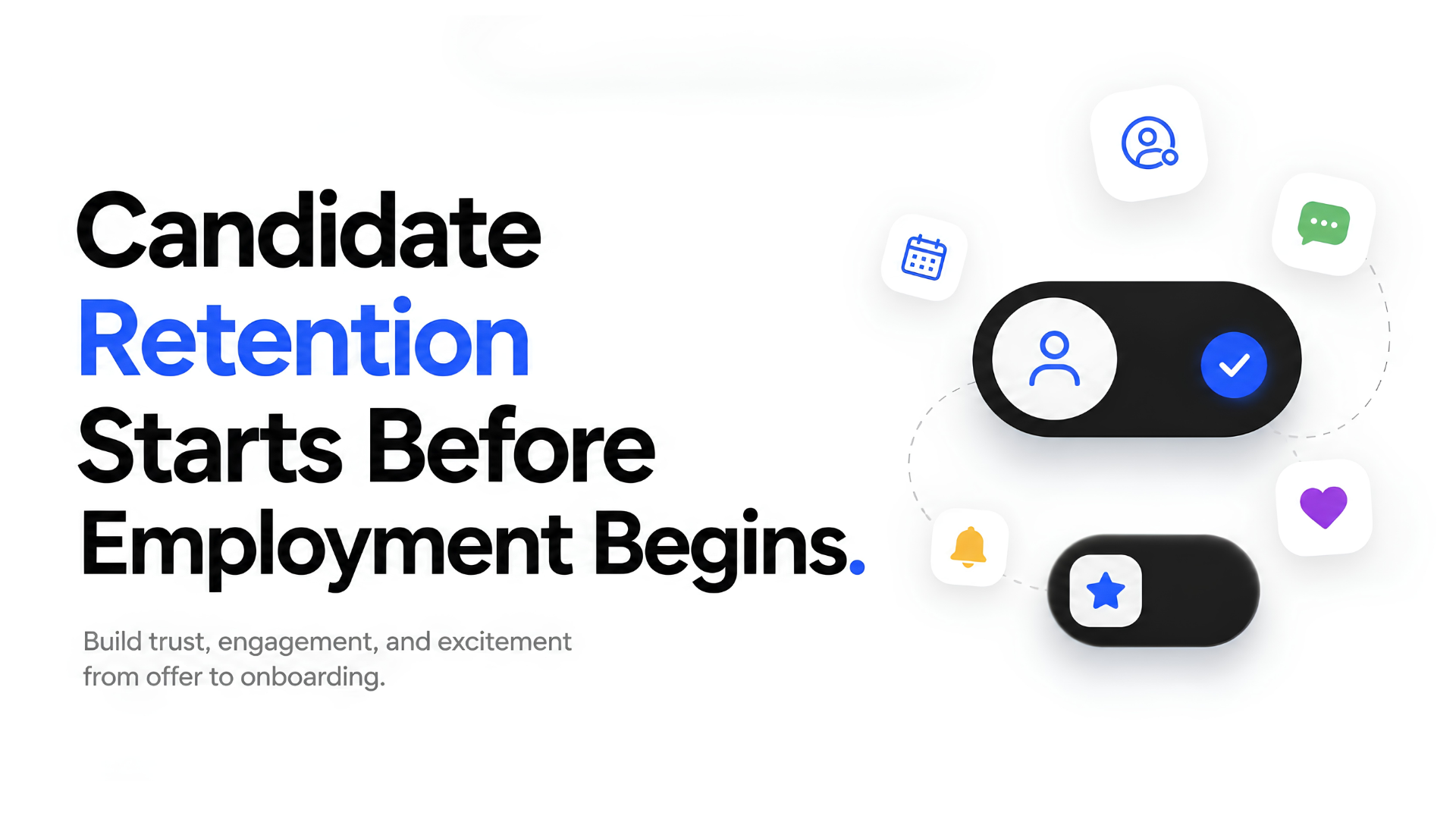
The organizations that will lead in talent retention over the next decade are not the ones that build the best onboarding programs or the most generous benefits packages. They are the ones that recognize that the employee's commitment to the organization begins forming the moment they accept the offer, and that the quality of the pre-employment experience is the single most controllable predictor of whether that commitment deepens or erodes. With the right process and the right technology, every organization can make candidate retention start before employment begins, and every hire can arrive on day one already committed to staying.