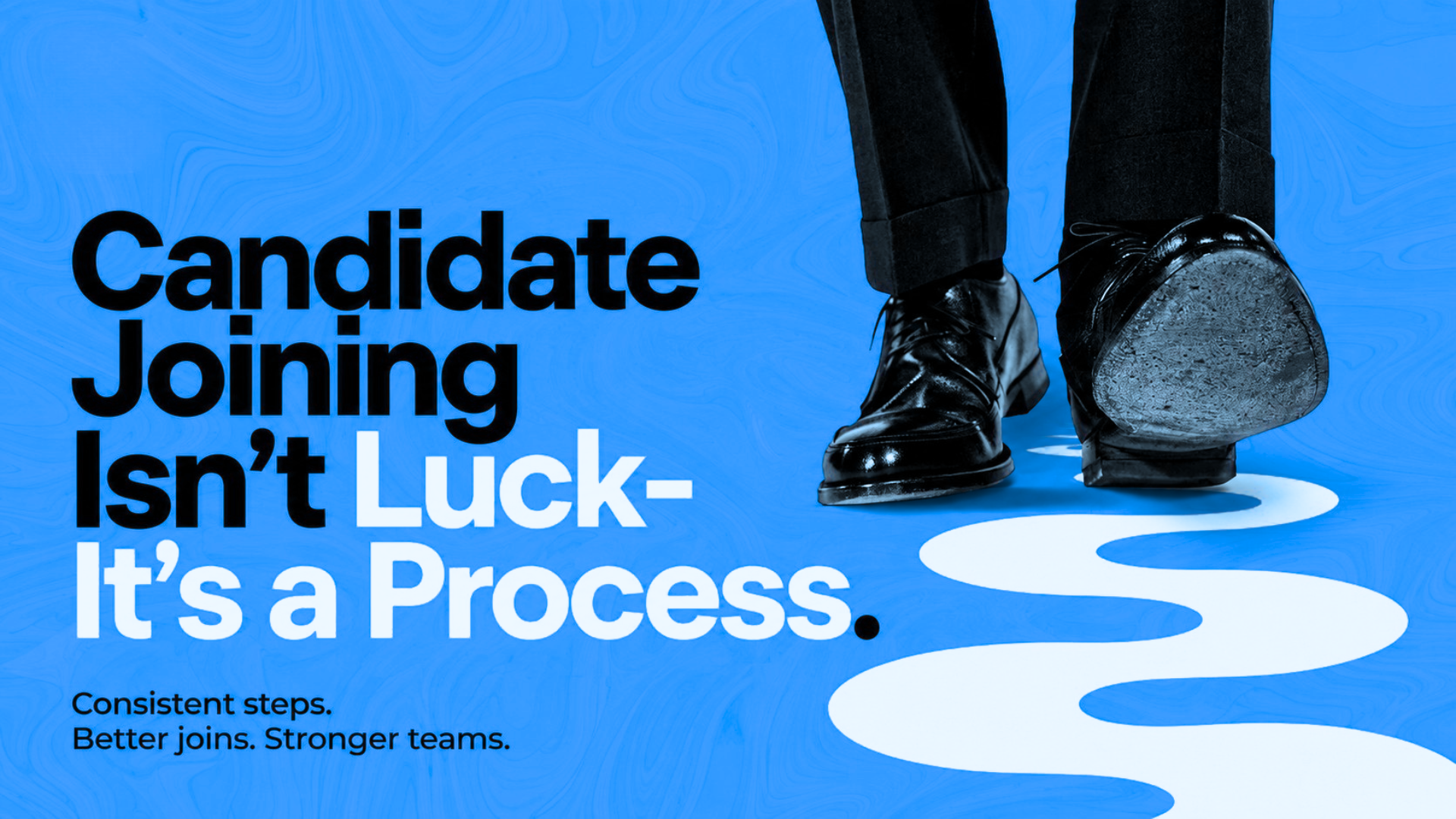
The recruiter closes the requisition. The hiring manager celebrates. The team plans the welcome lunch. Two weeks later, the candidate ghosts. No response to emails, no answer to calls, and a terse message arrives on what should have been day one: they decided to stay with their current employer. This scenario is so common in enterprise recruiting that most teams have accepted it as an unavoidable cost of doing business. It is not. It is the predictable outcome of a hiring process that ends at offer acceptance instead of at day-one arrival, and it is solvable with the same rigor that organizations apply to any other business process.
The gap between offer acceptance and actual joining is the most underinvested phase of the recruiting funnel. Organizations pour resources into sourcing, screening, interviewing, and negotiating, then effectively abandon the candidate the moment they sign. According to SHRM’s talent acquisition research, the average enterprise loses between ten and twenty percent of accepted candidates before their start date, yet fewer than fifteen percent of recruiting teams have a formal, documented process for managing the acceptance-to-joining transition. This is not a talent problem or a market problem. It is a process problem. And process problems yield to process solutions.
Why ‘Luck’ Became the Default Explanation
When a candidate joins successfully, most teams credit the strength of their employer brand or the appeal of the role. When a candidate drops out, they blame market conditions, counter-offers, or the candidate’s personal circumstances. Neither explanation is accurate. The real variable is not luck or market forces but the quality and consistency of the process that bridges acceptance and joining. Teams that attribute joining outcomes to luck do so because they lack visibility into what actually happens during this phase. They cannot measure it, they cannot improve it, and they cannot predict it. As we have discussed in our analysis of why
more tools produce the same hiring problems, adding more sourcing or screening tools does nothing to fix a broken acceptance-to-joining process. The problem is not a lack of tools but a lack of a defined, owned, and measured workflow for the most critical transition in the hiring funnel.
The luck narrative also serves an organizational function: it protects people from accountability. If joining is a matter of luck, then no one is responsible when a candidate drops out. The recruiter can blame the market. The hiring manager can blame the recruiter. HR can blame the compensation team. This diffusion of responsibility is possible because no single function owns the acceptance-to-joining phase. Sourcing ends at application. Screening ends at shortlist. Interviewing ends at selection. Offer management ends at acceptance. But joining requires all of these functions to coordinate in a way that none of them are structured to do. The result is a gap, and candidates fall through it. An automated hiring platform that provides a single, unified workflow across this entire transition is the first step toward making joining a repeatable, measurable outcome rather than a hopeful waiting game.
The Seven Stages of a Reliable Joining Process
A reliable joining process is not a single action but a sequence of seven distinct stages, each with its own objectives, stakeholders, and failure modes. The first stage is offer delivery and acceptance, which must be fast, clear, and celebratory. The candidate should receive the offer within hours of the hiring decision, with a clear summary of compensation, benefits, and start date, and with a personal expression of enthusiasm from the hiring manager. The second stage is the immediate post-acceptance window, the first five days, where the candidate’s emotional commitment is most volatile and most receptive to reinforcement. Understanding how many follow-ups one hire actually needs, and front-loading the highest-impact touchpoints in this window, is the foundation of a high-converting joining process.
The third stage is the notice period, two to four weeks where the candidate is still employed elsewhere and most vulnerable to counter-offers and retention packages. During this period, the new employer must maintain a steady cadence of meaningful communication that reinforces the candidate’s decision without being intrusive. The fourth stage is pre-boarding logistics, the administrative and practical preparation that transforms an abstract acceptance into a concrete plan. This includes benefits enrollment, IT provisioning, access credentials, and first-day scheduling. The fifth stage is the final-week ramp, where communication intensity increases and the candidate receives a detailed agenda, a personal call from their onboarding buddy, and reassurance from the hiring manager.
The sixth stage is day-one execution, where all the preparation pays off in a seamless arrival experience. The seventh stage, often overlooked, is the joining confirmation, a formal acknowledgment that the candidate has arrived, is settled, and is no longer at risk of withdrawal. Each of these stages requires specific actions from specific stakeholders, and the reliability of the overall process depends on the reliability of each individual stage. This is why recruiter workflow automation is so important: it ensures that every stage is executed on time, every
stakeholder is prompted to act, and no candidate falls through the cracks between stages, regardless of how many are in the pipeline simultaneously.
Designing the Workflow: Ownership, Triggers, and Escalation
A joining process that exists only in a recruiter’s head or in a shared spreadsheet is not a process. It is a hope. A real process has three components: ownership, triggers, and escalation. Ownership means that a single person or system is accountable for each stage of the joining journey. In enterprise organizations, this rarely means one person doing everything. It means the recruiter owns the overall orchestration, the hiring manager owns the relationship touchpoints, the HR operations team owns the logistics, and an onboarding buddy owns the peer connection. But someone, typically the recruiter, owns the process itself and is accountable for ensuring that every stage is completed for every candidate. As we have explored in our analysis of the difference between AI sourcing and AI recruiting, the recruiting phase is where orchestration across multiple stakeholders matters most, because the joining process requires coordination that no single function can provide alone.
Triggers are the events that initiate each stage of the process. An offer acceptance triggers the five-day kickoff. The end of the five-day kickoff triggers the notice-period cadence. The start of the final week triggers the ramp sequence. A missed response from the candidate triggers a risk check. A declining engagement score triggers an escalation. Each trigger must be automated, because manual trigger management does not scale. When triggers are automated through a recruitment workflow platform, the process runs itself, and the recruiter’s role shifts from executing tasks to managing exceptions. Escalation is the third component, and it defines what happens when a candidate shows signs of disengagement or when a trigger is missed. A three-level escalation model, from recruiter to hiring manager to senior leader, ensures that at-risk candidates receive the right intervention from the right person at the right time. Without escalation, risks go unnoticed until they become withdrawals.
The Data Layer: Measuring What Most Teams Ignore
You cannot improve what you do not measure, and most recruiting teams do not measure the acceptance-to-joining phase at all. They track time-to-fill and cost-per-hire, both of which measure the process up to offer acceptance. They track quality-of-hire and retention, both of which measure the process after joining. But the phase in between, the phase where ten to twenty percent of accepted candidates are lost, is a measurement vacuum. According to Gartner’s HR trends analysis, fewer than one in five enterprise recruiting teams tracks acceptance-to-joining conversion as a formal metric. This means they cannot diagnose where drop-offs occur, why they occur, or whether their interventions are working.
The minimum viable data layer for a joining process includes four metrics. First, acceptance-to-joining conversion rate, the overall percentage of accepted candidates who actually arrive on day one. Second, stage-by-stage conversion, which shows where in the seven-stage process candidates are dropping out. Third, time-to-engagement, which measures how
quickly each post-acceptance touchpoint is delivered. Fourth, candidate engagement score, a composite measure of response times, response quality, and interaction frequency that serves as an early warning indicator for potential drop-offs. When these metrics are tracked through hiring software for enterprises that provides real-time dashboards and trend analysis, the recruiting team gains the visibility it needs to identify problems, test solutions, and continuously improve. This is the data infrastructure that transforms joining from a hopeful outcome into a managed process.
Automating Without Losing the Human Touch
The most common objection to systematizing the joining process is that automation will make the experience feel impersonal. This objection misunderstands what automation does. Automation does not replace human interaction. It replaces the logistical coordination that prevents human interaction from happening consistently. When a recruiter is managing thirty active requisitions and dozens of candidates in various stages of the joining process, they do not have time to personally manage every touchpoint for every candidate. The result is that some candidates receive excellent, high-touch service while others receive nothing. Automation ensures that every candidate receives the right touchpoints at the right time, and it frees the recruiter to invest their personal attention where it matters most: the at-risk candidates who need a human conversation, not an automated email. According to LinkedIn’s recruiting research, candidates who receive a mix of automated logistics and personal touchpoints rate their experience higher than those who receive only personal outreach, because the automated logistics demonstrate organizational competence while the personal touchpoints demonstrate individual care.
The key is to automate the what and the when, while preserving the who and the why. Automate the scheduling of the five-day kickoff sequence. Automate the weekly notice-period cadence. Automate the risk detection and escalation triggers. But keep the hiring manager’s personal welcome message as a genuine, individually written communication. Keep the onboarding buddy’s call as a real conversation, not a script. And keep the recruiter’s check-in calls focused on listening to the candidate’s concerns, not reading from a checklist. This balance between automated orchestration and human interaction is what hiring workflow automation does best: it handles the logistics so that humans can handle the relationships. And it is what separates the platforms that deliver real outcomes from those that merely add another notification to the candidate’s inbox. This is also why the question of outdated candidate data in AI recruiting tools, matters so much: automated personalization is only as good as the data it is based on, and stale data produces generic, tone-deaf communications that undermine the very relationship they are meant to strengthen.
Scaling the Process Across the Enterprise
A joining process that works for one team or one recruiter is not a scalable process. Scalability requires three things: standardization, adaptability, and technology. Standardization means that every candidate, regardless of role, level, or location, goes
through the same seven-stage process with the same quality bar. This does not mean every candidate receives identical communications. It means every candidate receives communications that are personalized within a consistent framework. Adaptability means that the process can be calibrated for different candidate segments. A senior executive relocating from another city needs a different pre-boarding experience than a junior hire who lives locally. A candidate in a high-demand role needs more touchpoints and more competitive reassurance than a candidate in a role with less market competition. As McKinsey’s people organization research, notes, the organizations that scale hiring processes most effectively are the ones that build a core process with configurable parameters, not a rigid one-size-fits-all procedure.
Technology is the enabler that makes both standardization and adaptability possible at enterprise scale. An automated hiring platform that manages the entire acceptance-to-joining workflow, from trigger to escalation to measurement, across hundreds of simultaneous candidates, is not a nice-to-have. It is the only way to deliver a consistent, high-quality joining experience when the volume and complexity of enterprise hiring make manual coordination impossible. The platform must integrate with the organization’s existing HR systems, support multiple communication channels, and provide the real-time visibility that recruiting leaders need to manage performance across teams, regions, and business units. Without this technology foundation, the joining process will always be constrained by the capacity of the individuals who execute it, and it will break down precisely when it is needed most, during periods of high hiring volume.
Why Huntlo.ai Turns Joining into a Reliable Outcome
Huntlo.ai provides the complete joining process platform that enterprise recruiting teams need. The system automates the seven-stage acceptance-to-joining workflow, from offer delivery through day-one confirmation, with personalized engagement sequences, real-time risk detection, and intelligent escalation routing. Every candidate receives a consistent, high-quality experience that combines automated logistics with strategic human touchpoints. The platform’s AI engine monitors engagement signals, predicts which candidates are at risk, and prompts the appropriate intervener before a withdrawal occurs. When evaluating an AI recruiting tool before buying, the ability to demonstrate a complete, measurable joining process with stage-by-stage conversion tracking is the single most important differentiator, because it is the capability that most directly impacts the metric recruiting leaders care about most: how many accepted candidates actually show up.
For recruiting teams that are ready to stop relying on luck and start relying on process, Huntlo provides the workflow, the intelligence, and the scale to make joining a reliable, repeatable outcome. One where referrals outperform cold outreach, not because of the referral itself, but because every candidate, regardless of source, is guided through the same systematic journey from acceptance to arrival. And one where an agentic AI recruiting platform manages the complexity so that recruiters can focus on what they do best: building relationships with candidates and helping them make one of the most important decisions of their career.