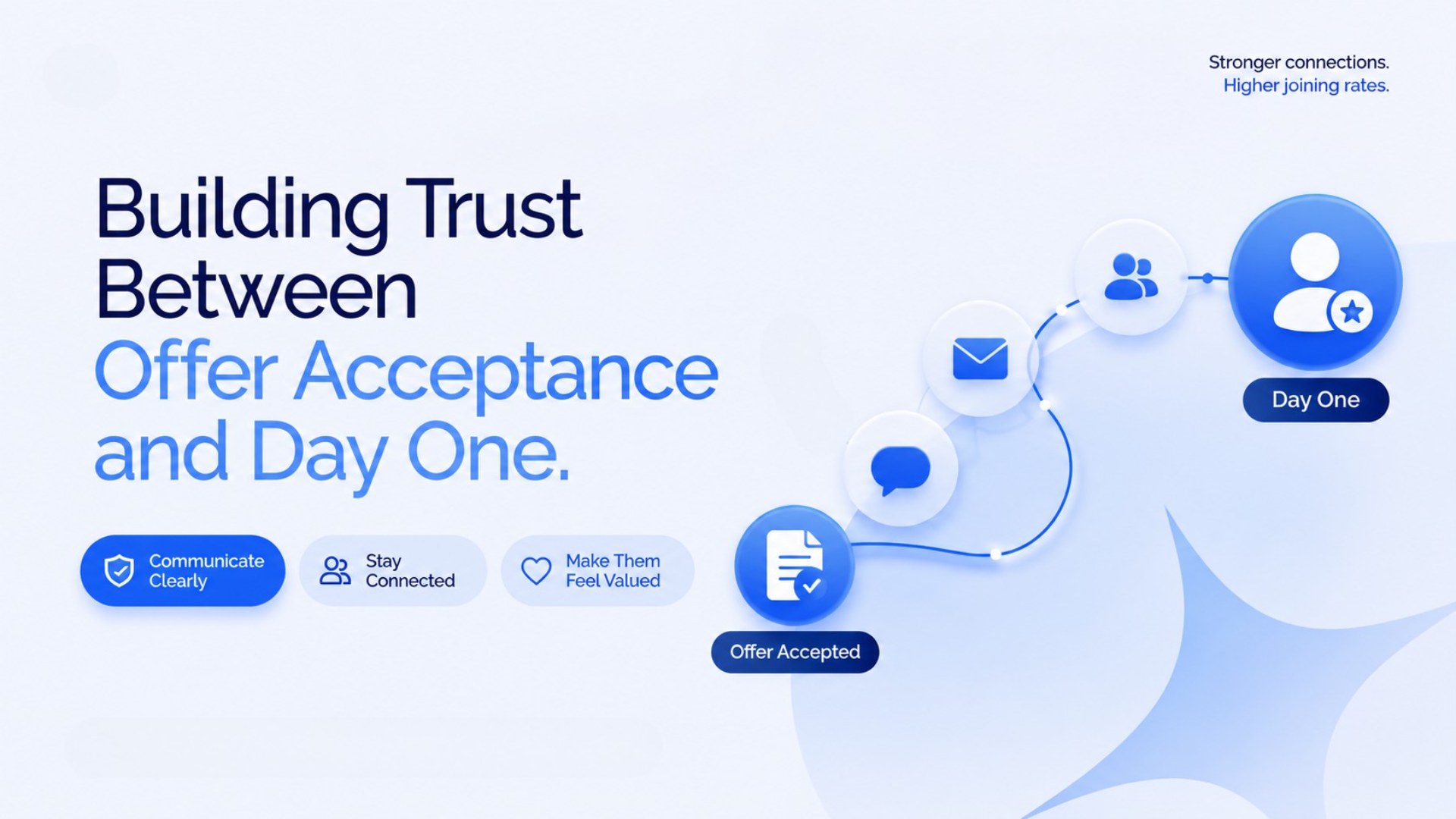
Trust is not a static asset. It is a living thing that grows with consistent positive experience and shrinks with neglect. When a candidate signs your offer letter, they trust your organization enough to upend their professional life. But that trust is provisional, conditional on the experience they have between the moment they sign and the moment they walk through your door. Every interaction during this period either deepens that trust or chips away at it. A hiring manager who calls personally to welcome the candidate deepens trust. A recruiter who takes three days to answer a question about benefits chips away at it. A detailed first-week agenda deepens trust. A vague email about "orientation details to follow" chips away at it. The cumulative effect of these micro-experiences determines whether the candidate arrives on day one feeling confident and excited, or anxious and wondering whether they made a mistake.
The recruiting industry talks extensively about building trust during the interview process. Candidate experience surveys, employer branding initiatives, and interview training programs all focus on creating a positive impression that leads to offer acceptance. But the trust built during the interview process is fragile. It is based on a limited set of interactions, a handful of interviews, a few campus visits, and some email exchanges. The candidate has not yet experienced the organization as an employee. They have not sat in the meetings, navigated the internal tools, or dealt with the bureaucratic realities that define day-to-day life at any company. Their trust is based on a promise, not on experience. The period between offer acceptance and day one is when that promise is either validated or violated, and the outcome has a direct, measurable impact on whether the candidate shows up. According to SHRM’s talent
acquisition research, candidates who report a high level of trust in their new employer at the end of the notice period are four times more likely to start the role and twice as likely to still be employed twelve months later. Effective candidate trust building during this phase is not a nice-to-have. It is a business imperative with quantifiable financial consequences.
The Trust Gap: Why Candidates Lose Confidence After Signing
There is a specific, predictable pattern to the erosion of candidate trust after offer acceptance, and it follows from the sudden change in communication dynamics that occurs the moment the offer is signed. During the interview process, the candidate is the center of attention. The recruiter is responsive, the hiring manager is engaged, and every interaction communicates that the organization values the candidate and wants them to join. Then the offer is signed, and the dynamics shift. The recruiter moves to the next requisition. The hiring manager returns to their operational responsibilities. The candidate, who was the most important person in the room, becomes one of many pending onboarding tasks. This shift is not malicious. It is structural. The recruiting process is designed to produce an accepted offer, and once that outcome is achieved, the system redeploys its resources elsewhere. But the candidate does not experience the shift as structural. They experience it as personal. They experience it as a reduction in the organization's interest in them, and that experience erodes trust. This is the recruiting trust gap: the systematic, organization-wide tendency to reduce engagement with the candidate the moment the offer is signed, creating a mismatch between the candidate's expectation of continued attention and the organization's actual behavior. Research from McKinsey’s people organization insights shows that the trust gap is the single strongest predictor of post-acceptance withdrawal, stronger than compensation, stronger than the counteroffer, and stronger than the candidate's satisfaction with the interview process itself. The trust gap does not just affect whether the candidate starts. It affects how they start: candidates who experience the trust gap report lower satisfaction, slower time to productivity, and higher early attrition, even when they do show up on day one.
The trust gap is compounded by the asymmetry of information during the notice period. The candidate is about to make one of the most significant decisions of their career. They need information about the role, the team, the culture, and the practicalities of the transition. But the organization that is best positioned to provide that information has gone silent. The candidate's current employer, by contrast, is highly motivated to provide information, reassurance, and incentives to stay. The result is an information environment that is heavily skewed toward the candidate's current employer. Every question the candidate asks their new employer goes unanswered for days. Every question they ask their current employer is answered immediately, often in person, with warmth and urgency. Over the course of a two-week notice period, this information asymmetry systematically undermines the candidate's trust in the new organization and strengthens their attachment to the old one. Closing this information gap is the first and most important step in pre-start trust development.
The Four Pillars of Post-Acceptance Trust
Trust during the post-acceptance phase is built on four pillars, each of which addresses a specific dimension of the candidate's need for confidence and security. The first pillar is responsiveness. Trust begins with the simple experience of being heard. When a candidate sends a question and receives a thoughtful response within a few hours, they feel respected and valued. When the same question goes unanswered for three days, they feel ignored. Responsiveness is the most fundamental trust signal because it communicates, at the most basic level, that the candidate matters to the organization. It is not about having every answer immediately. It is about acknowledging the question quickly and providing a timeline for the answer: "Great question about the remote work policy. Let me confirm the details with the hiring manager and get back to you by end of day Thursday." This type of response takes two minutes to write but communicates deep respect for the candidate's concern. The second pillar is consistency. Trust grows when the candidate's experience matches the promises made during the interview process. If the hiring manager said during the interview that the team works a hybrid schedule with two days in the office, and the candidate later receives an onboarding email saying the team is fully remote, trust is damaged. If the recruiter said the role reports to the VP of Engineering, and the candidate later learns it reports to a Director, trust is shattered. Consistency means that every piece of information the candidate receives after signing aligns with what they were told before signing. When inconsistencies arise, and they will, the recruiter's ability to acknowledge and resolve them quickly is itself a trust signal. According to LinkedIn’s recruiting resources, candidates who experience consistency between the interview promises and the post-acceptance communication report forty percent higher trust in their new employer than those who encounter inconsistencies that are not proactively addressed.
The third pillar is transparency. Candidates do not need everything to be perfect. They need to know what is happening, even when the news is not ideal. If the background check is taking longer than expected, tell the candidate. If the laptop provisioning is delayed, tell the candidate. If the hiring manager is traveling and cannot schedule the welcome call until next week, tell the candidate. Transparency communicates respect for the candidate's autonomy and intelligence. It also prevents the candidate from filling information vacuums with worst-case assumptions, which is exactly what they will do if left in silence. The fourth pillar is personalization. A candidate who receives a generic "welcome to the team" email feels processed. A candidate who receives a message that references their specific interests, concerns, and the conversations they had during the interview feels known. Personalization communicates that the organization sees the candidate as an individual, not as a headcount. This is the essence of candidate relationship continuity: maintaining the same quality of individualized attention that characterized the interview process throughout the post-acceptance phase. As we have explored in our analysis of how many follow-ups one hire actually needs, the number and quality of personalized touchpoints during the notice period directly correlate with the candidate's trust level at the start date.
Trust-Building Actions for Every Week of the Notice Period
Trust is built through specific, repeatable actions that can be planned and executed systematically. The following framework organizes these actions by week, though the timeline should be adapted to the length of the candidate's notice period. Week one, the foundation week. The objective is to establish the communication rhythm and demonstrate immediate responsiveness. Day one after signing: the recruiter sends a personalized welcome email that references specific details from the interviews and outlines what the candidate can expect in the coming weeks. Day two: the hiring manager sends a personal message expressing excitement and sharing one concrete detail about an upcoming project or initiative the candidate will be involved in. Day three: the recruiter schedules a brief call to answer any immediate questions and conduct the risk assessment. Day four or five: the candidate receives a detailed timeline of the pre-boarding process, including key dates, action items, and points of contact. These post-acceptance trust signals are not elaborate. But their timing and specificity communicate that the organization is organized, prepared, and genuinely invested in the candidate's arrival.
Week two, the deepening week. The objective is to move beyond logistical communication and build a personal connection between the candidate and their future team. The recruiter facilitates an introduction to the candidate's onboarding buddy, a peer-level teammate who can answer informal questions and provide social context. The hiring manager shares something meaningful about the team's work, a recent win, an upcoming challenge, or an interesting problem the team is solving. The candidate is invited, if logistics allow, to a team event, a happy hour, a lunch, or a virtual social, so they can begin forming social connections before their start date. The recruiter checks in with a question that demonstrates they remember the candidate's individual concerns: "I remember you mentioned being curious about how the team handles code reviews. I asked the hiring manager and they said they'd be happy to walk you through it. Want me to set up a quick call?" This type of touchpoint is far more trust-building than a generic "how are you?" because it demonstrates that the organization is paying attention to the candidate as an individual. Week three and beyond, the confidence week. The objective is to solidify the candidate's decision by providing clarity and reducing anxiety about the transition. The onboarding team provides the first-day agenda, parking instructions, dress code guidance, and any other practical details the candidate needs. The recruiter conducts a pre-boarding check-in to ensure all administrative items are on track and to address any last-minute concerns. The hiring manager sends a brief message expressing anticipation: "Really looking forward to having you on the team next Monday. We've got a great first week planned for you." These final touchpoints should communicate warmth, competence, and readiness. According to Gartner’s HR trends analysis, candidates who receive a structured, multi-week trust-building sequence during the notice period have a joining rate that is twenty-five to thirty-five percentage points higher than candidates who receive ad hoc or no communication.
The Role of the Hiring Manager in Building Trust
The hiring manager is the single most important trust-building resource available to the recruiting team, and they are also the most underutilized. There is a simple reason for this:
hiring managers are busy, and post-acceptance engagement does not feel like their job. They interviewed the candidate, approved the offer, and now they are waiting for the new hire to arrive so they can get back to their actual work. But from the candidate's perspective, the hiring manager is the most credible voice in the organization. The recruiter is a professional relationship builder whose enthusiasm is part of the job. The hiring manager is a senior leader who will be the candidate's direct supervisor, and whose interest in the candidate carries far more weight. The hiring manager does not need to invest hours in post-acceptance engagement to make a significant impact on trust. Three brief, well-timed touchpoints are sufficient. First, a personal message within forty-eight hours of the offer being signed that expresses genuine excitement and references something specific from the interviews. Second, one brief call or video conversation during the notice period to discuss the candidate's priorities for the first ninety days and to answer any role-specific questions the candidate may have. Third, a final message in the last few days before the start date that communicates anticipation and readiness. These three touchpoints, which together represent perhaps thirty to forty-five minutes of the hiring manager's time, have an outsized impact on the candidate's trust level. Research from Deloitte’s talent research shows that candidates who have direct contact with their hiring manager during the notice period are forty-five percent more likely to start the role with high confidence, and that confidence persists through the first ninety days of employment.
The challenge is that most recruiters do not ask the hiring manager to make these touchpoints, and most hiring managers do not volunteer. This is where the recruiting team's ability to manage upward becomes critical. The recruiter needs to frame the hiring manager's involvement not as an additional task but as a high-ROI investment in the hiring outcome. The data is compelling: a forty-five percent increase in the candidate's confidence level for thirty to forty-five minutes of the hiring manager's time. When the hiring manager understands the return on this investment, most are willing to participate. The recruiter's job is to make it as easy as possible by providing the talking points, scheduling the calls, and following up to ensure the touchpoints happen. This kind of candidate relationship continuity requires the recruiter to think of themselves as the orchestrator of a multi-stakeholder experience, not just the executor of a one-on-one communication cadence. As we have discussed in our analysis of the difference between AI sourcing and AI recruiting, recruiting at its best is about managing relationships across multiple stakeholders, and the post-acceptance phase is where this capability matters most.
How AI Sustains Trust When Human Attention Is Limited
For recruiting teams that manage multiple simultaneous hires, maintaining the level of personalized, responsive, consistent communication that builds trust is not possible through manual effort alone. AI bridges the gap by handling the structural elements of trust-building, communication scheduling, response time monitoring, and consistency checking, while preserving the human touch for the interactions that matter most. The AI system ensures that every candidate receives a response to every question within a defined timeframe, preventing
the silence that erodes trust. It monitors the consistency of information across all touchpoints, flagging any contradiction between what was said during the interview and what is communicated during the notice period. It personalizes communication by drawing on the candidate's individual profile, motivations, and concerns, so every message feels relevant rather than generic. Most importantly, the AI maintains continuity even when the humans involved are busy. A candidate who asks a question on Friday afternoon does not have to wait until Monday for an answer because the recruiter is offline. The AI provides an immediate acknowledgment and either answers the question from its knowledge base or escalates it to the appropriate human with the context needed for a fast, accurate response. This is what distinguishes an agentic AI recruiting platform from a simple automation tool: the ability to reason about the candidate's needs and respond appropriately even when no human is available. As we have discussed in our analysis of why more tools produce the same hiring problems, the organizations that build the most trust are not the ones with the most technology but the ones that use technology to ensure that no candidate ever feels ignored, even for a moment.
Why Huntlo.ai Builds Trust That Converts Acceptances into Arrivals
Huntlo.ai provides the complete trust-building infrastructure that recruiting teams need to maintain and deepen candidate trust throughout the post-acceptance phase. The platform captures every candidate's individual context from the interview process and uses that intelligence to drive personalized, consistent, and responsive communication across the entire notice period. It monitors response times and alerts recruiters when a candidate's question has gone unanswered for too long. It coordinates multi-stakeholder engagement, ensuring that the hiring manager, the onboarding buddy, and the future teammates all contribute to the candidate's trust-building journey at the right time and with the right message. Huntlo ensures that outdated candidate data in AI recruiting tools never undermines trust, because every interaction is based on fresh, accurate intelligence about the candidate's current state, concerns, and communication history.
For recruiting teams that understand that trust is the currency of successful hiring, Huntlo provides the technology to build it systematically and at scale. The platform makes it easy to see which candidates are receiving the trust-building experience they need and which ones are at risk of disengagement. It ensures that why referrals outperform cold outreach is understood as a trust advantage: referred candidates arrive with pre-existing trust that non-referred candidates lack, and Huntlo closes that gap by giving every candidate a trust-building experience that matches or exceeds what a referral provides. And for organizations evaluating their technology options, understanding how to evaluate an AI sourcing tool before buying, means asking whether the platform actively builds candidate trust during the post-acceptance phase, or whether it leaves the most vulnerable period of the hiring journey unmanaged.
Trust is built in drops and lost in buckets. Every responsive message, every personal touchpoint, and every proactive communication adds a drop. Every silence, every inconsistency, and every unanswered question drains a bucket. The organizations that win the talent competition are not the ones with the highest salaries or the most prestigious brands. They are the
ones that never stop building trust, from the first outreach message to the first day of work and beyond.