Sarah Chen had spent four years building her AI recruiting startup into a market leader. Her platform used large language models to source and screen candidates, and early adoption was explosive. Within eighteen months, she had signed two hundred staffing firms and three Fortune five hundred enterprise clients. Revenue was growing ninety percent year over year. Then the floor collapsed. Three well-funded competitors launched products with nearly identical features within six months of each other. Her differentiators, smarter parsing, faster matching, and a cleaner interface, were replicated within a single product cycle by teams with deeper pockets and larger engineering staffs. Client churn, which had been below five percent annually, spiked to twenty-two percent in one quarter as prospects compared her platform against four alternatives that all claimed to do the same thing. Sarah realized that her technology was a feature, not a moat. The models she used were available to everyone, the data she trained on was accessible through public sources, and the workflows she automated were standard across the industry. She had built a fast-growing business on top of a foundation that had no structural defensibility. The question that kept her up at night was not how to add more features. It was how to build something her competitors could not copy, something that would make her platform irreplaceable regardless of how many well-funded rivals entered the market.
Why Algorithm Quality Is Not a Moat
The most common mistake founders and investors make when evaluating AI recruiting companies is treating algorithm quality as a durable competitive advantage. A platform that matches candidates to jobs with ninety-two percent accuracy versus eighty-five percent accuracy appears to have a meaningful technical lead, but this lead is almost always temporary. The reason is structural: the AI models powering recruiting platforms are increasingly commoditized. Foundation models from major providers are available through APIs, and the techniques for fine-tuning them on recruiting-specific data, such as resume parsing, job description understanding, and candidate-job matching, are well-documented in academic literature and open-source repositories. Any well-resourced team can replicate a matching algorithm within months, and the marginal improvement from additional tuning diminishes rapidly after a certain threshold. The difference between a good matching algorithm and a great one is measured in single-digit percentage points, a gap that most clients cannot perceive in practice and that does not justify a significant price premium. This commoditization dynamic means that algorithmic superiority, while valuable for initial market entry and early adoption, does not provide the structural defensibility that a long-term moat requires.
The evidence for this commoditization is visible across the AI recruiting landscape. In the last two years, at least a dozen AI sourcing tools have launched with nearly identical feature sets: semantic search across resume databases, AI-generated outreach messages, candidate ranking based on job fit, and pipeline analytics dashboards. The products look the same, they pitch the same benefits, and they deliver similar results because they are built on the same underlying technology stack. The differentiation that exists is primarily in go-to-market strategy, user experience design, and client relationships, not in the core AI capabilities. This pattern is not unique to recruiting. It is the standard trajectory of AI-native markets: early movers build products on top of foundation models, establish initial differentiation through superior engineering, and then watch that differentiation erode as the models improve and the techniques diffuse. According to McKinsey, more than seventy percent of AI startups that relied primarily on algorithmic differentiation experienced significant competitive pressure within three years of launch as larger competitors or well-funded new entrants replicated their core capabilities, because the barriers to replicating an AI algorithm are far lower than the barriers to replicating the structural advantages that surround it.
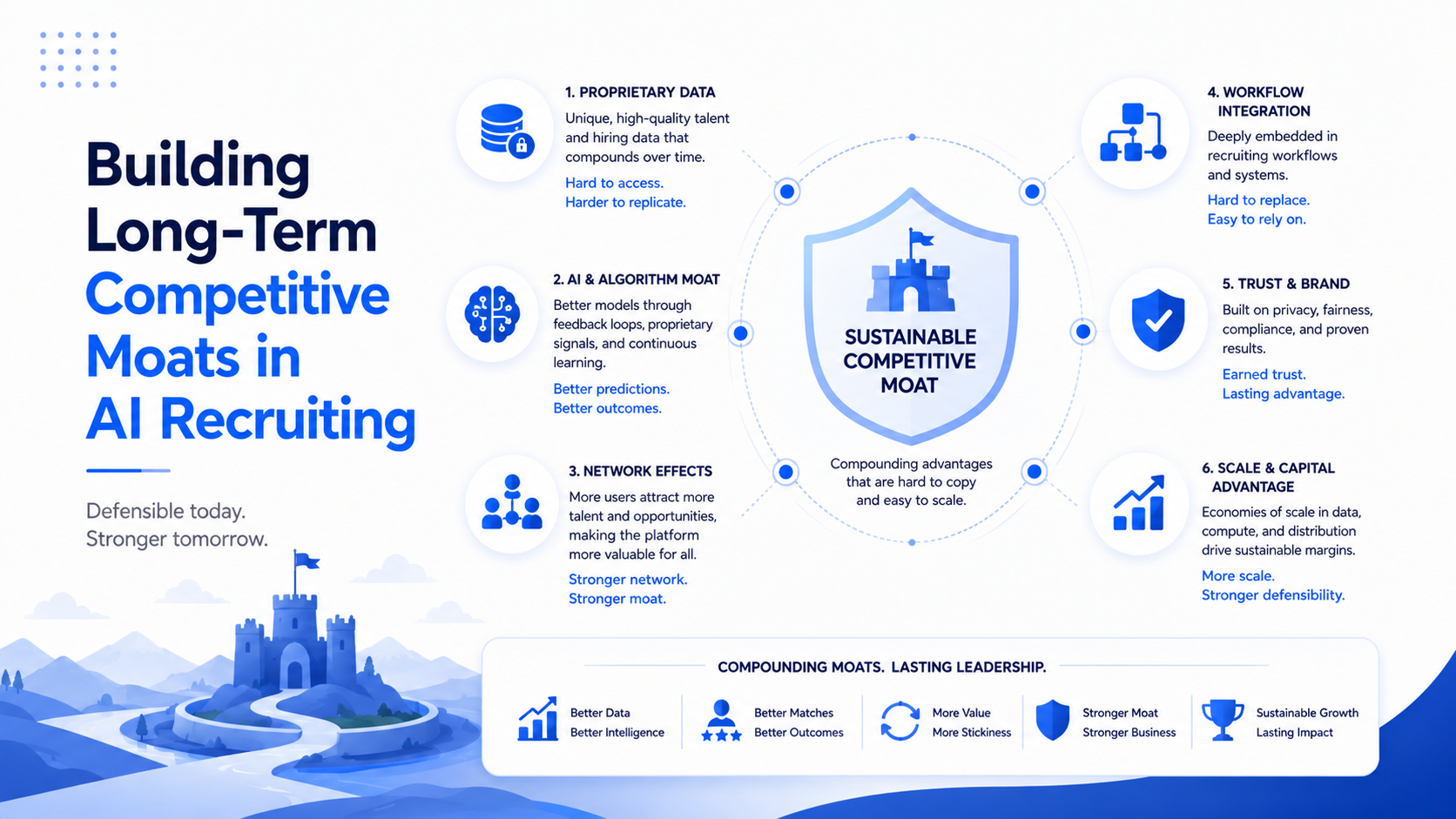
This does not mean that algorithm quality is irrelevant. It matters enormously for product-market fit, user experience, and initial traction. But it is a necessary condition, not a sufficient one, for building a defensible business. The platforms that will dominate AI recruiting over the next decade are those that treat algorithmic excellence as a baseline requirement and build their competitive strategy on top of structural moats that are far more difficult to replicate. These structural moats, proprietary data assets, network effects, high switching costs, embedded workflows, regulatory advantages, and concentrated talent, are the real determinants of long-term competitive position. A platform with a good algorithm and strong data flywheel will outperform a platform with a great algorithm and no structural advantages over time, because the data flywheel improves the algorithm faster than engineering alone can. Understanding these structural moats, how they form, how they compound, and how they
protect against commoditization, is essential for anyone building, investing in, or buying AI recruiting technology. agentic AI platforms vs automated ones illustrates why the architecture of the platform, specifically whether it operates autonomously or requires human direction, determines how quickly the data flywheel can spin and how defensible the resulting advantage becomes.
The Proprietary Data Flywheel
The single most powerful moat in AI recruiting is the proprietary data flywheel. A data flywheel exists when a platform's usage generates unique data that improves the platform's performance, which attracts more usage, which generates more unique data, creating a self-reinforcing cycle that accelerates over time. In AI recruiting, this flywheel operates through several mechanisms. Every candidate interaction, whether a screening conversation, an outreach response, a profile update, or a hiring outcome, generates data about what works and what does not. A platform that has processed ten million candidate interactions has a fundamentally different understanding of recruiting patterns than a platform that has processed one hundred thousand, even if both use the same underlying model. The data is not just bigger. It is different, because it captures the specific, granular patterns of candidate behavior, client preferences, and hiring outcomes that only emerge at scale and that are impossible to purchase or replicate from external sources.
The data flywheel creates a compounding advantage that is extremely difficult for competitors to match. A new entrant can download the same foundation model and implement the same fine-tuning techniques, but they cannot download ten million historical candidate interactions with their associated hiring outcomes. They must generate this data organically, which requires time, clients, and volume. The existing platform's data advantage grows every day as more clients use the platform, more candidates are processed, and more outcomes are recorded. This creates a widening gap between the incumbent and new entrants that is not about engineering talent or capital but about accumulated, proprietary experience encoded in data. The flywheel effect also means that the platform's improvement rate accelerates over time, because each incremental unit of data improves the model, which improves outcomes, which attracts more clients, which generates more data. According to Gartner, AI platforms with mature data flywheels improve their prediction accuracy by fifteen to twenty percent annually through organic data accumulation alone, even without significant algorithmic changes, because the volume and diversity of proprietary training data enables continuous model refinement that external datasets cannot provide.
The defensibility of the data flywheel depends on data exclusivity. If the data a platform generates is accessible to competitors through public sources, APIs, or data brokers, the flywheel advantage is weakened. The strongest data flywheels are built on interaction data that is generated exclusively through the platform's own operations. Screening conversation transcripts, candidate engagement patterns, client-specific hiring preferences, and feedback loops between candidate quality and hiring outcomes are all examples of data that is unique to the
platform that generates it. This is why platforms that manage the end-to-end recruiting process, from sourcing through screening to engagement, have stronger data flywheels than platforms that perform only a single step. A sourcing-only platform generates data about candidate identification but not about screening outcomes or hiring success, which limits the flywheel's completeness and its ability to improve the full recruiting workflow. why AI tools have outdated candidate data demonstrates why platforms that rely on static, purchased data rather than organically generated interaction data cannot build effective data flywheels, because their training data becomes stale and their models cannot improve from the continuous feedback loop that only live platform interactions provide. SHRM reports that recruiting platforms with proprietary interaction datasets outperform those relying on third-party data by twenty to thirty percent in placement accuracy, because the proprietary data captures the real-time signals, such as candidate responsiveness, engagement quality, and screening conversation depth, that predict hiring success more reliably than static resume data alone.
Network Effects and Marketplace Dynamics
Network effects exist when the value of a platform to each user increases as more users join. In AI recruiting, network effects operate at multiple levels. At the candidate level, a platform that attracts more candidates has a larger talent pool, which improves matching quality for every client on the platform. At the client level, more clients mean more job requisitions, which attracts more candidates because the platform offers more opportunities. At the data level, more interactions between candidates and clients generate more training data, which improves the platform's algorithms, which attracts more candidates and clients. These multi-sided network effects create a self-reinforcing dynamic where growth in one side of the market fuels growth in the other sides, making the platform increasingly valuable to all participants as it scales. The strength of network effects in AI recruiting is often underestimated because recruiting has historically been a relationship-driven business where individual recruiter networks, not platform scale, determined access to candidates.
However, AI recruiting is fundamentally shifting the source of competitive advantage from individual relationships to platform capabilities. When a hiring manager posts a role on a traditional job board, the quality of candidates they receive depends primarily on the board's traffic and the role's attractiveness. When a hiring manager uses an AI recruiting platform, the quality of candidates depends on the platform's ability to identify, engage, and pre-qualify candidates from across the web, which depends on the platform's data, algorithms, and candidate network. A platform with a large candidate network can match candidates to roles faster and more accurately than a platform with a small network, because it has more candidates to choose from and more historical data about how similar candidates have performed in similar roles. This creates a preference cascade: clients prefer the platform with the best candidates, candidates prefer the platform with the most opportunities, and the platform with the most clients and candidates generates the most data, which makes its matching even better. According to LinkedIn, AI recruiting platforms that have crossed the threshold of five
hundred active enterprise clients and one million engaged candidates in their talent networks exhibit retention rates twenty-five to thirty-five percent higher than platforms below this threshold, because the network effect creates a quality advantage that makes switching to a smaller platform unattractive regardless of feature parity.
The challenge with network effects in AI recruiting is that they are difficult to ignite and take time to compound. Unlike consumer social networks where network effects are strong and immediate, B2B recruiting platforms face longer sales cycles, higher switching costs, and more deliberate buying decisions that slow the network effect's momentum. A platform cannot simply acquire users and expect network effects to kick in immediately. The network effects in recruiting are data-mediated, meaning they operate through the accumulation of interaction data and hiring outcomes rather than through direct user-to-user connections. This makes the initial growth phase critical and difficult, because the platform must deliver sufficient value to early clients and candidates to generate the usage data that will fuel the network effect. Platforms that succeed in this phase, often by focusing on a specific vertical or use case where they can achieve density quickly, build a compounding advantage that becomes nearly impossible for latecomers to replicate. AI tools for niche technical roles explains why focusing on specific verticals or technical roles is an effective strategy for igniting network effects in AI recruiting, because the concentrated candidate pool and specialized hiring requirements create a dense interaction environment where the data flywheel accelerates faster and the network effect becomes self-sustaining more quickly than in broad, horizontal markets.
Switching Costs and Embedded Workflows
Switching costs are the expenses, effort, and risk that a client incurs when moving from one platform to another. In AI recruiting, switching costs are a powerful but often underappreciated moat, because they increase over time as the platform becomes more deeply embedded in the client's recruiting operations. The initial switching cost of adopting an AI recruiting platform is relatively low: a new integration, some data migration, and recruiter training. But the switching cost of leaving a platform that has been in use for two years is dramatically higher, because the client has built workflows, accumulated data, and established processes that are specific to the platform. Custom screening workflows, saved candidate pools, historical hiring analytics, automated outreach sequences, and integrations with the client's ATS, HRIS, and communication tools all represent investments that are lost or must be rebuilt when switching platforms. The more deeply a platform is embedded in the client's operations, the higher the switching cost, and the more likely the client is to renew and expand their usage.
The most effective switching cost strategy in AI recruiting is not contractual lock-in but value lock-in. Contractual lock-in, multi-year agreements with significant termination penalties, creates animosity and incentivizes clients to explore alternatives as the contract end date approaches. Value lock-in occurs when the platform becomes so integral to the client's recruiting operations that switching would require rebuilding processes, losing accumulated data
and insights, and accepting a temporary but significant decline in recruiting performance. A platform that has processed two years of a client's hiring data has built a model that understands that client's specific hiring patterns, candidate preferences, and quality indicators. This client-specific model is a proprietary asset that does not transfer to a competitor's platform. When the client evaluates switching, they must weigh not only the cost of migration but the loss of this accumulated model accuracy, which means their new platform will start with a generic model that will take months or years to match the performance of the incumbent. According to Deloitte, enterprise clients who have used an AI recruiting platform for more than eighteen months report that the perceived switching cost, including data loss, workflow disruption, and temporary performance degradation, is three to five times higher than the actual contractual cost of the platform itself, because the operational impact of losing accumulated platform intelligence far exceeds the financial cost of the subscription.
Embedded workflows amplify switching costs by making the platform a structural component of the client's recruiting operation rather than a standalone tool. When an AI recruiting platform is integrated into the client's ATS for automatic job requisition syncing, connected to their HRIS for candidate status updates, embedded in their communication tools for recruiter-candidate interactions, and linked to their analytics systems for hiring performance reporting, it becomes part of the operational infrastructure. Removing it is not like uninstalling an application. It is like rewiring a building. Each integration point represents a dependency that must be re-established with a new platform, tested, and validated. The more integration points, the higher the switching cost. This is why the most defensible AI recruiting platforms invest heavily in integration ecosystems, partner marketplaces, and API extensibility. A platform with fifty pre-built integrations and a robust API creates more switching cost than a platform with ten integrations and limited customization options, because the client has built more of their recruiting operation on top of the platform's infrastructure. more tools same hiring problems illustrates why adding more standalone tools without deep integration does not create switching costs, because tools that operate in isolation can be replaced individually without disrupting the overall workflow, whereas deeply embedded platforms create systemic dependencies that make replacement operationally complex and strategically risky. how to evaluate an AI sourcing tool provides a framework for evaluating how deeply an AI recruiting platform can be embedded in an organization's existing workflow, because the depth of embedding determines the switching cost and therefore the platform's retention and expansion potential over time.
Regulatory Moats and Talent Density
Regulatory compliance is an emerging moat in AI recruiting that will become increasingly important as governments worldwide introduce AI governance frameworks. The European Union's AI Act classifies AI-powered employment decisions as high-risk applications subject to strict transparency, auditing, and fairness requirements. Similar regulations are emerging in the United States at the state and federal levels, including New York City's Local Law 144
requiring bias audits for automated employment decision tools, and California's proposed AI accountability legislation. Compliance with these regulations is not merely a legal requirement. It is a significant engineering and operational challenge that requires ongoing investment in model auditing, bias detection, explainability, documentation, and governance processes. For established AI recruiting platforms with mature compliance infrastructure, these regulations create a barrier to entry that benefits incumbents and penalizes new entrants who must build compliance capabilities from scratch.
The regulatory moat operates through two mechanisms. First, compliance requires accumulated institutional knowledge about how recruiting AI models behave across different populations, geographies, and job categories. This knowledge cannot be acquired quickly. It must be built through years of model monitoring, bias auditing, and outcome analysis. A platform that has been conducting regular bias audits for three years has a depth of understanding about its model's fairness characteristics that a new entrant cannot replicate without undergoing the same multi-year accumulation process. Second, compliance creates operational overhead that increases the cost of building and maintaining an AI recruiting platform. New entrants must invest in compliance infrastructure, legal review, auditing processes, and documentation systems before they can legally operate in regulated markets. This increases the capital requirements for market entry and extends the time to market, both of which favor incumbents who have already made these investments. According to EY, AI recruiting platforms that have established compliance frameworks for the EU AI Act and comparable regulations report twenty to thirty percent higher win rates in enterprise procurement processes compared to non-compliant competitors, because enterprise buyers, particularly in regulated industries like financial services and healthcare, prioritize regulatory compliance as a non-negotiable vendor requirement.
The final moat, and the one that is most difficult to build but most durable once established, is talent density. AI recruiting is a specialized domain that requires a rare combination of AI engineering expertise, recruiting industry knowledge, and product development skill. The number of people who understand both transformer architectures and the nuances of full-cycle recruiting is small, and the number who can build production-grade AI systems that operate reliably in the messy, high-stakes environment of real-world hiring is even smaller. A company that has assembled a team of twenty engineers, researchers, and product people with deep expertise in both AI and recruiting has an asset that cannot be replicated by simply posting job listings and offering competitive salaries. The team's accumulated knowledge about what works in AI recruiting, built through years of experimentation, failure, and iteration, is encoded in their collective expertise, their institutional processes, and their cultural understanding of the domain. Competitors can hire individual engineers, but they cannot hire the team's accumulated experience, their shared mental models, or their established collaboration patterns. should recruiters worry about AI replacing jobs explains why the evolution of recruiter roles toward AI-augmented strategic positions increases the value of talent density, because the most effective AI recruiting companies are those that combine deep AI engineering talent with recruiting domain expertise in cross-functional teams that can iterate rapidly on both the
technology and the workflow. AI sourcing vs AI recruiting demonstrates why the intersection of AI sourcing and full-cycle recruiting requires a broader and deeper talent base than either function alone, because building an end-to-end AI recruiting platform demands expertise across candidate identification, engagement, screening, and hiring workflow automation, a scope that requires more specialized talent than point solutions.