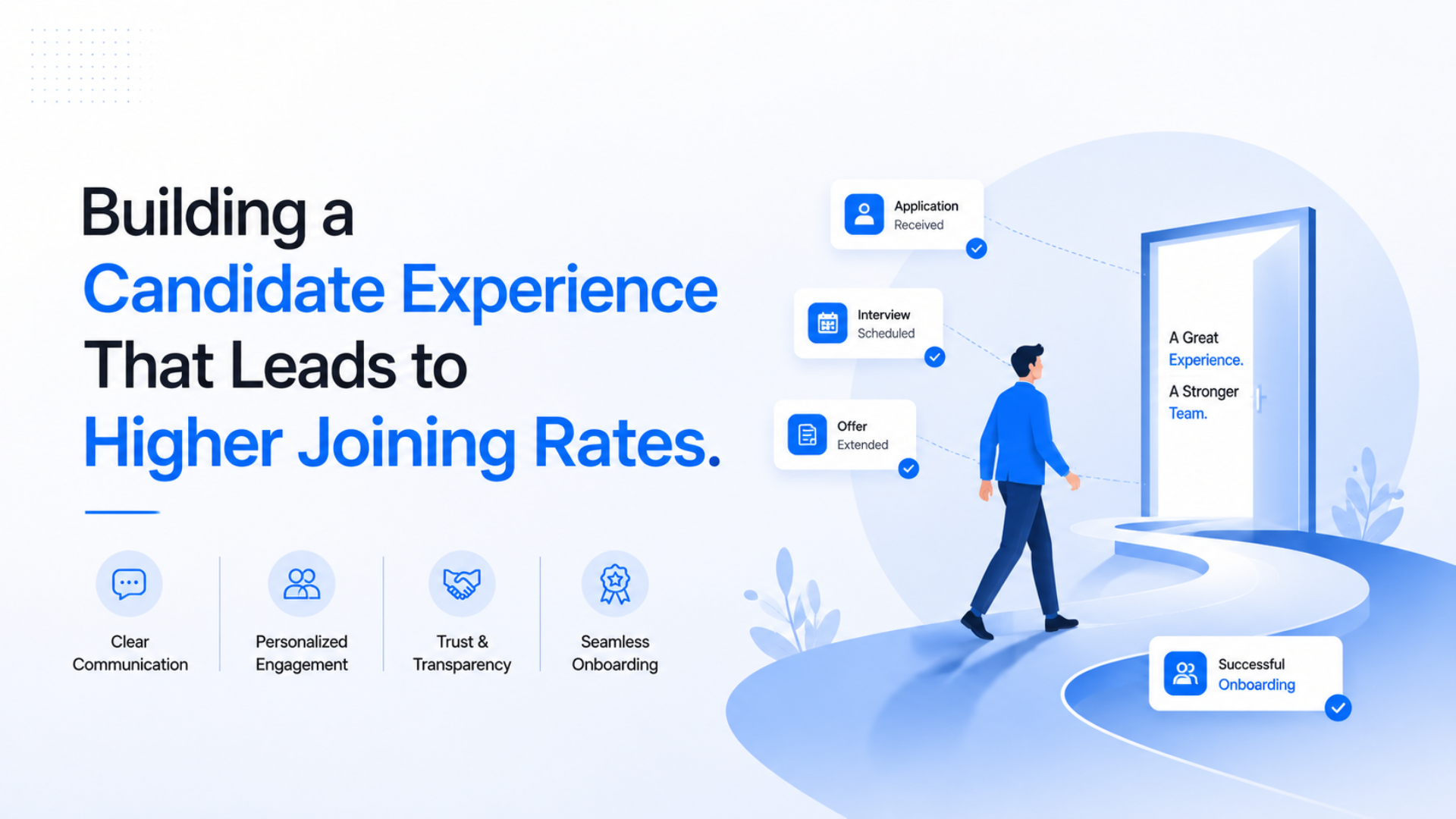
Your candidate signed the offer letter three weeks ago. The start date is next Monday. On Wednesday, they ghost. No reply to emails. No answer to calls. The hiring manager is furious, the recruiter is demoralized, and the vacancy clock resets to zero. This is not a rare event. Across industries, between ten and twenty-five percent of candidates who accept offers never show up on their first day. The cost of each no-show is not limited to the recruiting spend. It includes the hiring manager’s lost productivity, the team’s delayed projects, and the downstream effect on every other open role that had to wait while this position was supposedly filled. The root cause is almost never compensation. It is almost always a candidate experience that stopped the moment the offer was signed.
The gap between offer acceptance and day one is the most neglected stretch of the entire hiring journey. Recruiting teams pour enormous effort into sourcing, screening, interviewing, and negotiating. But once the offer is signed, the intensity drops off a cliff. The candidate goes from being the center of attention to being an afterthought, left alone with their doubts, their current employer’s counteroffer, and the growing anxiety of leaving a familiar environment for an unknown one. This drop-off is not just a feel-good problem. It is a measurable financial problem. According to SHRM’s talent acquisition research, the average cost of a candidate who accepts an offer but never joins is between fifteen thousand and forty thousand dollars when factoring in recruiting costs, interview panel time, and the extended vacancy. A strong candidate experience strategy closes this gap by treating the period between acceptance and start date as a critical phase of the hiring process, not a waiting room.
Why Acceptance Is Not the Finish Line
The conventional recruiting funnel measures success at the point of offer acceptance. Once the candidate signs, the funnel records a win and moves on. But offer acceptance is a commitment made under idealized conditions. The candidate has not yet resigned from their current role, navigated the emotional difficulty of telling their team they are leaving, or faced the reality of a counteroffer from an employer who suddenly realizes they are about to lose a valued team member. The period between acceptance and start date is when all of these stressors converge, and it is when the candidate is most vulnerable to changing their mind. Research from McKinsey’s people organization insights shows that candidates who report a positive post-acceptance experience are three times more likely to actually start the role, and twice as likely to still be employed twelve months later. The offer-to-join rate, the percentage of accepted offers that convert to actual starts, is the metric that captures this reality. Most organizations do not track it, which means they do not know the true conversion rate of their recruiting efforts.
The failure to track the offer-to-join rate is itself a symptom of a deeper problem: the assumption that the candidate’s decision is final once the offer is signed. In reality, the candidate’s decision is being re-evaluated continuously throughout the notice period. Every interaction, or lack of interaction, with the new employer either reinforces or weakens the decision to join. A candidate who receives a warm, personalized welcome from their hiring manager on the day they sign feels confident in their choice. A candidate who hears nothing for two weeks begins to wonder whether the organization actually wanted them or merely needed to fill a headcount. This distinction, feeling wanted versus feeling needed, is the single most important determinant of whether a candidate shows up on day one. The organizations that achieve the highest joining rates are not the ones that negotiate the best offers. They are the ones that make the candidate feel genuinely valued during the most uncertain period of their professional transition.
Mapping the Post-Acceptance Candidate Journey
Effective recruitment experience design requires understanding the candidate’s emotional and practical journey after they sign the offer. This journey has five distinct phases, and each phase presents different risks and requires different interventions. The first phase is the excitement phase, the first forty-eight hours after signing. The candidate is enthusiastic, optimistic, and emotionally committed. This is the best time to reinforce the decision with a personal call from the hiring manager, a welcome message from the future team, and a detailed overview of what to expect in the first week. The second phase is the resignation phase, typically days three through seven. The candidate informs their current employer of their departure, which triggers a retention response. This is the highest-risk phase, and it is when the candidate needs the most support. A proactive briefing on what to expect during the resignation conversation, including likely counteroffer tactics, can dramatically reduce the risk of the candidate being pulled back.
The third phase is the notice period, typically weeks two through four. The candidate is still at their current employer, fulfilling their notice, and may be experiencing a mix of nostalgia for
their current team and anxiety about the new role. This is the phase where candidates are most likely to go silent, not because they have changed their mind, but because the transition creates emotional turbulence. Regular, low-pressure touchpoints, a check-in message, an interesting article about the team’s work, an invitation to an upcoming team event, keep the candidate connected to the new organization without adding to their stress. Understanding how many follow-ups one hire actually needs, and calibrating the cadence to the candidate’s specific situation, is essential during this phase. The fourth phase is the pre-boarding phase, the final week before the start date. The candidate needs logistical clarity: where to park, what to bring, who to ask for, what the first day schedule looks like. Ambiguity during this phase breeds anxiety, and anxiety breeds second thoughts. The fifth phase is day one itself. The candidate’s first impression of the organization as an employee, not a candidate, either validates or undermines everything that came before.
The Five Pillars of a Joining-Rate-Optimized Candidate Experience
Organizations that consistently achieve joining rates above ninety percent share five structural characteristics. First, they assign a dedicated experience owner for every accepted candidate. This is not the recruiter, whose attention has already moved to the next open role, but a specific individual, often the hiring manager or an onboarding specialist, who is accountable for the candidate’s experience from acceptance through day one. The experience owner’s sole responsibility during this period is to ensure the candidate feels connected, informed, and valued. Second, they maintain a structured communication cadence. This is not ad hoc outreach driven by the recruiter’s intuition but a planned sequence of touchpoints, each with a specific purpose and content, that covers the entire notice period. According to LinkedIn’s recruiting resources, structured post-acceptance communication increases joining rates by twenty to thirty percent compared to ad hoc or no communication.
Third, they provide progressive information disclosure. Rather than overwhelming the candidate with everything at once, they distribute information across the notice period in a way that matches the candidate’s evolving needs. Week one covers the big picture: team structure, company strategy, and the role’s impact. Week two covers the practical details: benefits enrollment, IT setup, and administrative requirements. Week three covers the social context: team culture, communication norms, and informal expectations. Week four covers day-one logistics: schedule, location, parking, and first-week agenda. This progressive approach respects the candidate’s cognitive bandwidth, which is limited during a transition, and ensures that each piece of information arrives at the moment the candidate is ready to absorb it. Fourth, they involve the hiring manager actively. The hiring manager is the single most influential person in the candidate’s decision to join. A personal message from the hiring manager, a brief call to discuss the candidate’s priorities for the first ninety days, or an invitation to a team meeting before the start date all signal that the candidate is valued and that the organization is genuinely excited about their arrival. This kind of hiring experience optimization does not require a larger budget. It requires a shift in priorities and a willingness to invest the hiring manager’s time in the post-acceptance phase.
Fifth, they measure the candidate satisfaction score at multiple points during the post-acceptance journey. A brief, three-question survey at the end of each week, asking about the candidate’s confidence in their decision, the quality of communication they have received, and any concerns they have about the transition, provides an early warning system for candidates who are at risk of dropping out. A candidate whose confidence score drops between week one and week three is a candidate who needs immediate intervention, not another generic email. This measurement approach turns candidate experience from a subjective, feel-good concept into a data-driven discipline. As we have explored in our analysis of why more tools produce the same hiring problems, the organizations that improve their joining rates are not the ones that add more technology. They are the ones that measure the right things and act on what they measure.
Where Most Candidate Experience Programs Fail
Despite the clear business case, most candidate experience programs fail to improve joining rates. The failure is not due to lack of effort or good intentions. It is due to three structural mistakes that are remarkably common. The first mistake is confusing candidate experience with candidate communication. Sending a weekly email newsletter to accepted candidates is not a candidate experience program. It is a communication cadence, and it is necessary but not sufficient. Candidate experience encompasses communication, but it also includes the quality of the interactions, the personalization of the content, the responsiveness to the candidate’s specific concerns, and the emotional tone of every touchpoint. A candidate who receives a perfectly timed but entirely generic email does not feel valued. They feel processed. The distinction between being processed and being valued is the difference between a candidate who shows up and a candidate who ghosts.
The second mistake is treating the post-acceptance phase as the recruiter’s responsibility alone. In most organizations, the recruiter is the only person who maintains contact with the candidate after they sign the offer. But the recruiter does not have the organizational authority, the role-specific knowledge, or the emotional relationship with the candidate that the hiring manager has. When the candidate has a question about the role, a concern about the team, or a doubt about their decision, the recruiter’s reassurance carries far less weight than the hiring manager’s. Effective candidate experience programs distribute the responsibility across multiple stakeholders, with the hiring manager playing a central role. According to Gartner’s HR trends analysis, candidates who have direct contact with their hiring manager during the notice period are forty percent more likely to start the role, regardless of how much communication they receive from the recruiter.
The third mistake is failing to personalize the experience based on the candidate’s specific situation. Every candidate’s transition is different. A candidate who is relocating for the role has different needs and concerns than a candidate who is making a lateral move within the same city. A candidate who is leaving a toxic work environment is in a different emotional state than a candidate who is leaving a job they loved. A candidate who is the primary earner in their household faces different financial pressures than a candidate who is not. A
one-size-fits-all post-acceptance program fails to address these differences, and the candidates whose specific needs are not met are the ones most likely to drop out. This is why the difference between AI sourcing and AI recruiting matters so much in the post-acceptance context: recruiting is about understanding and responding to each candidate’s individual context, not executing a generic workflow.
The Technology That Makes Joining-Rate Optimization Scalable
For organizations that hire at volume, a manual approach to post-acceptance candidate experience is not feasible. A recruiting team that extends fifty offers per month cannot maintain a personalized, multi-stakeholder experience for each candidate through manual effort alone. What is needed is a technology platform that automates the structural elements of the experience, communication scheduling, information distribution, and satisfaction measurement, while preserving the personalization that makes the experience effective. This is the capability that distinguishes an agentic AI recruiting platform from a simple email automation tool. An agentic platform does not just send emails on a schedule. It monitors the candidate’s engagement level, identifies risk signals such as declining response rates or dropping satisfaction scores, and recommends specific interventions tailored to the candidate’s situation. It coordinates across stakeholders, prompting the hiring manager to reach out at the right moment, alerting the recruiter when a candidate’s confidence score drops, and ensuring that no candidate falls through the cracks during the transition.
The technology also solves one of the most persistent problems in post-acceptance experience management: the handoff gap. In most organizations, the post-acceptance phase is a no-man’s land between the recruiting team, which considers its job done once the offer is signed, and the onboarding team, which does not consider its job started until the candidate arrives on day one. During this gap, the candidate is nobody’s responsibility, and the experience suffers. A unified platform that spans the entire candidate journey, from first contact through first day, eliminates this gap by maintaining a single, continuous record of the candidate’s experience, concerns, and commitments. As Deloitte’s talent research emphasizes, the organizations that achieve the highest joining rates are the ones that treat the post-acceptance phase not as a gap between two processes but as a distinct phase with its own objectives, its own metrics, and its own dedicated resources. Ensuring that outdated candidate data in AI recruiting tools never undermines this continuity is critical, because every interaction with the candidate must be based on current, accurate information about their situation and needs.
Why Huntlo.ai Builds Experiences That Convert Acceptances into Start Dates
Huntlo.ai is purpose-built to close the gap between offer acceptance and day one. The platform captures every candidate’s motivations, concerns, and decision-making context during the interview process and uses that intelligence to drive a personalized post-acceptance experience that keeps each candidate engaged, informed, and confident throughout their transition. The system automatically schedules and orchestrates communication across the entire notice period, calibrating the cadence and content to each candidate’s specific situation. It monitors
engagement signals in real time, alerting recruiters and hiring managers when a candidate’s response patterns suggest a risk of dropout, and recommending the most effective intervention based on the candidate’s individual profile. For organizations that want to understand how to evaluate an AI sourcing tool before buying, the critical question to ask is whether the platform treats the post-acceptance phase as a first-class citizen of the hiring workflow, or whether it is an afterthought tacked onto the end of the funnel.
Every candidate who accepts your offer has made a decision to bet their career on your organization. The period between that decision and their first day is when that bet is most vulnerable. A candidate experience that is deliberate, personalized, and data-driven does not just make candidates feel good. It protects the organization’s investment in every hire, reduces the cost of vacancy extensions, and builds the kind of employer brand that attracts future talent. Huntlo ensures that referrals outperform cold outreach by creating a candidate experience so strong that every hire, regardless of source, arrives on day one committed and ready to contribute.