Two years ago, the phrase “AI outreach agent” would have sounded like marketing language attached to a slightly smarter email sequencer. Today, it describes a genuinely new category of recruiting technology: autonomous AI systems that can independently manage the end-to-end outreach process, from identifying qualified candidates through crafting personalized messages, executing multi-touch sequences across channels, adapting follow-up content based on candidate behavior, and handing off warm, engaged candidates to human recruiters for the final stages of the hiring process. The technology has moved from prototype to production faster than almost any previous recruiting innovation, and the early adopters are reporting results that are not incremental improvements but order-of-magnitude changes in outreach capacity, response rates, and recruiter productivity. This article explains what AI outreach agents are, how they differ from the automation tools that preceded them, what the early data shows about their impact, and what recruitment teams need to do to adopt them effectively.
The urgency around this topic is not driven by hype. It is driven by a structural problem in talent acquisition that has been getting worse for years and that conventional tools have failed to solve. The volume of outreach required to fill roles has increased dramatically as candidate expectations have risen, channel preferences have fragmented, and the competition for attention has intensified. At the same time, recruiter capacity has not increased proportionally. The average recruiter is responsible for more open requisitions, more candidate interactions, and more administrative tasks than they were five years ago, and the tools they have been given to manage this growing workload are mostly designed to help them do the same things slightly faster, not to do fundamentally different things. AI outreach agents represent a fundamentally different approach: instead of helping the recruiter send more messages, the agent sends the messages, manages the follow-ups, and handles the routine interactions, freeing the recruiter to focus on the high-value activities that only a human can perform. The distinction between these two approaches —
tool-assisted recruiting versus agent-augmented recruiting — is the most important strategic decision facing talent acquisition leaders in 2026.
What an AI Outreach Agent Actually Is (And Is Not)
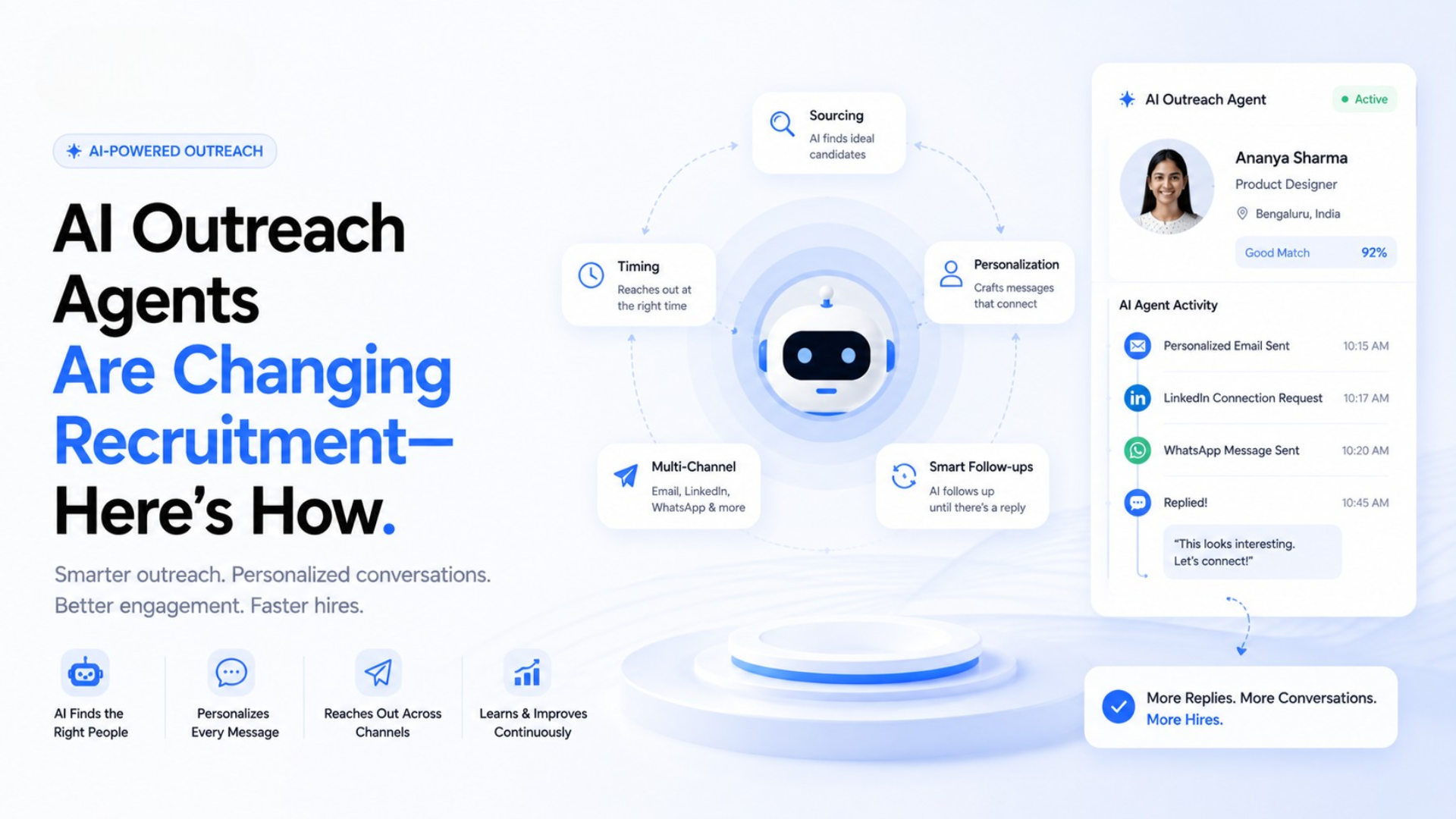
The term “AI agent” is used loosely in many contexts, so it is important to be precise about what it means in the recruiting outreach domain. An AI outreach agent is a system that can pursue a goal — in this case, engaging a qualified candidate in a conversation about a relevant opportunity — through a sequence of autonomous decisions and actions, without requiring human intervention at each step. The key word is autonomous. A traditional recruiting automation tool executes a pre-defined sequence: send message one, wait three days, send message two, wait five days, send message three. The sequence is designed by the recruiter, and the tool follows it mechanically. An AI outreach agent, by contrast, decides what to do next based on the context it observes. If the candidate opens the first message but does not reply, the agent may decide to send a follow-up that addresses the implicit interest shown by the open. If the candidate replies with a specific question, the agent crafts a contextually appropriate response rather than sending the next message in a pre-set queue. If the candidate goes silent after two interactions, the agent adjusts its approach — changing the channel, the tone, or the angle of the message — rather than blindly continuing the original sequence. This adaptability is what makes an agent fundamentally different from automation, and it is what produces the dramatic performance improvements that early adopters are reporting.
What an AI outreach agent is not is equally important. It is not a chatbot. Chatbots are conversational interfaces that respond to incoming messages within a defined ruleset. An AI outreach agent initiates interactions, makes strategic decisions about sequencing and content, and operates proactively rather than reactively. It is also not a sourcing tool. Sourcing tools identify potential candidates; outreach agents engage them. The two functions are complementary but distinct, and organizations that confuse them end up with strong candidate identification but weak candidate engagement. The relationship between sourcing and outreach is explored in depth in What’s the Difference Between AI Sourcing and AI Recruiting?, which argues that the industry has historically overinvested in sourcing at the expense of the engagement capabilities that actually convert identified candidates into active prospects. AI outreach agents address that imbalance by bringing the same level of technological sophistication to the engagement side of the equation that sourcing tools have brought to the identification side. Finally, an AI outreach agent is not a replacement for the recruiter. It is an augmentation of the recruiter’s capabilities, handling the high-volume, routine interactions that consume the majority of a recruiter’s time while leaving the strategic and relational work — the hiring manager conversations, the candidate evaluations, the offer negotiations — to the human professional who is best equipped to perform them.
How AI Agents Execute Outreach That Rivals Top Recruiters
The reason AI outreach agents produce results that rival or exceed those of
experienced recruiters is not that they are more creative or more persuasive than humans. It is that they are more consistent, more persistent, and more data-informed in their execution. A top recruiter, on their best day, with their most focused effort, will craft a brilliant outreach message that produces a high response rate. But that same recruiter, on a typical Tuesday, managing fifteen open requisitions and eighty active candidates, will not produce that same quality consistently across every interaction. The AI agent produces its best effort on every interaction, because its performance does not degrade with fatigue, distraction, or workload pressure. The first candidate of the day receives the same quality of outreach as the fiftieth. This consistency is the primary mechanism through which agents outperform manual outreach at scale.
The second mechanism is persistence. As research on follow-up effectiveness has consistently demonstrated, the majority of positive candidate responses do not come from the first touchpoint. They come from the second, third, fourth, or even fifth interaction. The specific data on how many touchpoints are required is detailed in How Many Follow-Ups Does One Hire Need?, and the answer is consistently higher than most organizations deliver through manual processes. The average recruiter sends one or two touchpoints per candidate. An AI outreach agent, operating without the time constraints that limit human recruiters, can execute five, seven, or even ten touchpoints per candidate, with each touchpoint differentiated in content and tone. This persistence advantage is not just about sending more messages. It is about maintaining a coherent, increasingly relevant conversation over time, which is something that requires both consistency and contextual memory — two capabilities where AI agents excel and manual processes fail.
The third mechanism is channel intelligence. An AI outreach agent can evaluate which channel is most likely to reach a specific candidate based on their profile, geography, industry, and behavioral signals, and it can switch channels mid-sequence if the initial channel is not producing engagement. A candidate who does not respond to email but is active on LinkedIn can be reached through InMail. A candidate who does not respond to InMail but has a verified phone number can receive an SMS. This multi-channel adaptability is difficult for a single recruiter to manage manually across a large candidate pool, but it is a natural capability for an AI system that can evaluate channel preferences and execute channel switches in real time. According to PwC’s hiring trends research, organizations that have implemented multi-channel AI outreach are seeing forty to sixty percent improvements in candidate engagement compared to single-channel approaches, with the gains concentrated in candidate segments — particularly senior and specialized professionals — that are hardest to reach through any single channel.
The Recruiter’s New Role: From Message Sender to Conversation Owner
The most significant organizational impact of AI outreach agents is not the increase in response rates or the reduction in time-to-fill, although both are substantial. The most significant impact is the change in what recruiters actually do with their time. When an AI agent handles the initial outreach, the follow-up sequences, the channel switching, and the routine candidate interactions, the recruiter’s role shifts from being primarily a message
sender to being primarily a conversation owner. A conversation owner is a recruiter who receives warm, engaged candidates who have already been vetted for basic qualifications, who have already expressed interest through their responses to the agent’s outreach, and who are ready for a substantive human conversation about the role, the team, and the opportunity. The recruiter’s time is no longer consumed by writing hundreds of messages that go unanswered. It is spent on the high-value interactions that actually produce hires: the discovery calls, the relationship-building conversations, the hiring manager alignments, and the candidate nurturing that closes deals.
This role shift has profound implications for recruiter hiring, training, and evaluation. Organizations that adopt AI outreach agents will need recruiters with different skills than the ones they have traditionally hired. The ability to write a good cold outreach message, while still valuable, becomes less central to the role. The ability to conduct a nuanced conversation with a senior candidate, to evaluate cultural fit beyond keyword matching, to manage a complex multi-party hiring process, and to represent the employer brand authentically in every interaction becomes more central. These are higher-order skills that many recruiters already possess but that are currently buried under the operational burden of high-volume outreach. AI agents do not eliminate the need for these skills. They create the space for them to be used effectively. According to Heidrick & Struggles’ insights on leadership hiring, the executive search firms that have been earliest to adopt AI-driven candidate engagement are not reducing their headcount. They are redeploying their consultants toward more strategic, relationship-intensive work, and they are finding that the quality of their placements improves because the consultants have more time to spend on each search. The same dynamic is now spreading to corporate talent acquisition teams, where AI agents are enabling a shift from recruiter-as-processor to recruiter-as-consultant.
What the Early Data Shows: Response Rates, Time-to-Fill, and Quality of Hire
The quantitative data on AI outreach agent performance is still early, because the technology has been in widespread production use for less than two years. But the available data from early adopters is consistent enough to draw preliminary conclusions. On response rates, organizations using AI outreach agents report improvements of two to four times over manual outreach, with the largest gains coming from senior and specialized candidate segments where manual outreach historically performs worst. On time-to-fill, the improvements are typically in the range of twenty to forty percent, driven primarily by the reduction in time spent waiting for responses and the elimination of the gap between sourcing and engagement that exists when those functions are handled by separate systems and teams. On quality of hire, the data is more nuanced but generally positive: organizations report that candidates sourced and engaged through AI agents are at least as strong as those sourced through traditional methods, and in some cases stronger, because the agent’s persistence allows the recruiter to reach candidates who would never have been engaged through a one-or-two-touch manual approach.
It is worth noting that these results are not universal, and the variance between
organizations is significant. The difference between high-performing and low-performing AI outreach implementations is not the technology itself. It is how the technology is deployed. Organizations that treat the AI agent as a plug-and-play solution — configure it once and let it run — tend to see moderate improvements that plateau quickly. Organizations that invest in continuous optimization — refining targeting criteria, adjusting messaging frameworks, reviewing agent performance data, and iteratively improving the handoff between agent and human recruiter — see compounding improvements that grow over time. This distinction between passive deployment and active optimization is a recurring theme in recruiting technology adoption, and it echoes the finding documented in More Tools, Same Hiring Problems: the tool itself is necessary but not sufficient. The organizational practices around the tool determine whether it produces transformational results or merely incremental ones. The organizations getting the best results from AI outreach agents are the ones that treat agent deployment as an ongoing operational practice rather than a one-time technology implementation.
Navigating the Challenges: Compliance, Candidate Experience, and Trust
The adoption of AI outreach agents raises legitimate questions that recruitment leaders must address proactively. The three most important are compliance, candidate experience, and trust. On compliance, the use of AI in candidate communication is subject to an evolving regulatory landscape that varies significantly by jurisdiction. Data privacy regulations affect how candidate information is collected, stored, and used in AI-driven outreach. Anti-discrimination regulations raise questions about whether AI-generated messages may inadvertently introduce bias based on candidate characteristics. And disclosure requirements in some jurisdictions may mandate that candidates be informed when they are interacting with an AI system rather than a human recruiter. The specific compliance considerations vary by region, as explored in Recruiting Compliance Differences: India vs USA vs UK, but the general principle is universal: recruitment teams must understand the regulatory environment in which they operate and ensure that their AI outreach practices are compliant before, not after, deployment. The best AI outreach platforms build compliance guardrails into the agent’s behavior, but the responsibility for compliance ultimately rests with the organization that deploys the agent, not the technology vendor that provides it.
On candidate experience, the concern is that AI-generated outreach may feel impersonal or deceptive if candidates do not know they are interacting with an AI system. This is a valid concern, and it is one that the best implementations address through transparency and quality. Transparency means being honest about the role of AI in the outreach process. The agent’s messages should make it clear that the candidate is being contacted by an AI system working on behalf of a specific recruiter and company, and the handoff to a human recruiter should happen as soon as the conversation reaches a point where human judgment is needed. Quality means ensuring that the AI’s messages are genuinely relevant, personalized, and valuable — not just in the first message, but in every subsequent touchpoint. When AI outreach is transparent and high-quality, candidate experience data actually
improves compared to manual outreach, because candidates receive faster, more consistent, and more relevant communication than overburdened human recruiters typically deliver. According to EY’s workforce research, candidates who are aware they are interacting with an AI system but find the interaction helpful and relevant report higher satisfaction than candidates who interact with a human recruiter who is clearly sending generic, copy-paste messages. The quality of the interaction matters more to candidates than the identity of the sender.
On trust, the challenge is building recruiter confidence in the AI agent’s judgment. Many recruiters are skeptical of AI outreach because they have seen previous generations of recruiting technology overpromised and underdelivered. This skepticism is healthy and should not be dismissed. The most effective approach to building trust is to start with a limited deployment — a single team, a single role type, or a single geography — and let the results speak for themselves. When recruiters see that the agent is producing genuine conversations with qualified candidates, that the handoff to human conversations is smooth, and that the candidates who come through the agent pipeline are as strong or stronger than those sourced manually, skepticism gives way to adoption. The key is to measure and share the data transparently, including the failures. Agents will occasionally produce a message that is off-tone or off-target. Acknowledging these instances and using them as optimization inputs builds more trust than pretending the system is perfect.
Huntlo: The AI Outreach Agent Built for How Recruiters Actually Work
The theory of AI outreach agents is compelling. The practice is what determines whether an organization actually benefits from the technology. And in practice, the difference between an AI outreach agent that works and one that does not comes down to three things: the quality of the candidate data it operates on, the sophistication of its decision-making, and the seamlessness of the handoff between agent and recruiter. Huntlo was designed to excel on all three dimensions. On data quality, Huntlo addresses the candidate data freshness problem that undermines many AI recruiting tools. When an AI agent is operating on outdated profiles — wrong job titles, old contact information, stale skill assessments — even the most sophisticated outreach logic produces poor results, because the agent is making decisions based on a picture of the candidate that no longer reflects reality. The reasons this happens and what to look for are analyzed in Why Do Some AI Recruiting Tools Have Outdated Candidate Data?, and Huntlo’s approach is to prioritize continuous data enrichment and verification as a foundational capability rather than an afterthought. Every candidate profile in Huntlo is continuously updated with fresh signals from multiple sources, so the agent’s outreach decisions are based on the candidate’s current reality, not their historical profile.
On decision-making sophistication, Huntlo’s AI engine is genuinely agentic in the sense that it adapts its behavior based on context rather than executing rigid sequences. The agent evaluates each candidate’s profile to determine the optimal channel, crafts a personalized opening message that leads with inquiry rather than pitch, monitors the candidate’s engagement signals across touchpoints, and adjusts its approach — channel, tone, content,
timing — based on what it observes. This is the distinction between automation and agency that is explored in What Makes an AI Recruiting Platform Agentic vs. Just Automated?, and it is the distinction that separates platforms that produce modest efficiency gains from platforms that produce transformational changes in outreach effectiveness. Huntlo’s agent does not just send more messages faster. It has better conversations on behalf of the recruiter, because it makes better decisions about what to say, when to say it, and through which channel to say it.
On handoff seamlessness, Huntlo is designed so that the transition from agent-managed outreach to recruiter-owned conversation is invisible to the candidate and effortless for the recruiter. The agent provides the recruiter with a full conversation summary, key signals detected, and recommended next steps for each candidate it hands off. The recruiter picks up the conversation with full context, no repetition required, and the candidate experiences a single coherent engagement thread from first touch to hire. This is the promise of AI-augmented recruiting: not replacing the recruiter, but giving the recruiter superpowers. The agent handles the scale. The recruiter handles the substance. The candidate gets a better experience. The organization gets better hires. And the recruiter gets to do the work they actually enjoy — building relationships, evaluating talent, and making hiring decisions — instead of spending their days writing messages that no one reads.
Related Topics:
The ATS Mistake Companies Keep Repeating
More Tools, Same Hiring Problems
What’s the Difference Between AI Sourcing and AI Recruiting?