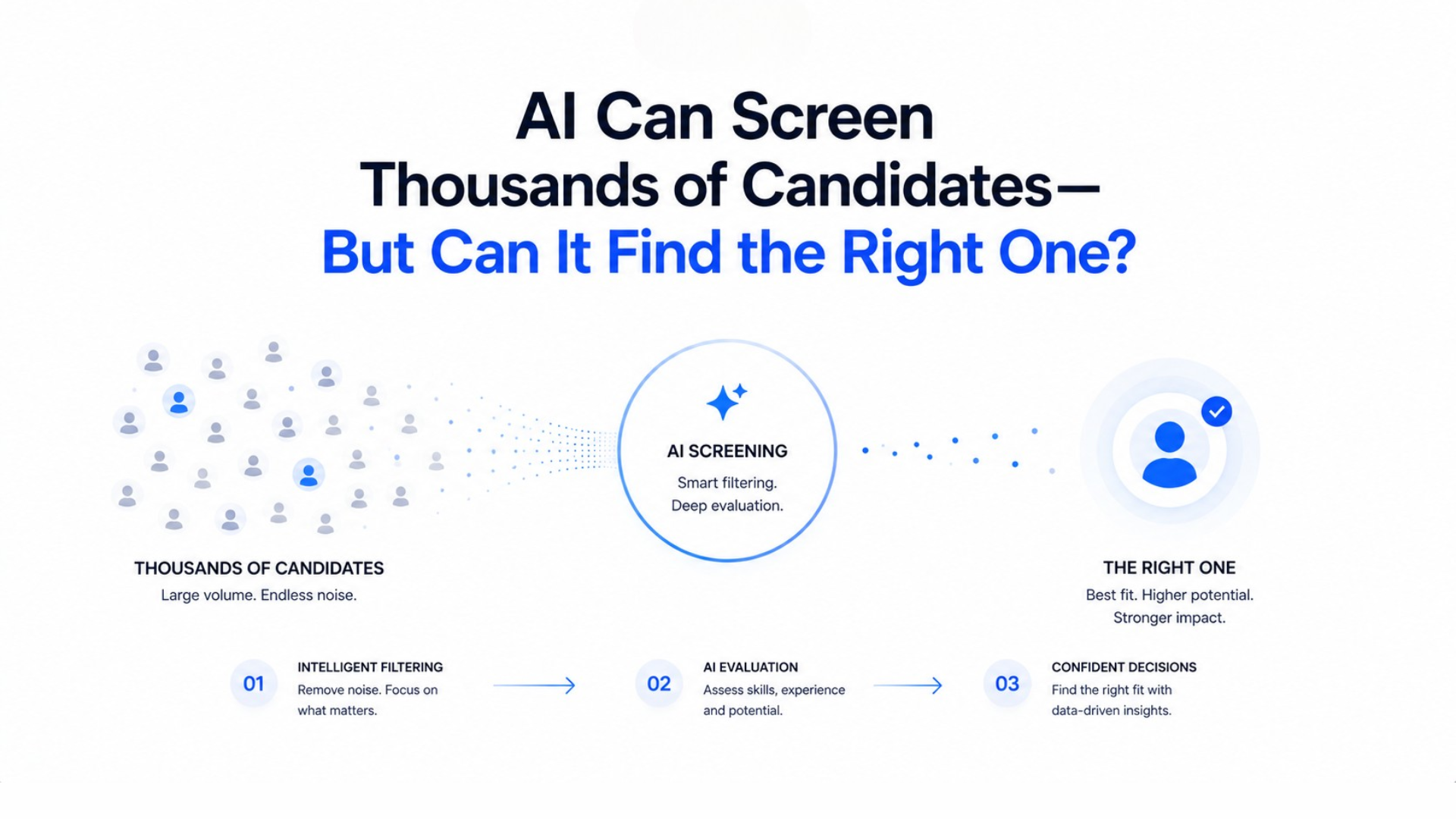
The marketing messages from AI screening vendors are compelling. Process a thousand candidates in minutes. Eliminate manual resume review entirely. Let the AI handle the first round while your recruiters focus on what matters. The promise is one of pure upside: more speed, more volume, more coverage, and the same or better quality. But anyone who has worked in recruiting long enough knows that promises about screening technology have been made before. ATS keyword filters were supposed to identify the best candidates automatically. Resume parsers were supposed to eliminate manual data entry. Job board algorithms were supposed to surface perfect matches. Each of these technologies delivered on its narrow promise while failing to deliver on the broader one: they processed more candidates, but they did not reliably find the right ones.
The question that matters is not whether AI can screen thousands of candidates. It clearly can. The question is whether the AI can distinguish the right candidate from the merely adequate ones when those thousands are evaluated. This is a fundamentally different capability, and it depends on factors that most screening vendors do not discuss and most buyers do not think to ask about. This article identifies the five capabilities that separate AI screening systems that genuinely find the right candidate from those that merely process more resumes faster. Understanding these capabilities is essential for any recruiting leader who is evaluating AI screening tools, because the difference between the two categories is the difference between a screening process that transforms your hiring outcomes and one that just adds another tool to a stack that is already producing more tools and the same hiring problems.
Capability One: Evaluating Substance, Not Just Surface
The first capability that distinguishes accurate AI screening from merely fast AI screening is the depth of evaluation. A screening system that evaluates candidates on surface signals, such
as job titles, employer names, years of experience, and keyword presence, is performing the same analysis that a human recruiter performs when skimming a resume in thirty seconds. It is doing it faster, and it may be doing it more consistently, but the quality of the evaluation is bounded by the quality of the signals being evaluated. If the signals have low predictive validity, processing more of them does not produce a better shortlist. It produces a larger pool of candidates who all look similar on the surface but may differ dramatically in their actual capability.
A genuinely intelligent screening system goes deeper. It evaluates what the candidate actually accomplished in each role, not just the title they held. It assesses the scale and complexity of the problems they solved, not just the technologies they listed. It analyzes the trajectory of their career progression, identifying candidates who are accelerating toward the capabilities the role requires rather than candidates who have plateaued at a comfortable level. It looks for evidence of impact, such as measurable outcomes, published work, open-source contributions, or demonstrable career growth, rather than relying on self-reported claims that cannot be verified. This deeper evaluation produces fundamentally different shortlists than surface-level screening, because it identifies candidates whose value is not immediately apparent from their resume alone: the candidate from a non-brand-name company who has been solving the exact problems your team needs to solve, or the candidate with a non-traditional background whose career trajectory demonstrates the adaptability and growth potential that the role demands.
This distinction between surface evaluation and substance evaluation is what separates an agentic AI recruiting platform from one that is merely automated. An automated platform takes the inputs that the human recruiter would have used and processes them faster. An agentic platform identifies the inputs that the human recruiter would not have had time to evaluate and incorporates them into the assessment. The agentic platform does not just screen more candidates. It screens each candidate on more dimensions, producing a richer and more accurate evaluation. The result is a shortlist that contains candidates a human recruiter would have found, plus candidates a human recruiter would have missed, which is where the real value of AI screening lives.
Capability Two: Role-Specific Intelligence, Not Generic Filters
The second capability is the ability to adapt its evaluation criteria to the specific requirements of each role. A generic screening system applies the same evaluation framework to every position, regardless of whether the role is a junior marketing coordinator or a senior machine learning engineer. The criteria may be slightly adjustable, perhaps through configurable keyword lists or experience thresholds, but the fundamental evaluation logic is the same. This approach is administratively simple but produces poor screening outcomes because it ignores the reality that the capabilities that predict success in one role have very little overlap with the capabilities that predict success in another.
A genuinely intelligent screening system derives its evaluation criteria from the specific
requirements of the role. It understands that a senior data scientist role requires statistical modeling, causal inference, and the ability to communicate findings to non-technical stakeholders, and it evaluates candidates against those specific capabilities rather than against a generic data science skills checklist. It understands that a product manager role at a growth-stage startup requires a different set of capabilities than a product manager role at an enterprise company, and it adjusts its evaluation accordingly. This role-specific intelligence is particularly critical for niche and technical roles.
niche and technical roles, where the must-have competencies are rare, highly specific, and difficult to assess with generic filters. A screening system that cannot distinguish between a candidate who has used machine learning in a production environment and a candidate who has completed a machine learning course is not an intelligent screening system for a senior ML engineering role. It is a keyword matcher that happens to be fast. The ability to evaluate candidates against role-specific, nuanced criteria is what enables AI to find the right candidate from a pool of thousands, rather than just finding the candidates who look most similar on the surface.
Capability Three: Multi-Signal Evaluation with Current Data
The third capability that determines whether AI screening can find the right candidate is the breadth and freshness of the data signals it evaluates. A screening system that relies solely on the resume, even an AI-powered one, is limited to the information that the candidate chose to include in a single self-reported document. This is inherently incomplete. Professionals build their capabilities through work that is not always captured on a resume: open-source contributions, conference talks, published research, mentorship relationships, side projects, and community involvement. The candidates who are most exceptional in their fields are often the candidates whose most impressive work is not on their resume, because their resumes were written for a previous job search and have not been updated to reflect their current capabilities.
Multi-signal evaluation addresses this limitation by incorporating data from professional profiles, public work portfolios, career history databases, and domain-specific platforms into the screening assessment. The AI evaluates the candidate’s full professional footprint, not just the curated snapshot that the resume provides. This produces a more complete and more accurate picture of each candidate’s capabilities, and it surfaces exceptional candidates who would be missed by a resume-only evaluation. The candidates who get discovered through multi-signal evaluation are often the candidates who are most in demand and hardest to identify, because they are not actively applying through standard channels and their resumes may be months or years out of date.
Data freshness is the non-negotiable complement to data breadth. As we have examined in our analysis of why some AI recruiting tools have outdated candidate data, the value of additional data signals depends entirely on whether that data is current. A professional profile that is six months out of date can be more misleading than no profile at all, because it creates a
false picture of the candidate’s current capabilities. An AI screening system that evaluates candidates against stale data is making accurate decisions about the wrong version of the candidate. Real-time data enrichment at the point of evaluation is the only way to ensure that the multi-signal assessment reflects the candidate’s actual current state, and it is a capability that separates genuinely effective screening platforms from those that process more signals but do not verify their currency. According to LinkedIn’s talent solutions research, recruiting teams that use platforms with real-time data enrichment report significantly higher shortlist accuracy than those relying on cached candidate data, because the evaluations are based on who the candidate is today, not who they were six months ago.
Capability Four: Consistent Scoring Across the Entire Pool
The fourth capability is the ability to produce consistent, calibrated scores across the entire candidate pool, regardless of its size. This sounds straightforward but is surprisingly difficult to achieve in practice. When an AI system evaluates thousands of candidates, subtle variations in how the model processes different types of profiles, different career patterns, or different industry backgrounds can introduce systematic scoring inconsistencies. A candidate from the technology sector may be scored on a slightly different scale than a candidate from the healthcare sector, not because the system was designed to do so but because the training data and model architecture may perform differently across domains. These inconsistencies are invisible when looking at individual scores but become significant when ranking a large pool, because they can cause systematically stronger candidates to be ranked below systematically weaker candidates from a different domain.
Consistent scoring matters because the whole point of screening thousands of candidates is to identify the best ones relative to the entire pool. If the scoring system produces inconsistent results across different segments of the pool, the ranking will not reflect genuine differences in candidate quality. It will reflect the artifacts of the scoring system’s inconsistencies. The best AI screening systems address this problem through cross-domain calibration, ensuring that candidates from different industries, career stages, and background types are evaluated on comparable scales. They also provide transparency into how each candidate’s score was derived, so that recruiters can understand and verify the reasoning behind the ranking rather than accepting an opaque numerical score on faith.
This consistency requirement is one of the most important factors to assess when you are evaluating an AI screening tool before buying. A system that produces different scores for the same candidate when evaluated at different times, or in different contexts, or alongside different peer candidates, is a system whose ranking cannot be trusted. The scoring must be deterministic and consistent, producing the same assessment of the same candidate regardless of external factors. According to Deloitte’s human capital insights, scoring consistency is the single strongest predictor of whether an AI screening tool will deliver on its quality-of-hire promises, because inconsistent scoring undermines every other capability the tool possesses. A system with perfect evaluation logic but inconsistent scoring will produce worse shortlists than a system with good evaluation logic and perfectly consistent scoring.
Capability Five: Learning from Outcomes, Not Just Processing Inputs
The fifth and ultimately most important capability is the ability to learn from screening outcomes. A screening system that processes thousands of candidates and produces a shortlist has completed only half of its job. The other half is connecting that shortlist to the downstream outcomes that follow: which candidates were interviewed, which received offers, which were hired, and most critically, how those hires performed after they joined the organization. A screening system that does not track these outcomes cannot know whether its evaluations were accurate, and a system that does not know whether its evaluations were accurate cannot improve.
The AI screening systems that find the right candidate from a pool of thousands are the systems that use outcome data to continuously refine their evaluation models. When a candidate who received a high screening score turns out to be a strong performer, that outcome strengthens the weighting of the signals that identified them. When a candidate who received a high score turns out to be a poor performer, that outcome triggers a review of the signals that led to their selection, and the model adjusts accordingly. Over time, this feedback loop produces a screening system whose accuracy improves with every hiring cycle, because it is continuously learning which signals predict success in the specific context of your organization and your roles.
This learning capability is also what addresses the most common concern about AI screening: the fear that it will make hiring less human. The concern is understandable but misplaced when the AI is designed with human-in-the-loop feedback from the start. The recruiter’s assessment of a candidate’s interview performance, the hiring manager’s evaluation of the new hire’s on-the-job contribution, and the team’s feedback on cultural fit are all data points that the learning system incorporates. The AI does not replace human judgment. It amplifies it by ensuring that human judgments from past hiring cycles inform the screening decisions in future ones. As we have discussed in our exploration of whether recruiters should worry about AI replacing their jobs, the AI that enhances rather than threatens the recruiter’s role is precisely the AI that learns from the recruiter’s expertise and uses it to make better screening decisions. According to McKinsey’s research on AI in hiring, organizations that deploy AI screening with outcome feedback loops see 30% to 50% improvements in quality-of-hire within the first year, with the improvement compounding as the system accumulates more outcome data.
How Huntlo Finds the Right Candidate, Not Just More Candidates
Huntlo was built to answer the question this article poses. It screens thousands of candidates, but it does so with the five capabilities that determine whether that screening actually finds the right one. It evaluates candidates on the substance of their capabilities, not just surface credentials, assessing demonstrated impact, career trajectory, and domain-specific evidence rather than relying on keyword matches. It adapts its evaluation criteria to the specific
requirements of each role, producing assessments that are calibrated to what the role actually demands rather than to a generic template. It draws on multiple data signals with real-time enrichment, ensuring that every evaluation is based on the most current and complete picture of the candidate available. It produces consistent, calibrated scores across the entire candidate pool, enabling accurate ranking regardless of the pool’s size or diversity. And it learns continuously from screening outcomes, improving its accuracy with every hiring cycle. The distinction between AI sourcing and AI recruiting, is the distinction between finding candidates and finding the right candidates. Huntlo does both, and the evidence is in the shortlists it produces: not just more candidates, but candidates who perform after they are hired. According to SHRM’s talent acquisition research, the recruiting teams that achieve the highest quality-of-hire are not the ones that screen the most candidates. They are the ones that screen with the most intelligent methods. Huntlo provides those methods in a platform that any recruiting team can deploy today.