David Kamara had spent eleven years as the head of HR technology for a Fortune five hundred manufacturing company, and in that time he had worked with every major HRTech vendor in the market. He had implemented Workday for core HRIS, SAP SuccessFactors for performance management, LinkedIn Recruiter for sourcing, iCIMS for applicant tracking, HireVue for video interviewing, and at least a dozen smaller tools for everything from engagement surveys to benefits administration. Each implementation had taken months. Each integration had required custom development. Each vendor renewal had consumed weeks of his team's time. But the thing that frustrated David most was not the cost or the complexity. It was that none of these vendors, individually or collectively, provided a coherent vision for how AI should transform the relationship between the organization and its talent. Each vendor was optimizing its own category, adding AI features to existing products without rethinking the fundamental architecture. These were AI features bolted onto legacy architectures, not AI-native platforms built from the ground up to leverage what AI makes possible. David had come to a conclusion shared by a growing number of senior HR technology leaders: the HRTech market lacks a category leader that offers a unified, AI-native vision for talent management, and until one emerges, organizations will continue assembling fragmented stacks that are expensive to manage and incapable of delivering the transformative outcomes that AI makes possible.
The Legacy Incumbent Problem
The HRTech market is dominated by a small number of large incumbents that built their core platforms in an era before modern AI was commercially viable. These platforms were designed to digitize and automate existing HR processes: tracking employee records, managing
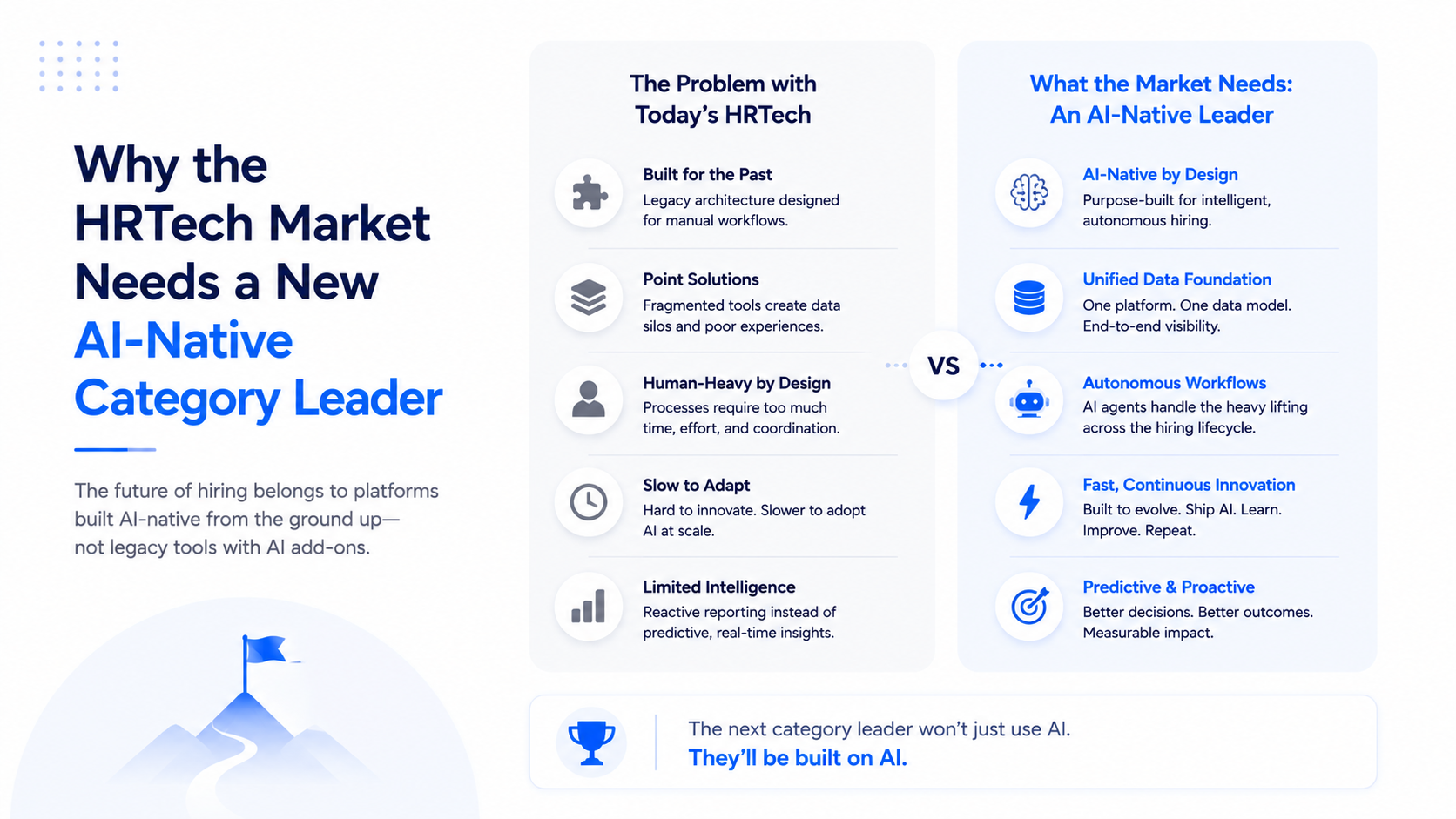
payroll, processing benefits, posting jobs, and routing applications. They were built on relational database architectures optimized for structured data storage and retrieval, with workflow engines that codified the sequential approval processes that defined pre-digital HR operations. These architectures were appropriate for their time, and the vendors that built them earned their market positions by solving real problems at scale. But the fundamental assumption underlying these architectures, that HR technology should digitize existing processes rather than reimagine them, is now the constraint that prevents these incumbents from delivering the transformative value that AI makes possible. An AI system designed to optimize the existing recruiting workflow, posting a job, receiving applications, screening resumes, scheduling interviews, and extending offers, will produce incremental improvements. An AI system designed from scratch to answer the question of how to connect the right person with the right opportunity at the right time, regardless of whether that person is an internal employee, an external candidate, or a contingent worker, will produce a fundamentally different and more valuable outcome. The legacy incumbents cannot build the latter because their architectures were designed for the former, and the cost of rearchitecting a platform that serves thousands of enterprise clients with deeply customized configurations is prohibitive.
The evidence for this architectural constraint is visible in the product strategies of the largest HRTech vendors. When these vendors announce AI features, the features are almost always additions to existing product modules rather than new products built on AI-native foundations. An AI-powered resume screening feature is added to the existing ATS module. An AI-powered skills recommendation feature is added to the existing learning management module. An AI-powered compensation benchmarking feature is added to the existing compensation module. Each of these features may be useful in isolation, but they are constrained by the data models, workflow structures, and integration architectures of the modules they inhabit. The ATS module has a candidate data model that was designed for application tracking, not for the rich, multi-dimensional candidate profiles that AI-native platforms maintain. The learning management module has a skills taxonomy that was designed for course cataloging, not for the dynamic, inference-driven skills graphs that AI-native platforms build. The compensation module has a market data model that was designed for annual benchmarking exercises, not for the real-time talent market intelligence that AI-native platforms provide. The AI features are constrained by the architectural foundations on which they are built, which means they deliver incremental improvement rather than transformational change.
This incremental AI approach creates a paradox for enterprise buyers. The vendors they trust most, because of brand reputation, implementation track records, and existing enterprise agreements, are the vendors least capable of delivering the AI-native experiences that will define the next generation of HRTech. The vendors most capable of delivering these experiences, AI-native startups with modern architectures and purpose-built AI models, are the vendors that enterprise buyers are least likely to trust with their most critical HR processes. This trust-capability gap is the defining structural tension in the HRTech market today, and it is the reason why the market needs a new category leader: an organization that combines the enterprise credibility and implementation scale of a legacy incumbent with the AI-native
architecture and product vision of a startup. According to McKinsey, sixty-three percent of HR technology leaders report that their primary frustration with existing HRTech vendors is the gap between the vendors' AI marketing claims and the actual AI capabilities delivered in production, because legacy architectures limit the depth and breadth of AI functionality that can be meaningfully integrated into existing products without fundamental rearchitecture. more tools same hiring problems illustrates why this gap manifests as tool sprawl, because when existing platforms fail to deliver meaningful AI capabilities, HR technology teams compensate by adding specialized AI point solutions, further fragmenting the stack and increasing the management burden that the legacy platforms were supposed to reduce.
What a True Category Leader Would Look Like
A true HRTech category leader would not be defined by the breadth of its feature set or the size of its customer base. It would be defined by the coherence of its vision and the native quality of its AI architecture. The distinguishing characteristic of a category leader is that it defines the category on its own terms rather than competing within the boundaries that incumbents have established. In enterprise software, category leadership has historically emerged when a company redefines the problem that the category exists to solve. Salesforce did not build a better contact manager. It redefined the category as a platform for managing the entire customer relationship across sales, service, marketing, and commerce. ServiceNow did not build a better ticketing system. It redefined the category as a platform for managing enterprise workflows across IT, HR, finance, and operations. A HRTech category leader would similarly redefine the category, not as a collection of HR process automation tools but as an AI-native platform for managing the relationship between an organization and its talent across the entire talent lifecycle, from initial awareness through hiring, development, advancement, and retention.
Architecturally, a category-leading HRTech platform would be built on three foundational principles that distinguish it from legacy incumbents. The first principle is a unified talent data model that represents every person who interacts with the organization, whether as a candidate, employee, contingent worker, alumni, or boomerang rehire, as a single entity with a rich, continuously updated profile. Legacy platforms maintain separate data models for candidates in the ATS, employees in the HRIS, and contingent workers in the VMS, which prevents the unified view of talent that AI requires. A category leader would maintain a single profile that accumulates data across all of these touchpoints, creating the comprehensive talent dataset that enables accurate matching, prediction, and recommendation. The second principle is an AI-first orchestration layer that manages workflows dynamically rather than following static, pre-defined process templates. Legacy platforms encode recruiting, onboarding, and performance management as fixed workflows with predefined steps and approval chains. An AI-first platform treats these workflows as dynamic sequences that the AI adapts in real time based on context, candidate behavior, and outcome data. The third principle is an open integration architecture that treats the platform as the central nervous system of the talent
technology ecosystem rather than as a walled garden. Legacy platforms integrate with other tools through APIs and middleware but treat integration as a secondary concern. A category leader would treat integration as a core capability, providing native connectivity to the broader enterprise technology ecosystem and enabling the platform to serve as the data and workflow hub that connects all talent-related activities.
The practical implications of these architectural principles are significant. A platform with a unified talent data model can match an internal employee to a new role with the same AI engine that matches an external candidate to an open position, because both the employee and the candidate exist in the same data model with the same attribute structure. A platform with an AI-first orchestration layer can adjust the recruiting workflow for a senior executive hire, which requires a different sequence of steps, stakeholders, and timelines than a high-volume early-career hire, without requiring the administrator to manually configure two separate workflow templates. A platform with an open integration architecture can pull performance data from the learning management system, engagement data from the communication platform, and market data from external talent intelligence sources into a single analytical framework that provides hiring managers with insights no single legacy module can provide. These capabilities do not exist in the current HRTech market because no vendor has combined all three architectural principles in a single platform. According to Gartner, the number of HRTech platforms that offer a unified talent data model, AI-first orchestration, and open integration architecture in a single system is currently zero, which means the category leadership position is available to whichever vendor can deliver this combination at enterprise scale. agentic AI platforms vs automated ones explains why the agentic AI architecture, where the platform autonomously manages workflows rather than executing static process templates, is the critical enabler of the AI-first orchestration principle, because it allows the platform to make real-time decisions about how to adapt workflows to specific contexts without requiring human configuration or intervention.
Why the Current Market Structure Prevents Leadership
The current HRTech market structure actively prevents the emergence of a category leader through several reinforcing dynamics. The first dynamic is the installation base trap. Legacy incumbents have thousands of enterprise clients with deeply customized configurations, multi-year contracts, and extensive integration dependencies. These clients represent enormous recurring revenue that creates a strong incentive for incumbents to protect their existing architectures rather than rearchitect for an AI-native future. Rearchitecting a platform that serves three thousand enterprise clients, each with custom workflows, custom fields, custom reports, and custom integrations, is an enormously risky undertaking that would require years of development, massive engineering investment, and a transition period during which the vendor must support both the legacy and new architectures simultaneously. The financial markets, which evaluate public HRTech companies on quarterly revenue growth and margin performance, penalize the kind of long-term, high-risk investment that rearchitecture
requires. The result is that incumbents are structurally incentivized to add AI features to their existing platforms rather than rebuild their platforms for AI, even though the latter would produce dramatically better outcomes for clients.
The second dynamic is the category fragmentation that prevents any single vendor from achieving the breadth of capability required for category leadership. The HRTech market is divided into dozens of subcategories, including core HRIS, payroll, ATS, CRM, learning management, compensation management, benefits administration, employee engagement, workforce management, talent intelligence, and contingent workforce management. Each subcategory has its own incumbent vendors, its own buying centers, and its own evaluation criteria. No single vendor dominates more than two or three of these subcategories, which means that every vendor's view of the talent lifecycle is incomplete. A vendor that dominates core HRIS does not have deep recruiting data. A vendor that dominates recruiting does not have deep workforce management data. A vendor that dominates learning does not have deep compensation data. This fragmentation means that no existing vendor has the comprehensive data asset required to build the unified AI models that category leadership demands. The data advantage in AI-driven HRTech belongs to the platform that can see the most of the talent lifecycle, and the current market structure ensures that no vendor sees more than a fraction of it. According to Deloitte, the average enterprise uses seven to eleven distinct HRTech platforms, each covering a different subcategory, and no single vendor accounts for more than twenty-five percent of the total HRTech spending of a typical large enterprise, which means that even the largest vendors have access to less than a quarter of the talent data that flows through the organization.
The third dynamic is the buying center fragmentation that makes it difficult for any vendor to sell a comprehensive platform even if one existed. In most enterprises, the decision to purchase an ATS is made by the talent acquisition team. The decision to purchase a learning management system is made by the learning and development team. The decision to purchase a core HRIS is made by the HR operations team. The decision to purchase a compensation tool is made by the total rewards team. These teams operate with separate budgets, separate evaluation processes, and separate vendor relationships. A vendor that offers a comprehensive platform covering all of these functions faces a sales challenge that is fundamentally different from selling a point solution. Instead of convincing one buying center, the vendor must convince four or five buying centers to align on a single platform, which requires coordinating across organizational silos that have historically made independent technology decisions. This sales complexity is a significant barrier to category leadership, because it means that the vendor with the best comprehensive platform may lose to a point solution vendor who can win the individual buying center's approval more quickly and with less organizational friction. SHRM reports that seventy-two percent of HR leaders say that organizational silos between HR functions are the primary barrier to adopting integrated HRTech platforms, because each function has different priorities, different timelines, and different vendor relationships that are difficult to align around a single platform decision. why AI tools have outdated candidate data explains why this fragmentation leads to outdated candidate and employee data
across the enterprise, because when different HR functions maintain separate systems with separate data models, the same person's information becomes inconsistent across systems, degrading the data quality that any AI model, whether deployed by a point solution or a comprehensive platform, requires to function effectively.
The Market Conditions That Enable a New Leader
Despite the structural barriers described above, several market conditions are converging to create a window of opportunity for a new HRTech category leader. The first condition is the maturation of AI technology to the point where AI-native platforms can credibly compete with legacy incumbents on enterprise requirements including security, compliance, scalability, and reliability. Two years ago, AI-native HRTech platforms faced legitimate enterprise concerns about data privacy, model accuracy, output consistency, and operational reliability. These concerns have been substantially addressed through advances in model architecture, fine-tuning techniques, guardrail systems, and compliance frameworks. AI-native platforms now routinely achieve accuracy and reliability metrics that match or exceed those of legacy platforms for core recruiting and talent management tasks, which removes the primary technical objection that enterprise buyers previously raised. The second condition is the growing frustration among enterprise HR leaders with the status quo. The combination of rising technology costs, persistent integration challenges, and the gap between vendor AI marketing and delivered AI capability has created a receptive audience for alternatives. When sixty-three percent of HR technology leaders report frustration with the AI gap, the market is signaling readiness for a vendor that can close it.
The third condition is the emergence of AI-native platforms that are approaching the scale and enterprise readiness required for category leadership. Several AI-native recruiting platforms have crossed the threshold of five hundred enterprise clients, demonstrating that they can serve large organizations with the security, compliance, and reliability that enterprise buyers require. These platforms are now expanding beyond recruiting into adjacent HCM functions, building the breadth of capability that category leadership demands. The expansion is happening not through internal development alone but through a combination of organic capability building, strategic acquisitions, and partnership ecosystems that extend the platform's reach without requiring the vendor to build every function from scratch. This platform-plus-ecosystem approach is the same model that previous category leaders in enterprise software used to achieve comprehensive capability coverage: Salesforce built its ecosystem through AppExchange partners, ServiceNow built through integration with third-party IT tools, and the HRTech category leader will build through a combination of native AI capabilities and deep integrations with complementary HRTech solutions. According to LinkedIn, AI-native HRTech platforms that have achieved enterprise-scale deployment, defined as more than three hundred enterprise clients with more than five thousand employees, are growing their client base at forty to fifty percent annually, roughly three times the growth rate of legacy HRTech incumbents, because the value proposition of a unified, AI-native platform
resonates strongly with organizations that have experienced the limitations of the fragmented legacy approach.
The fourth condition is the generational shift in HR leadership that is accelerating the adoption of AI-native platforms. The current generation of Chief Human Resources Officers and senior HR leaders is the first to have grown up with digital-native tools in their personal and professional lives. They are more comfortable evaluating technology on its merits rather than relying on brand reputation or incumbent relationships. They are more willing to take calculated risks on newer vendors if the technology delivers superior outcomes. And they are more frustrated by the limitations of legacy platforms because they have higher expectations for what technology should enable. This generational shift is significant because the buying decision for a category-defining HRTech platform is ultimately made by people, and the people making these decisions today have different preferences, different evaluation criteria, and different risk tolerances than the generation that made the buying decisions that established the current incumbent landscape. According to EY, Chief Human Resources Officers under the age of forty-five are two to three times more likely to evaluate AI-native HRTech platforms as primary systems rather than supplementary tools, and are fifty percent more likely to replace a legacy incumbent with an AI-native alternative at the next contract renewal, because their technology expectations, shaped by consumer software experiences, create a preference for platforms that deliver unified, intelligent, and adaptive user experiences over platforms that deliver comprehensive but fragmented process automation. how to evaluate an AI sourcing tool provides a framework that this new generation of HR leaders is using to evaluate AI-native platforms, because the evaluation criteria for AI-native platforms are fundamentally different from the criteria used to evaluate legacy systems, focusing on data architecture, AI model quality, and workflow intelligence rather than feature checklists and workflow configuration options.
What Category Leadership Means for the Industry
The emergence of a true HRTech category leader would reshape the industry in ways that extend far beyond the competitive dynamics between vendors. For enterprise buyers, a category leader would simplify the HRTech landscape by providing a primary platform that serves as the default system for most talent management functions, reducing the number of vendors, integrations, and contracts that HR technology teams must manage. This simplification would not mean a single-vendor monopoly, because no single platform will serve every specialized need, but it would mean a clear primary platform supplemented by a curated ecosystem of specialized tools, rather than the current free-for-all of dozens of point solutions competing for attention and budget. The primary platform would set the data standards, integration protocols, and workflow patterns that the specialized ecosystem plugs into, creating a coherent technology environment rather than a fragmented one. For HR technology professionals, a category leader would change the nature of their work from managing a complex portfolio of independent tools to optimizing a unified platform and its ecosystem, shifting the required
skills from integration management and vendor coordination to data governance, AI model oversight, and strategic talent analytics.
For incumbent vendors, the emergence of a category leader would force a strategic reckoning. Vendors that compete directly with the category leader in core functions would face increasing pressure as the leader's unified platform demonstrates the advantages of integration, data consistency, and AI-native architecture. Vendors that occupy specialized niches with deep domain expertise, such as platforms for healthcare credentialing, financial services compliance, or public sector hiring, may thrive as ecosystem partners rather than direct competitors, because the category leader's platform would need specialized capabilities that are best delivered through partnership rather than internal development. Vendors that occupy the middle ground, offering broad but shallow capabilities that overlap with the category leader without providing differentiated depth, would face the greatest competitive threat, because the category leader's integrated platform would deliver a better experience at comparable or lower cost. According to Gartner, the HRTech market is expected to undergo significant consolidation over the next five years, with the number of active vendors declining by twenty to thirty percent as category leadership emerges and marginal players either exit the market or are acquired, because the platform-plus-ecosystem model concentrates market value in the category leader and a smaller number of specialized ecosystem partners.
For the AI recruiting and HRTech ecosystem more broadly, the emergence of a category leader would accelerate the transition from a feature-competition market, where vendors compete on the breadth and depth of individual features, to a platform-competition market, where vendors compete on the quality of their AI models, the breadth of their data assets, and the coherence of their platform vision. This transition would benefit the entire ecosystem by raising the bar for what constitutes a viable HRTech product, forcing all vendors to invest in AI-native capabilities rather than bolting AI features onto legacy architectures. It would also benefit enterprise buyers by creating a clear reference point for what a modern HRTech platform should look like, making it easier to evaluate vendors and set expectations. The category leader would not eliminate competition. It would define the terms on which competition occurs, shifting the battleground from feature parity to AI quality, data depth, and platform coherence. The vendor that ultimately claims this position will be the one that combines three things: an AI-native architecture that enables unified talent intelligence across the full talent lifecycle, the enterprise scale and credibility to win the trust of large organizations, and the product vision to articulate a coherent picture of how AI transforms the relationship between organizations and their talent. AI sourcing vs AI recruiting illustrates why the boundary between sourcing and recruiting is one of many artificial category boundaries that a true category leader would dissolve, because the unified talent data model and AI-native architecture that category leadership requires treat the full talent lifecycle as a continuum rather than a collection of separate processes. AI tools for niche technical roles demonstrates why the category leader will likely emerge from a platform that developed deep expertise in a specific talent segment before expanding, because the concentrated data and domain knowledge from a focused starting point provide the AI training foundation that enables successful expansion into
broader HCM functions.