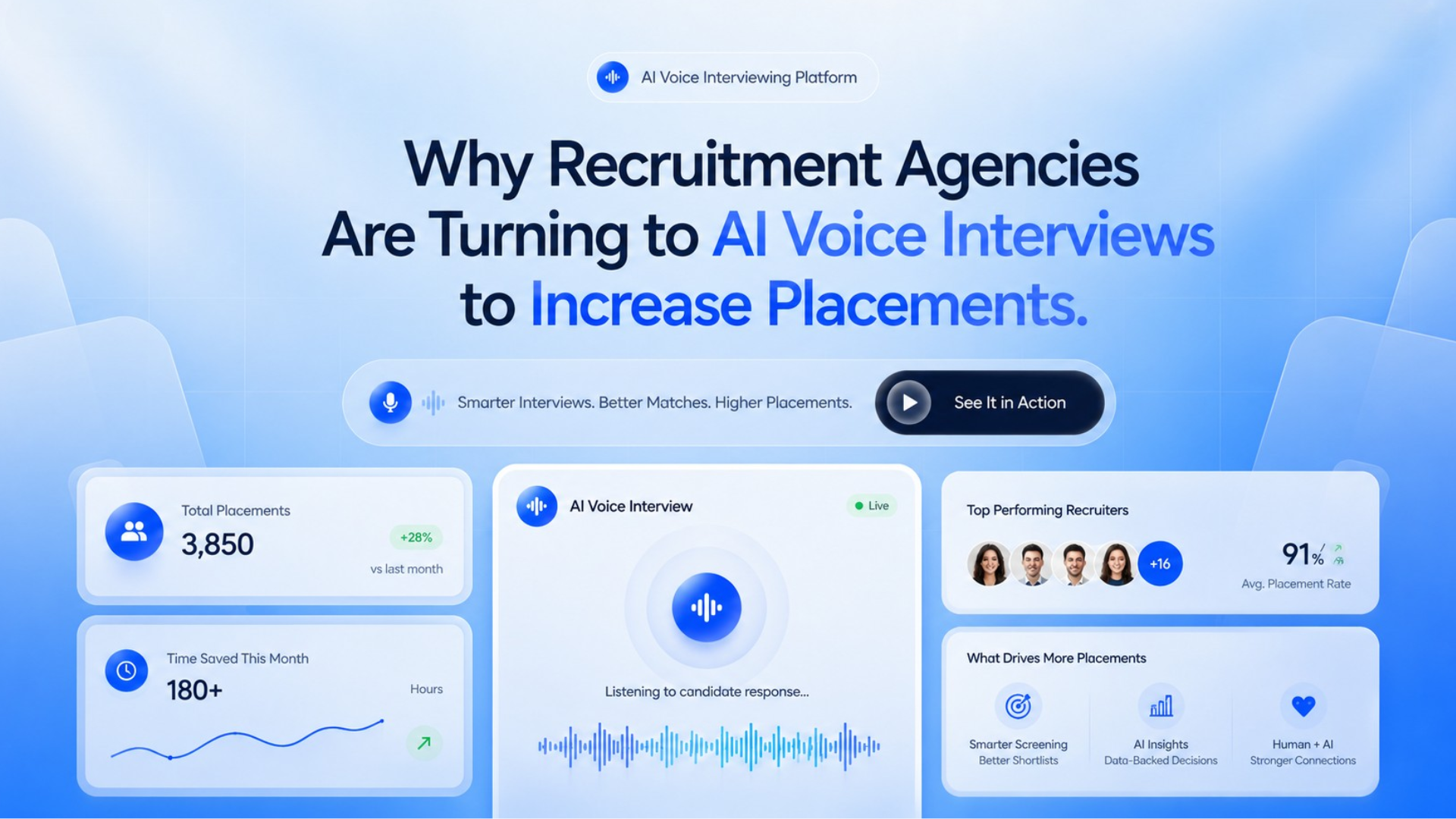
The recruitment agency business model is deceptively simple in concept and brutally difficult in execution. Revenue comes from placements. Every placement generates a fee, whether it is a contingency percentage of the candidate’s first-year compensation or a retainer paid by the client. Every placement that falls through — the candidate declines the offer, the client rejects the shortlist, the candidate drops out during the notice period — represents invested time and effort that produces zero revenue. The gap between the most profitable agencies and the rest is not usually a difference in sourcing capability or client network. It is a difference in conversion efficiency: how effectively the agency converts sourced candidates into submitted shortlists, shortlisted candidates into client interviews, interviewed candidates into offers, and offers into completed placements. AI voice interviews are emerging as the most impactful tool for improving this conversion chain at its earliest and most volume-intensive stage.
The Agency Economics Problem: Screening Is Where Revenue Bleeds
Consider the operational math of a typical mid-size contingency recruitment agency. A team of eight recruiters working on 30 active client mandates might source 200 to 400 candidates per week across all roles. Of those candidates, perhaps 60 to 80 percent will require an initial phone screen to assess viability before being submitted to the client. At 20 to 30 minutes per screen, that is 80 to 200 hours of recruiter time per week spent on initial screening alone. Across a month, the team is investing 350 to 800 hours in conversations whose primary purpose is to determine whether the candidate is worth submitting. The conversion rate from initial screen to client submission typically falls between 15 and 30
percent, meaning that 70 to 85 percent of those screening hours do not directly produce a submittable candidate. This is not wasted time — it is necessary due diligence — but it is enormous in volume, and it constrains the agency’s capacity to take on additional clients, work on more specialized roles, or invest in the candidate development activities that differentiate high-performing agencies.
The problem is not that agencies do not understand this. Every agency owner and team lead knows that initial screening is the single largest consumer of recruiter time relative to its direct placement impact. The problem is that the alternatives have historically been inadequate. Skipping the screen and submitting candidates based on resumes alone leads to higher client rejection rates, which damages the agency’s reputation and risks losing the client account entirely. Delegating screening to junior staff reduces per-screen cost but often sacrifices assessment quality, leading to the same client rejection problem. Automating screening with text-based chatbots or one-way video questions filters for basic qualifications but misses the communication and behavioral signals that recruiters rely on to assess whether a candidate will actually perform well in a client interview. AI voice interviews address all three of these failure modes simultaneously by providing the conversational depth of a phone screen with the consistency and scalability of automation, at a fraction of the time cost.
The financial impact of shifting screening to AI is not marginal. When an agency that previously spent 60 to 70 percent of its recruiter hours on initial screening reduces that proportion to 15 to 20 percent, the freed capacity can be redirected toward activities with much higher placement impact: deeper client relationship management, proactive candidate pipelining for anticipated requirements, specialized role research, and the kind of consultative engagement that positions the agency as a strategic talent partner rather than a transactional resume forwarder. Mercer’s talent trends research has found that recruitment agencies that invest a higher proportion of recruiter time in client-facing and candidate-development activities generate 30 to 45 percent more placements per recruiter than agencies where the majority of time is consumed by administrative screening and coordination tasks. The economics are straightforward: AI voice interviews do not just save time. They reallocate time toward the activities that generate revenue.
Higher-Quality Shortlists Mean Fewer Client Rejections
The most expensive outcome in agency recruitment is not a failed placement. It is a rejected shortlist. When an agency submits three to five candidates to a client and the client rejects all of them, the agency has invested sourcing time, screening time, and relationship capital for zero return. The client begins to question the agency’s understanding of the requirement. The recruiter’s confidence in their own assessment is shaken. And the clock is ticking, because the client’s hiring need has not gone away and competing agencies may already be working on the same role. Shortlist rejection is the silent killer of agency profitability, and it is far more common than most agencies are willing to admit publicly. Industry benchmarks suggest that the average shortlist rejection rate across contingency
agencies is between 20 and 35 percent, meaning that for every ten shortlists submitted, two to four are sent back with a request for better candidates.
AI voice interviews reduce shortlist rejection rates by improving the quality and consistency of the initial assessment. When every candidate who makes it to the shortlist has been evaluated through a structured voice conversation that assessed communication skills, role-relevant competencies, motivation, and cultural alignment, the agency can submit with confidence that the candidates have been thoroughly vetted on dimensions that matter to the client. The scorecard provides specific, evidence-based assessment data that the recruiter can reference in their submission notes, giving the client a clear rationale for why each candidate was selected. This level of rigor in the initial screening stage is difficult to achieve consistently with manual phone screens, particularly when recruiters are managing high volumes and the quality of each screen varies based on the recruiter’s energy, familiarity with the role, and time available.
The impact on client retention compounds over time. Clients who receive high-quality shortlists that consistently produce successful hires develop trust in the agency’s judgment and become more likely to expand the relationship with additional roles, exclusive mandates, and higher fee arrangements. Clients who repeatedly reject shortlists eventually move their business to agencies that demonstrate better judgment. AI voice interviews give agencies the assessment infrastructure to deliver that better judgment consistently, across every recruiter on the team and every role in their portfolio. As discussed in Agency Owners Are Solving Different Problems Than Recruiters Think, the challenges that drive agency profitability are not the same as the challenges that individual recruiters experience day-to-day, and the tools that address one level of the business often fail to address the other. AI voice interviews work at both levels: they make individual recruiters more productive, and they give agency owners the consistent assessment quality that drives client retention and business growth.
Speed to Submit: The Competitive Advantage That Wins Mandates
In contingency recruitment, speed is not just an operational metric. It is a competitive weapon. When a client sends the same requirement to three or four agencies simultaneously — which is standard practice in contingency arrangements — the first agency to submit a strong shortlist has a significant advantage. The client reviews the first submission, begins scheduling interviews, and may extend an offer before the other agencies have completed their screening. The second and third agencies to submit are competing for a diminishing opportunity, and their candidates may be evaluated against a higher bar because the client has already seen strong options. In some cases, the client fills the role from the first shortlist and cancels the requirement with the remaining agencies, leaving them with sunk costs and no placement.
AI voice interviews give agencies the ability to submit faster by compressing the screening stage from days or weeks to hours. A recruiter who sources 30 candidates for a
new mandate on Monday morning can have AI voice interview links sent to all 30 by Monday afternoon, receive completed scorecards by Tuesday morning, and submit a curated shortlist to the client by Tuesday afternoon. The same process with manual phone screens would take a minimum of four to five business days, assuming the recruiter could reach all 30 candidates, schedule and complete the calls, document the assessments, and prepare the submission. During those extra days, a competitor using AI screening may have already submitted and secured the client’s attention. PwC’s hiring trends analysis reports that the average time from requirement receipt to first shortlist submission has decreased by 35 percent across agencies that have adopted AI screening, and that this speed improvement directly correlates with a higher win rate on contested mandates where multiple agencies are competing for the same placement.
Speed to submit also affects the candidate side of the equation. Top candidates in competitive talent markets are typically in conversation with multiple employers and multiple agencies simultaneously. An agency that can complete its screening, present the opportunity, and submit the candidate to the client within 48 hours of first contact is far more likely to secure the candidate’s engagement than an agency that takes a week to complete the same process. By the time the slower agency is ready to submit, the candidate may have already accepted another opportunity, gone deep in another interview process, or simply lost interest. AI voice interviews protect the agency’s candidate pipeline by ensuring that the screening stage does not become the bottleneck that causes good candidates to disengage.
Scaling Without Adding Headcount: The Growth Path for Ambitious Agencies
The most common growth constraint for recruitment agencies is not a lack of client demand. It is a lack of recruiter capacity. An agency that wants to grow from handling 30 active mandates to 60, or from generating 50 placements per quarter to 100, faces a straightforward but expensive choice: hire more recruiters or find a way to make existing recruiters more productive. Hiring more recruiters increases fixed costs, requires training and ramp-up time, introduces variability in assessment quality as new recruiters join the team, and dilutes the agency’s culture and standards if growth outpaces the ability to maintain quality. Making existing recruiters more productive through AI voice interviews avoids all of these costs and risks while delivering a scalable increase in screening capacity.
The scalability of AI voice interviews is fundamentally different from the scalability of human recruiters. A recruiter can conduct eight to ten phone screens per day before quality starts to degrade. An AI voice interview system can screen 100, 500, or 1,000 candidates per day with the same level of consistency and rigor. The marginal cost of each additional screen approaches zero as volume increases, while the marginal cost of each additional human screen remains constant at 20 to 30 minutes of recruiter time. This asymmetry means that agencies using AI screening can take on higher-volume requirements, serve
clients with larger hiring needs, and enter market segments where the volume of screening would be prohibitive with manual processes. Staffing agencies supporting large-scale hiring for IT services companies, BPO operators, or manufacturing employers can now compete for mandates that were previously only accessible to the largest firms with the deepest recruiting benches.
The growth impact extends beyond just handling more volume. When screening is automated, agency owners and team leads gain visibility into the characteristics of their candidate pipeline that was previously invisible. How many candidates are being screened per role? What is the screen-to-submission conversion rate? Which competency dimensions are most frequently failing? Which recruiters are sourcing candidates who perform best on the AI evaluation? This data-driven view of the pipeline enables more informed decisions about which roles to pursue, which clients to prioritize, and where to invest in sourcing capability. As highlighted in More Tools, Same Hiring Problems, adding technology without changing how the data from that technology is used is a common trap. AI voice interviews generate actionable pipeline data that agencies can use to optimize their entire operation, not just their screening stage.
The Agency-Optimized Platform: Why Huntlo Is Built for Placement-Driven Teams
Recruitment agencies have specific platform requirements that differ from both corporate TA teams and executive search firms. They need multi-tenant or multi-client pipeline management, because every client mandate is a separate project with its own requirements, its own candidate pool, and its own reporting needs. They need sourcing that covers the broadest possible range of platforms, because contingency mandates often require casting a wide net. They need screening that produces professional-quality scorecards they can share with clients as evidence of their assessment rigor. And they need the entire workflow — from sourcing through screening through submission — to be fast enough to win on contested mandates and thorough enough to maintain the client’s trust. Generic AI screening tools designed for corporate HR teams often fail on one or more of these requirements because they were built for a different user, a different workflow, and a different definition of success.
Huntlo was built with agency workflows at its core. Its AI sourcing engine covers 50+ platforms, giving agencies the reach they need to find candidates across every channel where active and passive talent can be found. Its AI voice interview system generates detailed, competency-based scorecards that recruiters can reference in their client submissions, demonstrating the thoroughness of their assessment process. Its multi-channel outreach reaches candidates via SMS, WhatsApp, email, and other channels, ensuring that candidates are engaged through the communication methods they actually use and reducing the response-time lag that causes candidates to disengage. And its workflow management provides the client-by-client, mandate-by-mandate pipeline visibility that agency owners and team leads need to manage a growing portfolio of active requirements without
losing track of where each candidate stands in the process.
The practical impact for an agency that adopts Huntlo is a measurable shift in the ratio of recruiter time spent on revenue-generating activities versus administrative screening. Recruiters spend less time on the phone conducting repetitive initial screens and more time building client relationships, developing candidate networks, preparing compelling submissions, and managing the offer-to-start process where placements are won or lost. Agency owners get the pipeline analytics, the screening consistency, and the scalability they need to grow without proportionally increasing headcount. And clients receive better shortlists, faster submissions, and a more professional engagement experience that strengthens the agency’s position as a trusted talent partner. The agencies that will dominate the next five years of recruitment are not necessarily the largest or the most established. They are the ones that adopt the tools that let their recruiters operate at the highest possible level of effectiveness — and AI voice interviews, delivered through a platform designed for how agencies actually work, are the most impactful of those tools. As explored in How Many Follow-Ups Does One Hire Need?, the recruitment process from first contact to completed placement involves many touchpoints, and optimizing each one — starting with the first screening conversation — is what separates agencies that grow from those that plateau.
Related Topics:
Should Recruiters Worry About AI Replacing Their Jobs?
The ATS Mistake Companies Keep Repeating
What’s the Difference Between AI Sourcing and AI Recruiting?