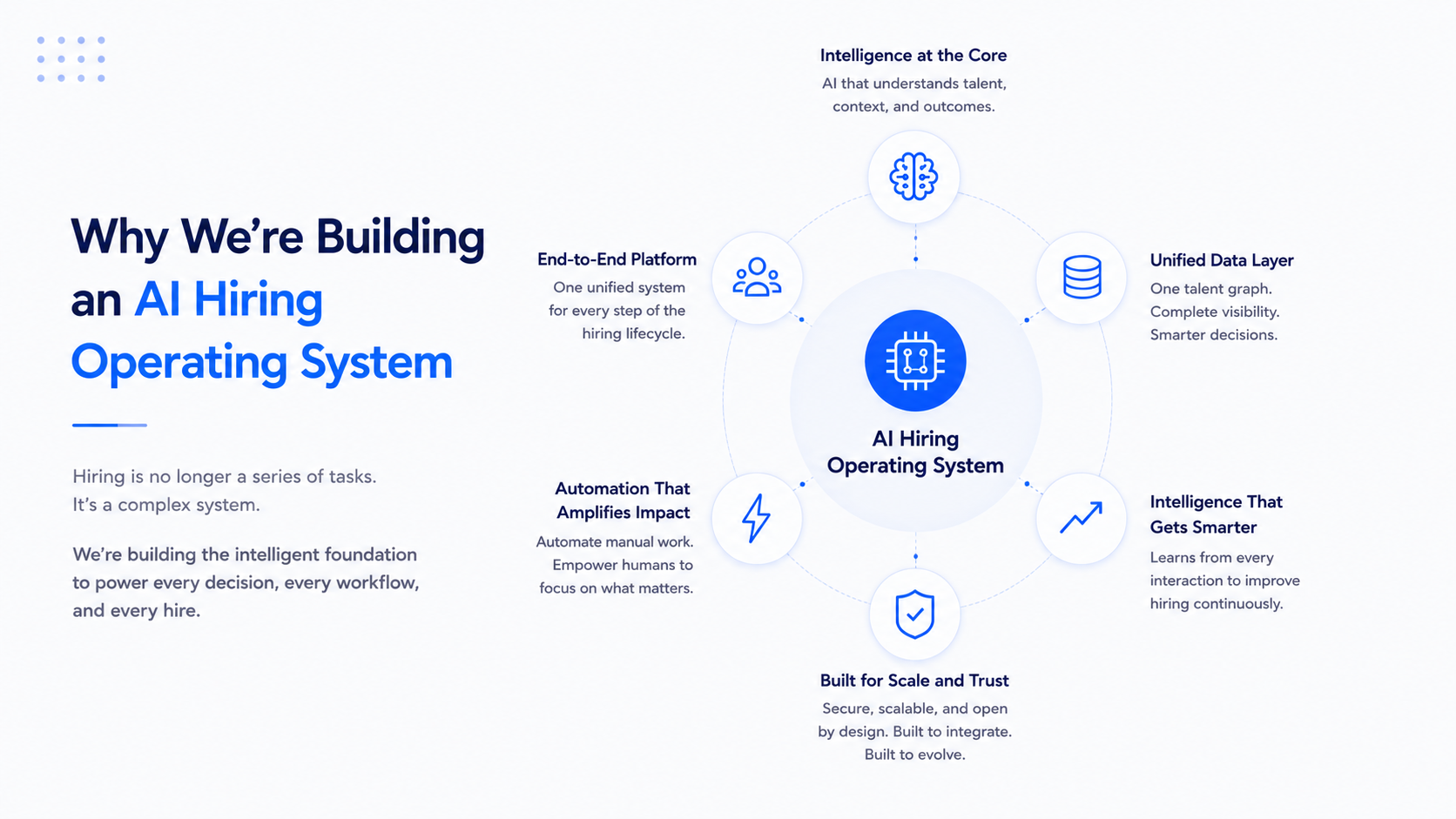
When the founding team at Huntlo set out to build their product, they did not start with a feature list or a competitive analysis. They started with a question that most recruiting technology companies never ask: what would recruiting look like if you designed it from scratch for an AI-native world, without any assumptions inherited from existing tools and processes? The answer led them to a conclusion that shaped everything that followed. Recruiting technology should not be a collection of tools that assist recruiters in managing a process. It should be an operating system that manages the entire hiring workflow autonomously, using AI to make real-time decisions about sourcing, engagement, screening, and process orchestration, while humans provide strategic oversight and outcome review. This was not an incremental improvement on the existing ATS, sourcing tool, or screening platform categories. It was a fundamentally different product archetype requiring a different architecture, a different data model, and a different business model. The team called it an AI hiring operating system, deliberately chosen to distinguish it from the tool-based paradigm that dominates HRTech. An operating system does not perform a single function. It provides the foundation on which multiple functions operate, coordinating resources, managing processes, and enabling applications to work together. Huntlo's AI hiring operating system applies this paradigm to recruiting: a unified, AI-driven foundation on which the entire process operates from talent identification through hiring decision.
The Problem with Recruiting Tools
The recruiting technology market offers thousands of tools, each designed to solve a specific
part of the recruiting problem. There are sourcing tools that find candidates, screening tools that evaluate candidates, outreach tools that engage candidates, scheduling tools that coordinate interviews, and analytics tools that measure recruiting performance. Each tool is individually useful, and the best tools in each category are genuinely impressive in their capability. But the tool-based approach to recruiting technology has a fundamental limitation that no amount of feature improvement can overcome: tools do not coordinate with each other. When a recruiting team uses five or six specialized tools, each tool operates independently, optimized for its own function but unaware of what the other tools are doing. A sourcing tool identifies a candidate and sends the profile to a screening tool. The screening tool evaluates the candidate and sends the result to an outreach tool. The outreach tool engages the candidate and sends the response to a scheduling tool. At each handoff, information is lost, context is fragmented, and optimization opportunities are missed. The sourcing tool does not know what the screening tool learned about the candidate's communication style, so it cannot adjust its sourcing criteria. The screening tool does not know what the outreach tool learned about the candidate's availability and interest level, so it cannot adjust its evaluation. The outreach tool does not know what the scheduling tool learned about the hiring manager's preferences, so it cannot tailor its messaging. This fragmentation is not a design flaw in any individual tool. It is a structural consequence of the tool-based paradigm, where each tool owns its function and its data, and coordination between tools is limited to the data that can be passed through integrations.
The fragmentation problem gets worse as recruiting complexity increases. High-volume recruiting for well-defined roles can tolerate tool fragmentation because the workflow is predictable and the decisions are relatively straightforward. But recruiting for critical, hard-to-fill roles, the roles that have the greatest impact on business outcomes, is inherently complex and unpredictable. The ideal candidate may come from an unexpected background. The screening criteria may need to be adjusted based on the candidate pool that is available. The outreach strategy may need to change based on which channels are producing responses. The interview process may need to adapt based on the candidate's schedule and the hiring manager's evolving requirements. A tool-based system cannot handle this complexity effectively because each tool optimizes its own function based on its own data, and the cross-functional optimization required for complex recruiting, adjusting the sourcing strategy based on screening results, adjusting the outreach strategy based on sourcing outcomes, and adjusting the screening criteria based on hiring manager feedback, requires a level of coordination that the tool-based paradigm cannot provide. The human recruiter is supposed to provide this coordination, manually synthesizing information from multiple tools and making cross-functional decisions. But asking a recruiter to manually coordinate five or six specialized tools while also managing candidate relationships, hiring manager expectations, and offer negotiations is asking them to do the one thing that humans are worst at: maintaining coherent awareness of multiple parallel data streams and making consistent, optimized decisions across all of them simultaneously.
The tool-based paradigm also creates a data problem that undermines AI effectiveness. Each
tool generates data about its function, sourcing metrics, screening scores, outreach response rates, and scheduling efficiency. But because the tools operate independently, their data is siloed in separate systems with separate data models. The AI models in each tool can only learn from the data that the tool generates, which means they can only optimize their specific function. The sourcing AI can learn which search queries produce the best candidates. The screening AI can learn which screening questions predict fit. The outreach AI can learn which message templates generate the highest response rates. But none of these AIs can learn from the data that the other tools generate, which means they cannot optimize across the recruiting workflow. They cannot learn that candidates sourced through a specific channel with a specific profile pattern tend to respond better to a specific outreach style and tend to perform better in a specific type of screening conversation. This cross-functional learning, where the AI improves its performance across the entire workflow based on data from every step, is what an operating system enables and what the tool-based paradigm structurally prevents. more tools same hiring problems explains why adding more recruiting tools to a fragmented stack does not solve this coordination problem, because each additional tool adds another data silo and another integration point without addressing the fundamental issue that the tools cannot learn from each other's data or coordinate their actions in real time. According to McKinsey, the average enterprise recruiting operation using a tool-based approach loses fifteen to twenty-five percent of potential hiring value to coordination gaps between tools, data fragmentation that prevents cross-functional AI optimization, and manual overhead that consumes recruiter time that should be spent on strategic activities.
The Operating System Paradigm for Recruiting
An operating system, whether for a computer, a smartphone, or a recruiting process, performs four functions that tools alone cannot perform. First, it provides a unified data model that all applications share, ensuring that every component of the system operates on the same view of reality. In a computer operating system, every application accesses the same file system, the same network resources, and the same hardware through standardized interfaces. In a recruiting operating system, every function, sourcing, screening, outreach, and scheduling, operates on the same candidate profile, the same job requisition, and the same hiring workflow, ensuring that information flows seamlessly between functions without the loss and fragmentation that occurs when tools hand off data through integrations. Second, an operating system provides process orchestration, coordinating the execution of multiple applications to achieve a coherent outcome. A computer operating system manages CPU scheduling, memory allocation, and I/O operations to ensure that applications run efficiently and do not conflict with each other. A recruiting operating system manages the sequence and timing of sourcing, screening, outreach, and scheduling activities to ensure that the recruiting process is optimized for speed, quality, and candidate experience.
Third, an operating system provides resource management, allocating computational resources, storage, bandwidth, and processing power, to the applications that need them based
on current priorities and constraints. A recruiting operating system allocates AI processing resources, candidate engagement capacity, and hiring manager attention, to the requisitions and candidates that will benefit most, dynamically adjusting allocation as conditions change. When a critical role has an upcoming deadline, the operating system allocates more sourcing and outreach resources to that role. When a candidate pool is deep for a particular requisition, the operating system allocates fewer screening resources per candidate. This dynamic resource allocation is impossible in a tool-based approach because each tool manages its own resources independently and cannot see the resource demands and constraints across the entire recruiting operation. Fourth, an operating system provides a security and governance layer that ensures all applications operate within defined policies and compliance requirements. A recruiting operating system ensures that every candidate interaction, whether generated by the sourcing, screening, or outreach function, complies with applicable regulations, organizational policies, and ethical standards. This governance is applied consistently across all functions, which is more effective and more auditable than the function-specific compliance checks that individual tools implement independently.
The operating system paradigm is not just a metaphor for Huntlo's product. It is the architectural principle that determines how the product is designed, built, and operated. Huntlo's AI hiring operating system has a unified candidate data model at its core, which means that every interaction with a candidate, whether it occurs during sourcing, screening, outreach, or scheduling, updates the same candidate profile. The AI models that power each function, sourcing, screening, outreach, and scheduling, all read from and write to this unified profile, which means they can learn from each other's data and optimize across the entire workflow. The sourcing model can use screening outcomes to improve its candidate identification. The screening model can use outreach response patterns to adjust its evaluation criteria. The outreach model can use scheduling data to personalize its messaging. This cross-functional AI optimization is the primary technical advantage of the operating system approach, and it produces compounding improvements in recruiting performance that tool-based systems cannot match. According to Gartner, AI platforms with unified data models and cross-functionally optimized AI models improve overall recruiting outcomes by twenty to thirty percent compared to best-in-class tool combinations, because the cross-functional optimization eliminates the coordination gaps and data fragmentation that limit the effectiveness of even the best individual tools. agentic AI platforms vs automated ones explains how the operating system paradigm enables agentic behavior, because the unified data model and process orchestration layer allow the AI to manage the entire recruiting workflow autonomously, making real-time decisions about how to allocate resources and prioritize activities based on the complete state of the recruiting operation rather than the partial view that any individual tool can provide.
What Makes Huntlo's Approach Different
The AI hiring operating system that Huntlo is building differs from existing recruiting technology in four fundamental ways that correspond to the four operating system functions
described above. The first difference is the unified talent graph, which is Huntlo's implementation of the unified data model. The talent graph is not a traditional database. It is a dynamic, continuously updated representation of every candidate, requisition, and hiring interaction in the system, connected through relationships that capture how candidates relate to roles, how interactions relate to outcomes, and how patterns in one part of the graph predict outcomes in another. When a candidate is sourced, the talent graph creates a node for that candidate and connects it to the requisition and the sourcing channel. When the candidate is screened, the screening results are added to the candidate's node and connected to the screening model's predictions. When the candidate receives an outreach message and responds, the response data is added and connected to the outreach model's predictions. The result is a rich, multi-dimensional representation of the candidate that incorporates data from every function in the recruiting process, enabling AI models to make predictions and decisions based on the complete picture rather than the partial view that any single function provides.
The second difference is the AI orchestration engine, which is Huntlo's implementation of process orchestration. The orchestration engine manages the end-to-end recruiting workflow, deciding in real time what actions to take, in what sequence, and with what priority, based on the current state of the talent graph and the objectives defined by the hiring team. When a new requisition is created, the orchestration engine analyzes the requisition requirements, assesses the available talent pool, and develops a sourcing strategy that considers the role's priority, the expected difficulty of filling the role, and the competing demands on the system's resources. As candidates are identified, the engine determines which candidates to screen, in what order, and with what screening approach, based on the sourcing data and the requisition requirements. As screening results become available, the engine determines which candidates to engage, through which channels, with what messaging, and at what cadence, based on the combined sourcing and screening data. This dynamic, AI-driven orchestration is fundamentally different from the static, rule-based workflow automation that traditional ATS platforms provide, because it adapts in real time to the actual conditions of the recruiting process rather than following a predetermined sequence of steps.
The third difference is the adaptive resource allocator, which dynamically distributes the system's AI processing capacity, candidate engagement bandwidth, and human reviewer attention across all active requisitions based on real-time priority and performance data. Critical roles with approaching deadlines receive more sourcing and outreach resources. Requisitions with strong candidate pipelines receive fewer additional sourcing resources. The allocator continuously rebalances resources as conditions change, ensuring that the recruiting operation's overall performance is optimized even when individual requisitions have conflicting demands. The fourth difference is the unified governance layer, which ensures that every action the system takes, whether sourcing, screening, outreach, or scheduling, complies with applicable regulations, organizational policies, and ethical standards. The governance layer is not a set of static rules. It is an AI-powered compliance system that evaluates each action in context, considering the candidate's jurisdiction, the role's regulatory sensitivity, and the organization's specific compliance requirements, and adjusts the action or escalates to a human
reviewer when compliance risk is detected. This four-pillar architecture, unified talent graph, AI orchestration engine, adaptive resource allocator, and unified governance layer, is what makes Huntlo's product an operating system rather than a tool, and it is the technical foundation that enables the autonomous recruiting workflow that produces the step-change improvements in cost, speed, and quality that enterprise clients are seeking. According to Deloitte, the operating system approach to recruiting technology represents the most significant architectural innovation in the HRTech market since the shift from on-premise to cloud deployment, because it fundamentally changes the relationship between the technology and the recruiting process from tool-assisted to system-managed. why AI tools have outdated candidate data explains why the unified talent graph solves the data staleness problem that plagues tool-based recruiting systems, because the continuous updates from all functions ensure that the candidate profile always reflects the most current information, enabling AI models to make decisions based on real-time data rather than the stale, fragmented data that tools provide.
The Outcomes the Operating System Delivers
The operating system approach delivers measurably different outcomes than the tool-based approach across the three dimensions that matter most to enterprise recruiting organizations: cost, speed, and quality. On cost, the operating system reduces the total cost of recruiting by thirty to fifty percent compared to tool-based approaches by eliminating the redundancy and overhead that tool fragmentation creates. In a tool-based approach, each tool has its own subscription cost, its own implementation cost, its own integration maintenance cost, and its own training cost. The operating system replaces multiple tools with a single platform, eliminating the duplicate costs while providing more comprehensive capability. More importantly, the operating system reduces the human labor cost per hire by enabling recruiters to manage significantly more requisitions at higher quality, because the AI orchestration engine handles the operational aspects of recruiting that currently consume the majority of recruiter time. Organizations using the operating system approach report that each recruiter can manage two to three times as many requisitions as with tool-based approaches, because the AI handles sourcing, screening, outreach, and scheduling autonomously, freeing the recruiter to focus on strategic activities like hiring manager consultation, candidate relationship management, and offer negotiation.
On speed, the operating system reduces time to fill by forty to sixty percent compared to tool-based approaches by eliminating the coordination delays and sequential handoffs that tool fragmentation creates. In a tool-based approach, each step in the recruiting process waits for the previous step to complete and for the human recruiter to initiate the next step. A candidate identified by the sourcing tool waits for the recruiter to review the profile, initiate the screening, review the screening result, initiate the outreach, and review the response before any engagement occurs. These human-initiated handoffs add days to the process at each step, and the cumulative effect is significant. The operating system eliminates these handoffs by orchestrating the entire workflow autonomously. A candidate identified by the sourcing function
is immediately evaluated by the screening function, and if the candidate passes the screening threshold, engaged by the outreach function, all without requiring human initiation at each step. The human recruiter reviews the system's decisions and intervenes only when the system escalates an exception or the hiring manager provides feedback that requires a strategic adjustment. This elimination of inter-step delays is the primary mechanism through which the operating system achieves its time-to-fill improvement, and it is a mechanism that is structurally impossible in a tool-based approach because the tools cannot initiate actions in other tools without human mediation.
On quality, the operating system improves quality of hire by fifteen to twenty-five percent compared to tool-based approaches by enabling the cross-functional AI optimization that the unified data model makes possible. In a tool-based approach, the screening AI evaluates candidates based on the data available in the screening tool, which is limited to the information captured during the screening interaction. The operating system's screening AI evaluates candidates based on the complete talent graph, which includes sourcing context, such as where the candidate was found and how they were discovered; screening data, including the full conversation and assessment results; outreach response patterns, including how quickly and enthusiastically the candidate responded; and historical data from similar candidates and similar roles. This richer evaluation context produces more accurate predictions of candidate fit and success, which translates into better hiring decisions. The quality improvement compounds over time as the operating system's AI models learn from the growing dataset of hiring outcomes, continuously refining their predictions and improving their accuracy. According to LinkedIn, organizations using operating-system-style AI recruiting platforms report twenty to thirty percent higher hiring manager satisfaction scores and fifteen to twenty percent lower first-year turnover compared to organizations using tool-based recruiting stacks, because the cross-functional AI optimization produces better candidate-role matches and the autonomous workflow ensures that top candidates are engaged faster than competitors using manual processes can achieve. how many follow-ups one hire needs illustrates how the operating system approach transforms candidate follow-up from a recruiter-dependent activity into a system-managed process, because the orchestration engine determines the optimal follow-up timing, channel, and content for each candidate based on the complete talent graph, producing response rates that exceed what even the best recruiters can achieve manually when managing large candidate volumes across multiple requisitions.
The Vision: Recruiting as a Strategic Function
The ultimate vision behind Huntlo's AI hiring operating system is not just to make recruiting faster, cheaper, or better, although it does all three. The vision is to elevate recruiting from a tactical operational function to a strategic business function that directly contributes to competitive advantage. In most organizations today, recruiting is viewed and managed as an operational process: receive a requisition, fill the requisition, report on the metrics. The recruiting team is evaluated on operational efficiency metrics like time to fill, cost per hire, and
requisition fulfillment rate. These are important metrics, but they measure the efficiency of the recruiting process, not its strategic impact. The strategic impact of recruiting is measured by the quality of talent the organization acquires, the speed with which the organization can build teams for new initiatives, and the alignment between the talent the organization hires and the strategy the organization is pursuing. An operating system that manages the recruiting process autonomously enables the recruiting function to shift its focus from operational execution to strategic contribution, because the AI handles the operational aspects of recruiting while the human recruiting team focuses on the strategic aspects: workforce planning, talent strategy, employer branding, and competitive talent intelligence.
This elevation of recruiting from operational to strategic is the transformation that the operating system enables and that tool-based approaches cannot deliver. When recruiters spend the majority of their time managing tools, coordinating handoffs, and executing process steps, they do not have the time or the mental bandwidth for strategic work. When the operating system handles the process execution, recruiters are freed to think about the bigger questions: what talent does the organization need to execute its strategy over the next three years? What talent segments are becoming more competitive and how should the organization respond? What is the organization's employer value proposition and how should it be communicated to attract the best candidates? How should the organization balance building talent internally versus acquiring talent externally? These strategic questions have far more impact on organizational performance than optimizing time to fill by three days or reducing cost per hire by five hundred dollars, but they are chronically underaddressed because the recruiting team's time is consumed by operational demands. The operating system does not eliminate the need for recruiting expertise. It redeployes that expertise from operational execution to strategic contribution, which is a higher-value use of the organization's most experienced recruiting talent. According to EY, organizations that have shifted their recruiting teams from operational execution to strategic advisory roles, enabled by AI-powered process automation, report twenty-five to thirty-five percent improvement in hiring manager satisfaction and twenty to thirty percent improvement in alignment between hiring outcomes and business strategy, because the strategic focus ensures that recruiting investment is directed toward the talent that matters most for business execution rather than being distributed evenly across all requisitions regardless of strategic priority.
The operating system vision extends beyond the recruiting team to the entire organization. When recruiting operates as a strategic function powered by an AI operating system, the insights it generates about the talent market, candidate preferences, competitive hiring dynamics, and hiring outcome patterns become strategic inputs for business decisions beyond hiring. The talent intelligence that the operating system generates through its daily operations, which roles are hard to fill, which skills are becoming scarce, which competitors are hiring aggressively, and which compensation strategies are most effective, informs decisions about where to locate offices, which markets to enter, which products to build, and how to allocate investment. This transformation of recruiting from a cost center to an intelligence center is the end state of the operating system vision. It is the reason Huntlo is building an operating system
rather than a tool: because an operating system generates the comprehensive, cross-functional data that enables strategic talent intelligence, while tools generate the fragmented, function-specific data that limits strategic insight. The companies that adopt this operating-system approach to recruiting will not just hire better. They will make better business decisions, because they will have better information about the talent markets that increasingly determine which companies win and which fall behind. AI sourcing vs AI recruiting demonstrates how the operating system's unified approach to sourcing and recruiting creates strategic intelligence that neither function can generate independently, because the combination of supply-side data from sourcing and demand-side data from recruiting provides the complete talent market picture that strategic decision-making requires. how to evaluate an AI sourcing tool explains why evaluating an AI hiring operating system requires a fundamentally different framework than evaluating a recruiting tool, because the operating system's value is measured in strategic outcomes like talent intelligence quality, recruiting team productivity, and business alignment, not in feature-by-feature comparisons that assess individual capabilities in isolation.