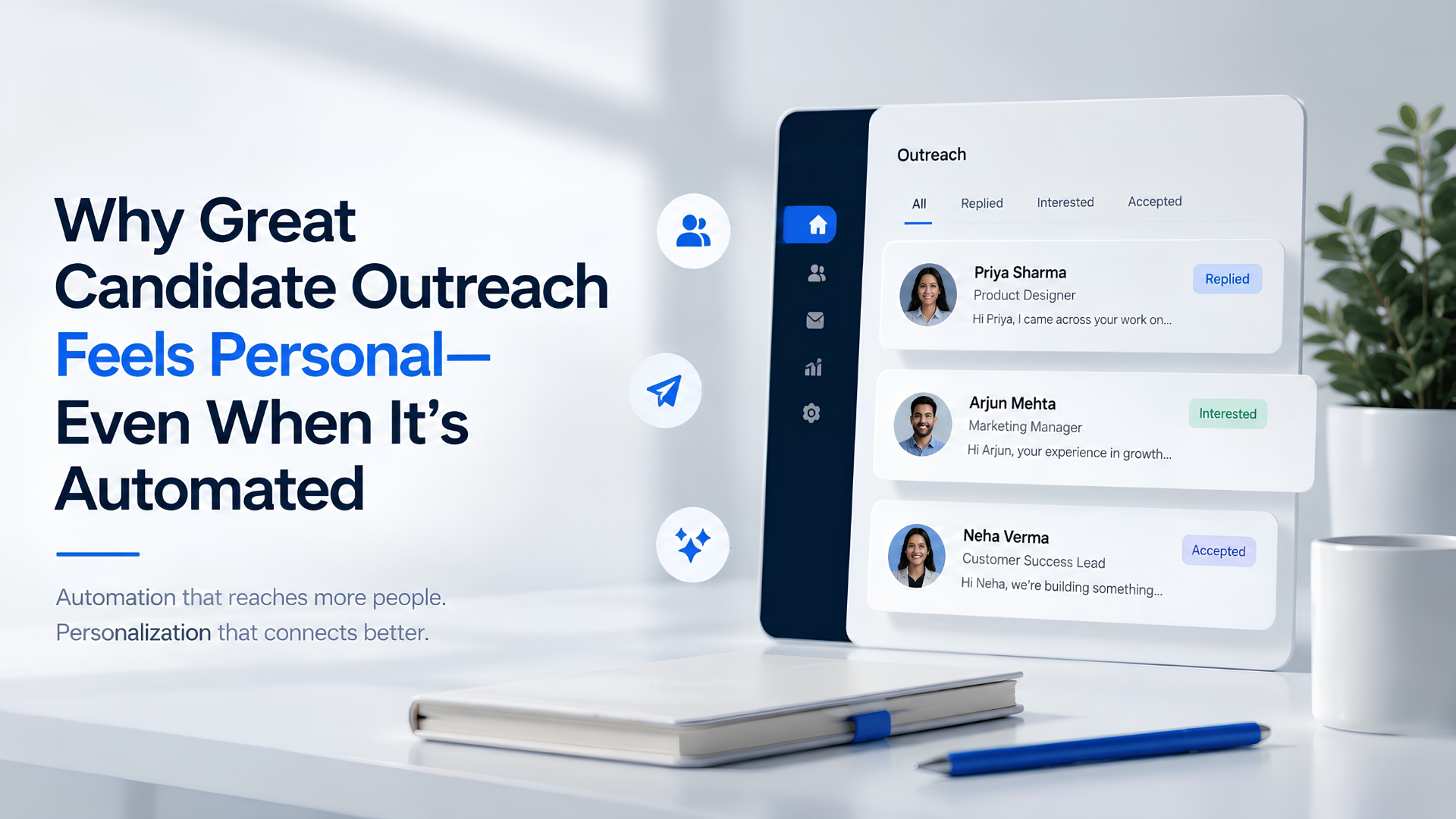
There is a fundamental difference between personalization that a candidate can see and personalization that a candidate can feel. The kind that candidates can see — a first name inserted into a generic template, a company name swapped into a boilerplate paragraph, a job title referenced without any context about why it might be relevant — does more harm than good, because it signals that the sender invested the minimum effort possible. Candidates recognize template personalization instantly, and their response to it is not engagement but dismissiveness. The message gets archived, the sender gets mentally categorized as another recruiter who has not done their homework, and the opportunity to make a meaningful first impression is lost. The kind of personalization that candidates can feel is entirely different. It is the sense that the person on the other end understands who you are, what you do, and why this particular opportunity might matter to you. The challenge for recruitment teams has never been understanding this distinction. It has been achieving the second kind at scale.
The Personalization Spectrum: From Embarrassing to Invisible
Most automated candidate outreach today operates at what might be called the visible personalization level. The system takes a template message, inserts the candidate’s first name, references their current employer and job title, and perhaps includes a sentence about the role being recruited for. The result reads like what it is: a mass message with variable fields filled in. A senior engineer who receives a message that says “Hi [Name], I came across your profile and was impressed by your experience at [Company]. We have an
exciting [Job Title] opportunity that I think would be a great fit” knows immediately that this message was sent to hundreds of people with the same template. The personalization is not just unconvincing. It is counterproductive, because it demonstrates that the recruiter did not invest time in understanding the candidate’s specific background, skills, or career trajectory before reaching out.
The next level up is contextual personalization, where the outreach message references specific elements of the candidate’s professional background that are relevant to the opportunity. This might include mentioning a specific project the candidate led, a technology stack they have deep experience with, a publication they authored, or a career transition they made that aligns with the role being recruited for. At this level, the message feels like it was written by someone who actually read the candidate’s profile and thought about the fit. The problem is that generating contextual personalization manually requires significant time per candidate — typically 10 to 15 minutes of research, reflection, and message drafting for each outreach. A recruiter who wants to send 50 personalized messages per day will spend 8 to 12 hours on research and writing alone, leaving no time for the follow-ups, screenings, and candidate management activities that move people through the hiring pipeline.
The highest level is intelligent personalization, where the outreach message not only references specific, relevant details about the candidate’s background but also connects those details to the specific value proposition of the opportunity in a way that demonstrates genuine understanding. This is the level where outreach stops feeling like outreach and starts feeling like a professional conversation initiated by someone who has done their homework. It is the level that generates response rates three to five times higher than template-based outreach, according to LinkedIn’s talent solutions research on recruiter messaging effectiveness, which found that messages containing specific references to a candidate’s work experience or professional achievements generated significantly higher engagement than messages that relied on template-based personalization. The challenge has always been that intelligent personalization is the most time-intensive level to produce manually, which means it has been reserved for the highest-priority candidates while the rest of the pipeline receives generic or semi-personalized messages. AI changes this equation by making intelligent personalization possible for every candidate in the pipeline, not just the ones at the top of the recruiter’s priority list.
What Makes AI-Generated Outreach Feel Genuinely Human
The reason AI-generated outreach can feel more personal than human-written template outreach is not that the AI is more creative or more empathetic than the recruiter. It is that the AI has access to more information about each candidate and can process that information faster than any human can. When a recruiter sends a manual outreach message, the personalization is limited by the time they can afford to spend researching each candidate. They might skim the candidate’s LinkedIn profile, note the current role and employer, and craft a message based on those surface-level data points. An AI outreach system, by contrast, can analyze the candidate’s full professional profile — including work history, skills,
endorsements, publications, certifications, project contributions, and professional activity patterns — and generate a message that references the specific aspects of the candidate’s background that are most relevant to the opportunity.
The result is not a generic message with the candidate’s name inserted. It is a message that might reference a specific product the candidate launched, a particular technology migration they led, a domain expertise they have developed over multiple roles, or a career trajectory that positions them uniquely for the opportunity. The candidate reading this message does not think “This was generated by AI.” They think “This recruiter actually understands my background.” That perception of understanding is what makes outreach feel personal, and it is remarkably difficult to distinguish from a well-researched human message when the AI has access to sufficient context about both the candidate and the role. The critical success factor is not the AI’s language generation capability, which is now mature and reliable for professional communication. It is the quality and depth of the candidate data that feeds the AI’s contextual understanding. As explored in Why Do Some AI Recruiting Tools Have Outdated Candidate Data?, the difference between AI outreach that impresses candidates and AI outreach that embarrasses recruiters often comes down to whether the underlying candidate data is current and comprehensive or stale and incomplete. The AI can only reference what it knows, and if it knows very little, the output will be generic regardless of how sophisticated the language model is.
The second factor that makes AI outreach feel human is specificity. Generic outreach talks about the opportunity in abstract terms: “exciting growth phase,” “collaborative culture,” “competitive compensation.” These phrases could describe thousands of companies and mean nothing to a candidate who is trying to decide whether a particular opportunity is worth their time. Intelligent AI outreach replaces abstractions with specifics: the actual scale of the engineering team the candidate would join, the specific technical challenges the product is facing, the tangible impact the role would have on the business, and the concrete reasons why the candidate’s particular experience makes them a strong fit. Specificity signals that the sender has done more than read a job description. It signals that they understand the role deeply enough to communicate its substance rather than its marketing copy. Candidates respond to specificity because it gives them something real to evaluate, and that sense of being treated as a serious professional rather than a name in a database is what makes outreach feel genuinely personal.
The Follow-Up Problem: Why Most Outreach Fails After the First Message
The outreach message is only the beginning of the engagement process, and it is in the follow-up stage that most recruitment teams fall short — not because they lack commitment, but because the operational demands of consistent, personalized follow-up across a large candidate pipeline are overwhelming. The data on follow-up effectiveness is unambiguous. According to research across multiple recruitment platforms, the majority of candidate responses to initial outreach occur after the second or third follow-up message, not after the first. Many candidates intend to respond to an interesting outreach message but
get distracted by the demands of their current role, and a well-timed follow-up that adds new information or addresses a question the candidate might have is often what converts interest into action. Yet the same research shows that most recruiters send only one follow-up before moving on, primarily because the manual effort of crafting personalized follow-ups for dozens or hundreds of candidates is operationally unsustainable.
AI outreach systems address this follow-up gap by generating contextually appropriate follow-up messages that build on the initial outreach rather than simply repeating it. The first follow-up might share additional detail about the role’s technical challenges or the team’s recent accomplishments. The second follow-up might address a common concern that candidates in this profile typically have, such as relocation, compensation structure, or career growth trajectory. The third follow-up might offer a specific piece of information that demonstrates the company’s credibility, such as a recent product launch, a notable customer win, or a leadership appointment. Each follow-up adds value rather than simply nudging, which is what distinguishes effective follow-up from annoying persistence. The candidate’s experience is of a recruiter who is thoughtful, knowledgeable, and genuinely interested in them — not a recruiter who is blast-sending the same reminder on a three-day cadence. As covered in How Many Follow-Ups Does One Hire Need?, the optimal follow-up strategy is not about sending more messages but about sending smarter ones, and AI is uniquely positioned to determine what “smarter” means for each individual candidate based on their profile, their engagement pattern, and the specific opportunity being discussed.
Multi-Channel Outreach: Meeting Candidates Where They Actually Are
The personalization of outreach extends beyond the content of the message to the channel through which it is delivered. Different candidate populations prefer different communication channels, and the channel preference is often influenced by factors like seniority level, industry, geography, and whether the candidate is actively or passively exploring opportunities. A senior technology executive in the United States is most likely to engage with a well-crafted LinkedIn message or a referral introduction. A mid-career professional in India may be more responsive to a WhatsApp message. A recent graduate in Southeast Asia may prefer an SMS or email approach. A blue-collar worker applying for a warehouse position is most effectively reached through the job platform where they discovered the listing. Sending every candidate the same message through the same channel is not just suboptimal. It signals that the recruiter has not thought about the candidate as an individual, which undermines the personalization of the message itself regardless of how well-written it is.
AI-powered outreach platforms can match the communication channel to the candidate’s likely preferences based on their professional profile, their activity patterns, and the channel through which they were originally sourced. A candidate discovered through LinkedIn receives a LinkedIn message. A candidate whose profile indicates they are active on a particular job board receives an email through that platform’s messaging system. A candidate who was referred by an employee receives a warm introduction that references
the mutual connection. This channel intelligence is a form of personalization that candidates feel even when they cannot articulate it. A message that arrives through the platform where the candidate is most active and most receptive feels natural and unobtrusive. A message that arrives through an unexpected or inconvenient channel feels intrusive, regardless of how personalized the content is. EY’s workforce research has found that candidate response rates improve by 20 to 35 percent when the outreach channel matches the candidate’s communication preferences, and that this improvement is independent of the message content, suggesting that channel fit is a distinct and underappreciated dimension of personalization that AI outreach systems are uniquely positioned to optimize.
Outreach That Works at Scale Requires a Platform Built for It
The principles of great outreach — intelligent personalization, specific and substantive messaging, consistent and value-adding follow-ups, and channel-appropriate delivery — are well understood. The challenge has always been execution at scale. A recruiter who can produce this quality of outreach for five candidates per day is performing at an elite level. But most hiring teams need to reach fifty, five hundred, or five thousand candidates to fill their pipelines, and the gap between what great outreach requires and what manual effort can deliver is where most candidate engagement strategies break down. The result is the familiar pattern: strong outreach for the top-priority candidates, generic template blasts for everyone else, and a pipeline that is either too narrow to produce enough qualified candidates or too wide to maintain the quality of engagement that converts interest into applicants.
Huntlo addresses this execution gap with an AI-powered outreach system that is deeply integrated with its sourcing, screening, and pipeline management capabilities. Its sourcing engine identifies candidates across 50+ platforms, providing the breadth of data that intelligent personalization requires. Its AI generates outreach messages that reference specific, relevant details from each candidate’s professional profile, connecting those details to the specific value proposition of the role. Its multi-channel delivery system reaches candidates via SMS, WhatsApp, email, and platform-native messaging, matching the channel to the candidate’s likely preferences. And its automated follow-up sequences generate contextually appropriate messages that build on previous interactions rather than repeating them, maintaining the quality of engagement across the entire pipeline without requiring manual effort from the recruiting team. The difference between outreach that generates a 5 percent response rate and outreach that generates a 20 to 30 percent response rate is not a better template. It is a fundamentally different approach to understanding the candidate and communicating with them as an individual. Huntlo delivers that approach at the scale that modern hiring demands.
The future of candidate outreach is not more messages. It is better ones. The organizations that will win the competition for talent are not the ones that send the highest volume of outreach, but the ones whose outreach consistently makes each candidate feel understood, respected, and genuinely contacted about something relevant to their career. AI makes this possible by providing the contextual intelligence, the personalization depth, the
follow-up consistency, and the channel optimization that human recruiters cannot deliver manually at scale. The result is not artificial personalization. It is authentic, information-rich communication that treats every candidate as an individual — which is exactly what the best human recruiters have always aspired to do, and what AI finally makes possible for every candidate in the pipeline, not just the lucky few at the top. As discussed in What’s the Difference Between AI Sourcing and AI Recruiting?, the full potential of AI in talent acquisition is realized when sourcing, outreach, screening, and pipeline management work together as an integrated system rather than a collection of disconnected tools. Outreach that feels personal is not the endpoint of that integration. It is the most visible sign that the system is working as it should.
Related Topics:
Why Referrals Outperform Cold Outreach
The ATS Mistake Companies Keep Repeating
What Makes an AI Recruiting Platform Agentic vs. Just Automated?