There is a persistent belief in recruiting that speed and quality are locked in a zero-sum tradeoff. Screen faster, the thinking goes, and you will inevitably miss great candidates. Take your time, be thorough, and you will find the right person. This intuition feels so self-evident that it rarely gets questioned. But it is wrong. Not slightly wrong, not wrong in edge cases, but fundamentally wrong in its assumption about the relationship between screening speed and screening accuracy. The truth is that in most real-world recruiting environments, slower screening actually produces worse hiring outcomes, not better ones. Understanding why this is the case requires looking at how human cognition works under the conditions that high-volume screening creates, and what happens when those conditions are changed by introducing a fundamentally different approach to candidate evaluation.
This article explains the science that debunks the speed-quality tradeoff in candidate screening. It covers the cognitive limits that make slow manual screening self-defeating, the difference between speed that comes from cutting corners and speed that comes from using better methods, and the specific ways in which AI-native screening platforms produce shortlists that are both faster to generate and more accurate than those produced by manual review. The argument is not that speed is inherently good. It is that the methods that produce speed and the methods that produce quality are, in candidate screening, the same methods. When you optimize for the right kind of speed, you automatically optimize for quality, because the obstacles to quality and the obstacles to speed share a common root cause: the limitations of unaided human judgment applied to high-volume evaluation tasks.
The Decision Fatigue Problem: Why Slower Screening Gets Worse Over Time
The most important reason that faster screening often means better quality is a cognitive phenomenon called decision fatigue. Research pioneered by Roy Baumeister and his colleagues has demonstrated that the quality of human decision-making degrades systematically after a sequence of demanding choices. Each screening decision requires the reviewer to process
multiple pieces of information, weigh competing signals, suppress intuitive biases, and render a judgment under uncertainty. This is cognitively expensive work, and the research shows that the cognitive resources required for this kind of careful evaluation are finite and depletable. After roughly 20 to 30 complex screening decisions, the accuracy of a recruiter’s evaluations begins to decline measurably.
The practical implications for recruiting are significant. When a recruiter is assigned to screen 150 candidates for an open role, the candidates reviewed in the first hour receive a fundamentally different quality of evaluation than the candidates reviewed in the fourth or fifth hour. The early candidates are evaluated with full cognitive resources: the recruiter is attentive, analytical, and capable of distinguishing between genuine evidence of capability and superficial credentials. The later candidates are evaluated under conditions of cognitive depletion: the recruiter is relying more heavily on heuristics, making faster and more superficial judgments, and is more susceptible to the halo effect, confirmation bias, and similarity bias that distort evaluation accuracy. The result is a shortlist that reflects not just candidate quality but also the order in which candidates were reviewed and the cognitive state of the reviewer at each point in that sequence.
This is why manual screening is not just slow. It is self-defeatingly slow. The more candidates there are to screen, the longer the process takes, and the longer the process takes, the worse the later evaluations become. The screening process consumes the very cognitive resources it needs to function well. AI screening platforms break this cycle by handling the high-volume first-pass evaluation with consistent accuracy regardless of how many candidates are in the pool. The recruiter’s cognitive resources are preserved for the smaller number of candidates who reach the second tier, where nuanced human judgment creates the most value. This is not about replacing recruiters, a concern we have addressed in our analysis of whether recruiters should worry about AI replacing their jobs. It is about ensuring that human judgment is applied where it matters most, rather than being diluted across a volume of evaluations that exceeds the brain’s capacity to perform them well.
The Predictive Validity Advantage: Why AI Evaluation Beats Rushed Human Review
The second reason that faster screening can mean better quality is that the evaluation methods used by AI screening platforms have higher predictive validity than the methods used by human reviewers under time pressure. Predictive validity, as established by decades of research in industrial-organizational psychology, measures how accurately an assessment method predicts the outcome it is designed to predict. In hiring, that outcome is job performance. Structured evaluation methods with clear criteria and consistent scoring consistently outperform unstructured human judgment, particularly when that judgment is applied under conditions of high volume and limited time per candidate.
Consider what happens when a recruiter is screening candidates under time pressure. They have a stack of 200 resumes to review and a deadline of two days. To meet that deadline, they must spend an average of roughly four minutes per candidate. In four minutes, they must read
the resume, assess the candidate’s fit against the role requirements, compare the candidate to the mental benchmark they have built from previous reviews, and make a screening decision. Under these conditions, the recruiter is not performing a structured evaluation. They are performing a rapid pattern-matching exercise, looking for surface signals like company names, job titles, and keyword matches. These surface signals have low predictive validity. The recruiter knows this, but they have no alternative, because the structured evaluation that would produce higher validity requires more time per candidate than the volume allows.
An AI screening platform faces no such time constraint. It can evaluate each candidate against a detailed, role-specific scoring framework in seconds, assessing signals that a time-pressed human reviewer would never have time to examine: the trajectory of the candidate’s career progression, the specificity and impact of their accomplishments, the relevance of their domain expertise, and the recency of their experience. Because the AI applies the same framework to every candidate with the same level of thoroughness, its evaluations are both faster and more valid than the compressed human reviews they replace. The speed is not the result of cutting corners. It is the result of using a method that does not require corners to be cut. According to SHRM’s research on structured hiring processes, organizations that implement structured evaluation frameworks see 25% to 40% improvements in quality-of-hire metrics, and the improvement is largest in the high-volume hiring scenarios where manual screening is most compressed.
Consistency at Scale: The Hidden Quality Cost of Inconsistent Screening
The third reason the speed-quality tradeoff is a myth is that speed, when achieved through the right methods, produces something that slow manual screening cannot: consistency. Consistency in screening means that every candidate is evaluated against the same criteria in the same way, regardless of when they are reviewed, which recruiter reviews them, or how many other candidates have been reviewed before them. This consistency has a direct and measurable impact on screening quality because it eliminates a major source of random variation in hiring outcomes.
In a manual screening process, consistency is nearly impossible to maintain. Different recruiters bring different implicit criteria, different levels of expertise, and different cognitive states to the evaluation process. The same candidate reviewed by Recruiter A on Monday morning and Recruiter B on Friday afternoon may receive completely different assessments, not because the candidate’s profile changed but because the reviewers brought different standards and different levels of cognitive energy to the task. This inconsistency is invisible in individual hiring decisions but devastating in aggregate. Over hundreds of hires, the random variation introduced by inconsistent screening produces a significant drag on overall hiring quality, because strong candidates are sometimes rejected and weak candidates are sometimes advanced, purely due to the luck of which reviewer they happened to get.
AI screening platforms eliminate this source of random variation by applying the same evaluation framework to every candidate with mathematical consistency. The 50th candidate
receives the same quality of evaluation as the first candidate. The 500th candidate receives the same quality of evaluation as the 50th. This is a property that no human review process can match, no matter how much time is allocated to each review. It is not a matter of being more careful. It is a structural limitation of human cognition that agentic AI recruiting platforms are specifically designed to overcome. The platform evaluates every candidate on the same signals with the same weighting, producing a shortlist where the ranking reflects genuine differences in candidate quality rather than random variation in reviewer behavior. This consistency is especially critical for niche and technical roles, where the evaluator’s domain expertise may vary and inconsistent screening can be particularly costly.
The Data Freshness Factor: Why Speed Preserves Accuracy
There is a fourth dimension to the speed-quality relationship that is often overlooked: data freshness. Candidate profiles are not static documents. Professionals update their skills, change roles, publish new work, and acquire new experience on an ongoing basis. A candidate’s profile today may be significantly different from their profile three months ago, and the difference matters because the most recent information is typically the most relevant for evaluating their current capabilities and fit for an open role.
In a slow manual screening process, the time lag between when a candidate enters the pipeline and when a recruiter actually reviews their profile can be weeks or even months. During that lag, the candidate may have acquired new skills, completed a major project, or received a promotion that would significantly change their screening assessment. But the recruiter evaluating the candidate at the end of the lag is working with the information available at the time of review, which may be outdated. This is not a minor issue. In fast-moving fields like technology, the half-life of professional skills can be as short as two to three years, and the half-life of specific project experience is even shorter. Screening against outdated information means screening against a version of the candidate that no longer exists.
Faster screening processes have a structural advantage in data freshness because the time lag between candidate identification and candidate evaluation is compressed. AI platforms that enrich candidate data in real time, at the point of evaluation, are working with the most current information available. As we have examined in our analysis of why some AI recruiting tools have outdated candidate data, the value of any screening evaluation depends entirely on the freshness of the data it is based on. A fast, data-fresh evaluation will consistently outperform a slow, data-stale one, regardless of how carefully the slow evaluation was performed. This is one of the key differentiators between platforms that genuinely improve screening outcomes and those that produce more tools and the same hiring problems. If the platform cannot deliver current data, its speed advantage is undermined by an accuracy disadvantage.
The Real Tradeoff: Manual Screening Slows Down Everything, Not Just Screening
The debate about speed versus quality in screening typically focuses on the screening stage in isolation, but the impact of slow screening extends far beyond the screening stage itself.
When screening takes weeks, every subsequent stage in the hiring pipeline is delayed. Interview scheduling is pushed back. Hiring managers wait longer to meet candidates. Offer decisions are made later. And during every day of that extended timeline, the best candidates in the pipeline are being courted by competing employers who are moving faster. The research on candidate experience consistently shows that the single biggest driver of candidate dropout is the length of the hiring process. According to LinkedIn’s annual hiring statistics, the average time to fill an open position across industries is 36 to 42 days, and the candidates who drop out during that process are disproportionately the high-quality candidates who have multiple competing offers.
This means that slow screening does not just reduce the quality of the shortlist through decision fatigue and inconsistent evaluation. It also reduces the quality of the shortlist through candidate attrition, because the best candidates are the most likely to accept another offer while your team is still reviewing resumes. The true cost of slow screening is not just the time spent on screening itself. It is the compound effect of lower screening accuracy, higher candidate dropout, and longer time-to-fill that together produce a significantly worse hiring outcome. According to McKinsey’s talent management research, organizations that reduce their time-to-shortlist by 50% or more see not just faster hiring but measurably better hiring outcomes, because they are evaluating fresher candidates and losing fewer of them to competing offers. The speed-quality tradeoff, when viewed across the entire hiring funnel rather than just the screening stage, runs in the opposite direction from what most recruiting leaders assume: faster screening leads to better overall hiring quality, not worse.
How Huntlo Delivers Speed and Quality Simultaneously
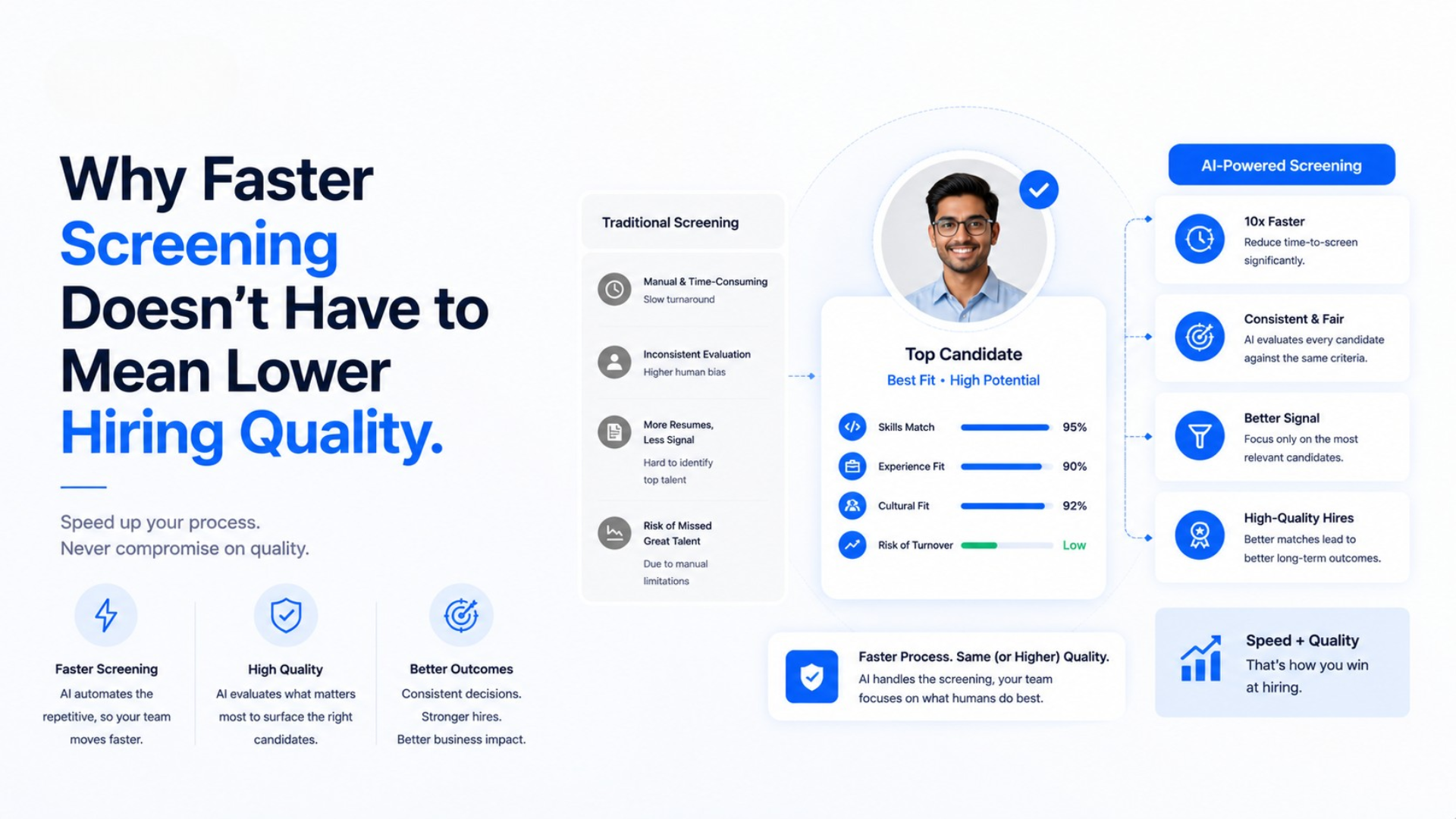
Huntlo was designed around the principle that speed and quality in candidate screening are not tradeoffs but complementary outcomes of the same methodology. The platform achieves faster screening not by reducing the thoroughness of each evaluation but by changing who and what performs the evaluation. AI handles the high-volume, repetitive first-pass assessment with consistent accuracy and real-time data enrichment, evaluating every candidate against role-specific criteria that maximize predictive validity. Human recruiters focus their cognitive resources on the second-tier evaluation of the pre-ranked shortlist, where their judgment and expertise create the most value. The result is a screening process that is dramatically faster than manual review and produces shortlists that are measurably more accurate.
The practical impact of this approach is significant across every dimension of the hiring funnel. Recruiters report 60% to 80% reductions in time-to-shortlist. The shortlists they receive are more consistent because every candidate has been evaluated against the same framework with the same level of rigor. The data underlying those evaluations is fresher because Huntlo enriches candidate profiles in real time rather than relying on cached information. And because the entire screening process is faster, the downstream stages of the hiring pipeline start sooner, which means candidates move through the funnel more quickly and the best candidates are less likely to drop out. When evaluating an AI screening tool, the critical question is whether it delivers speed by improving the evaluation method or by reducing the evaluation
depth. Huntlo does the former. Every evaluation is thorough. The speed comes from applying that thoroughness consistently at machine speed, which is something no manual process can replicate. The science is clear: faster screening, when done with the right methods, produces better hiring outcomes. Huntlo applies those methods to every candidate, every role, every time.