The number one reason candidates withdraw after accepting an offer is not a better competing offer, not a counter-offer from their current employer, and not a change of heart about the role. It is silence. The candidate signs the offer letter, the recruiter congratulates them, and then the organization goes quiet. For two to four weeks during the notice period, the person who is about to become your newest employee hears almost nothing meaningful from the team they committed to joining. In that silence, doubt grows. The current employer makes a retention pitch. A competitor extends a last-minute offer. The candidate starts second-guessing their decision. By the time the organization reaches out again, it is often too late.
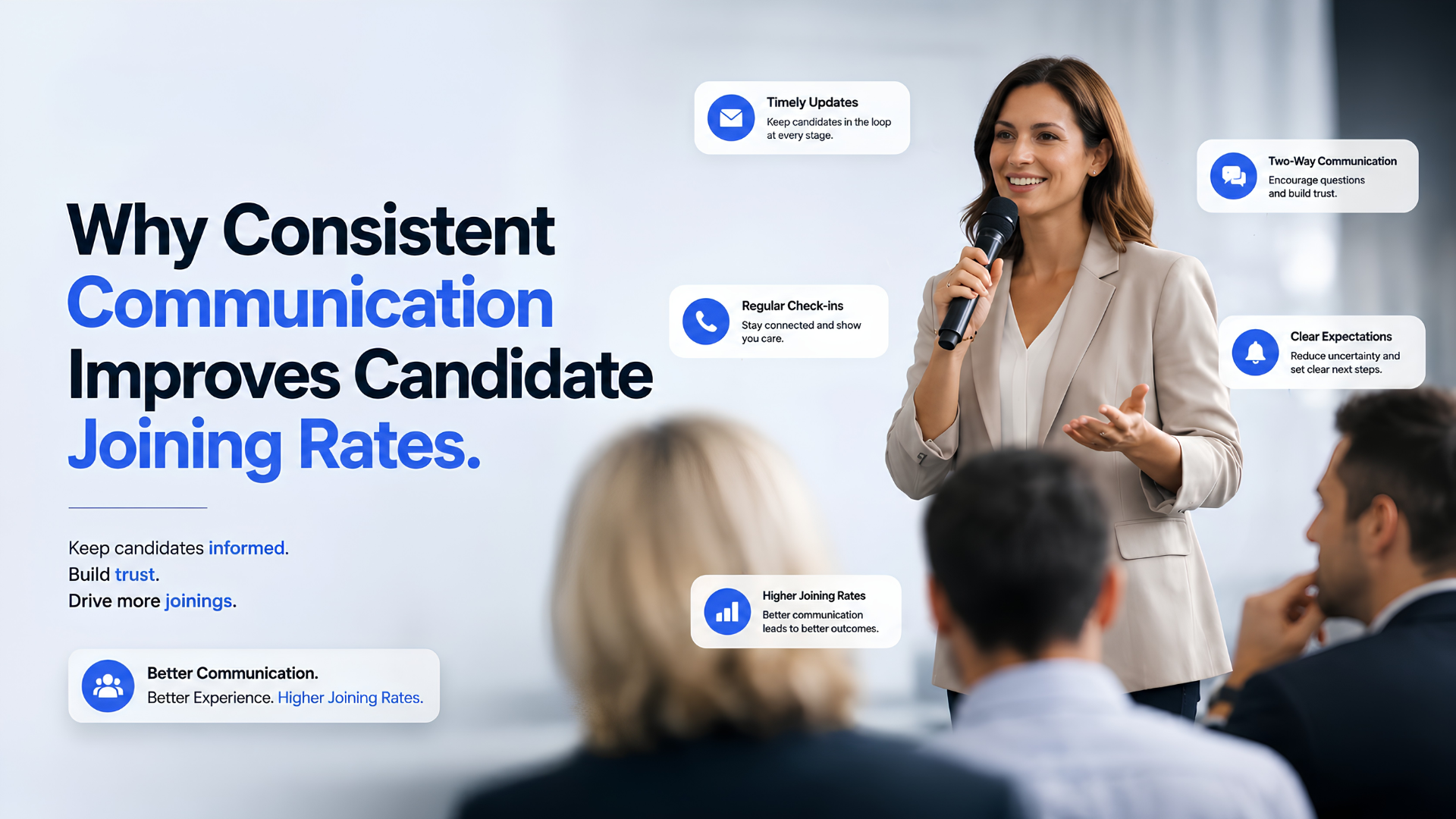
Consistent communication during the post-acceptance phase is the single most impactful lever for improving joining rates, and it is the lever that most organizations pull the least. According to SHRM’s talent acquisition research, the average time between a candidate’s acceptance and their first meaningful communication from the new employer is seven to ten days. In a notice period of fourteen to twenty-eight days, that means the candidate spends half their preboarding window without any substantive contact. Meanwhile, their current employer is actively engaging them every single day. This communication asymmetry is not a minor process gap. It is the primary driver of preventable candidate drop-offs, and addressing it requires a systematic candidate communication strategy that treats the post-acceptance phase with the same strategic importance as the interview process itself.
The Psychology of Silence: Why Candidates Withdraw
Human decision-making does not end at the point of commitment. When a candidate accepts an offer, they have made a decision, but that decision remains provisional until they actually start the new role. Psychologists call this the commitment-confirmation gap, the period between deciding and experiencing, during which the decision is vulnerable to reversal. During
this gap, people actively seek information that confirms their decision and discount information that contradicts it. When the new employer provides confirming information, through regular, substantive communication, the candidate’s confidence grows and the decision solidifies. When the new employer provides nothing, the candidate’s confirmation-seeking turns elsewhere, often to their current employer, who is all too happy to provide reasons to stay. Research from McKinsey’s people organization research, shows that decision confidence during transition periods follows a predictable decay curve. Confidence peaks at the moment of commitment and then declines steadily unless reinforced. Without reinforcement, confidence drops below the withdrawal threshold within ten to fourteen days for most candidates. With consistent reinforcement, confidence remains above the threshold indefinitely.
This psychology explains why communication timing matters more than communication volume. A single lengthy message from the hiring manager is less effective than three short, well-timed messages spread across the notice period. The reason is that each touchpoint provides a separate confidence boost, and the cumulative effect of multiple boosts over time is far stronger than a single boost of equivalent total length. This is the principle that underlies effective candidate nurturing, the practice of maintaining a steady cadence of relevant, personalized touchpoints that reinforce the candidate’s decision at regular intervals. It is the same principle that marketing teams have used for decades to nurture leads through the sales funnel, and it is equally applicable to the acceptance-to-joining transition in recruiting.
The Communication Pattern That Keeps Candidates Committed
The most effective post-acceptance communication pattern follows a specific structure that has been validated across hundreds of organizations and thousands of candidates. It is not random. It is not ad hoc. It is a designed sequence with specific objectives at each stage. The first stage is the immediate post-acceptance window, the first forty-eight hours. During this stage, the candidate’s emotional commitment is highest but also most volatile. They are excited but also anxious, and they need immediate reinforcement from the people who matter most. The communication sequence in this stage includes three touchpoints: a personal message from the hiring manager within six hours of acceptance, a welcome message from the recruiter that includes practical next steps, and an introduction to the candidate’s onboarding buddy or future teammate within forty-eight hours. Understanding how many follow-ups one hire actually needs, and front-loading the highest-impact touchpoints in this critical window, is the foundation of a high-converting communication plan.
The second stage is the notice period cadence, weeks two through three for a standard four-week notice. During this stage, the candidate is still employed elsewhere and most vulnerable to counter-offers. The communication cadence should settle into one substantive touchpoint per week, delivered by a rotating cast of stakeholders to keep the experience fresh. The recruiter sends a check-in with relevant company news. The hiring manager shares a brief update about the team or project. The onboarding buddy sends a casual message about what to expect. Each touchpoint serves a dual purpose: it provides the candidate with useful information, and it demonstrates that the organization is actively anticipating their arrival. A
recruitment communication platform that automates the scheduling, tracking, and escalation of these touchpoints ensures that the cadence is maintained consistently for every candidate, regardless of recruiter workload or hiring volume.
The third stage is the final-week ramp, the last seven days before the start date. During this stage, communication intensity increases and the focus shifts from relationship-building to practical preparation. The candidate needs a detailed first-day agenda, clear logistics for arrival, and reassurance from the hiring manager. A personal call from the onboarding buddy, a message from the hiring manager expressing genuine anticipation, and a clear, concise summary of what to bring and where to go on day one eliminate the practical anxiety that causes last-minute withdrawals. According to LinkedIn’s recruiting insights, candidates who receive a structured final-week communication sequence are five times less likely to withdraw in the seventy-two hours before their start date than candidates who receive no structured communication.
Why Most Communication Plans Fail Before They Start
Most organizations have a communication plan for the post-acceptance phase in theory. In practice, the plan exists in a recruiter’s head or in a forgotten onboarding document, and it is executed inconsistently, if at all. There are three reasons why these plans fail. First, no single person owns the communication plan. The recruiter thinks the hiring manager should reach out. The hiring manager assumes the recruiter is handling it. HR thinks the onboarding buddy will take care of it. The result is that no one does, or everyone does it once and then assumes someone else is handling the next touchpoint. This ownership gap is the most common cause of communication breakdown, and it cannot be solved by sending a reminder email. It requires a system with clear ownership, automated triggers, and accountability tracking. Second, the communication plan is not integrated into the recruiter’s workflow. Recruiters are measured on time-to-fill and requisition completion, not on post-acceptance engagement. When a recruiter closes a requisition, their incentive is to move to the next one, not to invest time in a candidate who has already signed. As we have explored in our analysis of why more tools produce the same hiring problems, adding a communication plan to an already-overloaded recruiter’s workflow without providing automation and system support is a recipe for inconsistent execution.
Third, the communication plan lacks personalization. Most post-acceptance communications are generic, the same welcome email, the same benefits summary, the same IT setup instructions sent to every candidate regardless of their role, level, or interests. Generic communications signal to the candidate that the organization’s engagement was performative, limited to the courtship phase, and that the reality of working there will be impersonal and bureaucratic. The contrast between a highly personalized interview experience and a generic preboarding experience is one of the strongest predictors of candidate withdrawal. Effective hiring communication tools solve this problem by enabling personalization at scale, drawing on the intelligence gathered during the interview process to tailor every touchpoint to the individual candidate’s interests, concerns, and motivations.
The Content Principle: Substantive Over Transactional
The single most common mistake in post-acceptance communication is confusing administrative tasks with meaningful engagement. Benefits enrollment links, IT provisioning forms, tax documents, and policy acknowledgments are necessary, but they are not engagement. They are transactional logistics that communicate bureaucracy, not excitement. Candidates do not feel valued because they received a link to the benefits portal. They feel valued because the hiring manager sent them a personal note about the project they will be working on, or because a future teammate shared an interesting article about the market they will be operating in. The distinction between transactional and substantive communication is critical. Transactional communication tells the candidate what they need to do. Substantive communication tells the candidate why they should be excited about doing it. The most effective post-acceptance communication plans separate these two streams. Transactional logistics are handled through automated administrative workflows. Substantive engagement is handled through personalized, human-driven touchpoints that reinforce the candidate’s decision and build anticipation for day one. This separation is what transforms preboarding from a bureaucratic process into a relationship-building experience, and it is the core capability that a candidate relationship management system must provide.
The content principle also applies to the tone and format of communication. Candidates are more likely to engage with short, specific, and personally relevant messages than with long, generic corporate communications. A two-sentence message from the hiring manager that references a specific topic discussed during the interview is worth more than a five-paragraph company newsletter. A brief note from a future teammate sharing something about the team culture is more impactful than a formal welcome packet from HR. According to Gartner’s HR trends analysis, candidates who receive short, personalized messages from multiple stakeholders during preboarding report fifty percent higher confidence in their decision than candidates who receive only formal, generic communications from a single sender.
Measuring Communication Effectiveness and Joining Impact
You cannot improve what you do not measure, and most organizations do not measure the effectiveness of their post-acceptance communication at all. They track whether the communication was sent, but not whether it was received, opened, read, or acted upon. They track joining rates in aggregate, but not the correlation between communication patterns and joining outcomes. This measurement gap means that most organizations cannot identify which communication touchpoints are driving value and which are wasting recruiter time. The minimum viable measurement framework for post-acceptance communication includes four metrics. First, touchpoint delivery rate, the percentage of planned touchpoints that are actually delivered on time. Second, candidate engagement rate, which measures how actively candidates interact with the communications they receive, including open rates, response rates, and content interaction. Third, time-to-first-response, which tracks how quickly candidates reply to post-acceptance messages and serves as an early warning indicator for disengagement.
Fourth, communication-to-joining correlation, which analyzes the relationship between communication patterns and joining outcomes to identify which touchpoints have the highest impact on conversion.
When these metrics are tracked through a centralized platform, the recruiting team gains the visibility it needs to optimize the communication plan continuously. They can identify which touchpoints are driving value and which are not, which stakeholders are engaging effectively and which need support, and which candidates are at risk and need intervention. This data-driven approach to post-acceptance communication transforms it from an art that depends on individual recruiter skill into a science that can be systematically improved. As Deloitte’s talent research, notes, the organizations that measure and optimize their post-acceptance communication see joining rate improvements of twenty to thirty percent within six months, because they are directing their effort toward the touchpoints that actually matter rather than relying on intuition and habit.
Why Huntlo.ai Makes Consistent Communication Effortless
Huntlo.ai provides the communication infrastructure that recruiting teams need to maintain consistent, personalized engagement with every accepted candidate. The platform automates the entire post-acceptance communication workflow, from the immediate welcome sequence through the notice-period cadence to the final-week ramp, ensuring that every candidate receives the right message from the right person at the right time. The AI engine personalizes every touchpoint based on the intelligence gathered during the interview process, so candidates receive communications that are relevant to their specific role, interests, and concerns rather than generic corporate messages. Real-time engagement monitoring identifies candidates who are disengaging before they reach the point of withdrawal, enabling proactive intervention that protects the hiring investment. For organizations that recognize that an agentic AI recruiting platform, must own the candidate experience all the way through day one, not just through the offer, Huntlo provides the workflow, the intelligence, and the automation to make consistent communication a standard operating procedure rather than an occasional best practice. And when evaluating an AI recruiting tool before buying, the ability to demonstrate a systematic, measurable post-acceptance communication program with joining rate data to prove its effectiveness is the capability that separates platforms that deliver real outcomes from those that merely add another tool to the stack.
For recruiting teams that are ready to stop losing accepted candidates to a preventable communication gap, Huntlo ensures that referrals outperform cold outreach, not because of the referral channel itself, but because every candidate, regardless of source, receives a communication experience that reinforces their decision and builds genuine excitement for day one. And it ensures that the question of outdated candidate data in AI recruiting tools, never undermines the communication experience, because every touchpoint is informed by fresh, accurate intelligence about the candidate and their journey.