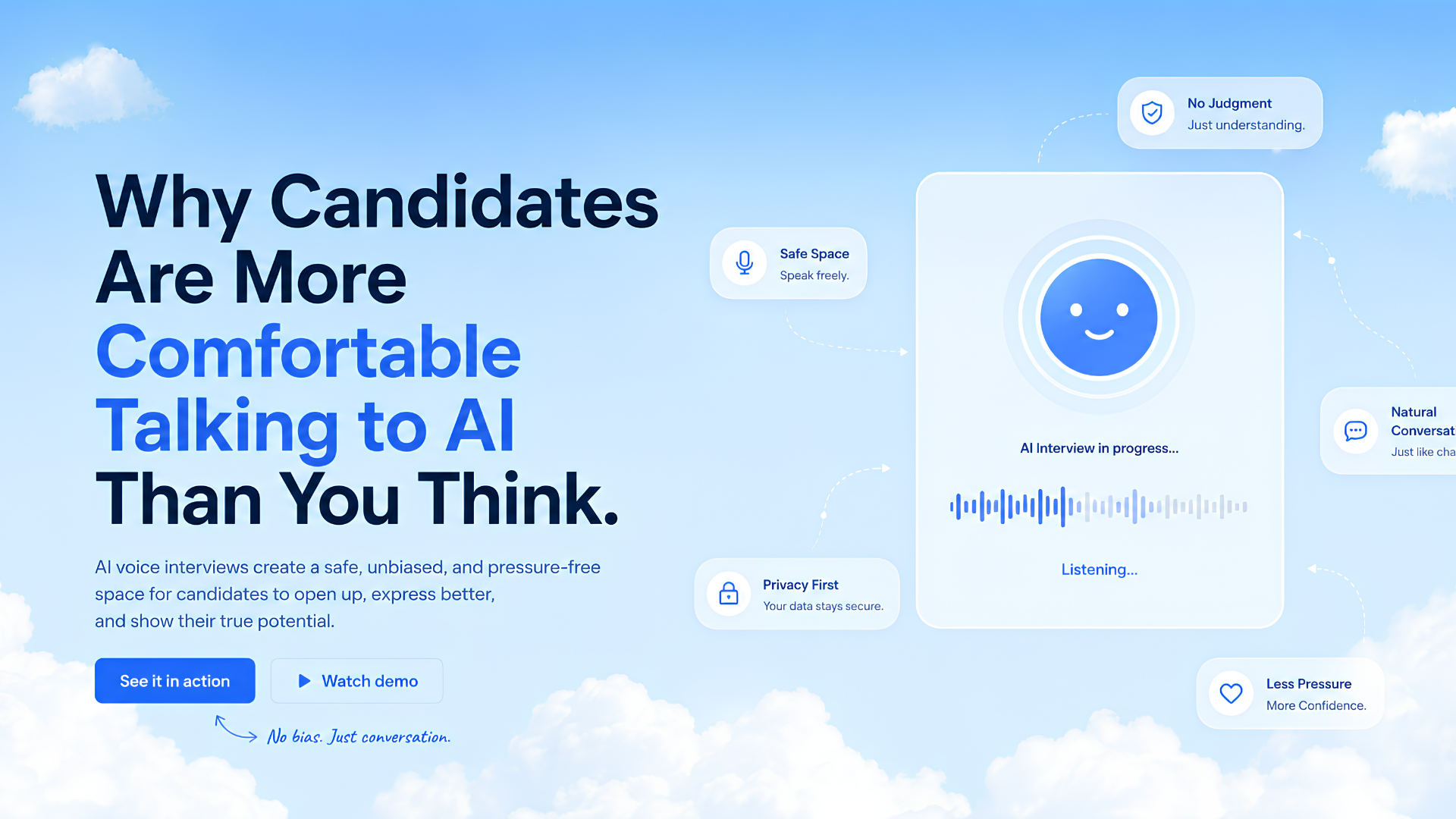
Ask most recruiters whether candidates would rather speak with a human or an AI during a screening call, and the answer comes without hesitation: a human, obviously. It feels intuitive. People want to connect with people. Job seekers are nervous enough without adding a machine into the mix. But this assumption, as natural as it seems, does not match what candidate experience data actually shows. Over the past two years, multiple surveys and behavioral studies have found that a significant share of candidates not only tolerate AI voice interviews but actively prefer them over traditional phone screens — and the reasons they give reveal something important about the state of modern hiring that most talent acquisition teams have not yet fully absorbed.
The Data: Candidates Are Not as Reluctant as Recruiters Assume
The Talent Board’s CandE Benchmark Research has tracked candidate experience across thousands of employers for over a decade, and their recent data points to a clear trend: candidates who go through structured, technology-mediated screening processes report satisfaction scores that are comparable to, and in some cases higher than, those who go through traditional phone screens. The key variable is not whether AI is involved — it is whether the process is respectful of the candidate’s time, transparent about what to expect, and designed to reduce rather than amplify the anxiety that is already inherent in any job application. When those conditions are met, candidates respond positively regardless of whether the interviewer is a person or an algorithm.
Independent research supports this finding. A 2024 study published by the National Bureau of Economic Research on algorithmic hiring tools found that candidates perceived AI-led screening as fairer and less biased than human screening — not because the AI was
actually free of bias, but because the process felt more standardized. Every candidate got the same questions in the same order, scored against the same criteria, without the variability of human mood, conversational chemistry, or unconscious preference that candidates intuitively sense in human interviews. This perception of fairness is a powerful driver of comfort. Candidates who believe they will be evaluated on their actual responses rather than on rapport, timing, or the recruiter’s subjective impression are more willing to engage fully with the process — and that engagement produces better data for the hiring team.
The demographic patterns are also worth noting. Younger candidates — particularly those under 35 who have grown up interacting with conversational AI through customer service chatbots, voice assistants, and AI-powered apps — show the highest comfort levels. But the preference is not limited to digital natives. Candidates across age groups report appreciating the ability to complete screening conversations at a time that works for them, without the pressure of scheduling a live call during business hours. This is especially relevant for candidates who are currently employed and cannot take calls at their desk, candidates in different time zones, and candidates who experience phone anxiety — a surprisingly common phenomenon that traditional hiring processes do not account for at all.
Why AI Conversations Reduce Candidate Anxiety
The conventional wisdom says that talking to a machine should make candidates more nervous, not less. In practice, the opposite is often true. A traditional phone screen creates a set of pressures that candidates find more stressful than the AI alternative. There is the pressure of performing well in a real-time conversation with someone who holds significant power over their career prospects. There is the pressure of scheduling — finding a quiet space, coordinating across time zones, potentially needing to take time off from a current job. There is the pressure of reading social cues, matching the recruiter’s energy, and managing the impression they create in ways that go beyond simply answering the questions. These pressures are not incidental. They are central to the phone screen experience, and they disproportionately affect candidates who are already disadvantaged in the hiring process — introverts, non-native speakers, neurodivergent individuals, and candidates from backgrounds where the unwritten rules of professional self-presentation were never explicitly taught.
An AI voice interview removes or reduces several of these pressures simultaneously. The candidate knows they will be asked specific questions and evaluated on their responses, not on whether they built rapport with the interviewer. The conversation can typically be completed at any time, eliminating scheduling stress. The evaluation criteria are consistent and competency-based, which means the candidate can prepare effectively — they know what they will be assessed on, and they can focus on demonstrating those competencies rather than trying to read the recruiter’s reactions in real time. Gallup’s workplace research has long demonstrated that clarity of expectations is one of the strongest drivers of confidence and performance, and AI voice interviews provide that clarity in a way that unstructured human conversations fundamentally cannot.
This does not mean every candidate finds AI voice interviews relaxing. Some candidates — particularly those who have never interacted with conversational AI and who associate the technology with surveillance or impersonal corporate processes — do experience initial discomfort. But the data suggests this discomfort is typically situational and transient. Once candidates understand what the AI is doing, how their responses will be used, and that a human recruiter will review the results before any hiring decision is made, the discomfort diminishes sharply. Transparency and communication are the critical variables, not the technology itself.
The Paradox: Recruiters Are More Uncomfortable Than Candidates
Perhaps the most striking finding in the candidate experience research is the gap between how candidates feel about AI voice interviews and how recruiters assume candidates feel. Recruiters consistently overestimate candidate resistance to AI screening. They assume that candidates want human connection, that they will perceive AI as cold or dismissive, and that the use of AI in screening will damage the employer brand. These concerns are understandable — recruiting is fundamentally a relationship-driven profession, and the idea of replacing a human conversation with an automated one feels like a step in the wrong direction. But the candidate data tells a different story, and the disconnect between recruiter perception and candidate reality is costing organizations in ways that are not immediately visible.
When recruiters resist AI voice interviews based on assumed candidate preferences, the practical consequence is that screening bottlenecks persist. Requisition pipelines stay clogged. Candidates wait days or weeks for a phone screen slot. The candidate experience degrades not because of the AI, but because of the delay, uncertainty, and lack of communication that are the inevitable byproducts of manually scheduling calls across dozens or hundreds of applicants. LinkedIn’s talent solutions research has found that the single largest driver of candidate dropout is not the use of technology in the hiring process — it is the time it takes to move through that process. A candidate who completes an AI voice interview and receives feedback within 48 hours has a dramatically better experience than a candidate who waits 10 days for a 20-minute phone screen, regardless of which approach they would theoretically prefer.
The recruiter discomfort with AI screening is also tied to a deeper concern about professional identity. As explored in Should Recruiters Worry About AI Replacing Their Jobs?, many recruiters fear that AI voice interviews will make their role redundant — that if the machine can handle the screening conversation, there is less need for human recruiting expertise. This fear is understandable but misplaced, and it leads to a defensive posture that prevents recruiting teams from adopting tools that would actually make their work more impactful. The recruiter’s discomfort with AI screening is a team and leadership problem to solve, not a data point that should drive technology adoption decisions.
What Candidates Actually Care About in a Screening Experience
To understand why candidates are comfortable with AI voice interviews, it helps to understand what they actually care about during the screening stage of a hiring process. Research from multiple candidate experience surveys, including data published by SHRM and corroborated by the CandE Awards program, consistently identifies the same set of priorities. Candidates want clarity about the process: what stage they are in, what happens next, and how long each step will take. They want timely communication: acknowledgment that their application was received, updates on their status, and feedback after each stage. They want respect for their time: minimal scheduling friction, reasonable time commitments, and a process that does not require them to repeatedly provide the same information. And they want a fair evaluation: confidence that they are being assessed on their qualifications and responses rather than on factors unrelated to their ability to do the job.
AI voice interviews perform well against each of these priorities when they are implemented thoughtfully. The process is inherently clear — the candidate knows they will complete a structured conversation and that the results will be used to determine whether they advance. The timeline is shorter because there is no scheduling latency. The time commitment is fixed and predictable. And the evaluation is standardized, which increases candidates’ perception of fairness. The areas where AI voice interviews fall short — the inability to answer candidate questions about the role, the lack of a personal connection, the absence of two-way dialogue — are real, but they are not the factors that candidates identify as most important during the initial screening stage. Those factors become critical later in the process, during the interview and offer stages, where human interaction is and should remain central.
How Leading Companies Are Using AI Screening Without Alienating Candidates
The organizations that have successfully integrated AI voice interviews into their hiring process share a common set of practices that address candidate comfort directly. The first is upfront communication. These companies do not surprise candidates with an AI voice interview. They explain what it is, why they use it, how the evaluation works, and what happens after. This transparency transforms the AI interview from an opaque gatekeeping mechanism into a clearly defined step in a process the candidate understands. The second practice is giving candidates control over timing. The best implementations allow candidates to complete the AI voice interview whenever they are ready, within a defined window. This eliminates the scheduling pressure that is one of the most consistently cited pain points in traditional phone screening. The third practice is maintaining a human touchpoint after the AI stage. Even when the screening conversation is AI-led, the follow-up — the email that says “we reviewed your responses and would like to schedule a conversation with the hiring manager” — comes from a real person with a name and a role. This combination of AI efficiency and human warmth is what candidates actually respond to.
These practices are not expensive or technically complex to implement. They are process design decisions. But they require a platform that supports them natively — one that can send branded communication before and after the AI interview, that integrates the
AI screening stage into a broader workflow where the recruiter remains visible and engaged, and that does not treat the AI conversation as a standalone interaction disconnected from the rest of the candidate journey. As discussed in The ATS Mistake Companies Keep Repeating, one of the most common failures in hiring technology adoption is implementing a tool in isolation — plugging an AI screening step into a process that was not designed to accommodate it, creating a disjointed experience that frustrates candidates and recruiters alike. The technology is only as good as the workflow it sits inside.
Why Candidate Comfort Depends on the Platform, Not Just the Technology
The finding that candidates are more comfortable with AI voice interviews than recruiters expect is encouraging, but it comes with an important caveat. Candidate comfort is not a property of AI voice technology in general — it is a property of well-designed AI voice interviews delivered through a platform that integrates them into a thoughtful, human-centered hiring workflow. A standalone AI voice interview tool that candidates access through a generic link, complete in isolation, and never hear back from is worse than a phone screen. It is not the AI that creates a positive candidate experience — it is the surrounding process: the branded communication, the clear expectations, the timely follow-up, and the visible human recruiter who picks up the conversation after the AI stage. This is why Huntlo approaches AI voice interviews as one stage within a complete hiring operating system rather than a standalone tool.
Huntlo’s AI voice interview capability is embedded within a platform that handles sourcing across 50+ job boards and platforms, multi-channel candidate outreach, automated scheduling, and recruiter workflow management. A candidate sourced through Huntlo receives outreach, completes an AI voice interview, and enters the recruiter’s review queue — all within a single system. The recruiter sees the AI evaluation scorecard, reviews the candidate’s responses, and makes a personalized, human follow-up with full context. The candidate experiences efficiency, clarity, and professionalism at every stage, and the AI conversation feels like a natural part of the process rather than an impersonal hurdle. This integration is what separates genuinely agentic AI recruiting platforms from the kind of point solutions that give AI hiring technology a bad reputation. Candidates are comfortable with AI voice interviews when the platform makes the entire experience feel designed for them, not when the platform makes them feel like they are being processed by a machine.
The future of candidate screening is not a debate between humans and machines. It is a design challenge: how to combine the consistency, scalability, and fairness of AI evaluation with the empathy, adaptability, and relationship-building of human recruiters, in a way that serves the candidate’s experience first and the organization’s efficiency second. The candidates are already more comfortable with this combination than most recruiters realize. The technology is ready. The question is whether hiring teams are ready to meet candidates where they are.
Related Topics:
Why Referrals Outperform Cold Outreach