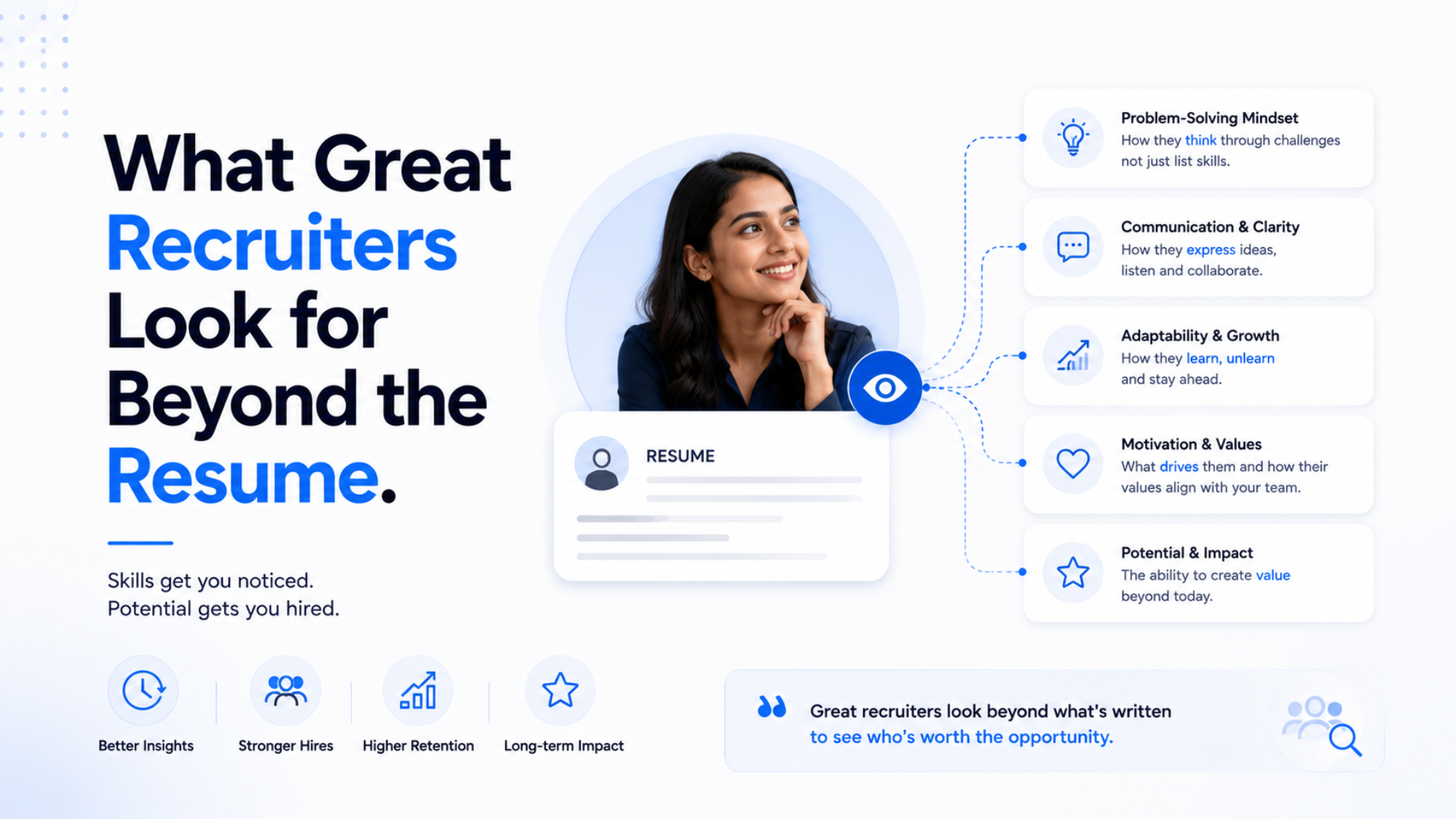
Every recruiter reads resumes. It is the most basic, universal activity in the profession. But the difference between a good recruiter and a great recruiter is not how carefully they read resumes. It is how much weight they give the resume relative to everything else they know about the candidate. Good recruiters treat the resume as the primary source of truth and evaluate candidates primarily on what the document says. Great recruiters treat the resume as one signal among many, and often not even the most important one. They look beyond the document to the person behind it, assessing signals that no resume can capture: trajectory, impact, learning velocity, adaptability, motivation, and cultural alignment. These are the dimensions that predict whether a candidate will succeed in a role, and they are the dimensions that great recruiters have always evaluated, long before AI made it possible to do so at scale.
The challenge has always been scalability. A great recruiter working one-on-one with a candidate can assess all of these dimensions through conversation, reference checks, and instinct. But when that same recruiter is handling 300 applications for a single role, the depth of evaluation collapses into a quick scan. The signals that matter most are the ones that require the most time and cognitive bandwidth to assess, and high-volume recruiting leaves neither. This is precisely the gap that AI candidate intelligence is designed to fill: not replacing the recruiter’s judgment, but extending it so that the signals great recruiters have always looked for can be evaluated at scale. According to McKinsey’s talent research, the recruiters who consistently produce the best hiring outcomes are the ones who evaluate candidates on the broadest set of signals, not the ones who read resumes the most carefully.
Career Trajectory: Not Where They Have Been, But Where They Are Going
The first and most important signal that great recruiters look for beyond the resume is career trajectory. A resume is inherently backward-looking. It describes what a candidate has done. But the question that matters most for hiring decisions is not what the candidate has done but where they are going. A candidate who has been on a steep upward trajectory, taking on
increasing responsibility, moving into more complex roles, and demonstrating accelerating impact, is likely to continue that trajectory in a new position. A candidate who has been in the same role for five years with no promotion or expanded scope may have plateaued, and no amount of impressive-sounding bullet points on their resume changes that underlying signal.
Great recruiters assess trajectory by looking at the pattern of transitions, not just the titles. A candidate who moved from individual contributor to team lead to department head in six years is on a management trajectory. A candidate who moved from junior developer to senior developer to staff engineer is on a technical leadership trajectory. Both are positive, but they indicate very different profiles and fit for different roles. The recruiter who only reads the resume sees three titles. The recruiter who evaluates trajectory sees a story about the candidate’s growth pattern, their appetite for increasing scope, and their likely trajectory over the next three to five years. That story is far more predictive of hiring success than any individual bullet point.
Trajectory assessment is especially valuable when evaluating candidates for roles that require growth potential, which is almost every role at every level. As we have explored in our analysis of what makes an AI recruiting platform agentic vs just automated, the platforms that can detect and evaluate career trajectory patterns are the ones that produce the most accurate candidate assessments, because trajectory is a signal that correlates strongly with future performance but is nearly impossible to evaluate through keyword matching alone. A keyword system can tell you that a candidate was a “senior engineer.” Only an intelligence system can tell you whether that senior engineer is on a trajectory toward staff or principal level, or whether they have plateaued.
Evidence of Impact Over Claims of Responsibility
The second signal great recruiters evaluate is the distinction between impact and responsibility. Most resumes are written in terms of responsibility: the candidate was responsible for managing a team of ten, responsible for a budget of two million dollars, responsible for launching a product. But responsibility is not the same as impact. A candidate can be responsible for launching a product that failed, managing a team that had high turnover, or overseeing a budget that was overspent. The resume does not distinguish between these outcomes because it was written by the candidate and optimized to present the most favorable interpretation of their experience.
Great recruiters look for evidence of impact that goes beyond responsibility claims. They look for quantified outcomes: revenue generated, efficiency improvements measured in percentages, customer satisfaction scores, retention rates, adoption metrics. They look for evidence that the candidate changed something for the better, not just that they were in the room when something happened. They look for specificity in how the candidate describes their contributions. A resume that says “led the development of a new platform” is a responsibility claim. A candidate who can explain that they led the development of a platform that reduced customer onboarding time by 40% and increased activation rates by 25% is providing impact
evidence. The difference is not subtle. It is the difference between a candidate who occupied a role and a candidate who performed in it.
This impact-vs-responsibility lens is one of the most powerful tools a recruiter can apply, and it is one that AI candidate intelligence systems are increasingly able to replicate at scale. By analyzing the language candidates use to describe their experience, the specificity of their claims, and the quantifiable outcomes they reference, these systems can distinguish between candidates who have genuinely driven results and those who have simply held titles. For teams that are evaluating AI sourcing and screening tools, the ability to detect impact evidence versus responsibility claims is one of the key capabilities that separates genuinely intelligent platforms from those that are simply matching keywords against job descriptions.
Learning Velocity: How Fast a Candidate Adapts and Grows
In a world where the half-life of professional skills is shrinking, one of the most valuable signals a recruiter can assess is learning velocity: how quickly a candidate acquires new skills, adapts to new contexts, and incorporates new knowledge into their work. A candidate who learned a new programming language in three months and shipped production code with it has a high learning velocity. A candidate who spent five years in the same role using the same tools and has not acquired any new skills in the last two years has a low learning velocity. The resume often does not reveal this signal directly, because most candidates do not explicitly list their learning activities. But great recruiters know how to read between the lines of a career history to detect it.
There are several patterns that indicate high learning velocity. A candidate who has worked across multiple industries or domains has demonstrated the ability to learn new contexts quickly. A candidate who has transitioned between functional areas, from engineering to product management, for example, has shown intellectual flexibility. A candidate whose career shows progressive complexity, moving from simpler to more challenging problems, is likely learning rapidly. A candidate who has pursued continuous education, whether through formal programs, certifications, or self-directed learning, is signaling a commitment to growth. These patterns are visible in the career history, but they require interpretation and contextual judgment to evaluate. A keyword system cannot assess learning velocity because it does not understand the concept. An AI candidate intelligence system can, because it can analyze career progression patterns and identify the trajectory signals that indicate rapid learning.
Learning velocity is especially critical for roles in fast-moving industries, but it matters everywhere. Even in stable industries, the companies that outperform their competitors are the ones whose employees learn and adapt faster than the industry average. According to Gartner’s workforce trends research, the ability to learn and apply new skills quickly is now the number one predictor of long-term employee performance across most industries, surpassing both experience level and educational credentials. Great recruiters have always known this intuitively. AI is making it possible to measure it.
Adaptability: How Candidates Handle Ambiguity and Change
Closely related to learning velocity but distinct from it is adaptability: the candidate’s ability to function effectively in situations of ambiguity, change, and uncertainty. Every role involves some degree of unpredictability, but the roles where adaptability matters most are the ones where the candidate is expected to operate without a clear playbook: early-stage companies, new team formations, turnaround situations, and any role where the environment is evolving faster than the processes can keep up. A resume can hint at adaptability, but it rarely captures it directly, because resumes are designed to present a clean, linear narrative of professional achievement rather than the messy reality of navigating uncertainty.
Great recruiters look for adaptability signals in the candidate’s career history. Has the candidate worked in environments of significant change, such as a company going through a merger, a startup scaling from ten to a hundred people, or a team undergoing a major strategic pivot? Has the candidate taken on roles that were newly created or poorly defined, where they had to build the function from scratch rather than operate within an established framework? Has the candidate worked across different cultural contexts, organizational structures, or geographic markets? Each of these experiences develops and demonstrates adaptability, and a candidate who has navigated them successfully is likely to handle the inevitable ambiguities of a new role more effectively than one whose entire career has been spent in stable, well-defined environments.
The challenge is that adaptability, like learning velocity, is a signal that requires interpretation rather than simple detection. Two candidates can have identical resumes in terms of titles and companies, but one may have been operating in a context of extreme ambiguity while the other was executing a well-defined plan in a stable environment. The resume will not tell you which is which. But an AI system that has access to broader context about the companies, the roles, and the industry conditions can make that distinction. This is one of the reasons why AI recruiting tools that work for niche and technical roles are particularly valuable: niche roles often require candidates who have thrived in ambiguous, evolving environments, and the ability to detect adaptability signals in a candidate’s background is a significant advantage in identifying the right fit for those positions.
Motivation and Alignment: Why They Want This Role, Not Just Any Role
The fifth signal that great recruiters assess is the candidate’s motivation for pursuing this specific opportunity. A candidate who is genuinely interested in the role, the company, and the problem the team is solving will approach the interview process, the onboarding process, and the job itself with a level of engagement and commitment that a candidate who is simply looking for their next paycheck cannot match. Motivation is one of the strongest predictors of both hiring success and retention, yet it is one of the signals that traditional resume screening is completely blind to. A resume tells you nothing about why a candidate wants your job, only what they have done in the past.
Great recruiters assess motivation through conversation, but they also look for preliminary signals in the candidate’s professional history. A candidate who has consistently pursued roles in a specific domain, even when other options were available, is demonstrating sustained interest in that area. A candidate who has done side projects, written about, or contributed to communities related to the field is demonstrating intrinsic motivation that goes beyond employment. A candidate who has made career decisions that prioritized learning and growth over short-term compensation is signaling that they are motivated by the work itself, not just the paycheck. These signals are visible to a recruiter who knows what to look for, but they require going beyond the resume to professional profiles, public work, and community involvement.
The motivation signal also connects to the broader question of the difference between AI sourcing and AI recruiting. Sourcing is about finding candidates. Recruiting is about engaging them around a specific opportunity. A recruiter who understands a candidate’s motivation can craft outreach that speaks to what the candidate actually cares about, rather than sending generic messages about an open role. This motivation-aware outreach dramatically increases response rates and the quality of the resulting conversations, because the candidate feels seen and understood rather than processed.
The Data Behind the Judgment: Why AI Makes These Signals Accessible at Scale
The six signals described in this article, trajectory, impact, learning velocity, adaptability, and motivation, are not new. Great recruiters have been evaluating them for decades, through conversation, reference checks, and professional instinct. What is new is the ability to evaluate these signals at scale, across hundreds of candidates, with the consistency and depth that previously required hours of one-on-one interaction per candidate. AI candidate intelligence platforms can analyze career histories for trajectory patterns, assess the language of experience descriptions for impact evidence, detect learning velocity through skill acquisition timelines, identify adaptability through career context analysis, and surface motivation signals from professional activity and community involvement.
The key requirement for AI to deliver on this promise is data quality and freshness. As we have discussed in our analysis of why some AI recruiting tools have outdated candidate data, the signals that matter most, trajectory, impact, learning velocity, are the ones most affected by data staleness. A candidate who was on a strong trajectory six months ago may have stalled. A candidate who had high impact in their last role may be underperforming in their current one. Only real-time data enrichment can ensure that the AI’s assessment reflects the candidate’s current reality rather than their historical snapshot. For recruiting teams that are still relying on tools that add features without changing the underlying approach, the familiar pattern of more tools producing the same hiring problems will continue. The shift requires not just better technology but a fundamentally different philosophy of what candidate evaluation means.
How Huntlo Evaluates What Great Recruiters Look For
Huntlo’s candidate intelligence engine was built to evaluate the same signals that great recruiters have always looked for, but at a scale and consistency that no human can achieve manually. The platform assesses career trajectory by analyzing the pattern and pace of a candidate’s professional progression. It evaluates impact by examining the specificity, quantification, and outcomes described in the candidate’s experience. It detects learning velocity by tracking skill acquisition, role transitions, and professional development patterns. It identifies adaptability by analyzing the contexts in which the candidate has operated, including company stage, industry dynamics, and role complexity. And it surfaces motivation signals from the candidate’s professional activity, contributions, and career decisions.
The result is not a resume summary. It is a candidate intelligence brief that tells the recruiter who this person is, what they are capable of, and why they might be the right fit for the role. The recruiter then brings their own judgment, their understanding of the hiring manager’s preferences, and their ability to build rapport with the candidate. This is the partnership model that the best recruiting teams are adopting: AI handles the signal detection and evaluation at scale, and the human handles the relationship building and nuanced judgment. Great recruiters never stopped looking beyond the resume. With Huntlo, they no longer have to choose between looking beyond the resume and processing the volume that modern hiring demands.