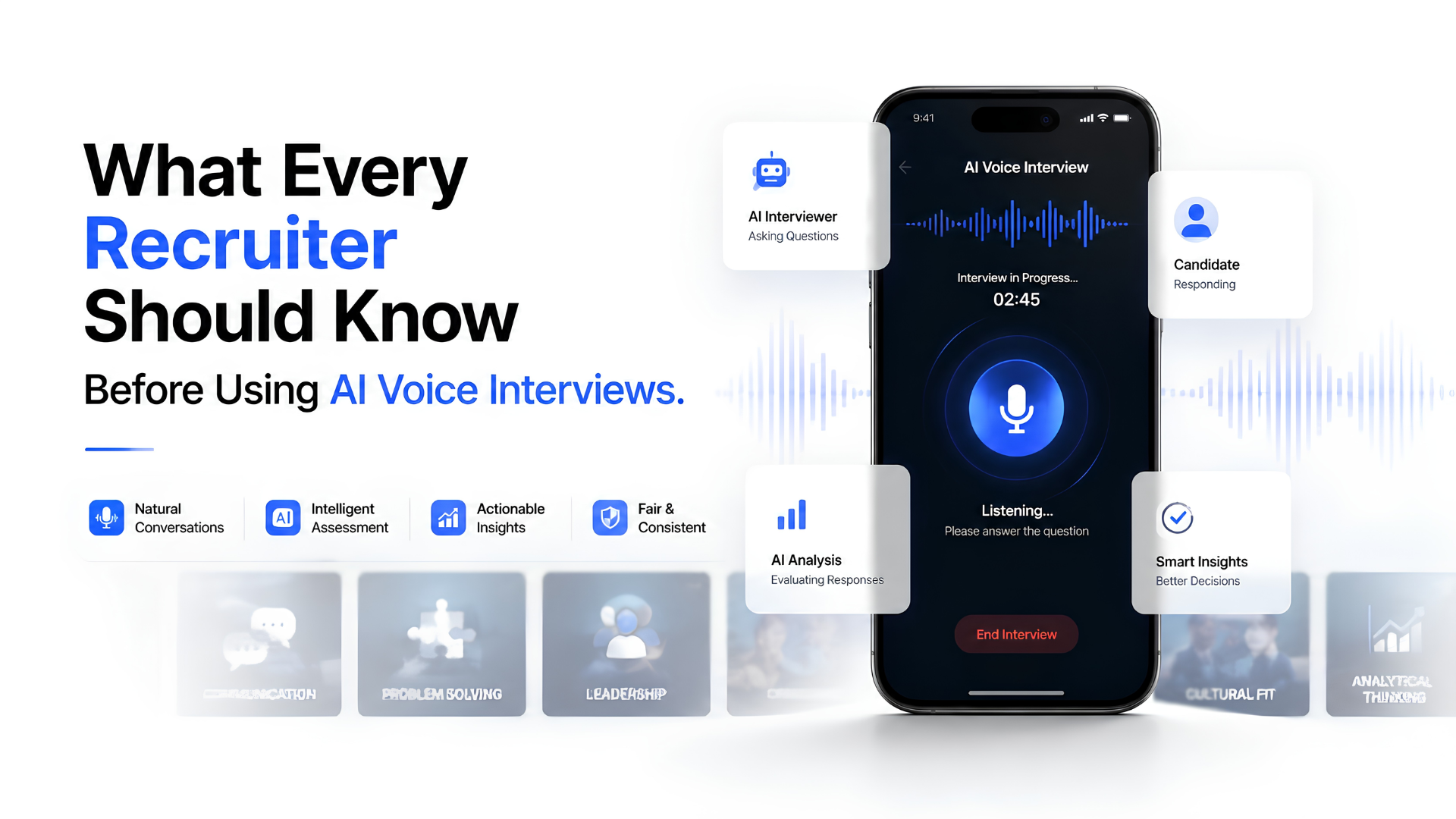
AI voice interviews are being adopted at a pace that outstrips the preparation most recruiting teams put into understanding them. The technology is compelling, the efficiency gains are real, and the competitive pressure to move faster is intense. But deploying AI voice interviews without a clear understanding of what they can do, what they cannot do, and what you need to get right before the first candidate receives an AI screening invitation is a recipe for underwhelming results, candidate complaints, and the kind of negative internal feedback that makes future adoption harder. This article is not a theoretical overview. It is a practical briefing on the six things every recruiter needs to understand before their first AI voice interview goes live.
Know What AI Voice Interviews Actually Evaluate
The first and most common mistake is misunderstanding what the technology assesses. AI voice interviews evaluate structured verbal responses against predefined competency criteria. They measure the content, specificity, relevance, and coherence of what candidates say, and the fluency, pace, and clarity of how they say it. They do not evaluate personality, emotional intelligence, cultural fit in any subjective sense, or the kind of interpersonal chemistry that determines whether someone will thrive on a specific team. Recruiters who expect AI voice interviews to tell them whether a candidate is a “good culture fit” or has “leadership presence” will be disappointed. These are human judgment calls that require real-time conversation, contextual awareness, and the kind of adaptive evaluation that AI is not designed to provide.
What AI voice interviews do well is assess the competencies you configure them to assess. If you set up the interview to evaluate communication clarity, problem-solving
approach, and domain knowledge, the AI will produce a detailed, evidence-based evaluation of each of those dimensions for every candidate. If you configure it to evaluate leadership behaviors, customer service orientation, and conflict resolution, it will do the same for those. The quality of the output is directly proportional to the quality of the configuration. This means the recruiter’s first real task is not deploying the tool — it is defining the competency framework that the tool will evaluate. The research from SHRM’s talent acquisition resources consistently shows that the organizations getting the best results from AI screening are those that invest significant upfront time in defining role-relevant competencies, designing questions that elicit behavioral evidence for those competencies, and setting scoring criteria that map to actual job requirements. Skipping this step and using generic interview configurations produces generic results that provide minimal value over a resume review.
Understand the Compliance Landscape Before You Deploy
The legal and regulatory environment for AI in hiring is evolving rapidly, and recruiters need to understand the rules that apply in their jurisdictions before launching AI voice interviews. In the United States, the regulatory landscape is fragmented. New York City’s Local Law 144 requires bias audits for automated employment decision tools and mandates that candidates be informed about the use of such tools before they are evaluated. Illinois, Maryland, and several other states have enacted or proposed legislation governing AI in hiring. At the federal level, the EEOC has issued guidance on how existing anti-discrimination laws apply to algorithmic decision-making, and the Department of Labor has signaled increased scrutiny of AI tools that may produce disparate impact across protected groups. The International Association of Privacy Professionals maintains one of the most comprehensive trackers of AI employment regulations globally, and it is an essential reference for any recruiting team deploying AI screening.
In the European Union, the AI Act classifies AI-powered employment decision tools as high-risk systems, subjecting them to requirements around transparency, human oversight, bias testing, and documentation. In India, the regulatory framework is still developing but trending toward greater scrutiny of automated decision-making in employment contexts. These jurisdictional differences matter because many recruiting teams hire across borders, and the compliance requirements can vary significantly depending on where the candidate is located, where the hiring company operates, and where the AI tool’s servers process the data. Understanding these requirements before deployment — not after a candidate files a complaint or a regulator sends an inquiry — is non-negotiable. The topic of cross-border compliance in AI-assisted hiring is examined in depth in Recruiting Compliance Differences: India vs USA vs UK, which provides a practical comparison of the regulatory frameworks most relevant to recruiting teams operating across these jurisdictions.
Beyond understanding the rules, recruiters need to verify that their AI voice interview provider has actually conducted the required audits and can produce documentation on demand. Many AI screening vendors market their tools as compliant without having
performed the specific bias audits that regulations like Local Law 144 mandate. Asking a vendor for their most recent bias audit report, their data retention and deletion policies, and their GDPR and CCPA compliance documentation should be a standard part of any evaluation process. Organizations that skip this due diligence step are exposing themselves to regulatory risk that is entirely avoidable, and the cost of non-compliance — both in fines and in reputational damage — far exceeds the cost of a thorough vendor assessment. As highlighted in What’s the Best Way to Evaluate an AI Sourcing Tool Before Buying?, a rigorous evaluation process focused on documented compliance and measurable performance is the most reliable way to separate platforms that take their responsibilities seriously from those that rely on marketing claims.
Candidate Communication Is Not Optional
Transparency with candidates about AI voice interviews is not just a regulatory requirement in many jurisdictions — it is a practical necessity. Candidates who receive an unexpected AI screening invitation with no explanation of what it is, why the company uses it, and what happens after it is completed will assume the worst. They will perceive the process as impersonal, they will worry that no human will ever review their application, and some will withdraw from the process entirely. The candidate experience data from the Talent Board CandE Awards program is unambiguous on this point: the single strongest predictor of candidate satisfaction with AI-mediated hiring processes is not the technology itself, but the quality and timing of communication that surrounds it.
Effective candidate communication for AI voice interviews has four components. First, a clear pre-interview message that explains what the AI voice interview is, what it evaluates, how long it takes, and that a human recruiter will review the results. Second, confirmation that the candidate’s data will be handled securely and in compliance with applicable privacy regulations. Third, post-interview communication that provides a timeline for next steps and reinforces that a human will be involved in the decision. Fourth, an accessible channel for candidates who have questions or technical difficulties. These communications do not need to be elaborate. They need to be clear, honest, and timely. Recruiters who treat AI voice interview communication as an afterthought are creating problems that are entirely preventable and that undermine the efficiency gains the technology is supposed to deliver.
Learn to Read Scorecards, Not Just Scores
The output of an AI voice interview is a scorecard, and how recruiters use that scorecard determines whether the technology improves or degrades hiring quality. The most common mistake is treating the scorecard as a ranking tool — sorting candidates by overall score and calling the top five. This approach wastes the majority of the data the AI produces. A well-designed scorecard evaluates multiple competency dimensions separately, provides evidence-based assessments for each, and identifies specific strengths and gaps in the candidate’s responses. A recruiter who only looks at the aggregate score is ignoring the dimensional detail that makes AI screening more useful than a resume keyword match.
The effective recruiter reads the scorecard to build an interview plan for the human follow-up stage. A candidate who scored high on communication and problem-solving but showed limited evidence of leadership and had difficulty articulating career motivation needs a different follow-up conversation than a candidate who demonstrated strong leadership examples but showed weaker technical communication. The AI scorecard tells the recruiter where to probe, what to verify, and what to explore — transforming the phone screen from a generic evaluation into a targeted, informed conversation. This is the practical difference between using AI as a sorting tool and using it as an intelligence tool. The Society for Industrial and Organizational Psychology has documented extensively that the predictive validity of structured assessments increases significantly when human evaluators use dimensional scorecard data to guide their subsequent evaluations, rather than treating the assessment output as a binary pass-fail decision.
Integrate, Do Not Isolate
One of the most costly implementation mistakes is deploying AI voice interviews as a standalone tool, disconnected from the rest of the hiring tech stack. When the AI screening results live in one system, the candidate records live in the ATS, the outreach happens through email and LinkedIn, and the scheduling happens through a calendar tool, the recruiter spends more time moving data between systems than they save through AI screening. This fragmented workflow is the reason many recruiting teams adopt AI tools with high expectations and abandon them within months — not because the technology fails, but because the operational overhead of managing a disconnected tool negates its efficiency benefits.
The same dynamic plays out at the organizational level. When one team uses AI screening, another uses manual phone screens, and the data from each approach lives in separate systems, the talent acquisition leader has no unified view of hiring effectiveness. They cannot compare candidate quality across screening methods. They cannot identify which sourcing channels produce the best AI-screened candidates. They cannot build the kind of data-driven hiring operation that Mercer’s talent trends research identifies as a defining characteristic of high-performing talent acquisition functions. The integration challenge is real, and it is why choosing the right platform matters more than choosing the right individual tool.
Starting Right Means Starting With the Right Platform
Everything discussed in this article — competency configuration, compliance awareness, candidate communication, scorecard interpretation, and workflow integration — is easier when the AI voice interview capability is embedded within a platform designed to support the entire hiring process rather than existing as a standalone product. Huntlo provides AI voice interviews as one stage within a unified hiring operating system that handles sourcing across 50+ platforms, multi-channel candidate outreach, AI screening, and interview scheduling in a single workflow. This means the competency framework configured for the AI interview is connected to the sourcing criteria used to find candidates. The
candidate who completes the AI interview flows directly into the recruiter’s review queue without manual data transfer. The scorecard informs the follow-up conversation, which is scheduled within the same platform, and every interaction is logged in a single candidate record. The recruiter does not have to manage the gap between systems because there is no gap.
For recruiters who are new to AI voice interviews, this integrated approach significantly reduces the learning curve and the implementation risk. The platform handles the technical complexity of AI screening deployment. The recruiter focuses on what they do best: defining what good looks like for each role, configuring the evaluation criteria accordingly, and applying human judgment to the candidates who have demonstrated they deserve it. This is not about replacing the recruiter — a concern thoughtfully addressed in Should Recruiters Worry About AI Replacing Their Jobs?. It is about giving the recruiter better tools and better data so they can do their job more effectively. The recruiters who get the most value from AI voice interviews are not the ones who treat it as a magic box that produces hires. They are the ones who understand what it does, configure it thoughtfully, communicate transparently with candidates, read the scorecards with care, and use a platform that connects the AI screening stage to the rest of the hiring workflow without friction.
Related Topics:
More Tools. Same Hiring Problems.
The ATS Mistake Companies Keep Repeating
Agency Owners Are Solving Different Problems Than Recruiters Think