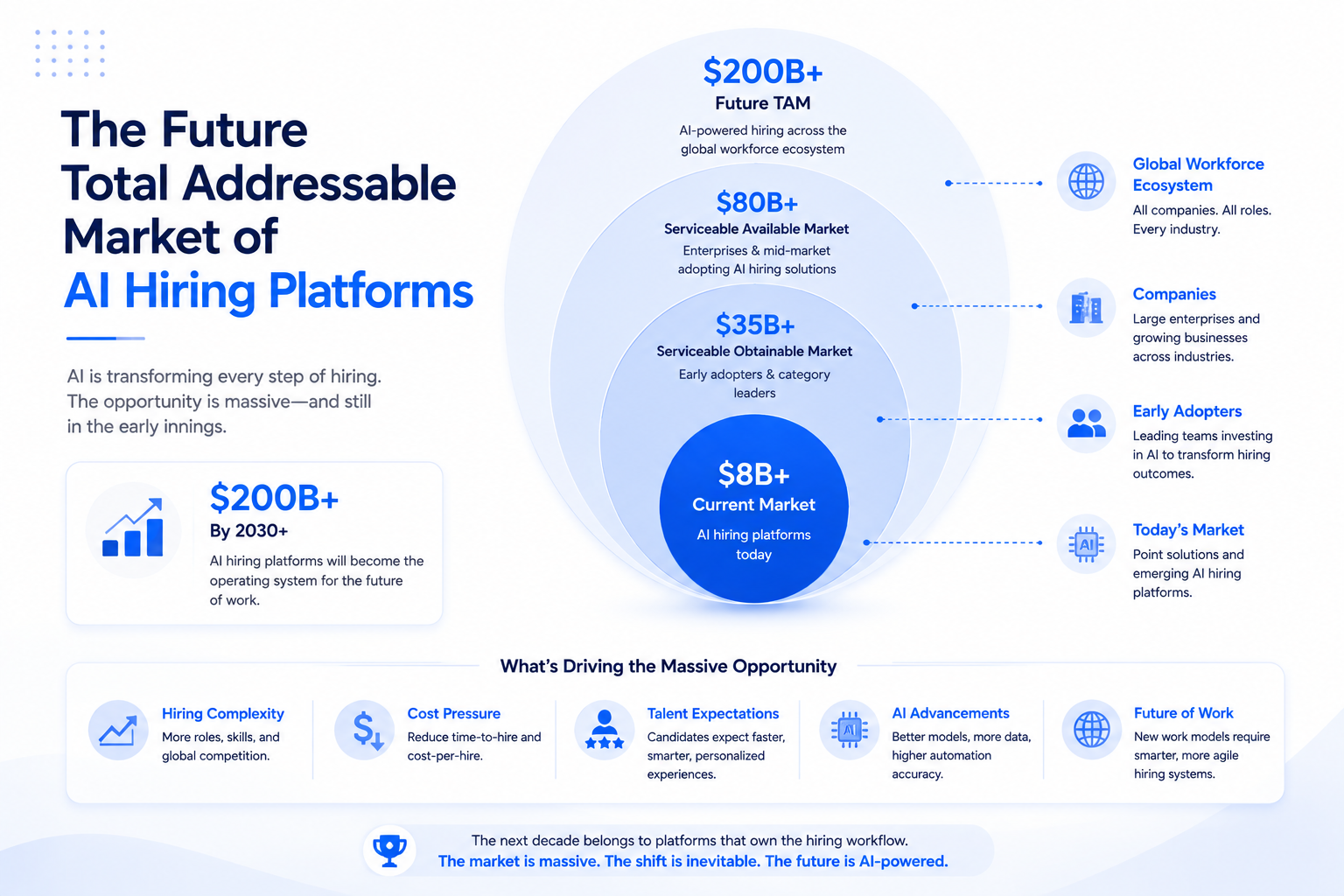
Rachel Torres, a partner at a growth-stage venture capital firm, was preparing for her annual market sizing review when she noticed something that challenged her existing thesis. Her firm had invested in two AI hiring companies, both performing well operationally, but the market size models she had built eighteen months earlier now looked conservative to the point of being misleading. The original model assumed AI hiring platforms would capture a portion of the existing recruiting technology market, estimated at twelve to fifteen billion dollars globally. But the actual adoption patterns she was observing among her portfolio companies' clients suggested something much larger was happening. Enterprise clients were not just replacing their existing recruiting technology with AI alternatives. They were expanding their use of AI hiring platforms into functions that had never been served by traditional recruiting technology: internal mobility, workforce planning, skills assessment at scale, contingent workforce management, and talent intelligence for business strategy. The total addressable market was not the recruiting technology market. It was a substantial fraction of the broader human capital management market, which was estimated at over two hundred billion dollars globally. Rachel's realization mirrored a broader shift happening among investors, analysts, and founders in the AI hiring space: the market opportunity for AI hiring platforms is significantly larger than the recruiting technology category they are currently classified within, and understanding the true size and shape of this opportunity is essential for making informed investment, build, and buying decisions.
Why Traditional Market Sizing Underestimates AI Hiring
The conventional approach to sizing the AI hiring platform market starts with the existing
recruiting technology market and applies a penetration percentage to estimate the AI platform share. This approach produces market size estimates in the range of three to eight billion dollars for AI hiring platforms, which is the range most industry analysts currently publish. The problem with this approach is that it treats AI hiring platforms as a subset of an existing category rather than as the foundation of an emerging category that is expanding the boundaries of what recruiting technology encompasses. Traditional recruiting technology was designed to manage the process of filling open positions: posting jobs, receiving applications, screening candidates, and tracking hiring workflows. AI hiring platforms do all of this, but they also perform functions that were never within the scope of traditional recruiting technology, such as proactively identifying internal candidates for promotion, predicting workforce skill gaps before they become critical, managing contingent labor pools alongside full-time hiring, and providing talent market intelligence that informs business strategy beyond hiring. These expanded capabilities address market needs that were previously served by consulting engagements, manual HR processes, or enterprise software categories entirely separate from recruiting, which means the revenue opportunity extends into market segments that traditional recruiting technology never reached.
The historical analogy that best illustrates this dynamic is the evolution of customer relationship management software. When CRM first emerged in the late 1990s, it was sized against the contact management software market, a category worth perhaps one to two billion dollars. But CRM platforms expanded beyond contact management into sales automation, marketing automation, customer service, analytics, and commerce, eventually becoming a seventy to eighty billion dollar market that was orders of magnitude larger than the original category. AI hiring platforms are following a similar expansion trajectory. They started as tools for automating specific recruiting tasks, but their AI capabilities enable them to expand into adjacent human capital functions that share a common data foundation: understanding people's skills, experiences, preferences, and trajectories. This common data foundation means that the AI models trained for recruiting, understanding candidate profiles, matching people to roles, predicting fit and success, are directly applicable to adjacent use cases like internal mobility, workforce planning, and talent intelligence. The models do not need to be rebuilt for each adjacent use case. They need to be extended, which is far less expensive and faster than building from scratch, which means AI hiring platforms can expand into adjacent markets with relatively low marginal cost and high marginal revenue.
The expansion is already visible in the product roadmaps of leading AI hiring platforms. Three of the five largest AI-native recruiting platforms have launched internal mobility modules in the last year. Two have announced workforce planning features. Two others have introduced contingent workforce management capabilities. These are not speculative future features. They are currently shipping products with paying customers, which means the revenue from these expanded use cases is already contributing to platform revenue even though most market sizing models do not account for it. According to McKinsey, the total human capital management technology market, which includes recruiting, learning and development, compensation management, workforce analytics, and employee engagement, is projected to reach
two hundred twenty billion dollars by 2028, and AI-native platforms that can serve multiple HCM functions from a unified data model are positioned to capture a disproportionate share of this growth because their AI capabilities create cross-functional value that point solutions cannot match. agentic AI platforms vs automated ones explains why the agentic architecture of modern AI platforms enables this expansion, because platforms that autonomously manage end-to-end workflows can extend those workflows into adjacent functions like internal mobility and workforce planning without requiring the fundamental architectural changes that traditional recruiting systems would need to serve these expanded use cases.
Sizing the Core Recruiting Technology Market
Before expanding the TAM model, it is important to establish the baseline. The core recruiting technology market, which includes applicant tracking systems, sourcing tools, recruitment marketing platforms, screening and assessment tools, interview scheduling software, and recruiting analytics, is currently estimated at twelve to fifteen billion dollars in annual recurring revenue globally. This market has grown at approximately twelve to fifteen percent annually over the last five years, driven by enterprise digital transformation and the increasing complexity of recruiting in competitive talent markets. The AI-native segment of this core market, defined as platforms where AI is the primary technology differentiator rather than a feature enhancement, is estimated at two to four billion dollars currently and growing at twenty-five to thirty-five percent annually, significantly faster than the overall recruiting technology market. This growth rate differential means that AI-native platforms are gaining market share from traditional recruiting technology, a trend that is expected to accelerate as AI capabilities improve and enterprise buyers become more confident in AI-driven recruiting workflows.
The core recruiting technology market itself has room for growth beyond the current twelve to fifteen billion dollar estimate. Recruiting technology penetration varies significantly by company size and geography. Large enterprises in North America and Western Europe have relatively high technology adoption, with most using at least an ATS and two to four supplementary tools. But mid-market companies, which represent the largest segment by employer count, often use only a basic ATS or no recruiting technology at all. Small businesses, which account for the majority of hiring volume globally, are even less penetrated. And companies in developing markets, particularly in Asia, Latin America, and Africa, represent a massive underserved population of employers who are beginning to adopt recruiting technology as their labor markets become more competitive and digital infrastructure improves. According to Gartner, the total addressable market for recruiting technology, if defined as the revenue opportunity if every employer globally adopted a baseline set of recruiting tools, is twenty to twenty-five billion dollars, roughly double the current market size, because mid-market and small business adoption and emerging market expansion together represent ten to twelve billion dollars in untapped demand.
Within this core market, AI-native platforms are positioned to capture an increasingly large
share. The current AI-native penetration of the core recruiting technology market is approximately fifteen to twenty percent, meaning that eighty to eighty-five percent of recruiting technology spending still goes to traditional, non-AI-native tools. As AI capabilities improve and enterprise confidence in AI-driven recruiting grows, this penetration percentage is expected to increase to forty to sixty percent over the next five to seven years, which would imply an AI-native core recruiting technology market of eight to fifteen billion dollars by 2030 to 2032. This core market expansion, from two to four billion dollars today to eight to fifteen billion dollars within five to seven years, represents a three to five times growth opportunity that is entirely within the boundaries of the existing recruiting technology category and does not require any market expansion into adjacent categories. SHRM reports that sixty-two percent of talent acquisition leaders plan to increase their investment in AI recruiting tools over the next two years, and that the primary barrier to faster adoption is not budget constraints but the difficulty of evaluating and comparing AI recruiting platforms, which suggests that demand is strong and growing and that the bottleneck is information and trust rather than market saturation. how to evaluate an AI sourcing tool addresses this evaluation challenge directly, because the difficulty of comparing AI recruiting platforms is a significant friction point in the buying process that slows adoption and extends sales cycles, particularly for mid-market buyers who lack dedicated HR technology evaluation resources.
Expansion Vector One: Internal Mobility and Talent Marketplace
Internal mobility, the process of matching existing employees to new roles, projects, or development opportunities within the organization, is the single largest adjacent market opportunity for AI hiring platforms. The internal mobility technology market, which includes internal talent marketplaces, skills inference engines, career pathing tools, and internal gig work platforms, is currently estimated at two to three billion dollars and growing at twenty to twenty-five percent annually. This market is driven by a structural shift in how organizations manage talent. Employee retention has become a strategic priority as labor markets remain competitive and the cost of turnover, which typically ranges from fifty to two hundred percent of annual salary depending on the role, has made retention one of the highest-ROI investments an organization can make. Internal mobility is the most effective retention lever available, because employees who see clear advancement opportunities within their organization are significantly less likely to leave. Research consistently shows that organizations with strong internal mobility programs have thirty to forty percent lower voluntary turnover than organizations that rely primarily on external hiring, and that internal hires reach full productivity fifty percent faster than external hires because they already understand the organization's culture, processes, and systems.
AI hiring platforms are uniquely positioned to capture the internal mobility market because the core AI capabilities required for external recruiting, understanding people's skills and experiences, matching them to role requirements, and predicting fit and success, are directly applicable to internal mobility. An AI model that can match an external candidate to an open
role can also match an existing employee to an internal opportunity, often more effectively because the platform has access to the employee's performance history, manager feedback, and internal project contributions, data that is not available for external candidates. This capability overlap means that AI hiring platforms can enter the internal mobility market with a significant technology advantage over incumbents who built their platforms specifically for internal mobility but lack the recruiting-grade matching and screening capabilities that AI hiring platforms have developed. The practical implication is that AI hiring platforms can offer their existing recruiting clients internal mobility as an extension of their current platform, creating a land-and-expand dynamic where the recruiting use case serves as the entry point and internal mobility serves as the expansion opportunity that increases per-client revenue and switching costs. According to LinkedIn, organizations that deploy AI-powered internal talent marketplaces see twenty-five to thirty-five percent increase in internal fill rates and fifteen to twenty percent reduction in voluntary turnover within the first year, which generates ROI that easily justifies the platform investment and creates strong retention economics for the vendor.
The revenue opportunity from internal mobility is substantial. If AI hiring platforms capture thirty to forty percent of the internal mobility technology market as it grows from two to three billion dollars today to five to eight billion dollars by 2028, the revenue opportunity is two to three billion dollars in incremental annual recurring revenue. This is revenue that is additive to the core recruiting technology market, because internal mobility platforms are typically sold as separate modules with separate pricing, and because the buyers for internal mobility technology often include HR business partners, learning and development leaders, and business unit heads who are not part of the traditional recruiting technology buying center. This expansion of the buying center is strategically important because it increases the number of stakeholders who derive value from the platform, which increases retention and creates cross-functional adoption that is difficult for competitors to displace. AI sourcing vs AI recruiting illustrates why the boundary between external recruiting and internal talent management is blurring, because the most effective talent strategies increasingly treat internal and external talent as a single pool, and AI platforms that can manage both from a unified system are better positioned than point solutions that serve only one side of this increasingly integrated talent equation.
Expansion Vectors: Workforce Planning, Contingent Labor, and Talent Intelligence
Beyond internal mobility, AI hiring platforms are expanding into three additional market segments that together represent a significant incremental revenue opportunity. The first is workforce planning, the process of forecasting an organization's future talent needs based on business strategy, growth projections, and workforce analytics. The workforce planning technology market is currently estimated at one point five to two point five billion dollars and growing at eighteen to twenty-two percent annually. Workforce planning has historically been a consulting-heavy function, with organizations relying on external consultants to build workforce
models, conduct scenario analyses, and recommend hiring plans. AI hiring platforms are disrupting this model by automating the analytical components of workforce planning, using their understanding of the external talent market, combined with internal workforce data, to generate demand forecasts, skill gap analyses, and hiring recommendations that previously required expensive consulting engagements. The key insight is that AI hiring platforms already have extensive data about the external talent market, including supply and demand dynamics for specific skills, salary trends, and geographic availability. When this external market intelligence is combined with an organization's internal workforce data, the platform can generate workforce planning insights that are more current, more granular, and more actionable than traditional consulting-delivered plans.
The second expansion vector is contingent workforce management. The contingent labor market, which includes freelancers, contractors, and temporary workers, is estimated at over one trillion dollars in global spend and growing faster than the traditional employment market. Technology penetration in contingent workforce management is relatively low, with many organizations still managing contingent labor through manual processes, spreadsheets, or basic vendor management systems. AI hiring platforms are expanding into this market by applying their sourcing, screening, and engagement capabilities to contingent labor pools, enabling organizations to manage full-time hiring and contingent staffing from a single platform with a unified talent pool and consistent evaluation criteria. This convergence of full-time and contingent hiring on a single AI platform is particularly valuable for organizations that use both types of labor extensively, which is an increasing proportion of enterprises as the gig economy expands and the traditional boundary between employee and contractor blurs. The contingent workforce management technology market is estimated at three to five billion dollars currently, with significant growth potential as AI platforms make it easier for organizations to manage blended workforces. According to Deloitte, organizations that use AI platforms to manage both full-time and contingent hiring report twenty to thirty percent reduction in contingent labor costs and fifteen to twenty-five percent faster time to fill for contingent roles, because the unified platform eliminates the duplication of effort and data fragmentation that occur when full-time and contingent hiring are managed on separate systems.
The third expansion vector is talent intelligence, the use of labor market data and analytics to inform business strategy beyond hiring. Talent intelligence goes beyond recruiting analytics, which measure hiring process efficiency, to provide insights about talent market dynamics, competitive talent positioning, skill availability trends, and geographic talent concentration that inform business decisions about where to locate offices, which markets to enter, what products to build, and how to price compensation. The talent intelligence technology market is currently nascent, estimated at five hundred million to one billion dollars, but it is growing rapidly as organizations recognize that talent market data is a strategic input to business planning, not just a recruiting operational tool. AI hiring platforms are well-positioned to lead this market because they already collect and process the labor market data that talent intelligence requires. A platform that sources candidates across industries and geographies, tracks salary and availability trends, and observes hiring patterns across thousands of organizations,
possesses a labor market dataset that is far more comprehensive than what dedicated talent intelligence vendors can assemble. The platform's AI models can transform this raw data into strategic insights, creating a talent intelligence product that is both more comprehensive and more current than existing alternatives. EY projects that the talent intelligence technology market will grow to four to six billion dollars by 2028 as organizations increasingly treat talent data as a strategic asset, and that AI hiring platforms with large-scale labor market datasets will capture thirty to forty percent of this market because their data advantage is difficult for dedicated talent intelligence vendors to replicate. why AI tools have outdated candidate data demonstrates why platforms with continuously updated, organically generated labor market data have a structural advantage over vendors relying on static or purchased datasets, because the freshness and granularity of the data directly determines the quality and actionability of the talent intelligence insights that the platform can deliver.
The Consolidated TAM Model and Investment Implications
When the core recruiting technology market and the four expansion vectors are combined, the future TAM for AI hiring platforms looks significantly different from the three to eight billion dollar estimates that most analysts currently publish. The core AI-native recruiting technology market, projected to reach eight to fifteen billion dollars by 2030 to 2032, provides the foundation. Internal mobility adds two to three billion dollars in incremental opportunity. Workforce planning adds one to two billion. Contingent workforce management adds two to four billion. And talent intelligence adds one point five to two point five billion. The sum of these components produces a future TAM range of approximately fifteen to twenty-seven billion dollars by 2028 and twenty-five to forty billion dollars by 2030 to 2032, depending on adoption rates, pricing evolution, and the pace of platform expansion into adjacent categories. This range is three to five times larger than current market estimates, and it reflects the reality that AI hiring platforms are not merely competing for share of an existing category but are actively expanding the boundaries of that category into adjacent markets. The upper end of this range, thirty to forty billion dollars, is achievable if AI hiring platforms successfully establish themselves as the primary technology platform for multiple human capital functions, effectively becoming the operating system for talent management within organizations.
The implications of this expanded TAM model are significant for investors, founders, and enterprise buyers. For investors, the larger TAM justifies higher valuations for AI hiring platforms, because the revenue growth runway is longer and the ultimate market position is larger than traditional models suggest. Investors should evaluate AI hiring platforms not on their current share of the recruiting technology market but on their ability to expand into adjacent categories, the strength of their data assets for enabling that expansion, and the architecture of their platform for supporting multiple HCM functions from a unified system. A platform with strong data assets and a flexible architecture may be worth significantly more than a platform with higher current revenue but limited expansion potential. For founders, the expanded TAM creates a strategic imperative to invest in platform architecture and data infrastructure that
supports adjacent market entry. The temptation is to optimize for the core recruiting use case and defer expansion, but the platforms that will capture the most value are those that build the data foundation and architectural flexibility for expansion early, even if the adjacent revenue is small today. According to Gartner, AI hiring platforms that have launched at least two adjacent market modules, such as internal mobility or workforce planning, are valued at two to three times the revenue multiples of platforms that remain focused exclusively on core recruiting, because the market recognizes that adjacent market expansion extends the growth runway and increases the platform's strategic importance to clients.
For enterprise buyers, the expanded TAM model has a different but equally important implication. Organizations that adopt AI hiring platforms early are not just buying a recruiting tool. They are investing in a talent management platform that will expand in capability over time as the vendor adds adjacent functions. This means that the buying decision should be evaluated not on current feature comparison but on the platform's data architecture, AI capabilities, product roadmap, and ability to serve as a long-term talent technology foundation. Organizations that choose platforms based on current feature checklists may find themselves locked into vendors who cannot expand beyond recruiting, while competitors who choose platforms with strong expansion capabilities will benefit from the continuous addition of new talent management functions without the cost and disruption of replacing their technology. The practical advice for enterprise buyers is to evaluate AI hiring platforms on four criteria: the breadth and quality of their talent data, the sophistication of their AI models, the extensibility of their platform architecture, and the credibility of their product roadmap for adjacent market entry. Platforms that score highly on all four criteria are the ones most likely to capture the expanded TAM and, by extension, to deliver the most value to their clients over time. AI tools for niche technical roles shows how platforms that develop deep expertise in specific talent segments build the data assets that enable expansion into adjacent categories, because the specialized data collected in niche markets provides the training foundation for AI models that can then generalize to broader use cases. how many follow-ups one hire needs illustrates how the continuous interaction data generated by AI-driven candidate engagement, which most point solutions cannot capture, becomes the data fuel for adjacent market intelligence products that expand the platform's revenue opportunity beyond core recruiting.