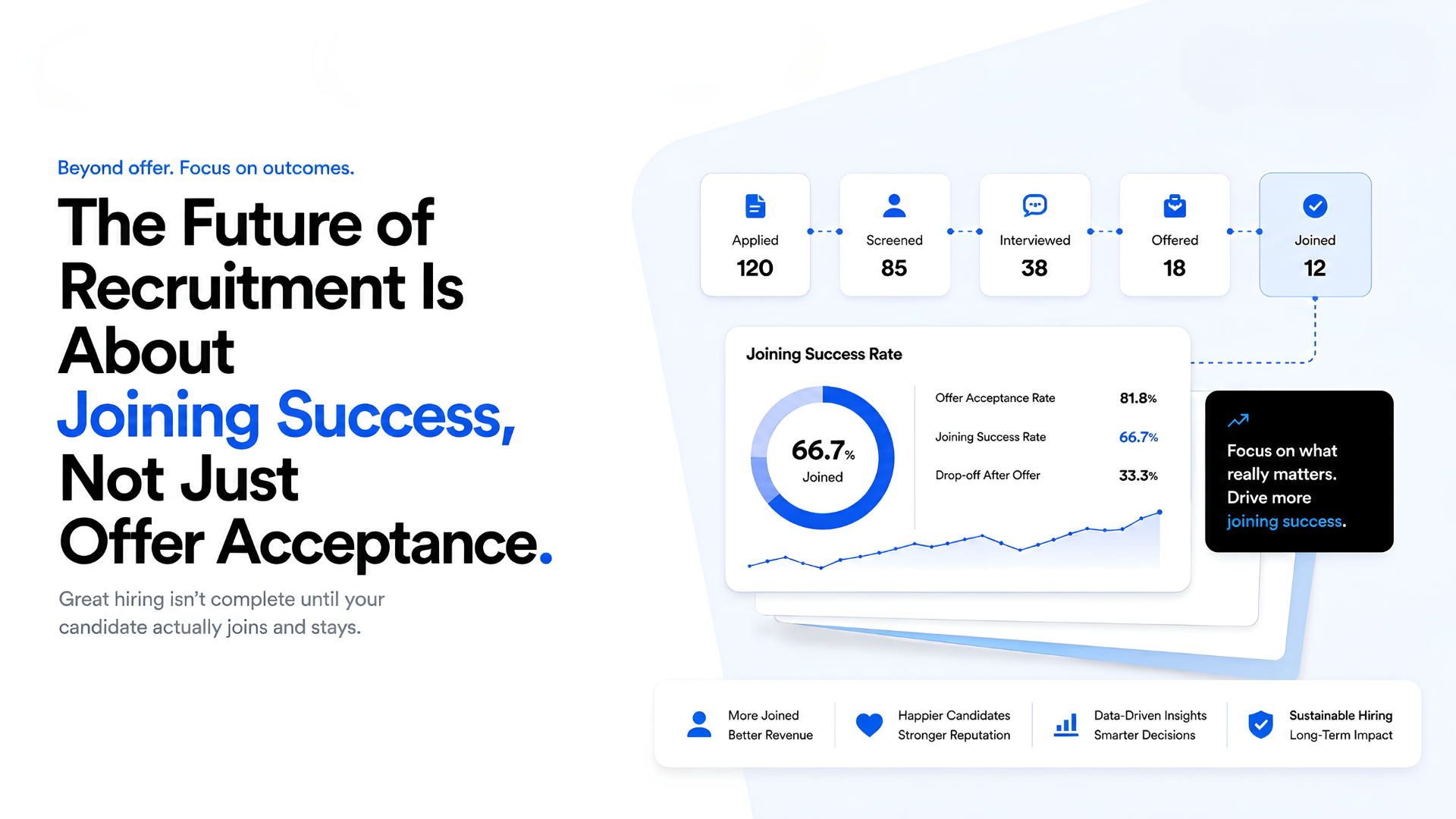
The recruiting industry's most celebrated metric is broken. Offer acceptance rate, the percentage of candidates who say yes to an offer, has been the primary measure of recruiting effectiveness for decades. It is the metric that recruiting leaders report to their boards, that agencies advertise to their clients, and that technology vendors highlight in their case studies. But offer acceptance rate measures the wrong thing. It measures whether the recruiting team was persuasive enough to get a candidate to sign a piece of paper. It does not measure whether the candidate actually shows up, stays through the guarantee period, and becomes a productive member of the team. A company with a ninety-five percent offer acceptance rate and a seventy-eight percent joining rate is not performing well. It is losing nearly one in five hires after the work of sourcing, screening, interviewing, and negotiating is complete, and it is doing so with no systematic process to prevent it. The future of recruitment belongs to the organizations that recognize this gap and redefine success around the outcome that matters: a candidate who joins, stays, and succeeds.
This is not a theoretical argument. The financial impact of the gap between offer acceptance and joining success is measurable and significant. According to SHRM's talent acquisition research, the average cost of a failed placement, one where the candidate accepts the offer but does not start or leaves within the guarantee period, ranges from one and a half to three times the placement fee or internal hiring cost. For an organization that makes two hundred offers
per year with a true hiring cost of twelve thousand dollars per offer, a seventeen-percentage-point gap between offer acceptance and joining rate represents roughly four hundred thousand dollars in annual wasted investment. This is not a marginal number. It is a material financial impact that would trigger immediate action if it appeared in any other part of the business. Yet in recruiting, it is tolerated as an unavoidable cost of doing business. The joining success as recruitment outcome framework challenges this assumption and provides a clear, actionable path to recovering that lost value.
Why Offer Acceptance Became the Default Metric
Offer acceptance rate became the default metric for a simple reason: it was the easiest thing to measure. In an era of paper-based hiring processes and fragmented applicant tracking systems, the moment of offer acceptance was the clearest, most unambiguous data point in the entire process. The candidate either signed or they did not. Tracking what happened after the signature required manual follow-up over weeks or months, cross-referencing data between the recruiting system and the HRIS, and making subjective judgments about whether an early departure was caused by a recruiting failure or an operational one. It was hard, and most organizations did not bother. The result was a metric system that rewarded the activity of closing offers rather than the outcome of producing productive hires. According to McKinsey's people organization insights, this metric legacy has persisted even as technology has made comprehensive post-offer tracking straightforward, because the inertia of decades of reporting and benchmarking makes it difficult for organizations to change what they measure and how they define success.
The consequence of this metric legacy is a systematic misallocation of recruiting resources. When offer acceptance rate is the primary metric, recruiters rationally optimize for getting candidates to say yes. They invest in offer negotiation skills, in competitive compensation packages, and in persuasive closing techniques. These investments are not wrong, but they are incomplete. They address the last moment of the front-end process without addressing the weeks and months that follow, the period during which the candidate's commitment is tested by counteroffers, competing opportunities, anxiety, doubt, and the practical challenges of transitioning between organizations. The recruiter who invests five hours in negotiating the perfect offer but zero hours in managing the candidate's post-offer experience is optimizing for the wrong metric. Understanding how many follow-ups one hire actually needs, the organizations that are leading the shift from offer acceptance to joining success are the ones that recognize recruiting does not end at the signed offer but continues until the candidate is productively employed.
The Three Pillars of a Joining-First Recruitment Model
A joining-first recruitment model is built on three pillars that together create a systematic, repeatable approach to turning signed offers into productive hires. The first pillar is metric realignment. The organization adopts joining rate, the percentage of accepted offers that result
in a candidate who completes the guarantee period, as the primary measure of recruiting effectiveness. Offer acceptance rate becomes a secondary metric, a leading indicator that is necessary but not sufficient. Time to fill remains relevant but is recalculated from the point of requisition approval to the candidate's first day, not to the point of offer acceptance. These three metrics, joining rate, offer acceptance rate, and true time to fill, together provide a complete picture of recruiting performance that the current metric system cannot deliver. According to Gartner's HR trends analysis, organizations that adopt joining rate as a primary metric see measurable improvements in both recruiting efficiency and business leader satisfaction within two quarters, because the metric forces the recruiting team to focus on the outcome that business leaders actually care about: people who show up and do the work.
The second pillar is process continuity. The recruiting process does not end at offer acceptance but continues through a structured post-offer phase that includes communication cadence management, multi-stakeholder engagement, risk monitoring, counteroffer preparation, and seamless handoff to the onboarding team. This phase is not an add-on or a nice-to-have. It is a core part of the recruiting process with defined ownership, defined activities, and defined success criteria. The third pillar is technology enablement. The post-offer phase is managed by an AI-powered platform that orchestrates communications, monitors engagement signals, coordinates stakeholder involvement, and provides the measurement infrastructure needed to track joining rate with full segment-level visibility. Without technology, the post-offer phase cannot be managed consistently at scale, because no human recruiter can maintain the required level of attention for twenty or thirty simultaneous candidates. This is the core of hiring completion over offer closure: the recognition that the recruiting process is not complete until the candidate is successfully employed, and that technology is the only way to make this extended process manageable at the scale that modern organizations require.
What This Shift Means for Recruiters
The shift from offer acceptance to joining success does not diminish the recruiter's role. It elevates it. In the current model, the recruiter's value is measured primarily by their ability to close offers, a skill that is important but that represents only a fraction of the value a great recruiter can deliver. In the joining-first model, the recruiter's value is measured by their ability to produce productive hires, a broader and more demanding standard that requires a more comprehensive skill set. The recruiter must be skilled not only at sourcing, screening, and closing but also at relationship management, stakeholder coordination, risk assessment, and post-offer engagement. According to LinkedIn's recruiting resources, recruiters who operate in a joining-first model report higher job satisfaction and stronger relationships with hiring managers, because they are measured on the outcome that the business actually values rather than on an intermediate metric that feels disconnected from the real-world result.
The shift also changes the recruiter's daily workflow. In the current model, the recruiter's focus moves rapidly from one requisition to the next, with minimal attention to candidates who have already accepted offers. In the joining-first model, the recruiter maintains active
ownership of every candidate from the moment of offer acceptance through the first ninety days of employment, supported by AI that handles the structural elements of post-offer management while the recruiter focuses on the high-stakes situations that require human judgment. Understanding the difference between AI sourcing and AI recruiting, the recruiters who thrive in this model are the ones who embrace AI as a partner that handles the repetitive elements of post-offer management, freeing them to invest their time in the relationship-building activities that only a human can perform. This is the recruitment outcome redefinition in practice: not replacing recruiters but expanding their scope and measuring their impact on the outcome that matters most.
What This Shift Means for Technology Vendors
The technology market for recruiting is undergoing a parallel shift. For years, the dominant innovation in recruiting technology has focused on the front end of the process: sourcing automation, AI-powered screening, interview scheduling, and offer management. These tools have made the front end dramatically more efficient, but they have done nothing to address the post-offer gap. The result is an industry where technology has made it faster and cheaper to generate offers that may never result in actual hires. The technology vendors that will lead the next phase of market growth are the ones that recognize this gap and build platforms that manage the full hiring lifecycle, from first contact through first ninety days. According to Deloitte's talent research, the post-offer technology segment is the fastest-growing category in recruiting technology, because it addresses the part of the process where the greatest value is at stake and where the current technology stack provides the least support.
The key differentiator in this new market segment is not feature richness but integration. The post-offer phase generates and requires data from every previous phase of the hiring process. The candidate's motivations, discovered during sourcing. Their concerns, surfaced during screening. Their relationship with the hiring manager, formed during interviews. Their compensation expectations, set during negotiation. All of this intelligence must flow seamlessly into the post-offer management system, where it informs the communication strategy, the risk assessment, and the intervention recommendations. As we have explored in our analysis of why more tools produce the same hiring problems, the organizations that have tried to solve the post-offer gap by bolting a separate tool onto their existing stack have seen limited results, because the data silos between the front-end and post-offer systems prevent the kind of integrated, context-aware management that joining success requires. This is the offer-to-joining success metric at the technology level: the platform that can measure and optimize the full journey from first contact to productive employment will outperform the platform that only manages a fragment of that journey.
How to Make the Shift in Your Organization
Making the shift from an offer-acceptance model to a joining-success model requires three steps. The first step is to measure the gap. Calculate your current joining rate, defined as the
percentage of accepted offers that result in a candidate who completes the guarantee period. Compare it to your offer acceptance rate. The gap between the two numbers is the opportunity. For most organizations, this gap is between fifteen and twenty-five percentage points, representing a significant amount of wasted recruiting investment. The second step is to adopt joining rate as a primary metric, communicated to the recruiting team, to hiring managers, and to business leaders. This single change in measurement will begin to reallocate recruiter attention and effort toward the post-offer phase, because people optimize for what they are measured on.
The third step is to deploy technology that makes the post-offer phase manageable at scale. This is where Huntlo.ai provides the complete solution. Huntlo captures candidate intelligence throughout the hiring process, builds personalized engagement plans for the post-offer phase, orchestrates multi-stakeholder communication, monitors risk in real time, and measures joining rate with full segment-level analytics. Huntlo ensures that outdated candidate data in AI recruiting tools never undermines the post-offer strategy, because every recommendation is based on fresh, continuously updated intelligence. For recruiting leaders who recognize that the future of recruitment is about joining success, Huntlo provides the technology, the workflow, and the measurement to make the shift. And for organizations evaluating their options, understanding how to evaluate an AI sourcing tool before buying, means asking whether the platform manages the full hiring lifecycle or whether it stops at the offer acceptance like every other tool on the market. As we have discussed in our analysis of why referrals outperform cold outreach, the organizations that manage the complete candidate journey consistently outperform those that optimize for individual stages, because joining success is a compound outcome that depends on the quality of every phase that precedes it.