The candidate signs the offer. The recruiter moves on. For the next two to four weeks, the person who is about to become your newest employee hears almost nothing from the team they just committed to joining. This is not a gap in process. It is a gap in intelligence. And it is being filled, rapidly and decisively, by AI systems that treat the preboarding window with the strategic importance it deserves.
The preboarding phase, the period between offer acceptance and day one, has historically been the least intelligent part of the hiring process. Organizations have invested heavily in AI for sourcing, screening, and interview scheduling, but the phase where ten to twenty percent of accepted candidates are lost has remained stubbornly manual, inconsistently executed, and largely unmeasured. That is changing. A new generation of AI preboarding systems is bringing the same level of intelligence and automation to the acceptance-to-joining transition that has already transformed the front end of the funnel. According to SHRM’s talent acquisition research, the organizations that have adopted AI-assisted preboarding in the past two years report joining rate improvements of twenty-five to forty percent, while simultaneously reducing the time recruiters spend on preboarding tasks by sixty to seventy percent. These are not marginal improvements. They represent a fundamental shift in how the most vulnerable phase of the hiring process is managed.
What AI-Assisted Preboarding Actually Does
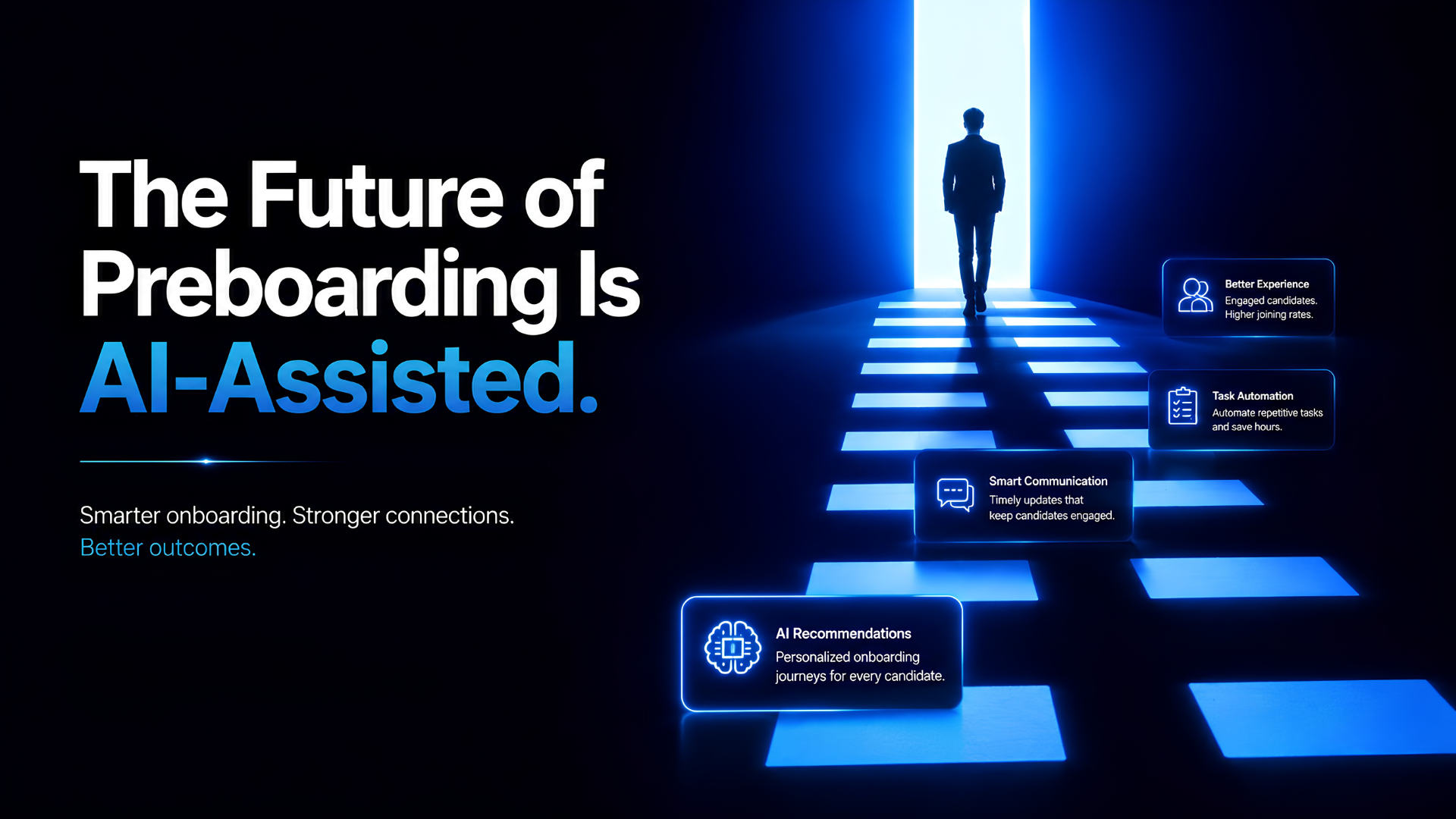
AI-assisted preboarding is not a single capability. It is a layered system that combines four distinct AI functions, each addressing a specific failure mode in the traditional preboarding process. The first function is intelligent communication orchestration. Rather than relying on a recruiter to manually schedule and send preboarding touchpoints, the AI system generates a personalized communication plan for each candidate based on their role, seniority, location, and the intelligence gathered during the interview process. It determines the optimal cadence, the right channel, the best sender for each message, and the content that will be most relevant to that specific candidate. A senior engineer who expressed excitement about the tech stack
during interviews receives a different preboarding sequence than a marketing manager who asked about campaign ownership. The AI adapts the plan in real time based on the candidate’s responsiveness and engagement level. This is fundamentally different from the simple automated email sequences that some organizations have implemented. Those sequences are rule-based and static. intelligent preboarding is adaptive and dynamic, learning from every interaction and continuously optimizing the experience for each individual candidate.
The second function is predictive risk detection. Traditional preboarding is reactive. A recruiter discovers that a candidate has disengaged only when the candidate stops responding to messages, and by that point, intervention is often too late. AI-assisted preboarding is predictive. The system analyzes a range of engagement signals, response times, email open rates, content interaction patterns, and the tone and length of the candidate’s replies, to identify candidates who are trending toward withdrawal. It does not wait for a candidate to go dark. It flags the risk when the earliest signals appear, giving the recruiter a window of days or even weeks to intervene proactively. Research from Gartner’s HR trends analysis, shows that early intervention based on predictive signals is three to five times more effective at preventing drop-offs than reactive outreach after a candidate has already disengaged.
The third function is automated content personalization. Preboarding communications need to be substantive, not just logistical. Candidates want to know about the team they will join, the projects they will work on, and the people they will work with. But creating personalized content for every candidate at scale is impossible without AI. An AI onboarding assistant can generate personalized content by drawing on the organization’s knowledge base, team wikis, project documentation, and the specific information gathered during interviews. It can compose a message that references the candidate’s conversation with the hiring manager about team structure, or share a relevant article about the market the candidate will be working in, or provide an introduction to the specific technology stack the team uses. This content feels personal and relevant because it is personal and relevant, generated specifically for that candidate based on what the AI has learned about their interests, concerns, and motivations.
The fourth function is stakeholder coordination. Preboarding requires input from multiple people: the recruiter, the hiring manager, the onboarding buddy, HR operations, and IT. In most organizations, this coordination happens through email chains, Slack messages, and shared spreadsheets, and it breaks down constantly under volume. The AI system acts as an orchestrator, assigning tasks to the right stakeholders, tracking completion, sending reminders, and escalating when deadlines are missed. It ensures that the hiring manager’s welcome message is sent within twenty-four hours, that the onboarding buddy introduction happens within the first week, and that IT provisioning is completed before the final week. As we have explored in our analysis of why more tools produce the same hiring problems, the value is not in any individual capability but in the coordination of all capabilities into a coherent system.
How AI Changes the Recruiter’s Role in Preboarding
One of the most common concerns about AI in preboarding is that it will make the experience feel impersonal. The reality is the opposite. AI does not replace the recruiter’s human touch. It amplifies it, by ensuring that the recruiter’s limited time is spent on the interactions that matter most. Consider what happens without AI. A recruiter managing thirty active requisitions has ten candidates in the preboarding phase at any given time. Under manual management, the recruiter can perhaps deliver a high-quality, personalized experience to three or four of those candidates. The other six or seven receive generic, delayed, or missed communications. With AI, all ten candidates receive a consistent, personalized experience, and the recruiter’s personal attention is directed to the one or two candidates who genuinely need a human conversation, identified by the AI’s risk detection system. This is the model that preboarding technology enables: AI handles the coordination and routine communication, while the recruiter handles the high-stakes human interactions that AI cannot replicate.
The recruiter’s role shifts from executor to strategist. Instead of spending hours each week manually scheduling touchpoints, drafting messages, and tracking responses, the recruiter reviews the AI’s recommendations, approves or adjusts the communication plan, and focuses their energy on the candidates who need personal intervention. According to LinkedIn’s recruiting insights, recruiters who use AI-assisted preboarding report higher job satisfaction because they spend less time on administrative tasks and more time on the relationship-building activities that attracted them to the profession. They also report better hiring outcomes, because the AI ensures that no candidate falls through the cracks, even when the recruiter is managing a high volume of simultaneous preboarding sequences.
The Data Foundation: Why AI Preboarding Needs Good Intelligence
AI-assisted preboarding is only as effective as the data it operates on. The system needs to know what the candidate cares about, what concerns they expressed during interviews, what excited them about the role, and what their communication preferences are. This intelligence must be captured systematically during the interview process and made available to the preboarding system. When it is, the result is a preboarding experience that feels like a natural continuation of the interview conversation, not a generic corporate onboarding program. When it is not, the result is automated but impersonal communications that demonstrate the limitations of AI rather than its potential. This is why the question of outdated candidate data in AI recruiting tools, is even more critical in the preboarding context than in sourcing. Sourcing with stale data produces irrelevant candidates. Preboarding with stale data produces disengaging experiences that actively increase drop-off risk. The AI systems that deliver the best preboarding outcomes are the ones that are continuously updated with fresh intelligence from every candidate interaction.
The data foundation also requires integration across systems. Preboarding intelligence lives in multiple places: the applicant tracking system, the interview feedback forms, the recruiter’s notes, the HR information system, and the IT provisioning system. An AI preboarding system that operates in isolation, without access to this data, can only deliver generic automation. The systems that deliver genuinely intelligent preboarding are the ones that integrate across
the entire hiring technology stack, drawing on data from every system and every interaction to build a comprehensive picture of each candidate. This is what distinguishes an agentic AI recruiting platform from a point solution: the ability to reason across multiple data sources and make intelligent decisions that no single system could make in isolation.
What the Best AI Preboarding Experiences Look Like in Practice
The most effective AI-assisted preboarding programs share five characteristics that define the current best practice. First, a personalized welcome sequence within the first twenty-four hours of acceptance. The candidate receives a message from the hiring manager that references something specific from their interview conversation, an introduction to their onboarding buddy, and a brief overview of what to expect in the first week. This is not a template. It is generated by the AI based on the specific context of that candidate’s hiring journey, and it feels personal because it is personal. Second, a curated information feed during the notice period. The AI selects and shares relevant content, team updates, project news, industry articles, and organizational announcements, based on the candidate’s role and interests. Third, proactive risk monitoring with real-time alerts. The AI tracks engagement signals and alerts the recruiter when a candidate’s behavior indicates rising risk. Understanding how many follow-ups one hire actually needs, and adapting the cadence based on the candidate’s individual engagement pattern, is what makes the difference between a system that feels responsive and one that feels mechanical.
Fourth, a structured final-week ramp. In the last seven days before the start date, the communication intensity increases. The candidate receives a detailed first-day agenda, a personal call from the onboarding buddy, a message from the hiring manager expressing anticipation, and clear instructions for logistics like parking, building access, and dress code. The AI ensures that every logistical detail is handled and every personal touchpoint is delivered. Fifth, a day-one confirmation workflow. The system confirms that the candidate has arrived, triggers the transition from preboarding to onboarding, and records the successful joining. This data feeds back into the AI’s models, improving the system’s ability to predict and prevent future drop-offs. According to McKinsey’s people organization research, organizations that implement all five of these characteristics see joining rates above ninety-five percent, compared to the industry average of eighty to eighty-five percent.
The ROI of AI-Assisted Preboarding
The return on investment for AI-assisted preboarding is one of the highest in the recruiting technology stack, because the cost of failure is so high and the cost of the solution is relatively low. Consider the math for a mid-size enterprise that makes three hundred offers per year with a twelve percent drop-off rate. That is thirty-six candidates who accept but never join. At an average cost of twenty-five thousand dollars per drop-off, including recruiter time, interview panel costs, vacancy delay, and opportunity cost, the annual cost of preboarding failures is nine hundred thousand dollars. An AI preboarding system that reduces the drop-off rate from twelve percent to seven percent saves the organization three hundred seventy-five
thousand dollars per year in avoided drop-off costs. Additionally, the recruiter time savings from automated preboarding coordination, estimated at five to eight hours per recruiter per week, translate into capacity equivalent to one to two additional full-time recruiters without any increase in headcount. As Deloitte’s talent research, notes, the organizations that calculate the true ROI of preboarding technology, including both the revenue saved from prevented drop-offs and the capacity gained from recruiter time savings, consistently find payback periods of six months or less.
The ROI also extends beyond the direct financial impact. Candidates who experience a strong AI-assisted preboarding process arrive on day one more engaged, better informed, and more prepared to contribute. They have already built a connection with their team, they understand the context of their role, and they feel confident in their decision. Research consistently shows that employees who had a positive preboarding experience reach full productivity faster, report higher job satisfaction in their first ninety days, and are less likely to leave within the first year. These downstream benefits, while harder to quantify, represent a significant additional return on the preboarding investment. This is the full value that AI-powered onboarding delivers: not just higher joining rates but better-prepared, more engaged new hires who contribute faster and stay longer.
Why Huntlo.ai Is Building the Preboarding Intelligence Layer
Huntlo.ai provides the complete AI-assisted preboarding platform that hiring teams need to transform the acceptance-to-joining transition from a risk zone into a competitive advantage. The system combines intelligent communication orchestration, predictive risk detection, automated content personalization, and stakeholder coordination into a single platform that operates across every requisition, every recruiter, and every candidate. The AI engine learns from every interaction, continuously improving the personalization and effectiveness of the preboarding experience. Every candidate receives a preboarding journey that is tailored to their specific role, interests, and concerns, while the recruiter retains full visibility and control over the process.
For hiring teams that are ready to bring the same intelligence to preboarding that they have already brought to sourcing and screening, Huntlo provides the technology, the workflow, and the adaptive intelligence to make it happen at any scale. One where referrals outperform cold outreach, not because of the channel, but because every candidate, regardless of source, receives a preboarding experience that reinforces their decision and builds genuine excitement for day one. And one where evaluating an AI recruiting tool before buying, means looking beyond sourcing capabilities to ask whether the platform can intelligently manage the entire candidate journey, from first contact through first week, with the same quality and consistency.