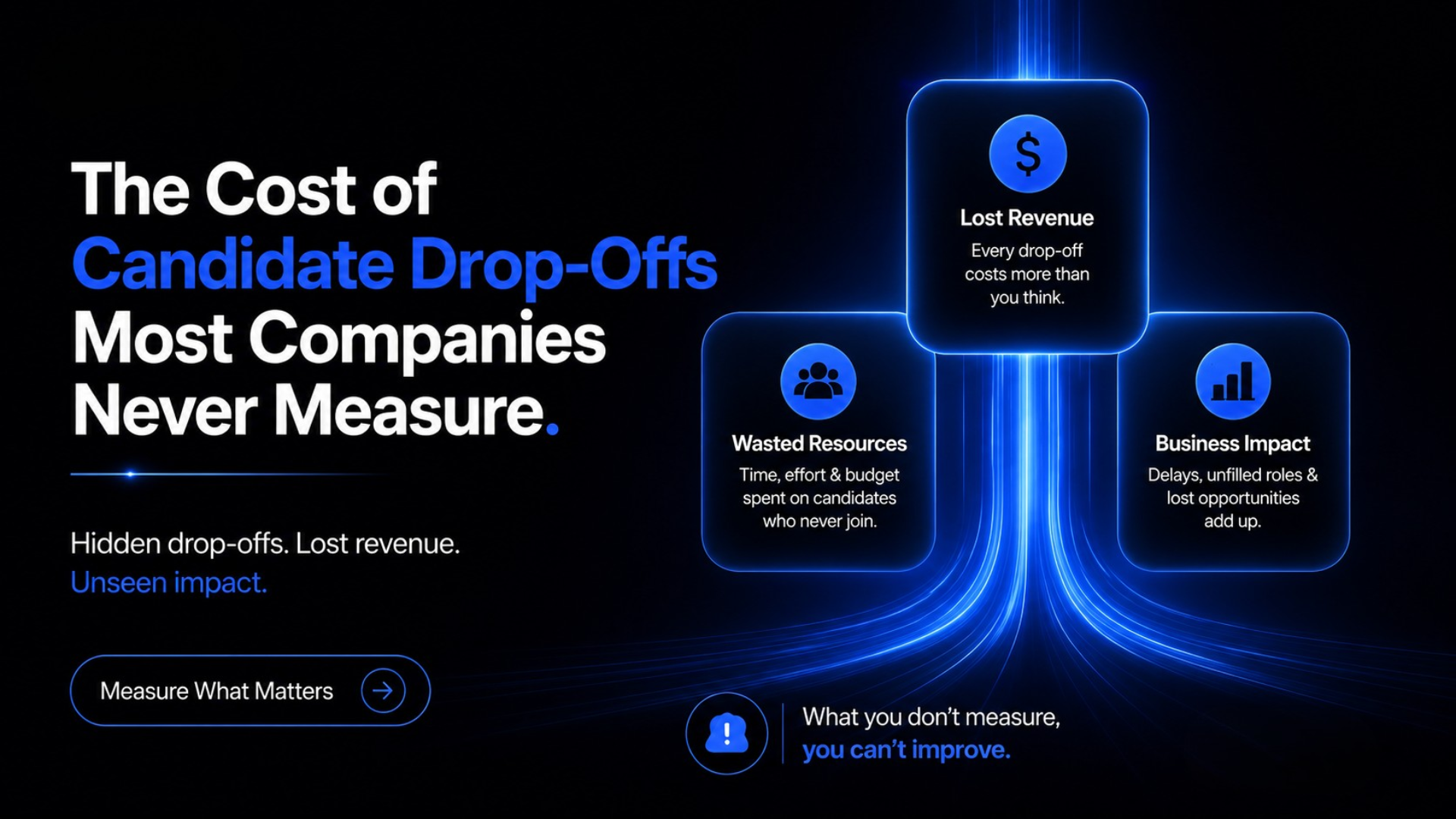
Every candidate who drops out of your hiring process costs money. Not just the obvious costs of recruiter time and advertising spend, but the invisible costs of delayed hiring, lost team productivity, interviewer hours, and employer brand erosion that compound across the organization. Most companies have no idea what drop-offs actually cost them because their primary hiring metric, cost-per-hire, only captures the cost of successful hires. It tells you how much you spent to get the hires you made. It says nothing about how much you spent on the candidates you lost.
Consider a mid-size company that hires two hundred people per year. Their cost-per-hire, a metric they track diligently, is twelve thousand dollars per successful placement, which means they spend roughly two point four million dollars per year on recruiting. What they do not track is how many candidates entered their funnel, how many dropped out at each stage, and what those drop-offs cost in aggregate. If they source five thousand candidates to make two hundred hires, that means forty-eight hundred candidates entered the process and left without joining. Each of those candidates consumed resources, recruiter time, screening tools, interview slots, and management attention. The cost of those forty-eight hundred failed candidates is almost certainly larger than the two point four million they spent on the two hundred successful ones. This is the cost that most companies never measure, and it is the single largest opportunity for improving both hiring efficiency and hiring ROI.
The Visible Costs: What Companies Think They Are Losing
When organizations do attempt to calculate the cost of candidate drop-offs, they typically focus on the most visible expenses. The most commonly measured cost is recruiter time. A recruiter spends an average of fifteen to twenty hours per candidate from initial outreach through offer stage, including sourcing, screening calls, interview scheduling, feedback
collection, and offer preparation. At an average fully loaded recruiter cost of sixty dollars per hour, that is nine hundred to twelve hundred dollars per candidate in recruiter labor alone. When a candidate drops out after three or four interviews, most of that investment is lost and cannot be recovered by reallocating the recruiter’s time. According to SHRM’s talent acquisition research, recruiter time represents the single largest direct cost of candidate drop-offs, accounting for roughly forty percent of the total measurable expense.
The second visible cost is advertising and sourcing spend. Job board postings, LinkedIn Recruiter licenses, sourcing tool subscriptions, and agency fees for positions that eventually get filled internally all represent sunk costs when candidates drop out. For enterprise organizations spending millions annually on sourcing channels, the portion of that spend that is wasted on candidates who never join can exceed five hundred thousand dollars per year. The third visible cost is interview panel time. When five interviewers each spend one hour interviewing a candidate who ultimately drops out, that is five hours of productive work lost. Across hundreds of drop-offs per year, interviewer time alone can represent a six-figure cost that is never tracked. These are the costs that companies can see when they look. They are significant, but they are only the tip of the iceberg. A proper recruitment cost analysis must go deeper to capture the full picture.
The Hidden Costs: Where the Real Money Is Lost
The hidden costs of candidate drop-offs are larger than the visible ones, and they compound in ways that most organizations fail to recognize. The first hidden cost is the cost of delayed hiring. When a candidate drops out, the position remains open longer. Every week a position stays vacant, the team loses productivity, existing employees absorb the workload, and projects fall behind schedule. Research from McKinsey’s people organization research, estimates that a vacant mid-level position costs an organization between five thousand and fifteen thousand dollars per week in lost productivity and delayed output. When candidate drop-offs extend time-to-fill by an average of three weeks across hundreds of positions, the cumulative cost of delayed hiring dwarfs the direct costs of the drop-offs themselves.
The second hidden cost is the opportunity cost of lost candidates. When a strong candidate drops out of your process, you do not just lose that candidate. You lose the next-best candidate who was waiting in your pipeline, because by the time you restart the process, that candidate has accepted another offer. You lose the candidates who were referred by the candidate who dropped out, because their experience was negative. And you lose future candidates who would have applied based on the positive experience of the candidate who joined, but that candidate never joined. The ripple effects of a single drop-off extend far beyond the individual candidate and impact the entire talent acquisition pipeline. This is why candidate attrition cost is not a single-event cost but a cascading cost that multiplies across the hiring funnel.
The third hidden cost is employer brand erosion. Candidates who drop out share their experiences, and negative candidate experiences are shared more frequently and more prominently than positive ones. Glassdoor reviews, social media posts, and word-of-mouth in professional
networks create a compounding negative effect on the organization’s ability to attract future candidates. As LinkedIn’s recruiting insights, reports, organizations with below-average candidate experience scores spend twenty to thirty percent more on sourcing to generate the same volume of qualified applicants. The brand erosion caused by drop-offs creates a hidden tax on every future hiring effort.
How to Calculate the True Cost of a Single Drop-Off
Calculating the true cost of a candidate drop-off requires a framework that accounts for both visible and hidden costs across every stage of the funnel. The framework has six components. First, the direct recruiter cost, calculated as the hours invested in the candidate multiplied by the recruiter’s fully loaded hourly rate. This includes sourcing time, screening time, interview coordination, and offer management. Second, the interview panel cost, calculated as the total hours spent by all interviewers multiplied by their respective hourly rates. For senior roles where interview panels include directors and VPs, this cost alone can exceed three thousand dollars per candidate. Third, the sourcing and advertising cost, calculated as the proportional cost of the channels used to source that specific candidate. Fourth, the delay cost, calculated as the additional weeks of vacancy attributable to the drop-off multiplied by the weekly cost of the vacant position.
Fifth, the opportunity cost, which is the hardest to quantify but often the largest. This includes the value of the work that was not done during the extended vacancy, the cost of the eventual hire being second-best rather than first-choice, and the downstream impact on team performance and project timelines. Sixth, the brand cost, which is the present value of the future sourcing spend increase attributable to the negative candidate experience. When all six components are calculated, the true cost of a single candidate drop-off at the offer stage in an enterprise setting typically ranges from twenty thousand to fifty thousand dollars, far exceeding the three to five thousand dollars that most organizations estimate when they think about drop-off costs. This comprehensive measurement approach is what recruitment pipeline analytics makes possible, transforming a vague sense of waste into a precise financial number that demands action.
Where Drop-Offs Happen and Why the Stage Matters
Not all drop-offs are created equal. The cost of a drop-off depends on when it happens in the funnel, and the later the stage, the higher the cost. Drop-offs at the top of the funnel, candidates who do not respond to outreach or withdraw after an initial screening call, have the lowest individual cost but the highest aggregate cost because they are the most numerous. An organization that sources five thousand candidates and loses sixty percent before the first interview has three thousand top-of-funnel drop-offs, each costing a few hundred dollars in recruiter time and sourcing spend. The aggregate cost is significant, but the per-candidate cost is relatively low.
Drop-offs at the middle of the funnel, candidates who complete one or more interviews and
then withdraw, are where the cost structure changes dramatically. By this stage, the organization has invested in multiple rounds of interviews, assessment exercises, and management time. A candidate who drops out after three rounds of interviews with a panel of four interviewers has consumed roughly twenty to thirty hours of organizational time, at a cost of three to five thousand dollars. These mid-funnel drop-offs are also the most frustrating for hiring managers, because they represent candidates who were deemed qualified and culturally aligned but who chose to go elsewhere. Understanding how many follow-ups one hire actually needs, and maintaining candidate engagement through the interview process, is the primary lever for reducing mid-funnel drop-offs.
Drop-offs at the bottom of the funnel, candidates who accept an offer but withdraw before their start date, are the most expensive individually but the least numerous. These late-stage drop-offs cost twenty to fifty thousand dollars each when all visible and hidden costs are included. They are also the most damaging to the hiring manager’s confidence in the recruiting function and to the recruiter’s own morale. The good news is that bottom-of-funnel drop-offs are the most preventable, because they are driven by specific, addressable causes: poor post-acceptance communication, slow offer processing, and inadequate preboarding engagement. As we have discussed in our analysis of why more tools produce the same hiring problems, the organizations that reduce bottom-of-funnel drop-offs are not the ones that add more tools but the ones that build a systematic process that coordinates existing tools into a coherent candidate experience.
The Multiplying Effect: Why Aggregate Cost Is the Number That Matters
Individual drop-off costs are useful for understanding the magnitude of the problem, but the number that should drive organizational action is the aggregate annual cost across all drop-offs, all stages, and all positions. When you multiply the per-stage per-candidate cost by the volume of drop-offs at each stage, the total is almost always surprising. For a company that hires two hundred people per year and sources five thousand candidates to do so, the math typically looks like this. Three thousand top-of-funnel drop-offs at two hundred dollars each equals six hundred thousand dollars. Eight hundred mid-funnel drop-offs at three thousand dollars each equals two point four million dollars. Fifty late-stage drop-offs at thirty thousand dollars each equals one point five million dollars. Total annual drop-off cost: four point five million dollars, nearly double the two point four million dollars the company spends on the hires it actually makes.
This aggregate number is transformative because it reframes the conversation about hiring investment. When leaders see that drop-offs cost four point five million dollars per year, investing five hundred thousand dollars in a systematic drop-off reduction program does not look like an expense. It looks like an opportunity with a nine-to-one return potential. This is the conversation that hiring funnel metrics enable, and it is the conversation that recruiting leaders need to be having with their CFOs and CHROs. The organizations that invest in measuring and reducing drop-off costs are not spending more on recruiting. They are spending smarter, redirecting resources from waste to outcomes. According to Gartner’s HR trends
analysis, organizations that implement systematic drop-off measurement and reduction programs see a fifteen to twenty-five percent reduction in total recruiting spend within eighteen months, because they are eliminating waste rather than adding capacity.
Building a Drop-Off Cost Measurement System
Measuring drop-off costs requires data that most organizations do not currently collect. The minimum viable data infrastructure has four layers. First, stage-by-stage funnel tracking that records how many candidates enter and exit at each stage of the hiring process. This data is the foundation for calculating drop-off volumes and identifying where the most costly leaks occur. Second, time-tracking data that captures how much recruiter and interviewer time is invested at each stage. This does not require manual time sheets. Modern recruiting platforms capture this data automatically through workflow analysis. Third, vacancy cost data that quantifies the weekly cost of open positions by role type and level. This data is often available from workforce planning or finance teams but is rarely connected to recruiting metrics. Fourth, sourcing channel cost data that attributes sourcing spend to individual candidates based on the channel through which they entered the funnel.
When these four data layers are combined, the organization can calculate the true cost of drop-offs at every stage and make data-driven investment decisions about where to focus improvement efforts. As Deloitte’s talent research, notes, the organizations that achieve the highest return on their recruiting technology investments are the ones that start with a clear understanding of where money is being wasted, and then deploy technology to eliminate that specific waste. This approach also highlights the importance of avoiding outdated candidate data in AI recruiting tools, because cost calculations based on inaccurate data will produce misleading results and drive the wrong investment decisions. Accurate measurement requires accurate data, and that is the foundation upon which every improvement is built.
Why Huntlo.ai Helps Companies Stop Paying for Candidates They Never Hire
Huntlo.ai provides the measurement and reduction capabilities that organizations need to address the true cost of candidate drop-offs. The platform tracks every candidate through every stage of the funnel, capturing the time, resources, and channel costs invested in each one. When a candidate drops out, the system calculates the actual cost of that drop-off in real time, including recruiter hours, interview panel time, sourcing spend, and projected vacancy delay. Over time, this data builds a precise picture of where the organization’s recruiting budget is being wasted and where interventions will have the highest financial impact. The AI engine identifies the patterns that predict drop-offs before they happen, enabling proactive intervention that prevents the cost rather than just recording it.
For organizations that are ready to stop treating candidate drop-offs as an inevitable cost of doing business, Huntlo provides the visibility, the intelligence, and the workflow to transform hiring from a cost center with massive hidden waste into a measurable, optimizable business process. One where an agentic AI recruiting platform learns from every interaction and
continuously reduces the cost of every stage in the funnel. One where evaluating an AI recruiting tool before buying means asking not just what the tool can source but what it can save. And one where referrals outperform cold outreach, not because the referral channel is inherently better, but because every candidate, regardless of source, is guided through a process designed to maximize the probability that they join, stay, and thrive.