AI voice interviews have graduated from pilot programs and proof-of-concept experiments into a mainstream recruiting technology adopted by organizations ranging from high-growth startups to Fortune 500 enterprises. But adoption and effectiveness are not the same thing. Many recruiting teams have implemented AI voice interviews, used them for a few hiring cycles, and settled into a pattern that uses the technology for basic screening while leaving most of its potential untapped. The gap between adoption and optimization is where this guide is focused. It covers the full deployment lifecycle: understanding what the technology does, deciding when and how to use it, configuring it for your specific roles, managing compliance, communicating with candidates, interpreting the results, and integrating the output into a workflow that produces measurably better hiring outcomes. This is not a theoretical overview. It is an operational playbook.
What AI Voice Interviews Actually Do
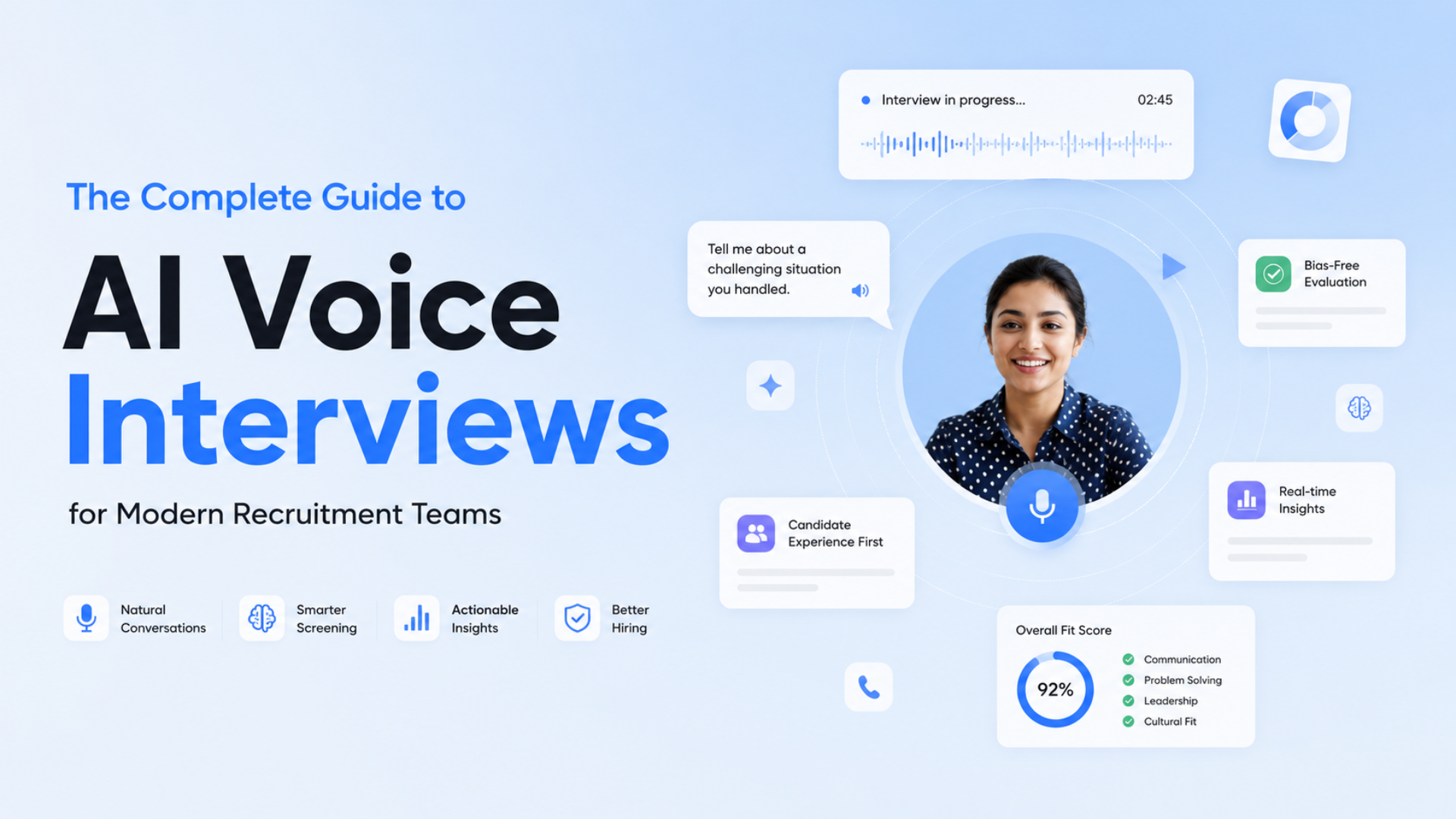
At its core, an AI voice interview is a structured, competency-based assessment delivered through a conversational voice interface. The candidate receives a phone call or clicks a link to start a voice conversation with an AI system. The AI asks predetermined questions designed to elicit behavioral evidence of specific competencies. The candidate responds in their own words. The system uses natural language processing to evaluate the content, specificity, relevance, and coherence of each response, producing a multi-dimensional scorecard that assesses the candidate across the competencies the interview was configured to measure. The entire interaction typically lasts between five and fifteen minutes, depending on the number of questions and the depth of responses.
What distinguishes this from a traditional phone screen or an automated IVR system is the evaluation layer. A phone screen produces recruiter notes, which are subjective, inconsistent across recruiters, and difficult to compare across candidates. An IVR system collects responses without evaluating them. An AI voice interview produces structured, criterion-referenced evaluations that are identical in methodology for every candidate, creating a dataset that supports comparison, benchmarking, and continuous improvement. The scientific foundation for this approach comes from decades of research on structured interview methodology, which the Society for Industrial and Organizational Psychology has consistently identified as one of the highest-validity selection tools available. AI voice interviews do not invent a new assessment methodology. They automate the delivery of a proven one, at scale and with a consistency that human interviewers cannot physically achieve.
When to Use AI Voice Interviews — and When Not To
AI voice interviews are not universally optimal. They are optimally suited for specific stages and scenarios within the hiring process, and the teams that get the best results use them with clear intention about where and why they are deployed. The strongest use case is initial screening for roles with more than 20 applicants per requisition. In this scenario, the AI evaluates every applicant against the same competency framework, producing scorecards that let the recruiter focus human conversation time on the candidates who have already demonstrated they deserve it. For high-volume operational roles — customer service, logistics, retail, data entry — AI voice interviews can serve as the primary screening stage, with recruiter phone screens reserved for a shortlist of the top 10 to 15 percent. For mid-level professional roles — marketing managers, software engineers, financial analysts — AI voice interviews serve as a structured first pass that narrows the field to a manageable number of candidates for recruiter-led conversations.
The scenarios where AI voice interviews are less appropriate are equally important to understand. Senior executive and C-suite roles require adaptive, exploratory conversations that assess strategic thinking, leadership presence, and organizational vision through real-time human judgment. While AI can provide preliminary triage data for executive roles, it should not serve as the primary evaluation. Similarly, roles that require highly specialized technical assessments — senior research scientists, specialized clinicians, advanced engineers — may need technical evaluation methods that go beyond what a voice-based interview can assess, a nuance explored in Do AI Recruiting Tools Work for Niche or Technical Roles?. The principle is straightforward: use AI voice interviews for the stages and roles where structured, competency-based verbal evaluation is the right assessment method, and supplement with other evaluation methods where it is not.
Configuring AI Voice Interviews for Your Roles
The single most impactful decision in deploying AI voice interviews is how you configure the competency framework. A generic configuration — the same five questions for every role in the company — will produce generic results that provide marginal value over
a resume review. Role-specific configuration, where the questions and evaluation criteria are tailored to the competencies that actually predict success in the specific role being hired for, is what separates effective AI screening from superficial AI screening. This requires upfront work: identifying the three to five most critical competencies for each role family, designing behavioral questions that elicit evidence of those competencies, and defining scoring criteria that distinguish strong evidence from weak evidence.
The practical approach is to start with role families rather than individual roles. A technology company might define three to four role families — engineering, product, go-to-market, and operations — each with its own competency framework and question set. Within each family, individual roles share the core questions with minor variations. This provides role-relevance without requiring a unique configuration for every requisition. Over time, as the team reviews AI scorecard data alongside actual hiring outcomes, the competency frameworks can be refined. Competencies that predict performance are emphasized. Competencies that do not correlate with outcomes are replaced. This continuous improvement cycle, driven by data rather than assumption, is one of the most underutilized advantages of AI screening. McKinsey’s research on hiring process optimization has found that organizations using data-driven approaches to refine their selection criteria outperform those relying on static job descriptions and unchanging interview protocols by a significant margin on both quality-of-hire and time-to-hire metrics.
Compliance: The Non-Negotiable Foundation
No guide to AI voice interviews is complete without a clear-eyed assessment of the regulatory landscape. The rules vary by jurisdiction, and they are evolving quickly. In the United States, New York City’s Local Law 144 requires bias audits for automated employment decision tools and mandates candidate disclosure. Illinois, Maryland, California, and several other states have enacted or proposed legislation governing AI in hiring. The EEOC has issued guidance on how existing anti-discrimination laws apply to algorithmic tools, making clear that disparate impact liability extends to AI-powered screening. In the European Union, the AI Act classifies employment decision tools as high-risk, requiring conformity assessments, transparency obligations, and human oversight mechanisms. In India, the regulatory framework is evolving but moving toward greater accountability for automated decision-making in employment.
The practical implications for recruiting teams are clear. First, ensure your AI voice interview provider has conducted bias audits and can produce the documentation required by applicable regulations. Second, inform candidates that AI is being used in the screening process, what it evaluates, and that a human will review the results before any hiring decision. Third, maintain human oversight at every decision point — AI should inform decisions, not make them autonomously. Fourth, audit your screening outcomes periodically for disparate impact across demographic groups. Fifth, ensure data handling complies with applicable privacy regulations, including GDPR, CCPA, and any sector-specific requirements. The International Association of Privacy Professionals provides the most comprehensive ongoing coverage of these regulatory developments, and recruiting teams
operating across jurisdictions should treat their guidance as essential reading. For teams hiring across India, the US, and the UK simultaneously, Recruiting Compliance Differences: India vs USA vs UK provides a practical comparison of the specific requirements in each market.
Reading and Acting on AI Scorecards
The scorecard is where the value of AI voice interviewing materializes, and how recruiters use it determines whether the technology improves or merely rearranges the hiring process. A well-designed scorecard evaluates each competency separately, provides evidence-based assessments drawn from the candidate’s actual responses, and includes enough detail to guide the recruiter’s follow-up conversation. The most common mistake is treating the overall score as a ranking tool and calling only the top-scoring candidates. This approach ignores the dimensional information that makes AI screening more useful than a keyword search.
The effective approach is to use the scorecard to build an interview plan. A candidate who scores high on communication and problem-solving but low on leadership receives a different follow-up conversation than a candidate with the opposite profile. The recruiter reviews the AI’s assessment of what the candidate demonstrated and what was missing, then designs the human phone screen or interview to probe the gaps and verify the strengths. This transforms the human interaction from a broad, repetitive evaluation into a targeted, informed conversation — which is exactly how the most effective recruiters already use their limited time. The AI does not replace this judgment. It directs it toward the candidates and the competency dimensions where it will produce the most value. Research from SHRM’s talent acquisition practice has found that recruiters who use structured assessment data to prepare for follow-up conversations make significantly better shortlist decisions than those who conduct unprepared phone screens, regardless of the recruiter’s experience level.
There is also a team-level dimension to effective scorecard use. When multiple recruiters are reviewing AI scorecards for the same role, a shared understanding of how to interpret the data is essential. Without alignment, Recruiter A might prioritize overall score while Recruiter B focuses on specific competency gaps, leading to inconsistent shortlist decisions that undermine the value of having a standardized AI evaluation in the first place. The most effective teams establish brief scorecard review protocols: what dimensions to prioritize, what score thresholds trigger automatic advancement or rejection, and what patterns in the data warrant discussion before a decision. This kind of internal calibration takes a single meeting to establish and pays dividends across every subsequent hiring cycle. The AI provides the consistent data. The team provides the consistent interpretation. Together, they produce hiring decisions that are both data-informed and human-judged.
The Platform That Ties It All Together
Every element of this guide — configuration, deployment, compliance, candidate
communication, scorecard interpretation, and continuous improvement — is easier and more effective when the AI voice interview operates within an integrated platform rather than as a standalone tool. The practical challenges of standalone deployment are well documented: scorecard data must be exported and imported between systems, candidate records live in the ATS while screening data lives in the AI tool, outreach happens through email and LinkedIn outside the screening workflow, and the recruiter spends significant time managing the gaps between disconnected systems. This fragmentation is the primary reason organizations adopt AI hiring tools with high expectations and see underwhelming results within months. The technology is not failing. The workflow around it is.
This is the problem Huntlo solves by design. Huntlo is a unified hiring operating system that combines AI sourcing across 50+ platforms, multi-channel candidate outreach, AI voice screening, recruiter review workflows, and interview scheduling within a single platform. A candidate is sourced through Huntlo’s AI engine, receives automated outreach, completes an AI voice interview, and appears in the recruiter’s review queue with a full scorecard — all without manual data transfer. The recruiter reviews the evaluation, selects candidates for follow-up, and schedules the next interaction within the same system. The AI screening data flows into every downstream decision. The candidate experience is seamless because the process is seamless. And the talent acquisition leader has a single analytics view across the entire pipeline, from sourcing source to final hire, enabling the kind of data-driven continuous improvement that transforms AI voice interviews from a screening tool into a strategic hiring capability. When the platform integrates the full workflow — as opposed to the collection of disconnected point solutions described in More Tools. Same Hiring Problems. — the complete guide is not just a reference document. It is an operational reality.
Related Topics:
What Makes an AI Recruiting Platform “Agentic” vs Just Automated?