Every week, recruiters identify brilliant candidates who would be transformative hires for their organizations. And every week, a significant portion of those candidates are lost — not because the role was wrong, not because the compensation was insufficient, and not because the candidate was not open to a move. They are lost because the outreach itself was flawed. The message was generic when it needed to be specific. The channel was wrong when the right one was available. The timing was off when a simple adjustment would have made the difference. The follow-up never came when persistence would have closed the gap. Or the recruiter made one of several other common mistakes that are so pervasive in the industry that they feel normal even though they are consistently driving away the very candidates they are meant to attract. The cost of these mistakes is not measured in missed messages. It is measured in missed hires, extended time-to-fill, degraded employer brand, and the compounding difficulty of recruiting for future roles in a talent market where the best candidates have long memories and share their experiences freely with their networks.
Mistake One: Confusing Activity with Effectiveness
The most fundamental outreach mistake is also the most insidious, because it corrupts everything that follows from it. It is the belief that the goal of outreach is to send messages rather than to create conversations. When a recruitment team measures success by
messages sent, InMails delivered, or candidates sourced, it creates an incentive structure that rewards volume over quality. The recruiter who sends five hundred generic messages and gets twenty responses looks more productive than the recruiter who sends fifty personalized messages and gets thirty responses, even though the second recruiter produced fifty percent more conversations with one-tenth the volume. This mistake is not just a measurement problem. It is a strategic failure that shapes every aspect of the outreach process, from targeting to messaging to follow-up. A team that is optimized for activity will always choose breadth over depth, volume over relevance, and speed over quality, because those are the choices that maximize the activity metrics they are measured on.
The fix is to redefine the primary metric from messages sent to qualified conversations created. A qualified conversation is one where the candidate is genuinely engaged, has a plausible reason to be interested in the opportunity, and the interaction has a realistic probability of progressing to the next stage. This metric is harder to track than message volume, but it is the metric that actually predicts hiring success. Teams that make this shift typically find that their message volume drops while their conversation volume increases, because the messages they do send are better-targeted, better-written, and better-timed. The resources that were previously spent sending messages to unresponsive candidates are redirected toward deeper research, more thoughtful messaging, and more persistent follow-up with the candidates who are most likely to convert. This is the same dynamic that The ATS Mistake Companies Keep Repeating describes at the organizational level: tools and processes that are optimized for the wrong metric produce activity that looks productive but delivers limited results. In outreach, the wrong metric is volume. The right metric is conversation quality, and until recruitment leaders align their measurement systems around the right metric, the other mistakes on this list will persist because the incentive structure rewards them.
Mistake Two: Treating Every Candidate the Same Way
A senior engineering leader at a major technology company has fundamentally different communication preferences, career motivations, and decision-making processes than a junior developer two years out of college. A healthcare executive in Mumbai has a different professional context than a finance manager in New York. A candidate who just published a thought leadership article is sending different signals than a candidate whose profile has not been updated in two years. Yet most recruitment outreach programs treat all of these candidates the same way: the same channel, the same message structure, the same call to action, and the same follow-up cadence. This one-size-fits-all approach is the second most common mistake in candidate outreach, and it is responsible for a staggering amount of wasted effort and missed connections.
The candidates who are most affected by this mistake are the ones recruiters most want to reach: senior professionals, specialized experts, and candidates in high-demand fields who have multiple options and can afford to be selective. These candidates can immediately detect generic outreach, and they penalize it harshly. A senior candidate who receives a message that could have been sent to any of a hundred people with similar job
titles does not think, “Close enough, let me read more.” They think, “This recruiter has no idea who I am, and this company does not value my time.” The consequence is not just a lost response. It is a negative brand impression that makes the candidate less likely to engage with future outreach from the same organization, even if that future outreach is significantly better. According to LinkedIn’s talent solutions data, senior candidates — defined as those with more than twelve years of experience or in director-level and above positions — are three to four times more likely to permanently ignore messages from a company after receiving one generic outreach message than they are after receiving no outreach at all. The generic message is worse than silence because it replaces neutrality with active negative perception. Effective outreach requires segmenting candidates by seniority, industry, geography, and communication preference, and adapting the channel, message, and approach for each segment. This does not mean writing a unique message from scratch for every candidate. It means having a framework of approaches that can be adapted based on the candidate’s profile, and investing the effort to make the adaptation meaningful rather than cosmetic.
Mistake Three: The One-Message-and-Done Approach
If there is a single outreach behavior that recruitment organizations should eliminate immediately, it is the practice of sending a single message to a candidate and making no further effort if there is no response. This one-and-done approach is the default behavior for the majority of recruiters, and it is one of the most costly mistakes in talent acquisition. The data on follow-up effectiveness is consistent and unambiguous across industries and candidate segments. The majority of positive responses to recruiting outreach do not come from the first message. They come from the second, third, or subsequent touchpoint. Sales research — which shares fundamental dynamics with recruiting outreach — has demonstrated this principle for decades: the probability of a positive response increases with each touchpoint up to a point, and the majority of conversions happen after the fifth to seventh contact. Recruiting data shows a similar pattern, with most qualified candidate responses arriving after the second or third touch.
The reason recruiters default to one-and-done is not that they do not believe in follow-up. It is that follow-up is operationally burdensome when managed manually. Tracking which candidates need a second touch, crafting a differentiated follow-up message for each one, timing the follow-up appropriately, and repeating this process for dozens or hundreds of candidates across multiple open requisitions is more work than most recruiters have time for given their other responsibilities. So the follow-up does not happen, and the candidates who would have responded to a second or third touch are lost. This is not a recruiter failure. It is a systems failure. A system that relies on individual recruiter initiative to execute follow-up will always underperform a system that builds follow-up into the process by default. The most effective recruitment organizations have recognized this and invested in automated follow-up capabilities that execute multi-touch sequences on the recruiter’s behalf. The specific data on how many touchpoints are needed to convert a candidate into a hire is explored in How Many Follow-Ups Does One Hire Need?, and the answer is
consistently more than most recruitment organizations are currently delivering. The practical minimum is three touches. The optimal range is five to eight. The average team is delivering one. That gap represents an enormous pool of candidates who would have engaged if the system had been designed to persist.
Mistake Four: Leading with the Ask Instead of the Value
Most recruiting outreach messages follow a structure that is designed around the recruiter’s needs rather than the candidate’s. The typical structure is: introduce yourself, describe the role, highlight the company, and ask the candidate for their time, resume, or availability. From the candidate’s perspective, this is a message that wants something from them and offers nothing in return. The implicit contract is entirely one-sided. This structure is so ubiquitous in recruiting that most recruiters do not question it. It is simply how recruiting messages are written. But the candidates who receive these messages do question it, and their response — or rather their non-response — reflects their evaluation of the value exchange. When a message asks for something without offering anything, the candidate’s psychological default is to decline by silence. This is not rudeness. It is a rational response to an asymmetric value proposition.
The fix is to restructure the message so that the value comes before the ask. This does not mean burying the job opportunity in the third paragraph or being evasive about why you are reaching out. It means leading with something that is genuinely valuable to the candidate, independent of whether they are interested in the role. A specific insight about their industry. A connection to someone working on a similar challenge. Information about market compensation for their role and level. A resource or event invitation that is relevant to their professional interests. When the candidate receives value before being asked for anything, two psychological mechanisms activate simultaneously. Reciprocity creates an inclination to respond because the candidate feels they owe something in return for what they received. And credibility is established because the candidate infers, correctly, that a recruiter who provides genuine value is likely to be knowledgeable, professional, and worth engaging with. The contrast between value-first outreach and ask-first outreach explains much of the performance gap between referrals and cold outreach. Referrals come with built-in credibility and a pre-existing relationship that functions as a value exchange. Cold outreach has to create that value exchange from scratch, and most of it fails to do so. As documented in Why Referrals Outperform Cold Outreach, the referral advantage is not just about trust. It is about the pre-existing value dynamic that referrals create, a dynamic that value-first outreach can replicate artificially for cold candidates.
Mistake Five: Ignoring the Channel That the Candidate Actually Uses
Sending a well-crafted, highly personalized message through a channel the candidate does not check is equivalent to writing a brilliant letter and mailing it to the wrong address. The message is wasted, the effort is wasted, and the candidate is completely unaware that you ever tried to reach them. This mistake is more common than most recruiters realize, because most recruiters default to one or two channels — typically email and LinkedIn —
and use those channels for every candidate regardless of whether those channels are where the candidate is most reachable and receptive. A junior software developer in Bangalore who conducts most of their professional communication through WhatsApp is unlikely to respond to an email that arrives in an inbox they check once a day. A senior finance executive in London who treats LinkedIn as a passive content consumption platform is unlikely to engage with an InMail, but might respond to a well-crafted email that arrives in their morning inbox. The mismatch between channel and candidate is a silent killer of outreach effectiveness, because it does not generate a rejection or a complaint. It generates nothing, and the recruiter has no way of knowing that the message was lost rather than considered and declined.
The most effective outreach programs build channel selection into the targeting process. Before the first message is sent, the recruiter or the outreach system evaluates which channels the candidate is most likely to be active on, based on their geography, industry, seniority level, and available contact information. This evaluation does not need to be complex. A simple framework — messaging apps for early-career and frontline candidates in Asia, Latin America, and the Middle East; LinkedIn for mid-career professionals who are actively engaging on the platform; email for senior professionals and candidates in traditional industries — captures most of the available improvement without requiring sophisticated modeling. The key is to make channel selection a conscious decision rather than a default behavior. According to Deloitte’s workforce of the future research, recruitment teams that have implemented even basic channel-matching frameworks report a thirty to fifty percent improvement in response rates compared to teams that default to a single channel, because a significant portion of the improvement comes from reaching candidates who would never have seen the message through the default channel at all. The distinction between sourcing — which identifies the candidate — and recruiting — which engages them — is relevant here. Sourcing finds the candidate. The channel strategy determines whether the candidate actually receives the message. As explored in What’s the Difference Between AI Sourcing and AI Recruiting?, many organizations invest heavily in the sourcing side of the equation while underinvesting in the engagement side, which means they are finding candidates they never actually reach.
Mistake Six: Reaching Out at the Worst Possible Time
Timing is the most overlooked variable in candidate outreach. Most recruiters send messages during business hours because that is when they are working, and they assume candidates are also available during business hours. But business hours are precisely when candidates are least receptive to recruiting messages. They are in meetings, focused on project deadlines, managing their own workloads, and dealing with the flood of professional communications that fills their inbox throughout the day. A recruiting message that arrives at two in the afternoon on a Tuesday is competing with every other demand on the candidate’s attention, and it loses that competition more often than it wins. The candidate may see the notification, mentally categorize it as “deal with later,” and then never return to it because “later” never arrives.
The optimal timing for candidate outreach is not during business hours. It is during the windows when candidates are checking their devices in a more relaxed, receptive state: early morning before the workday begins, evening after work, and weekends. The specific window varies by channel — email performs best in the early morning, LinkedIn in the evening, and messaging apps in the late afternoon and evening — but the general principle holds across all channels: messages received during low-cognitive-load moments are more likely to be read, considered, and responded to than messages received during high-pressure work periods. The practical barrier to timing optimization is that it requires sending messages outside of the recruiter’s working hours. The solution is scheduling: composing messages during the workday and using a scheduling tool to deliver them at the optimal time in the candidate’s time zone. This is a simple capability that most outreach tools support, yet Gartner’s talent acquisition research has found that fewer than twenty-five percent of recruiters systematically schedule their outreach for optimal delivery times. The remaining seventy-five percent are leaving a fifteen to twenty-five percent response rate improvement on the table because they are sending messages at their convenience rather than the candidate’s receptivity.
Avoiding All Seven Mistakes at Once: The System-Level Solution
Each of the mistakes described in this article is a significant problem on its own. But the real cost of these mistakes is not the impact of any single one. It is the compound effect of making multiple mistakes simultaneously. A recruiter who sends a generic message through the wrong channel at the wrong time, with no follow-up and no value offered, is not making one mistake. They are making six mistakes in a single outreach interaction, and the candidate’s experience of that interaction reflects the cumulative impact of all six. The probability of a response in this scenario is not low. It is effectively zero, and the negative brand impression is correspondingly high. Fixing these mistakes one at a time — better targeting this quarter, better messaging next quarter, multi-channel outreach next year — is the approach most organizations take, and it produces incremental improvements that are quickly absorbed by the declining effectiveness of the overall approach.
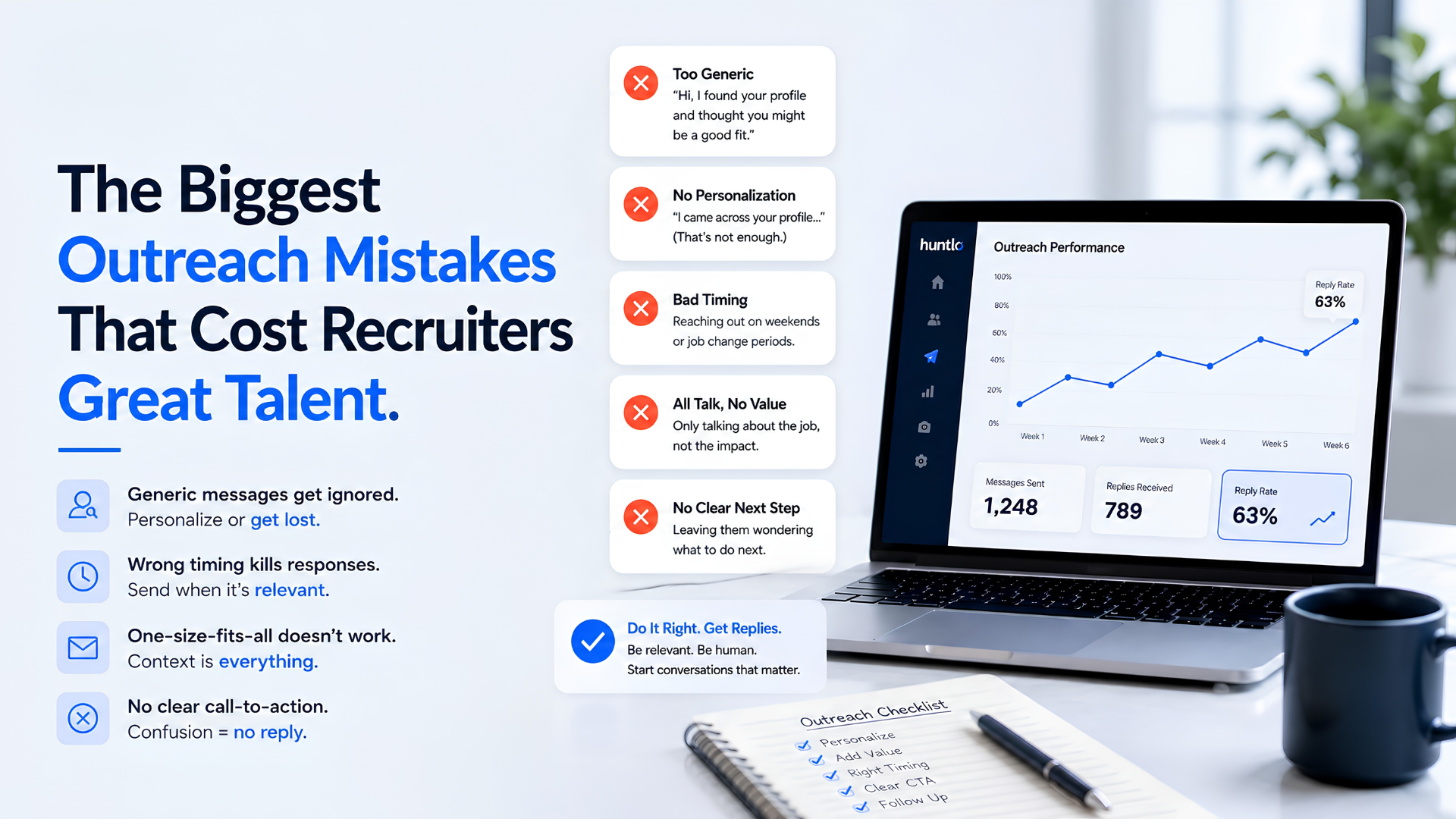
The alternative is to fix all of these mistakes simultaneously by adopting a system that is designed to avoid them by default. Huntlo was built around the understanding that candidate outreach fails not because of individual recruiter mistakes but because the systems recruiters operate within make those mistakes inevitable. Huntlo’s AI sourcing engine applies rigorous pre-qualification filters that eliminate the targeting mistakes described in the first two sections. Its AI-generated messages are grounded in each candidate’s specific profile, addressing the generic-messaging mistake. Its multi-channel delivery — supporting email, LinkedIn, WhatsApp, and SMS as first-class channels — addresses the channel mismatch. Its automated follow-up sequences execute multi-touch campaigns with differentiated content, eliminating the one-and-done problem. Its value-first message design leads with relevant insights and connections before making the ask. And its scheduling optimization delivers each message at the time when the candidate is most likely to be receptive. These are not separate features that a recruiter has to remember to use. They are integrated
capabilities that operate by default for every candidate in the pipeline, ensuring that the system avoids the mistakes that manual processes consistently reproduce. The result is outreach that reaches the right candidates, through the right channels, with the right message, at the right time, with the right follow-up. That is not a theoretical ideal. It is an operational capability, and it is available now.
Related Topics:
Should Recruiters Worry About AI Replacing Their Jobs?