There is a deeply held belief in recruiting that thoroughness means reading every resume. Hiring managers expect it. Recruiting leaders preach it. Recruiters themselves feel guilty when they do not do it. The logic seems unassailable: if you do not read every resume, you might miss a great candidate. But this logic confuses volume of attention with quality of attention, and in doing so it guarantees the very outcome it is trying to prevent. When a recruiter is responsible for filling five open roles and each role receives 300 applications, reading every resume means giving each one approximately 30 seconds of attention spread across a ten-hour day. That is not thoroughness. That is a scan, and it is a scan performed under conditions of cognitive fatigue that make it less accurate, not more.
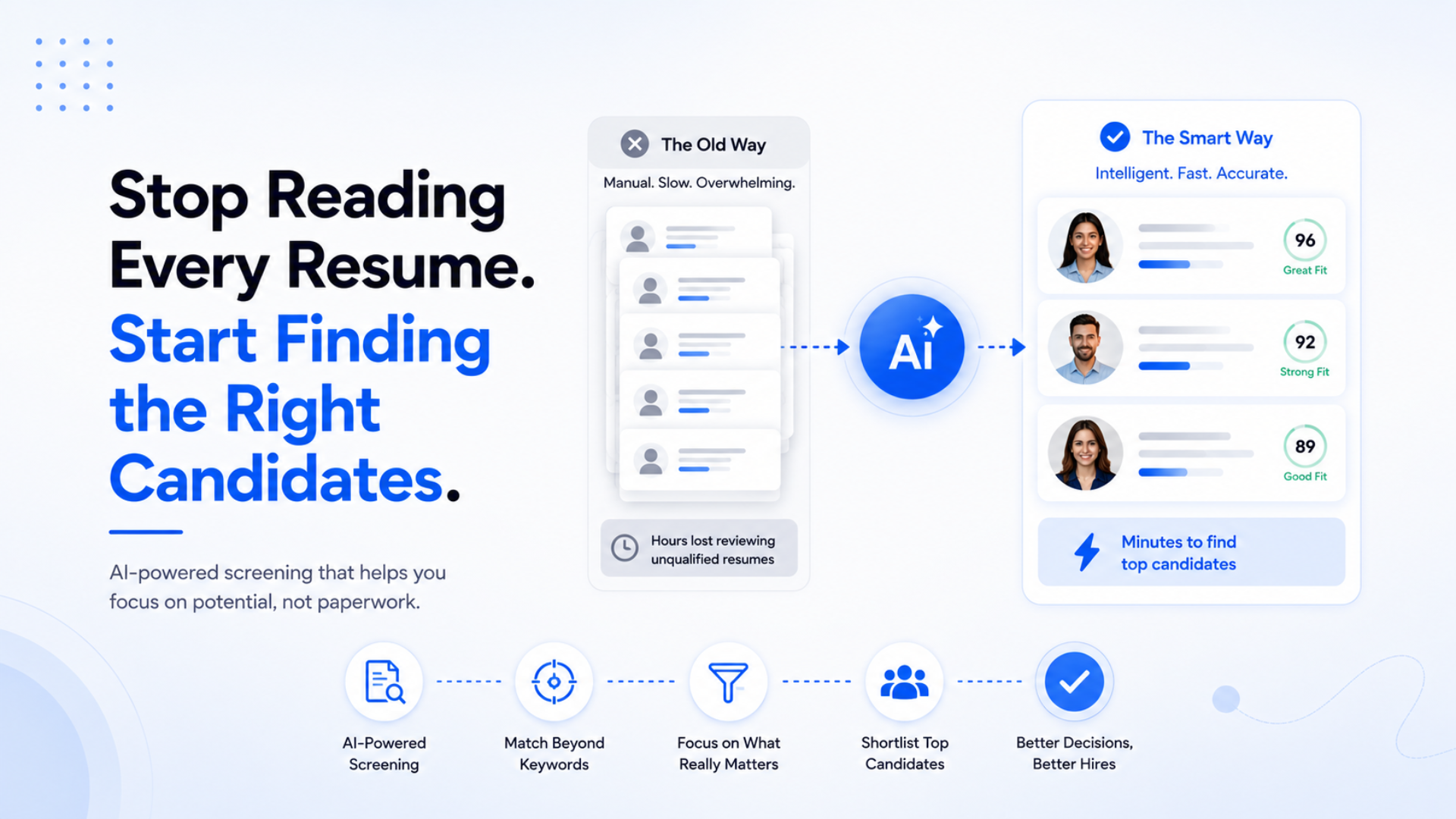
The alternative to reading every resume is not skipping resumes. It is replacing the manual reading process with an intelligent system that evaluates every candidate with more depth, more consistency, and more accuracy than any human reviewer could achieve at speed. This is not a new idea in principle. Recruiting teams have used ATS keyword filters for years as a way to reduce the manual review burden. But keyword filters are a crude instrument, and as we have discussed in our analysis of more tools, same hiring problems, adding a keyword filter on top of a broken workflow does not fix the underlying problem. The question is not whether to automate screening. It is whether the automation is intelligent enough to produce better outcomes than manual review. The answer, in 2026, is increasingly yes, and this article explains how the best teams are making the transition.
Why Reading Every Resume Is a Quality Problem, Not a Virtue
The fundamental flaw in the "read every resume" approach is that it treats attention as a constant when it is actually a diminishing resource. Cognitive science has a well-established concept called decision fatigue, which describes the degradation in decision quality that occurs after a long sequence of similar judgments. Screening resumes is a textbook example of an activity that produces decision fatigue. The recruiter is making the same type of judgment, is
this candidate potentially qualified for this role, hundreds of times in a row. Each successive judgment is made with slightly less cognitive precision than the one before it. By the time the recruiter reaches the 150th resume, their ability to distinguish between a genuinely interesting candidate and a marginally relevant one has deteriorated significantly.
The practical consequence is that the order in which resumes are reviewed becomes a hidden variable in screening outcomes. Candidates whose resumes appear in the first third of the review queue receive more careful evaluation than those who appear in the last third. This has nothing to do with candidate quality and everything to do with the reviewer’s cognitive state. A recruiter who reads every resume is not giving equal attention to every candidate. They are giving systematically unequal attention, with the first candidates receiving better evaluation than the last. The result is not a meritocratic screening process. It is a process that rewards randomness, and it produces shortlists that reflect review order more than candidate quality.
This problem compounds when the recruiter is handling multiple roles simultaneously, which is the norm rather than the exception. Research from LinkedIn’s talent solutions team shows that the average agency recruiter manages 15 to 20 open requisitions at any given time, and the average in-house recruiter manages 8 to 12. At those volumes, the idea that any recruiter is giving thoughtful attention to every resume is not just unrealistic. It is mathematically impossible. The question for recruiting leaders is not whether their recruiters should read every resume, but whether the current approach is producing screening outcomes good enough to justify the time and cognitive cost it consumes. For most organizations, the answer is no.
The Shift from Resume Reading to Candidate Finding
The conceptual shift that the best recruiting teams have made is from resume reading to candidate finding. These are fundamentally different activities. Resume reading starts with a document and asks: what can I learn about this person from what they have written? Candidate finding starts with a role’s requirements and asks: who are the people most likely to succeed in this position, and where can I find evidence of their capability? The difference in orientation produces a dramatically different screening process. A resume reader processes documents sequentially, evaluating each one on its own terms. A candidate finder defines what success looks like for the role, identifies the signals that predict success, and then searches the candidate pool for those signals regardless of how they are expressed or where they appear.
Candidate finding is inherently multi-signal. It does not rely on the resume as the sole source of information. It considers professional profiles, work samples, career trajectory patterns, domain expertise evidence, and professional network signals. It does not require candidates to describe their capabilities in the specific language of the job description. It recognizes that a data scientist who writes about building prediction models on their blog is demonstrating the same capability as one who writes about machine learning on their resume, even if neither uses the exact phrase from the job posting. This signal-based approach is more accurate than document-based review because it evaluates evidence of capability rather than claims of capability.
This distinction between sourcing and evaluating is important to understand clearly. As we have explored in our breakdown of the difference between AI sourcing and AI recruiting, finding the right candidates is not the same as sourcing them. Sourcing is about building a pool of potential candidates. Finding is about identifying the right people within that pool. AI-powered candidate intelligence handles the finding part by evaluating every candidate against the specific requirements of the role and producing a ranked shortlist that reflects genuine fit rather than keyword proximity. The recruiter then focuses their attention on the shortlisted candidates, where their expertise and judgment create the most value.
What Intelligent Screening Looks Like in Practice
An intelligent screening system operates in three stages that mirror and enhance what an experienced recruiter would do manually, but at a scale and consistency level that no human can match. The first stage is signal extraction. For every candidate in the pool, the system identifies and extracts the key capability signals from all available data sources: the resume, professional profiles, work samples, career history, and any other accessible information. This is not keyword extraction. It is the identification of evidence patterns that indicate specific capabilities. A keyword system would extract the word "Python." An intelligent system extracts the evidence that the candidate has used Python to build production systems, the complexity and scale of those systems, and how recently they did so.
The second stage is role-specific evaluation. The system takes the extracted signals for each candidate and evaluates them against the specific requirements of the open role. This is not a generic matching exercise. The system considers the seniority level, the industry context, the company stage, and the relative importance of different competencies for this specific position. A candidate with exceptional technical skills but limited leadership experience might rank highly for an individual contributor role but lower for a management role, and the system adjusts its evaluation accordingly. This adaptivity is what distinguishes an intelligent screening platform from a sophisticated keyword filter. It understands that the same candidate can be a great fit for one version of a role and a poor fit for another.
The third stage is shortlist delivery with context. The system does not just produce a ranked list of names. It provides the recruiter with a detailed intelligence brief for each shortlisted candidate, explaining why they were selected, what their strengths are relative to the role requirements, and what questions the recruiter should explore in the first conversation. This turns the screening process from a filtering gate into an insight engine. The recruiter does not start their evaluation from scratch. They start with a rich understanding of each candidate’s fit, built by a system that has already done the heavy lifting of multi-signal analysis. For teams that are evaluating AI recruiting tools, the quality of this shortlist context is one of the most important differentiators between platforms that genuinely improve screening outcomes and those that simply automate existing workflows.
The Data Problem: Why AI Needs Fresh Signals to Find the Right Candidates
Intelligent screening is only as good as the data it processes. If the candidate profiles in the system are outdated, incomplete, or inaccurate, the screening output will be unreliable regardless of how sophisticated the algorithm is. This is a critical point that many organizations overlook when adopting AI screening tools. They evaluate the algorithm’s capabilities but neglect to assess the quality and freshness of the data flowing into it. The result is systems that are technically impressive but practically ineffective, because they are making intelligent decisions based on bad information.
The most common data problem in candidate screening is staleness. A candidate’s resume typically reflects their professional situation at the time they last updated it, which may be months or even years before they apply for a role. In fast-moving industries like technology, a year of professional development can represent a significant change in a candidate’s capabilities. A developer who was working with legacy frameworks twelve months ago may have completed certifications, contributed to major open-source projects, or taken on new responsibilities that dramatically change their fit for a role. A screening system that evaluates them based on their last resume update will underestimate their current capability.
This is why real-time data enrichment is not an optional feature for AI screening. It is a structural requirement. As we have examined in our analysis of why some AI recruiting tools have outdated candidate data, the platforms that produce the most accurate screening results are those that verify and update candidate information at the point of evaluation rather than relying on cached profiles. When you are trying to find the right candidate rather than just scan documents, the freshness of your data directly determines the quality of your results. A recruiter reading every resume manually also faces this data problem, but at least they can ask the candidate for updated information during the screening call. An AI system that operates on stale data has no such correction mechanism unless it is specifically designed to refresh its inputs.
From Volume Processing to Strategic Recruiting
The most significant benefit of moving from resume reading to intelligent candidate finding is not time savings. It is the transformation of the recruiter’s role from volume processor to strategic talent advisor. When AI handles the initial screening and produces a pre-evaluated shortlist, the recruiter’s time is freed for the activities that actually determine hiring outcomes: building relationships with shortlisted candidates, advising hiring managers on candidate fit and market conditions, managing the candidate experience through the interview process, and making the nuanced judgment calls that convert a shortlist into a successful hire.
According to McKinsey’s hiring research, the recruiters who have the greatest impact on hiring outcomes spend less than 20% of their time on screening and more than 60% on candidate engagement and hiring manager advisory. These are the recruiters who consistently fill roles faster, with better candidates, and with higher offer acceptance rates. They achieve these outcomes not because they are faster at reading resumes but because they have structured their workflow so that the machine handles the volume and they handle the judgment. The
shift from resume reading to candidate finding is not about doing less work. It is about doing higher-value work, and the recruiting teams that have made this shift are seeing the results in their hiring metrics.
The recruiters who are concerned about AI displacing their roles should consider the evidence. As we have discussed in our exploration of whether recruiters should worry about AI replacing their jobs, the technology is not eliminating the need for human recruiters. It is eliminating the need for recruiters to spend their time on tasks that do not require human capability. Reading 300 resumes for a single role is not a high-value human activity. It is a data processing task that a machine can do better. Building a relationship with the five candidates who are genuinely worth pursuing, understanding their motivations, and helping them see why your opportunity is the right one, that is a high-value human activity, and it is the activity that AI screening frees recruiters to focus on.
How Huntlo Helps You Stop Reading and Start Finding
Huntlo replaces the manual resume review process with an AI-powered candidate intelligence engine that evaluates every applicant across multiple dimensions and produces a ranked, context-rich shortlist. The platform does not just scan documents for keywords. It builds a multi-dimensional understanding of each candidate, synthesizing career history, demonstrated achievements, domain expertise, and trajectory data into an assessment that tells you who the right candidates are and why. Every candidate is evaluated against the specific requirements of the open role, with the system adapting its criteria based on seniority, industry, and hiring manager priorities.
The impact on the recruiter’s workflow is immediate and significant. Instead of spending hours reading resumes for each open role, the recruiter receives a pre-evaluated shortlist with detailed intelligence briefs for each candidate. Their time shifts from document scanning to candidate engagement, from processing volume to exercising judgment. Because Huntlo operates as an agentic platform, it adapts its screening approach to each specific role rather than applying a one-size-fits-all filter. It also enriches candidate data in real time, ensuring that screening decisions are based on current information rather than outdated resumes. The result is not just faster screening. It is better hiring, because the right candidates are identified and advanced regardless of whether their resume uses the right keywords. That is the difference between reading every resume and finding the right candidates.