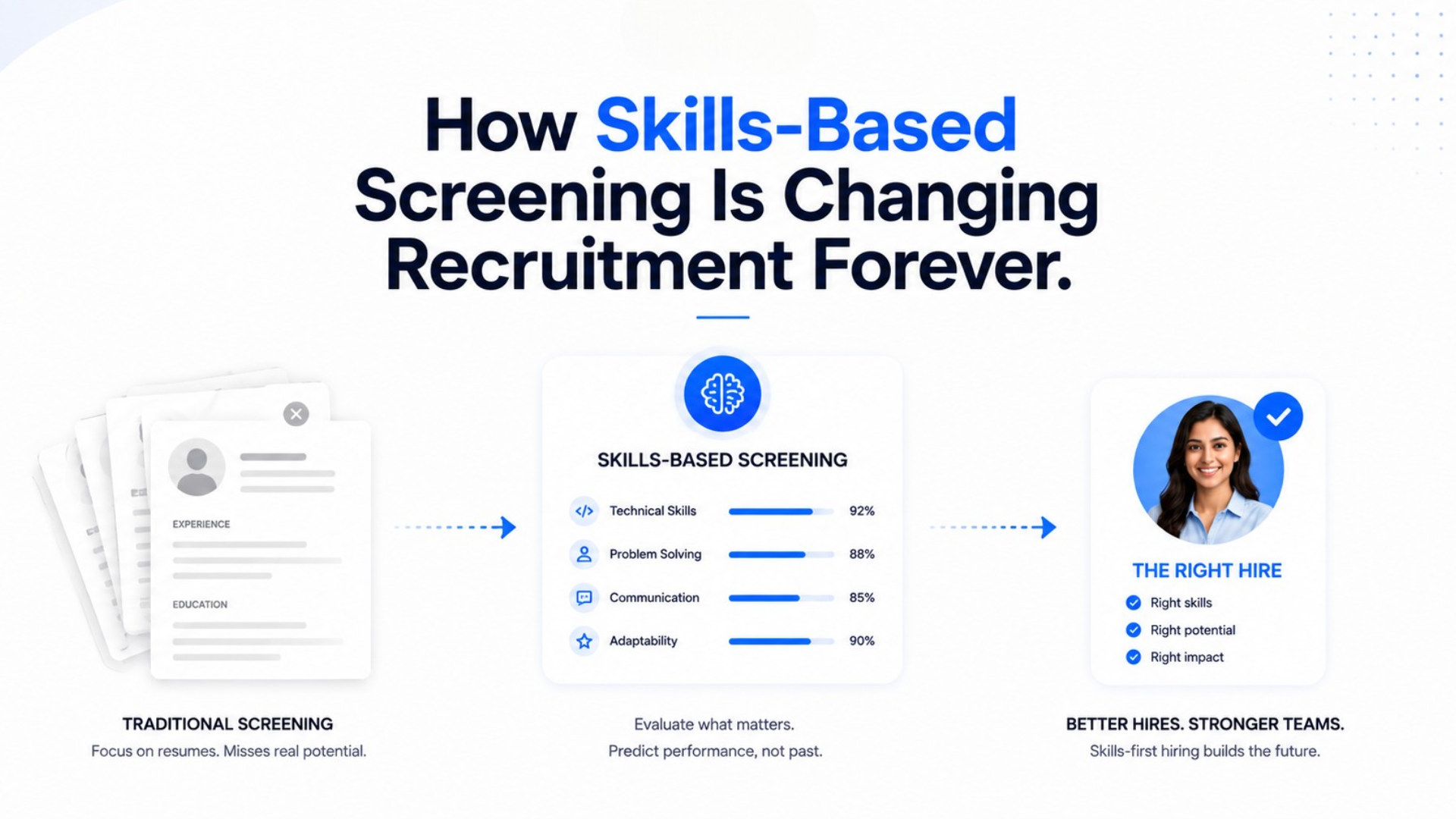
For the better part of a century, candidate screening has operated on the same basic logic: use observable proxies to estimate a candidate’s actual capability. The degree tells you what they studied. The job title tells you what they were hired to do. The employer name tells you the caliber of organization that found them valuable. The years of experience tell you how long they have been doing it. These proxies are easy to verify, easy to compare across candidates, and easy to build screening processes around. The problem is that they are increasingly poor predictors of actual job performance, and the gap between what proxies measure and what matters on the job is widening every year.
The shift toward skills-based screening is not a trend or a philosophical preference. It is a structural response to a labor market where the old proxies have lost their information value. Skills evolve faster than degree programs can update their curricula. Job titles have become so variable across organizations that the same title can describe fundamentally different roles. Employer prestige is a weaker signal of individual capability than it was when large employers offered standardized career paths. And years of experience, the most stubbornly persistent proxy, correlates weakly with actual skill level because the rate at which professionals develop skills varies enormously from person to person. Skills-based screening addresses these problems directly by evaluating what candidates can actually do rather than what their credentials suggest they might be able to do. This article explains why this shift is happening now, what it looks like in practice, and how AI is making genuine skills assessment possible at the scale that modern recruiting requires.
Why Credential-Based Screening Is Losing Its Predictive Power
The decline of credential-based screening is not happening because credentials have become worthless. It is happening because the relationship between credentials and capability has become too weak to serve as a reliable screening criterion. Consider the degree. Thirty years
ago, a computer science degree from a reputable university provided a reasonably strong signal that the graduate had proficiency in a defined set of programming languages, algorithms, and software engineering principles. Today, a computer science graduate may have studied machine learning or cloud architecture or cybersecurity, and the specific technologies they learned may be outdated by the time they enter the workforce. The degree still signals that the graduate can complete a rigorous academic program, which is valuable. But it no longer provides a reliable signal about whether the graduate can do the specific work that the hiring organization needs done.
Job titles have undergone a similar dilution. The title “product manager” at a two-person startup, where the product manager is also doing customer support, writing documentation, and managing the deployment pipeline, describes a fundamentally different set of skills and experiences than the same title at a large enterprise, where the product manager is managing a team of eight, coordinating with three engineering teams, and presenting to the C-suite quarterly. Screening on the title “product manager” without understanding the context in which the title was held is not screening. It is keyword matching applied to a different field. The same problem applies to employer names, years of experience, and every other credential-based proxy. They all provide information, but the information they provide is too coarse and too context-dependent to serve as a reliable basis for screening decisions.
The organizations that recognize the limitations of credential-based screening are the ones moving to skills-based evaluation. According to McKinsey’s research on the skills-based organization, companies that have adopted skills-based hiring practices see 20% to 30% improvements in quality-of-hire and significant increases in workforce diversity, because skills-based evaluation opens the pipeline to candidates with non-traditional backgrounds who would have been filtered out by credential-based screens. The challenge has always been implementation: evaluating actual skills is more labor-intensive than checking credentials, which is why most organizations have not made the transition. That constraint is what AI screening platforms are now removing.
What Skills-Based Screening Actually Looks Like
Skills-based screening does not mean abandoning all structure and asking every candidate to complete a work sample test before they can be considered. That would be impractical at the scale that most recruiting teams operate. What it means is shifting the primary evaluation criterion from “does this candidate have the right credentials?” to “does this candidate demonstrate the right skills?” and building the screening process around that question. In practice, this shift manifests in three concrete changes to how screening works.
The first change is in how job requirements are defined. Instead of specifying a degree, a number of years, and a list of job titles that would be acceptable, skills-based screening starts by defining the specific capabilities the role requires. A data engineering role might require the ability to design and optimize large-scale ETL pipelines, proficiency in Python and SQL, experience with cloud data platforms, and the ability to collaborate with data scientists on
model deployment. These are skill-based requirements, not credential-based ones. They describe what the hire needs to be able to do, not what they need to have on their resume. The screening process then evaluates candidates against these skill-based requirements, looking for evidence that the candidate has demonstrated each capability in a professional context.
The second change is in how candidates are evaluated. Instead of scanning resumes for credential matches, the screening process looks for evidence of skill application. Did the candidate design ETL pipelines, or did they merely list ETL as a skill on their resume? What was the scale and complexity of the pipelines they built? Can the evidence be verified through public profiles, GitHub repositories, published work, or career progression patterns? This kind of evidence-based evaluation is what distinguishes genuine skills-based screening from the credential-based screening that has been relabeled. As we have discussed in our analysis of what makes an AI recruiting platform agentic vs just automated, the platform that can evaluate the substance behind a skill claim, rather than just checking for the claim’s presence, is the platform that produces accurate shortlists. The third change is in how shortlists are ranked. Instead of ranking candidates by the prestige of their credentials, they are ranked by the strength of the evidence for the skills the role requires. This produces fundamentally different shortlists, because the candidates with the strongest skill evidence are often not the candidates with the most impressive credentials.
The AI Enabler: Why Skills-Based Screening Is Possible Now
If skills-based screening is better than credential-based screening, and the research has been saying this for decades, why is it happening now? The answer is that AI has removed the implementation constraint that made skills-based screening impractical at scale. Evaluating actual skills requires processing multiple data sources per candidate, assessing evidence quality, comparing career trajectories, and making nuanced judgments about capability that go well beyond keyword matching. For a human recruiter reviewing ten candidates, this is feasible but time-consuming. For a human recruiter reviewing five hundred candidates, it is impossible, which is why credential-based screening has persisted despite its known limitations: it was the only approach that could operate at the scale the hiring funnel required.
AI changes this equation by performing the deep, multi-signal evaluation that skills-based assessment requires, but doing it in seconds per candidate rather than hours. An AI screening platform can examine a candidate’s resume, professional profile, work samples, and career history simultaneously, identifying evidence of the specific skills the role requires and assessing the quality and recency of that evidence. It can evaluate five hundred candidates against a skill-based framework in the time it would take a human recruiter to perform the same evaluation for ten. This does not just make skills-based screening faster. It makes it possible in contexts where it was previously impossible, which is the structural change that is driving the shift away from credentials.
The data freshness requirement that skills-based screening demands is also where AI platforms demonstrate a critical advantage. Because skills evolve rapidly, evaluating a
candidate’s skills based on data that is six months old can produce inaccurate assessments. Real-time data enrichment, as we have examined in our analysis of why some AI recruiting tools have outdated candidate data, ensures that the skills evaluation is based on the candidate’s current capabilities, not their capabilities from the last time their profile was updated. This is a non-negotiable requirement for skills-based screening, because a skills assessment based on stale data is worse than a credential check: it is more expensive to perform and potentially less accurate. According to SHRM’s research on skills-based hiring, the organizations that are leading the transition to skills-based screening are the ones that combine AI evaluation with real-time data enrichment, because this combination is what makes skills-based assessment both accurate and scalable.
The Impact on Quality, Diversity, and Candidate Experience
The impact of skills-based screening on hiring quality is significant and well-documented. When screening criteria are aligned with the actual capabilities required for the role, the candidates who advance to the interview stage are more likely to succeed after being hired. This is not a subtle effect. Organizations that have shifted to skills-based screening report that their interview-to-offer conversion rates increase, because the candidates being interviewed are better matched to the role requirements. Their new hire performance ratings improve, because the skills that predicted success in the screening stage are the skills that actually matter on the job. And their early-tenure turnover decreases, because candidates who were selected for their demonstrated capabilities are more likely to find the role challenging and engaging than candidates who were selected for their credentials.
The impact on diversity is equally significant, and it is one of the strongest arguments for making the transition. Credential-based screening creates structural barriers for candidates from non-traditional backgrounds. A candidate who learned data engineering through self-directed study, open-source contributions, and progressive responsibility at a series of startups may have stronger data engineering skills than a candidate with a master’s degree and three years at a large tech company. But under credential-based screening, the candidate with the non-traditional background is systematically disadvantaged, because their credentials are less impressive even if their skills are stronger. Skills-based screening eliminates this structural bias by evaluating the capability directly rather than inferring it from the credential. The result is a candidate pool and a shortlist that are more diverse, not because diversity was prioritized over quality, but because the evaluation method that produces the highest quality also produces the most diversity.
The candidate experience also improves under skills-based screening, because candidates are evaluated on what they can actually do rather than being filtered out by criteria that may have little connection to the role. A candidate who does not have the “right” degree or the “right” number of years but who has the specific skills the role requires will be identified and advanced by a skills-based process, creating a more inclusive and more engaging candidate experience. This is particularly important for niche and technical roles, where the best candidates often have non-traditional backgrounds and the credential-based screen would filter out
the strongest applicants. According to LinkedIn’s talent solutions research, organizations that have adopted skills-based screening see 25% to 40% increases in candidate satisfaction scores, because candidates feel they are being evaluated fairly on relevant criteria rather than being rejected by arbitrary credential thresholds.
The Transition: Moving from Credentials to Skills Without Disrupting Your Pipeline
The transition from credential-based to skills-based screening does not require a wholesale overnight transformation. It can be implemented incrementally, starting with a single role or team and expanding as the organization develops confidence in the new approach. The first step is to redefine job requirements in skill-based terms, working with hiring managers to identify the specific capabilities each role requires rather than specifying degrees, years, and titles. This step alone often produces significant improvements in screening outcomes, because it forces a clarity about what the role actually demands that credential-based requirements obscure.
The second step is to pilot the skills-based evaluation on a limited set of roles, using an AI screening platform that can evaluate candidates against the skill-based criteria at scale. This allows the recruiting team to compare the quality of the shortlists produced by skills-based screening with the quality of the shortlists produced by the existing credential-based process, using downstream hiring outcomes as the benchmark. In most cases, the skills-based shortlists outperform the credential-based shortlists on every quality metric, which builds organizational confidence in the new approach and creates momentum for broader adoption.
The third step is to iterate and expand, refining the skill-based criteria based on outcome data and extending the approach to more roles and teams. This is also where the importance of selecting the right platform becomes apparent. A platform that cannot adapt its evaluation to specific skills, or that evaluates skills based on outdated data, or that cannot demonstrate a clear connection between its screening scores and downstream performance, will not deliver the benefits that skills-based screening promises. When you are evaluating an AI screening tool, the question is not just whether it can screen faster than your current process. It is whether it can screen on skills rather than credentials, and whether it can demonstrate that its skills-based evaluations predict hiring outcomes. The platforms that can do both are the ones that will define the next generation of recruitment. The ones that merely automate credential-based screening at higher speed will produce more tools and the same hiring problems. The difference between these two categories of platforms is the difference between participating in the skills-based revolution and being left behind by it.
How Huntlo Makes Skills-Based Screening Practical for Every Team
Huntlo was designed from the ground up for skills-based screening. The platform evaluates candidates on the substance of their demonstrated capabilities, not on the proxies that credential-based screening relies on. Every candidate is assessed against role-specific skill requirements that are derived from the job context, ensuring that the evaluation is calibrated to what
the role actually demands. Huntlo draws on multiple data signals, including professional profiles, work samples, career trajectory, and domain-specific evidence, to build a comprehensive picture of each candidate’s skills. Real-time data enrichment ensures that this picture reflects the candidate’s current capabilities, not their capabilities from a previous job search. The platform produces consistent, calibrated scores that rank candidates by the strength of their skill evidence rather than the prestige of their credentials. And its outcome feedback loop continuously improves the accuracy of its skills assessments by connecting screening evaluations to downstream hiring performance. The distinction between AI sourcing and AI recruiting, is directly relevant here: sourcing identifies candidates who match surface criteria, while recruiting evaluates candidates on the deeper skill signals that predict performance. Huntlo does both, which is why it produces shortlists that are not just larger but fundamentally better. According to Deloitte’s human capital research, the organizations that will dominate talent competition over the next decade are the ones that complete the transition from credentials to skills. Huntlo exists to make that transition practical, measurable, and immediately rewarding for every recruiting team, regardless of size or technical sophistication. The future of screening is skills-based. The tools to get there are here.