A candidate accepts your offer on a Friday afternoon. The hiring manager celebrates. The recruiter marks the requisition as closed and pivots to the next open role. By Monday, a competitor has extended a counter-offer. By Wednesday, the candidate has withdrawn. The recruiter reopens the requisition, the hiring manager is frustrated, and the team is back to square one after weeks of interviews, evaluations, and negotiations. This sequence plays out thousands of times a month across enterprise hiring teams, and the cost goes far beyond a single lost placement. The root causes are structural, not unlucky, and the solutions are systematic, not heroic.
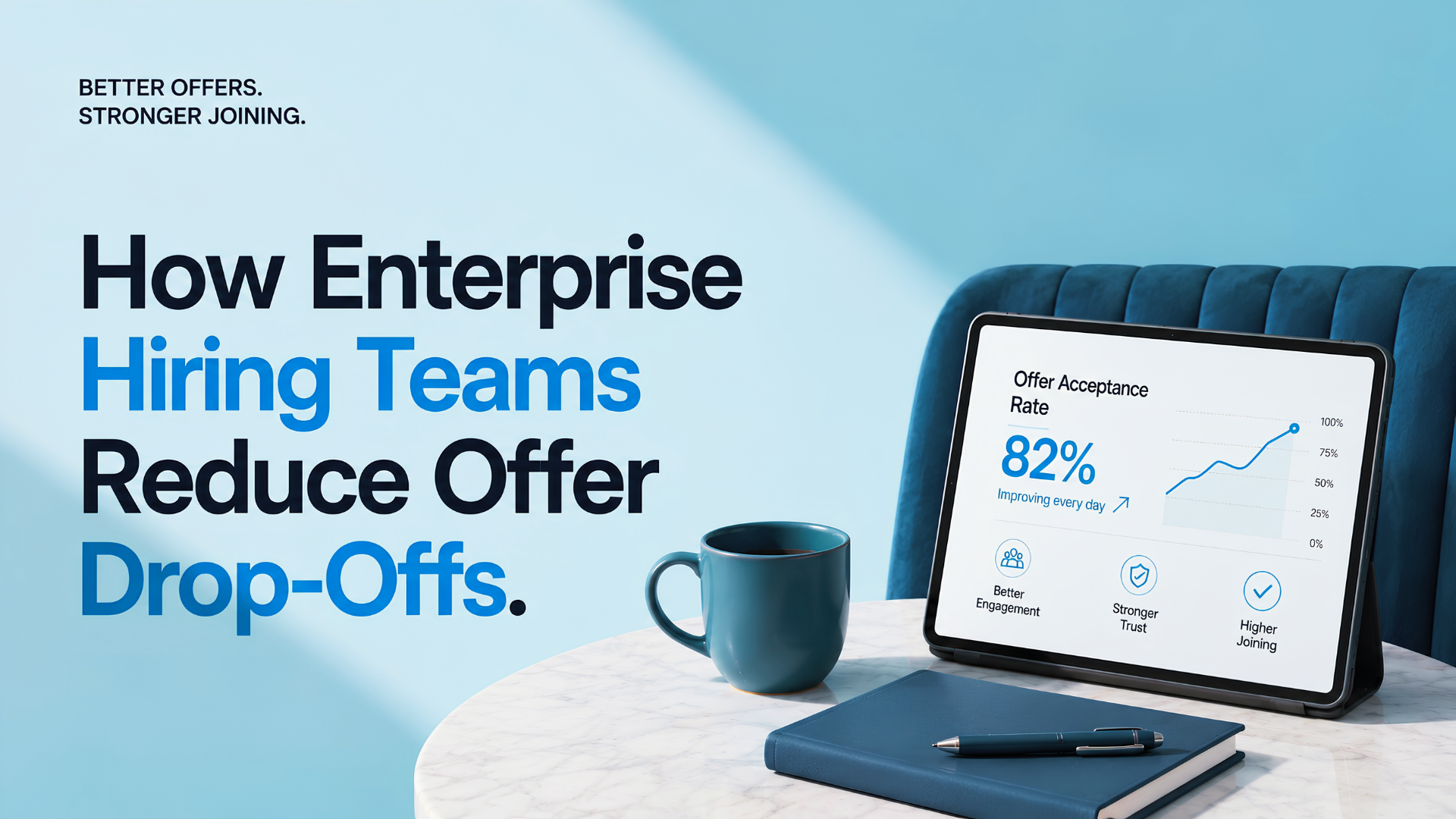
Offer drop-offs, the phenomenon where a candidate accepts an offer but withdraws before their start date, represent one of the most expensive and least understood failures in the enterprise hiring process. According to SHRM’s talent acquisition research, the average cost of a single offer withdrawal in an enterprise setting ranges from fifteen thousand to forty thousand dollars when you factor in recruiter time, interviewing costs, management hours, and the opportunity cost of a vacant position. For organizations making hundreds of offers per quarter, even a modest drop-off rate of ten to fifteen percent translates into millions of dollars in annual waste. Yet most teams treat drop-offs as isolated incidents rather than symptoms of a process that needs fundamental redesign.
The Real Cost Goes Beyond the Lost Candidate
When a candidate drops off after accepting an offer, the visible cost is the time and resources spent on that specific hire. But the invisible costs are often larger. The hiring manager has to re-engage with the interview process, which takes them away from their actual work. The recruiter has to restart sourcing and screening, which delays other open requisitions. The interview panel has to block calendar time again, which creates scheduling friction across the
organization. And the team that was expecting a new colleague has to absorb the workload for an extended period, which drives existing employees toward burnout and potential attrition. As McKinsey’s people organization research, highlights, hiring delays and failed offers have a cascading effect on team productivity that compounds over time.
There is also a reputational cost that compounds over time. Candidates talk. They post on Glassdoor, they share their experiences in professional communities, and they tell their networks. An enterprise that earns a reputation for slow, disorganized offer processes or poor post-acceptance communication will find it progressively harder to attract top talent. The candidate who withdraws today becomes the reason a different candidate declines to interview tomorrow. This is why the most successful enterprise teams treat offer drop-off reduction not as a recruiting metric but as an organizational capability. They invest in talent acquisition software that provides end-to-end visibility into the offer-to-joining funnel, because they understand that every drop-off prevented is a compounding return on their hiring brand.
Where the Drop-Off Happens and Why
Offer drop-offs cluster around three specific moments in the hiring timeline, and each has a distinct root cause. The first cluster occurs within forty-eight hours of acceptance, driven primarily by competing offers. In enterprise hiring, top candidates are typically interviewing with multiple organizations simultaneously. When a candidate accepts your offer, their other interviews do not stop. Competitors who learn about the acceptance often respond with counter-offers that include higher compensation, better titles, or faster start dates. The candidate, now in a position of leverage, re-evaluates their decision. If your organization has not built sufficient emotional commitment during the interview process, the counter-offer wins. This is a matching problem at its core. When AI candidate matching systems are used to ensure that the role is genuinely aligned with the candidate’s career trajectory, compensation expectations, and cultural preferences from the earliest stage, the likelihood of a counter-offer succeeding drops dramatically because the candidate’s decision was based on fit, not just on being first.
The second cluster occurs during the notice period, typically two to four weeks after acceptance, driven by disengagement and buyer’s remorse. The candidate has informed their current employer, which may respond with a retention offer or a promotion. Meanwhile, the new employer goes silent during the notice period, providing no engagement beyond administrative onboarding paperwork. The candidate is left in an emotional vacuum where their current employer is actively demonstrating value while their future employer is demonstrating bureaucracy. This asymmetry is the single most preventable cause of drop-offs, and it is solved not by faster processes but by sustained, strategic communication during the pre-boarding window.
The third cluster occurs in the final seventy-two hours before the start date, driven by practical anxiety. The candidate begins overthinking logistics, questioning their decision, and seeking reassurance that they made the right choice. Small uncertainties, an unanswered question
about benefits, a vague first-day agenda, a lack of clarity about reporting structure, expand into existential doubts. This is the moment when a single unanswered email or a delayed response from HR can tip the balance. The teams that prevent last-minute drop-offs are the ones that have a structured, time-bound pre-boarding sequence that eliminates uncertainty at every step. And as we have explored in our analysis of why more tools produce the same hiring problems, the issue is not the absence of tools but the absence of a system that coordinates them into a coherent candidate experience.
Speed: The Single Most Impactful Lever
In enterprise hiring, speed is not just a convenience metric. It is the most powerful lever for reducing offer drop-offs, because the longer your hiring process takes, the more time a candidate has to receive competing offers, receive counter-offers from their current employer, and talk themselves out of the decision. Research from Gartner’s HR trends analysis, consistently shows that time-to-offer is one of the strongest predictors of offer acceptance-to-joining conversion. Offers extended within forty-eight hours of the final interview have drop-off rates two to three times lower than offers that take a week or more. The reason is straightforward: a candidate’s enthusiasm peaks immediately after a positive interview experience and decays over time. Every day of delay is a day of emotional erosion.
The bottleneck that slows down most enterprise offer processes is not the decision itself. Hiring managers usually know whether they want to extend an offer within a day of the final interview. The bottleneck is the approval chain. Compensation approvals, budget sign-offs, legal review, and HR compliance checks create a multi-step process that can take days or even weeks in large organizations. The most effective enterprises solve this problem by pre-approving compensation bands before the interview process begins, by empowering recruiters with delegated authority for standard offers, and by using an AI recruiting solution that automates the offer generation and approval workflow. When the offer can be assembled, reviewed, and extended within hours of the hiring manager’s decision, the candidate’s enthusiasm is still at its peak and competing offers have not had time to materialize.
Better Matching Means Fewer Regrets
A significant percentage of offer drop-offs are not caused by external competition or slow processes. They are caused by a fundamental mismatch between the candidate’s expectations and the reality of the role. When a candidate accepts an offer and then discovers, during the notice period or even during the first week, that the role is different from what they were led to believe, they withdraw. This happens most frequently when the interview process focused on selling the opportunity rather than accurately representing it. Hiring managers who oversell the role, recruiters who downplay challenges, and job descriptions that omit key responsibilities all contribute to a mismatch that surfaces after the offer is signed. According to LinkedIn’s recruiting insights, candidates who report a significant gap between interview expectations and role reality are three times more likely to withdraw before their start date.
The solution is not more selling. It is more rigorous, data-driven matching that ensures alignment between the candidate’s capabilities, expectations, and career goals and the actual requirements, culture, and growth opportunities of the role. Modern AI candidate matching systems go far beyond keyword matching on resumes. They analyze the candidate’s career trajectory, skill progression, and stated preferences to generate a fit score that predicts not just whether the candidate can do the job, but whether they will thrive in the specific team, reporting structure, and organizational context. When matching is done well, the candidate’s post-acceptance experience reinforces their decision rather than undermining it, because the role they encounter during pre-boarding and onboarding is consistent with what they were told during the interview process. This alignment is what makes the difference between an offer that holds and an offer that falls apart.
The Communication Infrastructure That Prevents Backing Out
Communication during the post-acceptance period is the single most controllable factor in preventing drop-offs, and it is the factor that most enterprises handle worst. The typical pattern is a burst of communication around the offer itself, followed by weeks of silence during the notice period, punctuated by administrative emails about benefits enrollment and IT setup. This communication pattern is not just ineffective. It is actively harmful, because it tells the candidate that the organization’s enthusiasm was performative, limited to the courtship phase, and that the reality of working there will be bureaucratic and impersonal. The best AI recruiting platform for enterprise teams is the one that treats post-acceptance communication as a first-class workflow, not an afterthought.
Effective post-acceptance communication follows a structured cadence that blends personal touchpoints with automated engagement. The first five days after acceptance should include a personal message from the hiring manager, an introduction to the candidate’s future teammate or onboarding buddy, and a substantive piece of information about the team or project they will be joining. Understanding how many follow-ups one hire actually needs, and calibrating the frequency to the candidate’s engagement level, prevents both under-communication and the over-communication that feels intrusive. During the notice period, the cadence should settle into one meaningful touchpoint per week, with content personalized to the candidate’s interests and concerns. In the final week before the start date, the intensity should increase again with a detailed first-day agenda, a call from the onboarding buddy, and a personal message from the hiring manager expressing anticipation.
This communication infrastructure requires coordination across multiple stakeholders, the recruiter, the hiring manager, the onboarding buddy, and sometimes the candidate’s future skip-level manager. In enterprise organizations where dozens or hundreds of candidates may be in the post-acceptance pipeline simultaneously, this coordination is impossible without technology. A recruiter productivity software platform that automates the scheduling, tracking, and escalation of post-acceptance touchpoints ensures that every candidate receives a consistent, high-quality experience regardless of how many are in the pipeline. The platform should monitor the candidate’s responsiveness, flag declining engagement, and trigger escalations to
the appropriate stakeholder before the candidate reaches the point of withdrawal.
Building a System, Not a Checklist
The enterprises that consistently achieve offer-to-joining conversion rates above ninety percent share a common characteristic: they have built a system, not a checklist. A checklist is a list of tasks that a recruiter manually executes for each candidate. A system is an integrated set of processes, tools, and escalation protocols that operates consistently regardless of which individual recruiter is managing the candidate. The difference matters because checklists break down under volume, under turnover, and under the pressure of competing priorities. When a recruiter is managing thirty active requisitions, the post-acceptance checklist is the first thing that gets deprioritized. When a recruiter leaves the organization, their personal checklist leaves with them. A system, by contrast, is resilient to these disruptions because it is embedded in the technology and the process, not in any individual’s memory or discipline.
Building this system requires three components. First, a technology platform that automates the offer-to-joining workflow, including offer generation, approval routing, post-acceptance communication, engagement monitoring, and risk escalation. Second, a set of standardized playbooks that define the communication cadence, escalation protocols, and stakeholder responsibilities for different candidate segments and role types. Third, a feedback loop that captures data on every drop-off, analyzes the root cause, and feeds the insights back into the system to improve future performance. As we have discussed in our analysis of what makes an AI recruiting platform agentic versus just automated, the platforms that deliver the best outcomes are the ones that combine workflow automation with adaptive intelligence that learns from every interaction and continuously optimizes the process. This is also why the question of outdated candidate data in AI recruiting tools, is so critical: a system that makes decisions based on stale data will produce stale results, no matter how sophisticated its algorithms.
The financial case for investing in this system is straightforward. If your enterprise extends five hundred offers per quarter and your drop-off rate is fifteen percent, you are losing seventy-five accepted candidates per quarter. At an average cost of twenty-five thousand dollars per drop-off, that is nearly two million dollars in annual waste. Reducing the drop-off rate by even five percentage points, from fifteen to ten percent, saves over six hundred thousand dollars per year and frees up recruiter capacity to fill roles faster. When you factor in the downstream effects on team productivity, hiring manager satisfaction, and employer brand, the return on investment becomes even more compelling. As Deloitte’s talent research, notes, the organizations that invest in systematic offer-to-joining processes see a measurable improvement in new-hire retention and time-to-productivity, because candidates who experience a strong post-acceptance journey arrive on day one more engaged and better prepared.
Why Huntlo.ai Delivers the System Enterprise Teams Need
Huntlo.ai provides the integrated system that enterprise hiring teams need to reduce offer drop-offs systematically. The platform combines AI-powered candidate matching, automated
post-acceptance communication workflows, real-time engagement monitoring, and intelligent risk escalation into a single solution that operates consistently across every requisition, every recruiter, and every candidate. The AI engine creates a personalized engagement plan for each accepted candidate based on their role, profile, and the intelligence gathered during the interview process, ensuring that every touchpoint is relevant and timely. When evaluating an AI recruiting tool before buying, the ability to demonstrate a complete offer-to-joining workflow with measurable drop-off reduction is one of the most important differentiators.
For enterprise hiring teams that are ready to stop losing accepted candidates to preventable drop-offs, Huntlo provides the technology, the playbooks, and the intelligence to build a system that works at any scale. One where every candidate feels valued, informed, and connected from the moment they sign the offer through their first day. One where referrals outperform cold outreach, not because of the referral channel itself, but because every candidate, regardless of source, receives the same high-quality post-acceptance experience. And one where offer drop-offs are not treated as inevitable losses but as preventable failures that the system is designed to eliminate.