The most underappreciated problem in recruiting is not the quality of candidates, the speed of the hiring process, or even the availability of talent. It is the allocation of recruiter attention. In most hiring processes, recruiters spend the majority of their screening time talking to candidates who will not advance to the next stage — not because the recruiter is bad at identifying talent, but because the structure of the traditional hiring funnel forces them to evaluate candidates one at a time, in sequence, before they have enough information to know which ones are worth their time. AI voice interviews do not just make screening faster. They fundamentally change what recruiters spend their time on, shifting the focus from sorting through large volumes of unqualified applicants to having deeper, more productive conversations with the candidates who have already demonstrated they deserve the attention.
The Attention-Allocation Problem in Traditional Screening
Consider a typical mid-level requisition. A marketing manager role at a growing technology company generates 75 applications. Of those, perhaps 50 meet the basic qualification requirements listed in the job description. A recruiter with limited time needs to screen these 50 candidates through phone calls, typically spending 20 to 30 minutes per call. That is 17 to 25 hours of phone screening — nearly half a work week for a single requisition. But here is the problem that most hiring metrics do not capture: the recruiter will not know which 10 to 15 candidates are the strongest until they have spoken to most of the 50. The screening process is fundamentally serial. Candidate one gets a call, gets a subjective assessment, and is either advanced or rejected. Then candidate two. Then candidate three.
The recruiter’s calibration improves as they move through the pile — by the time they reach candidate 40, they have a much clearer sense of what good looks like than they did at candidate five — but the candidates screened early are evaluated against a less informed standard than the candidates screened late.
This serial evaluation process creates two distinct failures. First, it wastes recruiter time on candidates who could have been identified as below-threshold through a structured preliminary evaluation. Many of the 50 candidates who pass the resume screen will clearly not be a fit within the first five minutes of a phone call — but the recruiter has already invested the scheduling overhead, the call setup, and the opening minutes of conversation before that becomes apparent. Second, it underinvests in the candidates who matter most. A recruiter who has spent 20 hours on phone screens across 50 candidates does not have another 20 hours to spend on deep-dive conversations with the 10 strongest candidates. Those conversations — the ones where the recruiter probes motivations, explores cultural alignment, discusses career aspirations, and sells the opportunity — are compressed into the same 25-minute window as the screening calls, or skipped entirely. The net effect is that the best candidates get less recruiter attention than they deserve, and the weakest candidates get more recruiter attention than they warrant.
Research from Gartner’s HR technology practice has quantified this imbalance: in organizations using traditional phone screening, recruiters spend approximately 70 to 80 percent of their screening time on candidates who are ultimately rejected, and only 20 to 30 percent on candidates who advance. This ratio is the hidden efficiency gap in hiring, and it is far more consequential than most talent acquisition leaders realize, because it directly affects the quality of the shortlist that reaches the hiring manager.
How AI Changes the Recruiters Focus
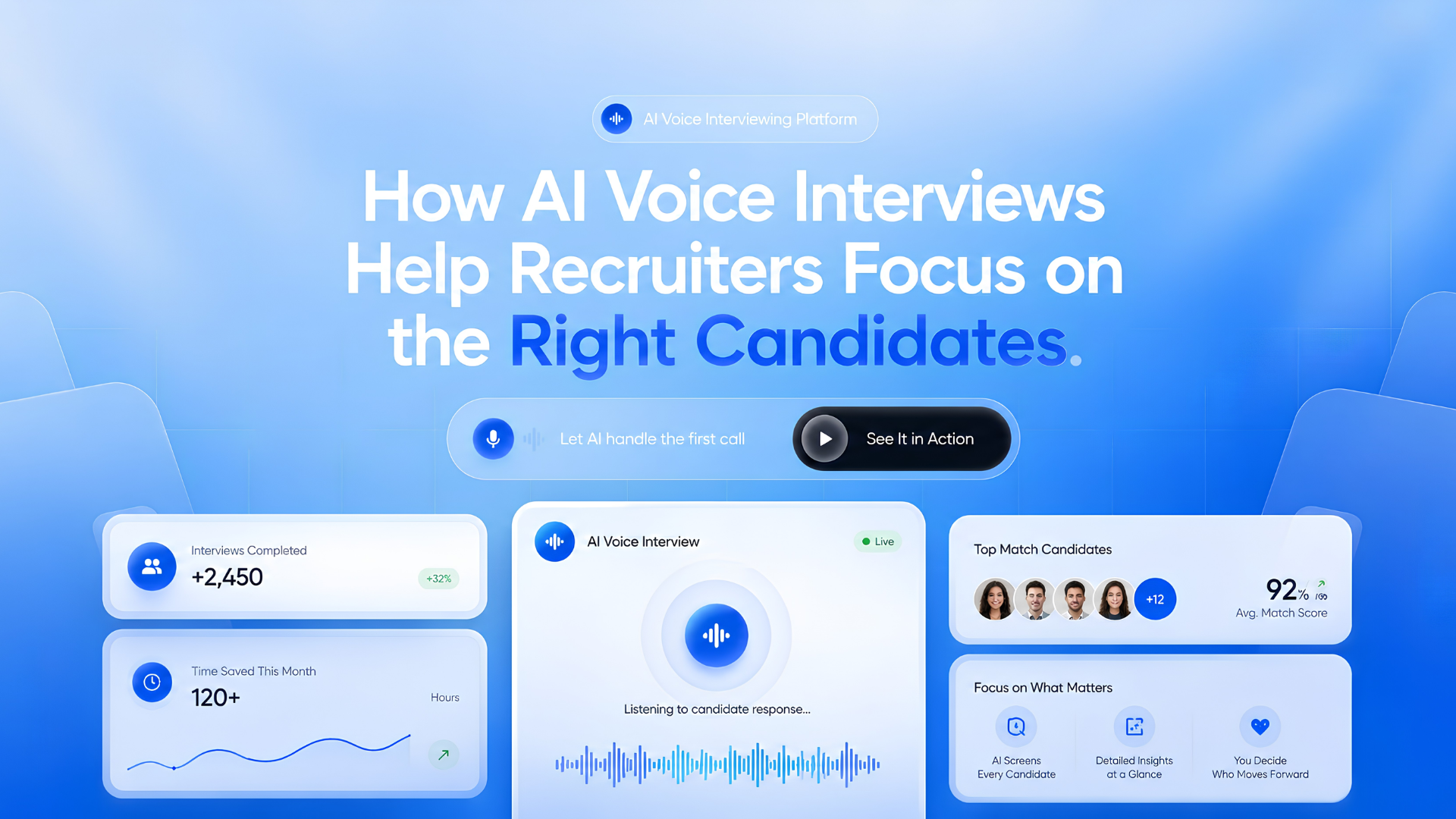
AI voice interviews invert this allocation by decoupling the initial evaluation from the recruiter’s time. Every candidate who meets basic qualifications completes an AI voice interview — a structured, consistent conversation that evaluates their responses against predefined competency criteria. The AI does not get tired, does not have a bad day, does not evaluate candidate 40 against a more refined standard than candidate five, and does not spend 15 minutes on a call with someone who clearly is not a fit. Every candidate receives the same thorough evaluation, and every evaluation produces a detailed scorecard. The recruiter reviews these scorecards and decides which candidates to invest human conversation time in — but they make that decision with complete information about every candidate, not partial information gathered one call at a time.
The impact on recruiter focus is immediate and significant. Instead of spending 20 hours on phone screens with 50 candidates, the recruiter might spend two hours reviewing 50 AI scorecards, identify the 12 strongest candidates, and then spend those 20 hours on 12 deeper conversations — each lasting 60 to 90 minutes, covering motivations, career narrative, cultural questions, and opportunity selling in a way that a 25-minute screening call cannot. The total recruiter time investment is similar. The quality of that investment is
radically different. The recruiter is no longer spending their time sorting. They are spending it engaging, assessing, and building relationships with the candidates who have already earned the right to a human conversation. EY’s workforce advisory research has found that this shift from volume screening to quality engagement is the single most impactful change recruiting teams can make, not just for hiring outcomes but for recruiter satisfaction and retention — because recruiters who spend their time on meaningful candidate conversations report significantly higher job satisfaction than those who spend it on repetitive screening calls.
There is also a subtler benefit that affects hiring quality. When a recruiter knows that a candidate has already been evaluated by AI and scored well on the relevant competencies, they approach the human conversation differently. They are not trying to determine whether the candidate is qualified — the AI has already established that. They are trying to understand the candidate’s motivations, assess cultural fit, and determine whether the specific role and team are the right match. This changes the conversation from an interrogation into a dialogue, and candidates can feel the difference. A recruiter who is genuinely exploring fit rather than checking boxes creates a candidate experience that is more engaging, more respectful, and more likely to convert a strong candidate into an enthusiastic applicant. The Talent Board CandE Awards data consistently shows that candidate perception of the hiring process is most strongly influenced not by the technology used, but by the quality and depth of human interaction they receive after the initial screening stage.
Scorecards That Actually Guide Recruiter Decisions
The value of AI voice interviews as a focus-allocation tool depends entirely on the quality of the evaluation data they produce. A scorecard that merely ranks candidates on a single numeric scale is only marginally better than a resume sort. To actually change recruiter behavior, the AI evaluation needs to provide competency-specific, actionable information that tells the recruiter not just who is strong, but where they are strong and where they need further exploration. The best AI voice interview platforms produce scorecards that break down the evaluation into individual competency dimensions — communication clarity, problem-solving approach, domain knowledge, leadership indicators, motivational alignment — and provide evidence-based assessments for each dimension, drawn from the candidate’s actual responses.
This level of detail transforms the recruiter’s preparation for follow-up conversations. When a recruiter reviews a scorecard that shows a candidate scored highly on technical communication and problem-solving but demonstrated limited evidence of leadership experience and had difficulty articulating long-term career goals, the recruiter knows exactly what to focus on during the human call. They do not need to re-evaluate the competencies the AI has already assessed. They need to probe the gaps, verify the strengths, and explore the dimensions that the AI cannot evaluate — interpersonal chemistry, cultural alignment, and the kind of contextual judgment that requires a human conversation. This is the operational difference between an AI tool that simply adds a step to the process and a genuinely agentic platform that makes every subsequent step more productive by providing better
information at the point where decisions are made.
The Hidden Cost of Unfocused Screening
Organizations that continue to rely on manual phone screening as the primary evaluation method are paying costs that do not appear in any standard hiring metric. The most visible cost is time — recruiter hours spent on calls that produce no value. But there are less visible costs that are arguably more damaging. When recruiters are overloaded with screening calls, their response time to candidates slows. Follow-up emails take days instead of hours. Scheduling takes longer. The candidate experience degrades not because the process is poorly designed, but because the recruiter does not have the bandwidth to execute it well. Candidates who are interested in the role lose enthusiasm during the wait. Passive candidates who were initially receptive go cold. The hiring manager, waiting for a shortlist, starts questioning whether the recruiting team is moving fast enough. These cascading effects are difficult to attribute to any single cause, but they share a common root: the recruiter’s attention is spread too thin across too many candidates who will not advance.
There is also a quality cost. When recruiters evaluate candidates serially, the evaluation standard shifts as they build context about the applicant pool. This means that comparable candidates may receive different assessments depending on where they fall in the screening sequence. A candidate who would have been advanced if screened on day four might be rejected if screened on day one, when the recruiter’s calibration was still forming. This inconsistency is not the recruiter’s fault — it is an inherent property of sequential human evaluation. AI voice interviews eliminate it by applying the same standard to every candidate, ensuring that the shortlist reflects the actual quality distribution of the applicant pool rather than the order in which candidates were reviewed. As discussed in The ATS Mistake Companies Keep Repeating, many of the persistent problems in hiring are not technology problems or people problems — they are process design problems that manifest as technology or people failures. Unfocused screening is one of the clearest examples.
Why Focus Requires More Than Just an AI Interview Tool
The principle is straightforward: AI voice interviews evaluate every candidate so recruiters can focus their human conversation time on the ones who deserve it. The implementation, however, requires more than a standalone AI screening tool. If the AI interview exists in isolation — separate from the sourcing pipeline, disconnected from the ATS, requiring manual scorecard review and then manual outreach to the candidates who score well — the focus benefit is real but limited. The recruiter still has to manage the handoff between systems, still has to coordinate scheduling manually, and still has to operate within a fragmented workflow that creates its own inefficiencies. The time saved by AI screening is partially consumed by the overhead of managing the gap between the AI tool and the rest of the hiring process.
This is why integrated platforms matter. Huntlo combines AI sourcing across 50+
platforms, automated multi-channel outreach, AI voice screening, and interview scheduling within a single hiring operating system. A candidate is sourced, engaged, screened by AI, and presented to the recruiter as a scored, prioritized lead — all without manual intervention. The recruiter reviews the scorecard, selects the candidates who deserve a deeper conversation, and conducts that conversation with full context from the AI evaluation, scheduling the next round and updating the candidate record within the same platform. The focus is not theoretical. It is engineered into the workflow. There is no gap between screening and engagement because both happen inside the same system, driven by the same data, managed through the same interface. The difference between AI sourcing and AI recruiting is relevant here — as explored in What’s the Difference Between AI Sourcing and AI Recruiting?, sourcing brings candidates in, but it is the integrated screening-to-engagement workflow that ensures recruiter time is spent on the right ones. When that workflow is unified, the recruiter’s attention is not just reallocated. It is amplified.
Related Topics:
Recruiting Compliance Differences: India vs USA vs UK