Rachel Okonkwo, Head of Recruiting at a midsize SaaS company in Austin, ended her fourth quarter planning meeting with a familiar sense of frustration. Her leadership team wanted to hire sixty engineers in the next six months, a target that would require her team of six recruiters to fill ten roles per month, nearly double their current pace. She knew her recruiters were already working at capacity, many logging fifty-five hour weeks just to maintain the current hiring rate. The problem was not effort or skill. Every one of her recruiters was experienced, motivated, and deeply committed to finding great candidates. The problem was that so much of their time was consumed by tasks that had nothing to do with actually evaluating talent: updating candidate records in the applicant tracking system, drafting outreach messages one at a time, scheduling interviews across multiple time zones, writing interview summaries from memory, and generating weekly pipeline reports for hiring managers. Rachel estimated that her team spent roughly sixty percent of their working hours on administrative and operational tasks rather than on the candidate-facing activities that drove hiring outcomes. She had heard that AI tools were beginning to change how recruiting teams operated, but she was not looking for incremental improvements. She needed a fundamental shift in how her team's time was allocated, and she was not sure any technology could deliver that.
The Recruiter Productivity Problem Is Structural, Not Personal
The challenges facing recruiters today are not primarily about individual capability or work ethic. Most recruiters enter the profession because they enjoy building relationships, identifying talent, and helping people find roles where they can thrive. Yet the reality of modern recruiting involves enormous amounts of administrative work that has little to do with these core strengths. Sourcing candidates requires navigating multiple platforms, screening resumes involves repetitive evaluation against similar criteria, and interview scheduling often devolves into weeks of back-and-forth emails. The structural nature of this problem means
that working harder or longer hours does not produce proportionally better results, because the bottleneck is not effort but how that effort is allocated.
Research from SHRM quantifies the scope of this misallocation. The average corporate recruiter spends roughly one-third of their day on administrative tasks including data entry, email coordination, and system navigation. Another significant portion goes to sourcing activities that, while important, are increasingly automatable. Only a fraction of a typical recruiter's working hours are spent on the activities that most directly influence hiring outcomes: candidate evaluation, relationship building, hiring manager consultation, and offer management. This imbalance is not a failure of individual recruiters but a structural characteristic of how recruiting organizations have traditionally operated.
The consequences extend beyond recruiter frustration. When talented recruiters spend most of their time on low-value tasks, they burn out faster, turnover increases, and the institutional knowledge they carry walks out the door. Hiring managers grow impatient with slow pipeline progression. Candidates experience longer response times and less personalized communication. The entire hiring engine slows down, not because the people running it are ineffective, but because the system they operate within forces them to spend their limited time on the wrong activities. AI offers a way to restructure that system by handling the tasks that do not require human judgment and freeing recruiters to focus on the ones that do.
What Recruiter Productivity Actually Means in an AI Context
Productivity in recruiting is fundamentally different from productivity in manufacturing or other output-driven domains. A recruiter's value is not measured by the number of tasks completed but by the quality of hiring decisions they contribute to and the strength of the talent pipelines they build. This means that simply automating more tasks does not automatically make a recruiter more productive. If an AI tool helps a recruiter send five hundred outreach messages per day instead of one hundred, but those messages produce lower response rates because they are less thoughtful, the recruiter has become busier but not more productive. True productivity improvement means better hiring outcomes per unit of recruiter effort, not just more activity.
In an AI context, recruiter productivity manifests across several dimensions. First, there is capacity: the number of concurrent searches a recruiter can effectively manage. Second, there is quality: the caliber of candidates who progress through the pipeline and ultimately receive offers. Third, there is speed: the time from role approval to qualified candidate shortlist. Fourth, there is consistency: the degree to which every candidate receives a fair and thorough evaluation regardless of which recruiter handles their search. McKinsey has found that organizations that measure productivity across all four dimensions, rather than focusing solely on time-to-fill, make significantly better use of AI recruiting tools because they optimize for outcomes rather than activity.
The most productive recruiters in AI-enabled organizations are not those who use the most
tools or automate the most tasks. They are the ones who have learned to partner with AI systems effectively, using technology to handle the repetitive and data-intensive aspects of their work while applying their human judgment, communication skills, and market knowledge to the decisions that matter most. This partnership model is fundamentally different from both the fully manual approach of traditional recruiting and the fully automated vision that some AI vendors promote. It represents a middle path where technology amplifies human capability rather than replacing it. Understanding agentic AI platforms vs automated ones is key to grasping this distinction, because agentic AI platforms operate alongside recruiters as collaborative agents rather than simple task automators.
Automating the Tasks That Drain Recruiter Time
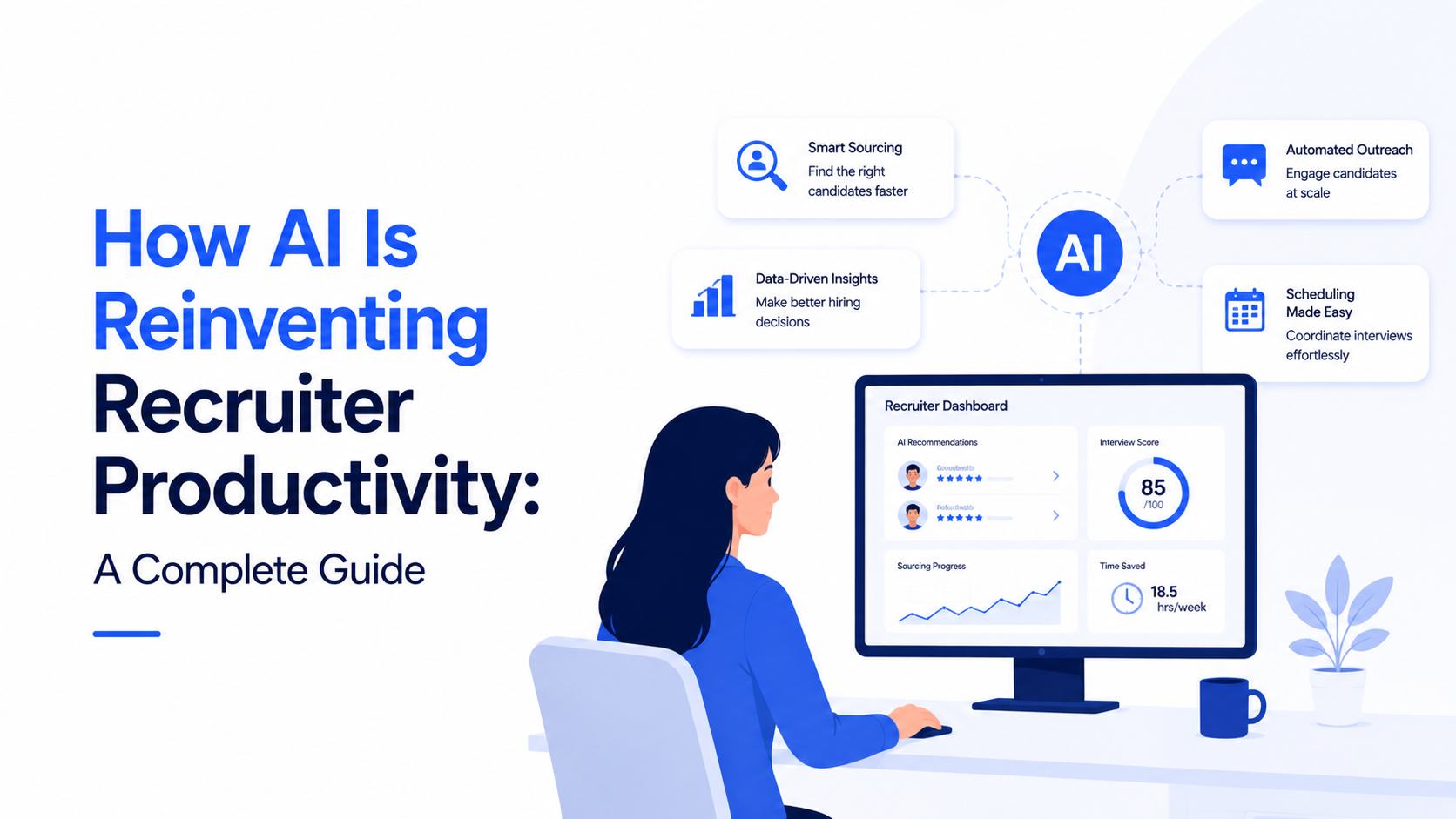
The most immediate productivity gains from AI come from automating the high-volume, low-judgment tasks that consume the largest share of recruiter time. Resume screening is perhaps the most visible example. A recruiter reviewing fifty applications for a single role can spend hours reading resumes, identifying relevant experience, and making preliminary fit assessments. AI screening tools can process the same volume in minutes, ranking candidates by relevance and highlighting specific qualifications that match the role requirements. The recruiter's role shifts from reading every resume to reviewing the AI's top candidates and applying contextual judgment that the algorithm cannot provide.
Interview scheduling is another task where AI delivers immediate and measurable productivity improvements. Coordinating availability between a candidate and three or four interviewers across different time zones can take dozens of emails and several days to finalize. AI scheduling assistants can analyze calendar availability across all participants, propose optimal time slots, send invitations, handle rescheduling requests, and automatically update the applicant tracking system. Gartner reports that organizations using AI scheduling tools reduce average time-to-schedule by sixty to seventy percent, freeing recruiters to focus on preparing candidates for interviews rather than playing calendar tetris.
Candidate communication represents a third major automation opportunity. Initial outreach messages, status updates, interview reminders, post-interview thank-you notes, and rejection communications all follow predictable patterns that can be intelligently automated. The key word is intelligently: effective AI communication tools do not send generic templates but generate personalized messages based on the candidate's profile, the stage of the process, and the specific context of the interaction. more tools same hiring problems captures a common frustration among talent leaders who have tried automating communications with basic tools: without intelligent personalization, automated messages often feel robotic and can damage candidate experience, undermining the very productivity gains they were meant to deliver.
Real-Time Pipeline Intelligence Changes Decision-Making
Beyond task automation, AI is transforming recruiter productivity by providing real-time
intelligence about pipeline health, bottlenecks, and opportunities. Traditional recruiting dashboards show historical data: how many candidates were sourced last week, how many interviews were completed, how many offers were extended. These lagging indicators are useful for reporting but do not help recruiters make better decisions in the moment. AI-powered pipeline intelligence, by contrast, provides forward-looking insights: which searches are at risk of missing their target start dates, which candidates are likely to drop out of the pipeline based on engagement signals, and which hiring managers need additional support to make timely decisions.
This real-time intelligence changes how recruiters allocate their attention. Instead of treating every open requisition equally, recruiters can focus their effort on the searches where intervention will have the greatest impact. If the AI identifies that a critical engineering search has only three active candidates in late-stage interviews and the hiring manager has a history of slow decision-making, the recruiter can proactively engage with that hiring manager to accelerate the process before the pipeline dries up. LinkedIn data shows that recruiters who use AI-powered pipeline insights fill roles twenty to thirty percent faster than those who rely on periodic manual reviews, because they can identify and address problems as they emerge rather than discovering them during weekly pipeline reviews.
Predictive analytics also enables recruiters to manage candidate expectations more effectively. If the AI detects that a candidate who seemed highly engaged has stopped opening emails or has recently updated their LinkedIn profile, the recruiter can reach out proactively with a personalized check-in rather than waiting for the candidate to go silent. This kind of anticipatory engagement is extremely difficult to achieve manually at scale, because no recruiter can monitor the behavioral signals of hundreds of candidates simultaneously. AI makes it possible by processing these signals in real time and surfacing the ones that require human attention. how many follow-ups one hire needs demonstrates that the timing and relevance of follow-up communications are among the strongest predictors of whether a candidate remains engaged through a multi-week hiring process.
From Reactive to Proactive: How AI Changes Recruiter Workflow
Traditional recruiting workflow is fundamentally reactive. A hiring manager submits a requisition, the recruiter begins sourcing, candidates flow into the pipeline, and the recruiter manages the process as it unfolds. Each step happens in response to the previous one, and recruiters spend much of their time reacting to events rather than shaping them. AI enables a proactive workflow where the system anticipates needs, prepares resources in advance, and nudges recruiters toward the most impactful actions at each moment.
Consider how a proactive AI system might handle a typical engineering search. Before the requisition is even approved, the system could begin building a preliminary candidate pool based on the job description draft, identifying passive candidates who match the likely
requirements, and preparing outreach templates tailored to the specific role type. When the requisition is approved, the recruiter starts with a pre-built pipeline rather than an empty slate. As candidates move through the process, the system pre-loads interview materials, prepares evaluation frameworks, and drafts offer language based on the candidate's profile and the competitive market data. Deloitte has documented that organizations using proactive AI workflows reduce average time-to-shortlist by forty percent compared to reactive approaches.
The shift from reactive to proactive workflow also changes the recruiter's relationship with hiring managers. Instead of functioning as an order-taker who waits for requirements and then executes, the recruiter becomes a strategic talent advisor who brings data-driven insights to the conversation. AI provides the recruiter with market intelligence about talent availability, compensation benchmarks, and competitive hiring dynamics that enable more productive conversations with hiring managers about what is realistic and how to position the opportunity attractively. This elevated role is more fulfilling for experienced recruiters and more valuable for the organization, but it requires the kind of data foundation that only AI can provide at scale. Understanding AI tools for niche technical roles is particularly valuable here, because recruiting for specialized roles demands the kind of deep market intelligence that AI systems can aggregate and deliver more efficiently than manual research.
Measuring the Real Productivity Gains from AI
Quantifying the productivity impact of AI in recruiting requires moving beyond simple metrics like time-to-fill or requisitions-per-recruiter. These metrics can be misleading because they do not account for the quality of hires or the candidate experience. A recruiter who fills roles faster but with lower-quality candidates is not truly more productive. The most meaningful productivity metrics compare outcomes before and after AI implementation while controlling for market conditions, role complexity, and team composition. Organizations that do this rigorously often find that the headline productivity numbers understate the actual impact.
Several leading companies have shared data on their AI-driven productivity improvements. Response rates to outreach typically increase by two to three times when AI optimizes message timing and personalization. Candidate pipeline velocity improves because AI identifies and removes bottlenecks in real time. Recruiter capacity increases by thirty to fifty percent for sourcing and screening activities, though the actual improvement in hiring output depends on whether downstream processes like interview loops and decision-making can absorb the increased candidate flow. EY has found that the organizations realizing the largest productivity gains are those that use AI to optimize the entire recruiting workflow end to end, rather than deploying point solutions that improve one step while leaving adjacent steps unchanged.
Cost efficiency is another important dimension of productivity. When AI enables a recruiting team to handle higher volume without proportional headcount increases, the cost-per-hire improves significantly. However, the investment in AI tools themselves must be factored into the calculation. For organizations making fewer than one hundred hires annually, the tool subscription costs may approach or exceed the efficiency savings. For high-volume hiring
organizations making several hundred or thousands of hires per year, the economics become compelling quickly. The key is measuring total recruiting cost, including technology investment, recruiter compensation, and hiring manager time, rather than just counting recruiter hours saved.
The Human Skills That Become More Valuable With AI
Paradoxically, the more that AI automates routine recruiting tasks, the more valuable certain human skills become. As the administrative burden decreases, the differentiating factor between good and great recruiters shifts toward abilities that AI cannot replicate: building genuine rapport with candidates, reading the subtext of a hiring manager's requirements, navigating complex offer negotiations, and making judgment calls about cultural fit that require nuance and contextual understanding. These skills were always important, but they were often overshadowed by the sheer volume of operational work that demanded attention.
Relationship management becomes the core competency of AI-era recruiters. When AI handles sourcing, screening, scheduling, and routine communication, the recruiter's primary value shifts to the interpersonal dimensions of the hiring process. This includes coaching hiring managers on interview techniques, providing candidates with genuine insight into the team and culture, managing competing offer situations, and building long-term talent communities that yield dividends over multiple hiring cycles. Gartner predicts that by 2027, the most successful recruiting organizations will evaluate recruiters primarily on relationship and influence metrics rather than activity-based metrics, reflecting the fundamental shift in what recruiters actually do day to day.
Strategic thinking also becomes more important. When recruiters are freed from operational overload, they have the bandwidth to contribute to workforce planning, employer branding strategy, and talent market analysis. They can identify trends in candidate feedback that point to broader organizational challenges, recommend adjustments to job descriptions or compensation structures based on market data, and help business leaders anticipate future hiring needs rather than simply reacting to current vacancies. should recruiters worry about AI replacing jobs explores why the evolution of AI in recruiting is creating more strategic roles for human recruiters rather than eliminating them, as the technology handles execution while humans focus on strategy and relationship.
Common Pitfalls When Implementing AI Productivity Tools
The most common mistake organizations make when adopting AI recruiting tools is treating implementation as a technology project rather than a workflow transformation. Deploying an AI sourcing tool without redesigning how recruiters interact with candidates, or implementing AI scheduling without adjusting interview team expectations, typically produces disappointing results. The technology delivers its promised efficiency gains, but those gains are absorbed by inefficiencies elsewhere in the process. Effective implementation requires mapping
the entire recruiting workflow, identifying where AI creates the most leverage, and redesigning adjacent processes to take full advantage of the time and data that AI makes available.
Another frequent pitfall is inadequate change management. Recruiters who have built their careers on manual processes may resist AI tools because they feel their expertise is being devalued or because they fear the technology will eventually replace them. This resistance is often rooted in legitimate concerns about job security and professional identity, not in stubbornness or technical aversion. Organizations that invest in thorough training, clear communication about how roles will evolve, and opportunities for recruiters to shape the implementation tend to achieve much higher adoption rates and productivity gains. McKinsey emphasizes that the human side of AI implementation is at least as important as the technical side, and that organizations neglecting change management typically leave fifty to sixty percent of the potential value unrealized.
Data quality is a third common failure point. AI recruiting tools are only as effective as the data they operate on. If the applicant tracking system is full of outdated records, inconsistent job descriptions, and incomplete candidate profiles, the AI will produce unreliable recommendations regardless of how sophisticated its algorithms are. Organizations must invest in data hygiene before or alongside AI implementation, ensuring that candidate records are current, job requirements are accurately documented, and historical hiring outcomes are properly recorded. why AI tools have outdated candidate data explains why candidate data quality is a persistent challenge in AI recruiting and how organizations can address it through systematic data governance practices.
Building a Sustainable AI-Enabled Recruiting Operation
Sustainable productivity improvement from AI does not come from deploying a single tool and declaring success. It comes from building a coherent technology ecosystem where data flows between sourcing, screening, interviewing, and analytics tools, and where each tool's output becomes the next tool's input. This integration is what transforms AI from a collection of point solutions into a true productivity multiplier. Organizations that achieve this integration report compounding efficiency gains over time, as each quarter of data and experience makes the system more effective.
The organizational structure of the recruiting team also matters. As AI handles more of the operational workload, some organizations are creating specialized roles that did not exist before: recruiting operations analysts who manage AI tool configurations and interpret system data, candidate experience specialists who focus entirely on the human touchpoints of the hiring journey, and talent intelligence professionals who use AI-generated market insights to inform workforce strategy. These specializations are only possible when AI absorbs the generalist operational work that previously consumed all of the recruiter's time. Deloitte notes that organizations creating these specialized roles report higher recruiter satisfaction and lower turnover, because recruiters can focus on the aspects of their work they find most engaging.
Ultimately, the most productive recruiting operations of the next decade will be those that treat AI not as a cost-reduction tool but as a capability multiplier. The goal is not to hire the same number of people with fewer recruiters, but to hire better people with the same team while giving those recruiters more fulfilling, more strategic, and more impactful roles. This framing matters because it determines how organizations measure success, how they communicate change to their recruiting teams, and how they invest in the human capabilities that AI cannot replace. LinkedIn research consistently shows that the highest-performing recruiting teams are not the most automated ones but the ones that achieve the best balance between technological efficiency and human connection.