Candidate screening has been the bottleneck of the hiring process for as long as corporate recruiting has existed. Every organization, regardless of size or industry, faces the same fundamental problem at the top of the funnel: too many applicants, too little time to evaluate them properly, and too much at stake if the wrong candidates advance while the right ones are filtered out. For two decades, the answer to this problem was keyword matching. Applicant tracking systems scanned resumes for specific terms, ranked candidates by match count, and produced a shortlist that the recruiter could then review. It was a solution born of necessity, and for a while, it was good enough. It is no longer good enough. Artificial intelligence is not just improving screening. It is reinventing it from the ground up.
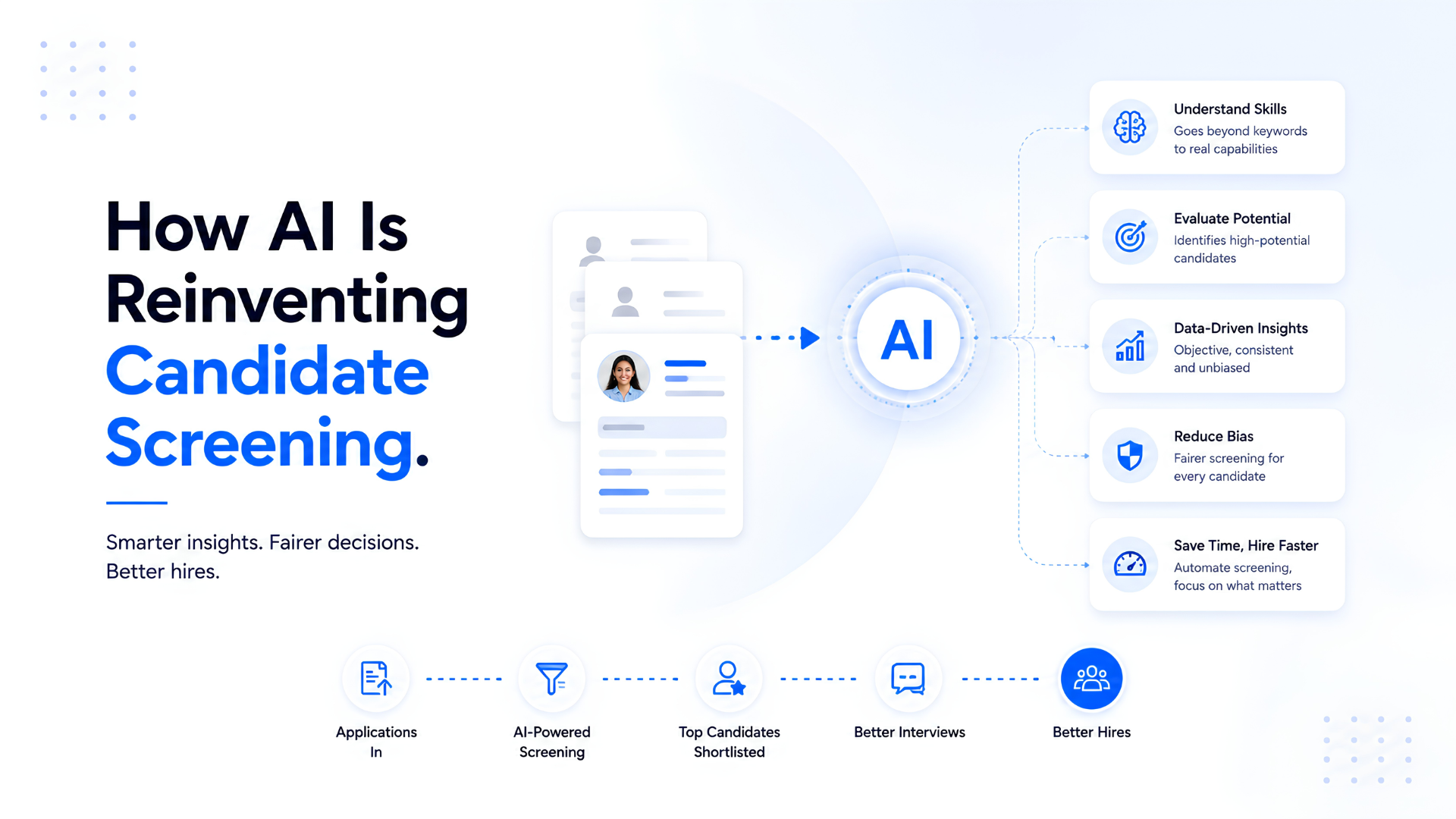
The reinvention is happening across five dimensions simultaneously: how candidates are evaluated, what data is used to evaluate them, how evaluations adapt to different roles, how bias is managed, and what the recruiter’s role becomes in the process. Each of these dimensions represents a departure from the keyword-matching paradigm that has dominated recruiting for twenty years. Together, they represent a fundamentally new approach to the oldest problem in hiring. According to Deloitte’s human capital research, organizations that have adopted AI-native screening report 40% to 60% improvements in shortlist quality and 50% reductions in time-to-shortlist. These are not marginal gains. They are the kind of improvements that change hiring outcomes at an organizational level.
From Keyword Matching to Multi-Signal Candidate Intelligence
The most visible change AI is bringing to screening is the shift from single-signal evaluation to multi-signal candidate intelligence. A keyword system looks at exactly one data source, the text of the resume, and evaluates it against exactly one set of criteria, the keyword list. An AI screening system looks at multiple data sources, including the resume, professional profiles, publicly available work samples, career history patterns, and domain-specific achievements, and synthesizes them into a holistic assessment of the candidate’s capabilities, trajectory, and
fit for the role.
The practical impact of this shift is profound. Consider two software engineering candidates. Candidate A has a resume that perfectly matches the keyword list: ten years of experience, the right technologies listed, a degree from a recognized university. Candidate B has a non-traditional background: a physics degree, five years of experience, but an exceptional GitHub profile with significant open-source contributions, published technical writing, and a pattern of working on problems directly relevant to the role. A keyword system ranks Candidate A higher. A multi-signal AI system, which can evaluate the evidence of capability in Candidate B’s public work, recognizes that Candidate B may be the stronger hire. The AI is not just processing more data. It is evaluating different kinds of data that reveal different dimensions of capability.
This multi-signal approach is especially critical for specialized roles where traditional resumes are often the worst indicator of actual ability. As we have explored in our analysis of whether AI recruiting tools work for niche or technical roles, the candidates who look weakest on paper are sometimes the strongest in practice, and only a multi-signal evaluation system can detect that strength. The AI does not just find more candidates. It finds better candidates by looking at evidence that keyword systems cannot see.
Adaptive Screening: One Role, One Evaluation, Every Time
The second dimension of the AI reinvention is adaptivity. Traditional screening systems apply the same evaluation criteria to every candidate for a given role. If the job description says five years of experience and knowledge of Python, every candidate is evaluated against those two criteria regardless of context. But experienced recruiters know that the ideal criteria are different for almost every hire. A startup hiring a senior engineer needs someone who can operate with ambiguity and make architectural decisions independently. An enterprise hiring for the same title needs someone who can work within established processes and scale existing systems. The same job title, fundamentally different screening criteria.
AI screening systems that are truly intelligent do not apply a static filter. They adapt their evaluation to the specific context of the role, the seniority level, the company stage, and the hiring manager’s stated priorities. They recognize that a candidate who is an exceptional fit for one version of a role may be a poor fit for another version of the same role, and they adjust their scoring accordingly. This adaptivity is what separates the current generation of AI screening from the previous generation of automated tools. Automated tools execute pre-defined rules. Intelligent AI systems reason about what matters for each specific hire and evaluate candidates accordingly.
This distinction between automation and intelligence is critical. As we have written about extensively in our piece on what makes an AI recruiting platform agentic vs just automated, the platforms that are genuinely transforming hiring outcomes are the ones that can adapt their behavior based on context, not just execute faster versions of the same workflows. Adaptive screening means every candidate is evaluated against the role as it actually exists, not the role
as a generic keyword list describes it. The result is shortlists that are more accurate, more nuanced, and more useful to the hiring manager.
Real-Time Data Enrichment: Screening Against the Present, Not the Past
One of the most overlooked limitations of traditional screening is its dependence on static data. A resume is a snapshot of a candidate’s professional history at the moment they wrote it. By the time a recruiter reviews it, the candidate may have changed roles, acquired new skills, completed significant projects, or received promotions. The resume, as a data source, is inherently backward-looking and often outdated. Screening decisions made on stale data are screening decisions made on false premises, and the larger the gap between the resume’s creation date and the screening date, the larger the risk of inaccuracy.
AI screening platforms address this problem through real-time data enrichment. Rather than relying solely on the resume submitted with the application, these platforms pull in current data from multiple sources at the point of evaluation. The candidate’s current professional profile, their recent activity and posts, their most recent work samples and contributions, and their updated career history are all factored into the screening assessment. The candidate is evaluated against who they are today, not who they were when they last updated their resume. This real-time enrichment dramatically reduces the false-negative rate, because candidates who have grown significantly since their last resume update are evaluated on their current capabilities rather than an outdated snapshot.
Data freshness is not a nice-to-have. It is a structural requirement for accurate screening. As we have examined in our analysis of why some AI recruiting tools have outdated candidate data, screening algorithms that process stale data will produce stale results, regardless of how sophisticated the algorithm is. The best AI screening platforms treat data freshness as a first-class engineering concern, continuously verifying and updating candidate profiles rather than relying on cached information that may be months or years out of date.
Bias Reduction Through Structured, Consistent Evaluation
Candidate screening has always been a magnet for bias, both human and algorithmic. Human reviewers are influenced by name-based signals, institutional prestige, resume formatting, and a dozen other factors that have no correlation with job performance. Keyword-based systems introduced their own form of bias, systematically favoring candidates whose resumes used the specific terminology the system was configured to recognize. AI has the potential to significantly reduce both forms of bias, but only if it is designed and deployed with bias reduction as an explicit goal rather than an afterthought.
The mechanism by which AI reduces bias is structured consistency. Unlike a human reviewer whose evaluation standards drift over the course of a long screening session, an AI system applies the same evaluation criteria to every candidate, every time. It does not get fatigued, it does not have bad days, and it does not unconsciously shift its standards based on the candidate it reviewed five minutes ago. This consistency is especially valuable in high-volume
screening, where the sheer number of candidates makes human consistency virtually impossible to maintain. The AI evaluates each candidate against the same weighted criteria, producing rankings that reflect genuine differences in candidate quality rather than artifacts of reviewer fatigue or inconsistency.
However, AI is not bias-free by default. An AI trained on historical hiring data will learn and perpetuate the biases embedded in that data. This is a version of the broader problem we have described as more tools, same hiring problems: applying new technology to a flawed process without changing the underlying logic simply produces the same flawed outcomes at greater speed. The AI screening systems that actually reduce bias are those that are trained on capability-relevant signals rather than historical hiring patterns, that evaluate candidates on demonstrated evidence rather than proxy characteristics, and that are regularly audited for disparate impact across demographic groups. According to McKinsey’s research on AI in hiring, organizations that implement AI screening with deliberate bias-mitigation protocols see 20% to 35% increases in shortlist diversity without any decrease in shortlist quality.
The Recruiter’s New Role: From Screen Processor to Talent Strategist
Perhaps the most important dimension of AI’s reinvention of screening is what it means for the recruiters themselves. The keyword era reduced the recruiter’s role to a combination of keyword list manager and resume processor. Recruiters spent the majority of their time on low-judgment, high-volume work: scanning documents, checking boxes, and moving candidates through a pipeline that was designed for efficiency rather than intelligence. The most capable recruiters found this work frustrating, and the least capable recruiters were protected by the fact that the system did not require much skill to operate. AI is changing this dynamic fundamentally by automating the low-judgment work and freeing recruiters to focus on the high-judgment work where their expertise creates the most value.
In the AI-screening model, the recruiter’s role shifts from processing candidates to strategizing about talent. Instead of scanning 200 resumes, the recruiter reviews an AI-generated shortlist of 15 to 20 candidates who have already been evaluated on multiple dimensions. The recruiter’s job is then to apply contextual judgment that the AI cannot replicate: understanding the hiring manager’s unstated preferences, assessing cultural fit based on team dynamics, identifying candidates whose potential outweighs their experience, and building the relational connection that converts a candidate into a hire. This is work that requires experience, empathy, and strategic thinking. It is also work that most recruiters find far more rewarding than the document-processing tasks that dominated their days in the keyword era.
The transition raises an understandable concern among recruiters about job displacement. But as we have discussed in our analysis of whether recruiters should worry about AI replacing their jobs, the evidence so far suggests the opposite is happening. AI is not replacing recruiters. It is elevating them by removing the mechanical parts of the job and creating space for the strategic parts. Recruiters who learn to work alongside AI screening tools are becoming more effective, more valuable, and more satisfied with their work. The recruiters who are
at risk are those who resist the transition and continue trying to compete with AI on the low-judgment tasks where the machine will always be faster and more consistent.
How Huntlo Is Leading the AI Screening Reinvention
Huntlo’s screening engine embodies all five dimensions of the AI reinvention described in this article. The platform evaluates candidates on multiple signals, drawing from professional profiles, career history, demonstrated achievements, and domain expertise to build a holistic assessment that goes far beyond keyword matching. Its screening is adaptive, adjusting evaluation criteria for each specific role and candidate pairing rather than applying a static filter. It enriches candidate data in real time, ensuring that screening decisions are based on current information rather than outdated resumes. It applies structured, consistent evaluation that reduces the variability and unconscious bias that plague manual screening. And it redefines the recruiter’s role by handling the high-volume processing work and presenting the recruiter with pre-evaluated, high-quality shortlists that they can then enrich with their contextual expertise.
The practical difference is not theoretical. It is measurable in hiring outcomes. Shortlists are more diverse and higher quality. Time-to-shortlist drops by 50% or more because the AI handles the initial volume. Recruiters spend their time on candidate engagement, hiring manager advisory, and strategic talent planning rather than document scanning. And when it comes to evaluating which AI screening platform to adopt, the key differentiator is whether the platform can demonstrate all five of these capabilities, not just one or two. Many tools offer AI-assisted keyword matching and call it intelligent screening. Huntlo offers genuine candidate intelligence, and the hiring outcomes speak for themselves.