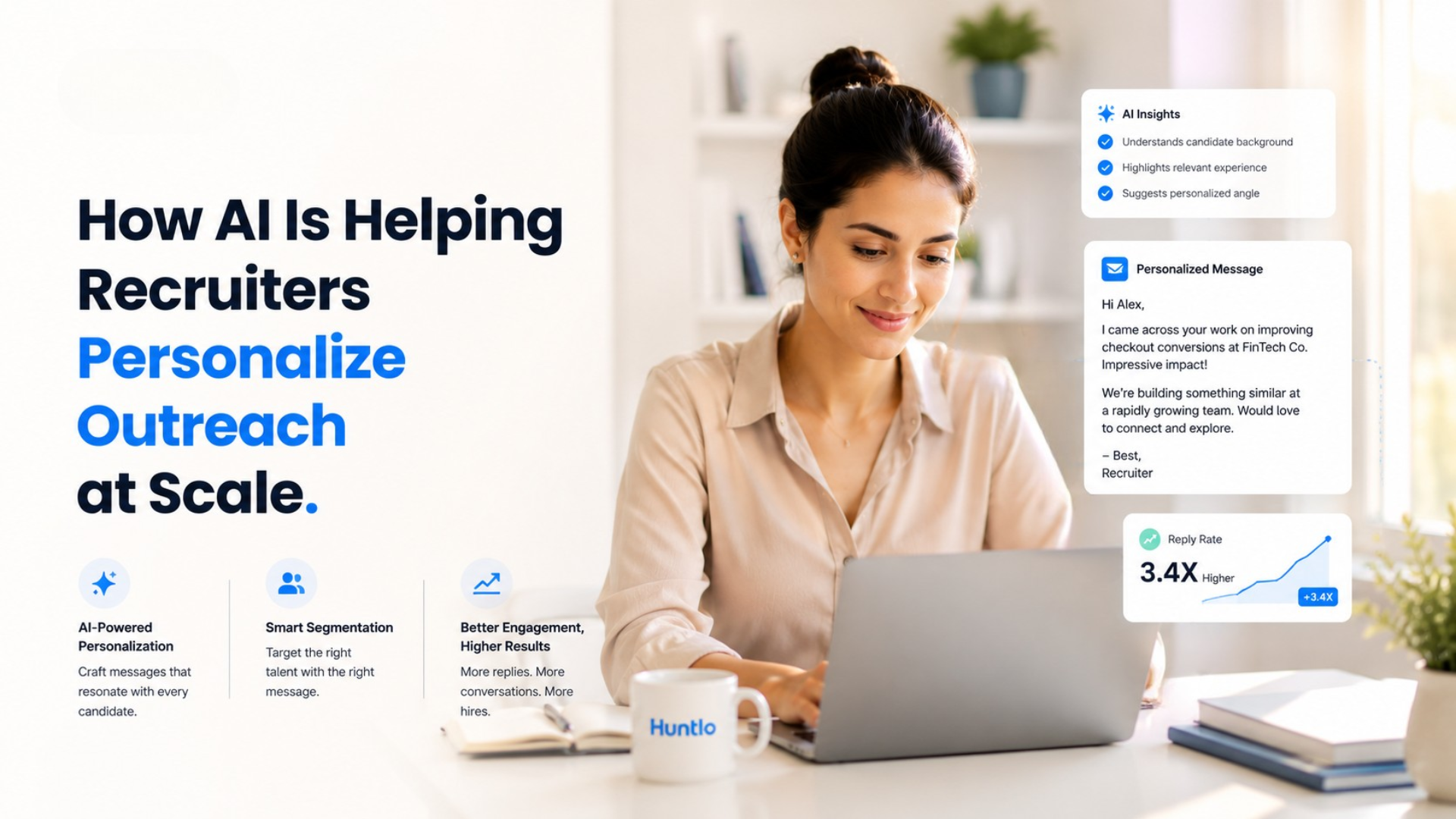
Every recruiter has experienced the personalization paradox. They know that a message referencing a candidate’s specific project, career transition, or professional achievement will outperform a generic message by a wide margin. They have seen it in their own results: the candidate who responds enthusiastically to a message about their recent work and ignores the template-based message from a competitor. They understand the principle intuitively. The problem is execution. Personalizing a single message takes five to ten minutes of research plus two to three minutes of careful writing. A recruiter managing twenty open requisitions with ten to fifteen active candidates each has two hundred to three hundred candidates in the pipeline. Personalizing outreach for every one of them would require twenty to fifty hours per week of research and writing alone, which is more time than the recruiter has available for all of their responsibilities combined. The result is that personalization is rationed: the top five to ten candidates receive deeply personalized messages, and the remaining two hundred and fifty receive something closer to a template. The candidates who receive the template messages are the ones who are most likely to ignore the outreach, and the recruiter’s overall response rate reflects this uneven quality. AI is solving this problem by automating the two activities that make personalization expensive: the research and the writing.
The impact of this automation is not incremental. It is structural, because it changes the fundamental economics of personalized outreach. When personalization required ten minutes of human effort per candidate, it was a scarce resource that had to be allocated carefully. When AI can perform the equivalent research and generate an equivalent message in seconds, personalization becomes abundant, and the allocation problem disappears. Every candidate in the pipeline can receive the same quality of personalized outreach that was previously reserved for the highest-priority prospects. This does not mean that
AI-generated personalization is identical to human-crafted personalization. It means that AI-generated personalization can achieve the same functional outcome — a message that demonstrates genuine understanding of the candidate and invites a substantive response — at a fraction of the cost and time. The functional equivalence is what matters for the candidate, because the candidate evaluates the message based on what it says and how relevant it feels, not on how many minutes of human effort went into producing it. This article explains the specific AI capabilities that make personalization at scale possible, distinguishes between real AI personalization and the superficial kind, and shows how recruiting teams can evaluate and adopt these capabilities effectively.
The Three AI Capabilities That Enable Personalization at Scale
Personalization at scale requires three distinct AI capabilities working together. The first is candidate intelligence: the ability to analyze a candidate’s professional profile and extract the most relevant, compelling signals from a large amount of potentially relevant information. A senior candidate’s profile may contain dozens of notable elements — past roles, projects, publications, certifications, skills, and career transitions. The challenge is not finding information. It is selecting the one or two elements that are most likely to resonate with the candidate and connect most naturally to the opportunity being presented. Human recruiters do this instinctively when they have time to review a profile carefully, but at scale, instinct gives way to speed, and the selection becomes superficial. AI candidate intelligence performs this selection systematically, evaluating each potential signal against the role requirements and the candidate’s likely interests to identify the strongest possible message hook. The quality of this selection process is the foundation of personalization quality. If the AI selects a weak or irrelevant signal, the message will feel generic regardless of how well it is written. If it selects a strong, specific signal, the message will feel personal even if the writing is straightforward.
The second capability is natural language generation: the ability to construct a complete, natural-sounding message that integrates the selected candidate signal with information about the role and the company. This is where many AI outreach tools fall short. They can identify a relevant signal, but when they construct the message around it, the result reads like a template with a personalized fact inserted into a generic frame. The candidate perceives this as “personalization lite” — better than nothing, but not good enough to feel genuinely human. The best AI generation systems do not insert facts into templates. They generate the entire message from scratch, constructing a narrative flow that connects the candidate’s specific context to the opportunity in a way that reads as a single, coherent thought rather than a template with a variable. The difference is subtle in isolation but cumulative across dozens of messages. A candidate who receives two AI-generated messages — one from a template-insertion system and one from a fresh-generation system — can distinguish between them, and their response rates reflect that distinction.
The third capability is adaptive learning: the ability to improve personalization quality over time based on outcome data. When a generated message produces a response, the system records which signals were used, how the message was structured, and what the
candidate’s response was. When a message does not produce a response, the system records that as well. Over time, the system builds a model of which personalization strategies work for which candidate profiles, which channels, and which role types, and it applies that model to improve future message generation. This learning loop is what transforms AI personalization from a static tool into an improving system. The first thousand messages may produce good results. The ten-thousandth message, informed by the learning from the first nine thousand nine hundred and ninety-nine, produces better results. According to Deloitte’s workforce of the future research, organizations that deploy AI outreach systems with active learning loops report a fifteen to twenty-five percent improvement in response rates between the first quarter of deployment and the fourth quarter, as the system calibrates its personalization strategies to the specific candidate populations and role types that the organization targets. The organizations that do not have active learning — the ones whose AI systems use fixed generation models that do not improve from outcomes — see initial gains that plateau quickly and may even degrade over time as candidates become more sophisticated at detecting the system’s patterns.
Real Personalization vs. Fake Personalization: How to Tell the Difference
The recruiting technology market has been flooded with products that claim to offer AI-powered personalization, and many of them do not deliver on that claim in any meaningful way. Understanding the difference between real AI personalization and fake AI personalization is essential for recruiters and talent acquisition leaders who are evaluating these tools, because the gap between the two is the gap between outreach that works and outreach that wastes time and money while producing mediocre results. Fake personalization follows a consistent pattern. The system identifies one or two data points from the candidate’s profile, typically their name, current employer, and job title, and inserts those data points into a pre-written message template. The template was written by a human marketer, and the AI’s only contribution is the data extraction and insertion. The result is a message like: “Hi [Name], I see you are a [Title] at [Company]. We are hiring for a similar role at [Our Company].” This is personalization in the most technical sense — the message contains candidate-specific data — but it fails the candidate’s perception test, because the candidate immediately recognizes that the message could have been written for anyone with the same job title. The specific data points add no insight and create no connection.
Real personalization operates differently. The AI analyzes the candidate’s full profile, identifies the most compelling professional signal — not just the job title but a specific accomplishment, transition, or interest — and generates a message that integrates that signal into a coherent, original narrative. The message does not follow a template. It is constructed fresh for each candidate, which means that two candidates for the same role receive fundamentally different messages. The candidate reading the message cannot find a sentence that could have been written for someone else, because every sentence is grounded in their specific professional context. This is the standard that determines whether AI personalization produces genuine engagement or merely the appearance of personalization. The practical test is the swap test: if you can swap the candidate’s details for another candidate’s and
the message still works, the personalization is fake. If the swap makes the message nonsensical, the personalization is real. The swap test is fast, requires no technical expertise, and can be applied to any message from any AI system, making it the most accessible quality check available to recruiters evaluating personalization tools. When the personalization is real, the data foundation that supports it must also be real, which means the candidate profiles the AI is working from need to be current and accurate. Personalization built on outdated data — a candidate’s old job title, a project they completed years ago, or a skill set they have moved beyond — is worse than no personalization at all, because it demonstrates that the sender’s information is wrong. The causes of this data freshness problem and how to address them are explored in Why Do Some AI Recruiting Tools Have Outdated Candidate Data?, and the lesson for personalization is clear: the quality of the message depends on the quality of the data it is generated from, and data quality is a feature that must be evaluated alongside message quality when choosing an AI outreach platform.
How AI Personalization Works Across the Full Outreach Journey
The most common misconception about AI personalization is that it applies only to the first outreach message. In reality, the most valuable application of AI personalization may be in the follow-up and nurture stages, where the challenge of maintaining quality at scale is even greater than it is for the initial message. A recruiter might invest significant effort in a personalized first message, but the second and third touchpoints typically regress toward generic templates as time pressure increases and the recruiter’s attention shifts to newer candidates. This quality degradation in the follow-up stage is one of the most pervasive and least discussed problems in candidate outreach, because it is invisible in aggregate metrics. The overall response rate looks acceptable, but it is being dragged down by the candidates who received a great first message followed by generic follow-ups that felt like a different person — or a different system — had taken over the conversation.
AI personalization addresses this problem by maintaining the same quality of contextual intelligence across every touchpoint in the sequence. The second message is not a reminder. It is a new, original message that builds on the context of the first, introduces additional information or a new angle, and maintains the curiosity-driven tone that earned the candidate’s initial engagement. The third message adapts based on the candidate’s behavior: if they opened the second message but did not reply, the third message takes a different approach than if they ignored the second message entirely. This adaptability across touchpoints is the hallmark of genuinely intelligent personalization, and it is the capability that separates AI systems that produce real engagement from systems that produce better-than-average automation. The distinction is explored in depth in What Makes an AI Recruiting Platform Agentic vs. Just Automated?, which argues that the ability to adapt behavior based on context — rather than executing a fixed sequence — is the defining characteristic of AI systems that produce transformative results versus those that produce incremental improvements. In the context of personalization, this means that the AI does not just personalize the first message. It personalizes the entire candidate journey, from
first touch to qualified conversation, with each touchpoint reflecting the accumulated context of all previous interactions.
The pre-interview nurture phase is another area where AI personalization delivers significant value. Once a candidate has expressed interest and is scheduled for an interview, the communication between the initial engagement and the interview is often handled through generic confirmations and reminders. AI personalization can transform this phase by generating pre-interview touchpoints that are tailored to the specific candidate’s concerns, interests, and preparation needs, based on the content of the earlier conversations. A candidate who asked about team culture during the outreach phase might receive a pre-interview message with information about the team’s working style. A candidate who expressed interest in the technical challenges of the role might receive a message about a recent technical milestone. These touchpoints keep the candidate engaged and prepared, which improves interview show rates and the quality of the interview conversation itself. The cumulative effect of AI personalization across the full journey is not just more responses. It is a fundamentally better candidate experience that produces stronger relationships, higher conversion rates, and more positive employer brand impressions.
What the Data Shows: Personalization Impact Across Candidate Segments
The impact of AI-powered personalization varies significantly across candidate segments, and understanding these variations is important for setting realistic expectations and allocating resources effectively. The segments where AI personalization delivers the largest improvement over manual or template-based outreach are the ones where personalization was previously most scarce: senior professionals, specialized technical candidates, and passive candidates who are not actively looking for roles. These are the candidates who are most valuable and hardest to reach, and they are also the candidates who are most sensitive to the quality of the initial outreach. A senior engineering leader who receives a generic message will almost certainly ignore it. The same leader who receives a message that demonstrates genuine understanding of their technical domain and connects it to a relevant challenge is significantly more likely to engage. AI personalization makes this level of outreach available for every senior candidate in the pipeline, not just the one or two that the recruiter has time to research manually.
The quantitative data from early adopters of AI personalization shows consistent patterns. According to LinkedIn’s talent solutions data, AI-personalized outreach produces response rates that are two to three times higher than template-based outreach for mid-career professionals and three to five times higher for senior professionals and executives. The improvement is driven not by the volume of outreach but by the relevance of each individual message, which translates directly into the candidate’s willingness to invest their time in a response. For entry-level and early-career candidates, the improvement is smaller but still meaningful, typically in the range of thirty to fifty percent, because these candidates are more responsive to outreach in general and therefore the personalization advantage is less pronounced. The data also shows that the personalization advantage compounds across
multi-touch sequences. A sequence where the first message is personalized but follow-ups are generic produces a smaller total improvement than a sequence where every touchpoint is personalized, because the quality degradation in the follow-up stage undermines the engagement that the first message created. This finding reinforces the importance of AI personalization across the full journey, not just the first message.
The impact data also reveals an important interaction between personalization and channel. AI personalization has the greatest absolute impact on LinkedIn, where the constrained format of InMail makes every word count and where candidates are most sensitive to relevance signals. Email shows the second-largest impact, because the volume of email candidates receive makes relevance the primary differentiator. Messaging platforms like WhatsApp show a more nuanced pattern: personalization matters, but the conversational nature of the platform means that even moderately personalized messages can produce strong results if the tone is appropriate. The practical implication is that AI personalization should be deployed with channel-specific calibration, adjusting the depth and style of personalization to match the platform’s norms and the candidate’s expectations on that platform. The sourcing quality that feeds the personalization engine also matters enormously. The AI can only personalize based on the data it has, and if the sourcing process delivers incomplete or inaccurate candidate profiles, the personalization will be shallow or incorrect. This is one of the reasons why the integration between sourcing and outreach is so critical. As explored in What’s the Difference Between AI Sourcing and AI Recruiting?, organizations that treat sourcing and engagement as separate functions with separate tools create a data handoff problem that degrades personalization quality. The most effective approach is an integrated platform where sourcing and outreach share a common candidate data layer, so the personalization engine has access to the richest possible profile for every candidate it engages.
Huntlo: Personalization That Is Real, Not Ritual
The recruiting industry has spent years talking about personalization while simultaneously delivering the same template-based outreach at scale. The gap between the aspiration and the reality has persisted because the technology to close it did not exist. Huntlo closes that gap. Its AI engine performs deep candidate analysis for every individual in the pipeline, identifying the professional signals that will resonate most strongly and generating original, candidate-specific messages that integrate those signals into a coherent, natural-sounding outreach narrative. The messages are not selected from a template library. They are generated fresh for each candidate, which means that the personalization passes the swap test: every message contains elements that are so specific to the individual candidate that swapping their details for another candidate’s would make the message nonsensical. This is not cosmetic personalization. It is structural personalization, built into the generation process itself.
The personalization extends across the entire candidate journey. Follow-up messages are not reminders. They are context-aware continuations that reference the earlier conversation, introduce new information relevant to the candidate’s interests, and maintain the
curiosity-driven tone that earned the initial engagement. Pre-interview nurture messages are tailored to the specific candidate’s concerns and preparation needs. And the system’s adaptive learning capability means that personalization quality improves over time as the AI learns which approaches produce the strongest responses for different candidate segments, role types, and channels. The data foundation is equally strong. Huntlo continuously enriches and verifies candidate information, ensuring that the personalization engine is working with current, accurate data rather than the stale profiles that undermine so many AI recruiting tools. When organizations evaluate AI personalization capabilities, the most important question to ask is whether the system can pass the swap test consistently, across all candidate segments, for every touchpoint in the outreach journey. Most cannot. Huntlo can, and the results speak for themselves: higher response rates, deeper candidate conversations, and a recruiting process that treats every candidate as an individual, regardless of how large the pipeline becomes. Personalization at scale is no longer an aspiration. With Huntlo, it is an operational reality.
Related Topics:
What’s the Best Way to Evaluate an AI Sourcing Tool Before Buying?