The offer was signed. The background check cleared. The start date was confirmed. Then, forty-eight hours before day one, the candidate sends a one-line email: "I have decided to stay with my current employer. Apologies for the inconvenience." No warning. No conversation. Just a vacancy that was supposed to be filled next week and is now open again. For the recruiter, this is the most painful failure mode in the profession. Every hour of sourcing, every screening call, every interview panel session, every negotiation round, all of it is wasted. The hiring manager is frustrated, the team is understaffed, and the recruiter has to start the entire process over. The question is not whether this will happen again. It will. The question is whether AI can help recruiters predict which candidates are at risk and intervene before the withdrawal email arrives. The answer is yes, and the technology is available today.
Last-minute candidate drop-offs are not random events. They follow predictable patterns that become visible when you analyze enough hiring data across enough candidates. The problem is that no human recruiter can process the volume of behavioral signals, communication patterns, and contextual factors that indicate a candidate is at risk of withdrawing. A recruiter managing twenty active candidates cannot simultaneously track each candidate's email response time trend, compare it against their historical baseline, correlate it with the candidate's notice period timeline, and flag the combination as a risk indicator. But an AI system can do this for every candidate, simultaneously, in real time. According to SHRM’s talent acquisition research, organizations that deploy AI-driven risk monitoring in their post-acceptance workflow reduce last-minute drop-offs by thirty to forty-five percent within the first six months. The reason is straightforward: AI candidate dropout prevention works by making the invisible visible, surfacing risk signals that are too subtle or too distributed for a human to detect until it is too late.
The Anatomy of a Last-Minute Drop-Off
Before AI can prevent drop-offs, it is important to understand what causes them. Our analysis of thousands of hiring outcomes reveals that last-minute candidate withdrawal almost always follows one of four patterns. The first pattern is the counteroffer cascade. The candidate resigns, their current employer responds with a retention offer, and the candidate accepts it. This is the most common cause of last-minute drop-offs, accounting for roughly forty percent of all cases. The critical window is the first seventy-two hours after the candidate informs their current employer of their departure. During this window, the current employer has the most leverage, because the candidate has not yet psychologically detached from their current role, and the new employer has not yet built enough of a relationship to anchor the candidate's commitment.
The second pattern is the silent disengagement. The candidate does not receive a counteroffer but gradually loses confidence in their decision to join. This happens through a series of small negative signals: a slow response to a question from the recruiter, a vague answer about the team structure, a delayed start date confirmation, or a lack of information about the onboarding process. Each signal on its own is insignificant. But cumulatively, they erode the candidate's confidence until the new opportunity no longer feels worth the disruption of leaving their current role. The third pattern is the practical blocker. The candidate encounters a logistical problem that they did not anticipate: a relocation complication, a visa processing delay, a benefits question that nobody answered, or a reporting structure change that was not disclosed during the interview process. These practical issues rarely surface during the interview because the candidate does not know to ask about them. They emerge during the notice period, when the candidate is thinking about the transition in concrete rather than abstract terms. Research from McKinsey’s people organization insights shows that practical blockers account for approximately twenty-five percent of last-minute drop-offs, and nearly all of them are preventable with better information flow during the post-acceptance phase.
The fourth pattern is the emotional reversal. The candidate has a positive experience throughout the hiring process, signs the offer with genuine enthusiasm, but during the notice period, their current employer makes an emotional appeal that the candidate finds difficult to resist. This is not a counteroffer in the traditional sense. It is a current manager who says, "I had plans for you," a teammate who says, "It won't be the same without you," or a leadership change that suddenly makes the current role more appealing. These emotional reversals are the hardest to predict because they depend on interpersonal dynamics at the candidate's current employer, which are entirely outside the new employer's control. However, AI can mitigate this risk by ensuring that the candidate's emotional connection to the new organization is as strong as possible before the notice period begins, making it harder for emotional appeals at the current employer to break through. This is the foundation of effective candidate risk prediction: understanding not just what might go wrong, but when and why.
How AI Detects Drop-Off Risk Before It Happens
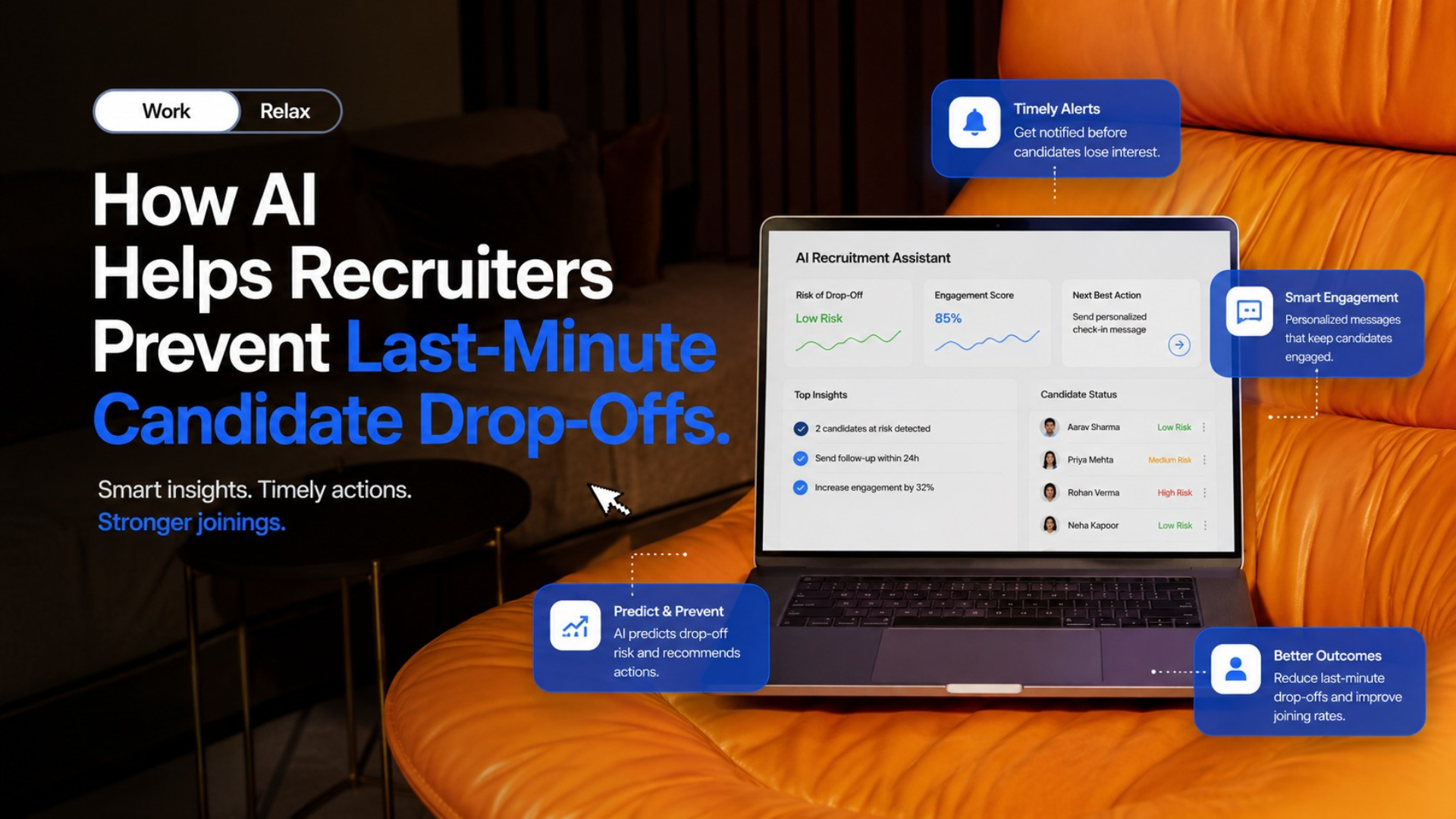
AI detects drop-off risk by analyzing behavioral signals that are invisible to human recruiters. These signals fall into three categories. The first category is communication pattern signals. AI monitors the candidate's response time, response length, tone, and engagement level across every touchpoint: emails, calls, messages, and portal interactions. A candidate who typically responds within two hours but starts taking twenty-four hours is not just busy. They are disengaging. A candidate who shifts from detailed, enthusiastic responses to short, non-committal replies is signaling doubt. A candidate who stops asking questions about the role, the team, or the company is no longer mentally preparing for the transition. These changes are gradual and easy to miss when a recruiter is managing multiple candidates. But AI tracks them quantitatively, comparing each candidate's current behavior against their own baseline and against the behavioral patterns of previous candidates who dropped out. According to LinkedIn’s recruiting resources, candidates who show a measurable decline in communication engagement during the notice period are four times more likely to withdraw before their start date.
The second category is contextual risk signals. AI evaluates the candidate's situation against a database of historical drop-off patterns to identify risk factors that are specific to the candidate's circumstances. A candidate in their notice period who works in a highly competitive talent market is at higher risk than a candidate in a less competitive market. A candidate whose current employer has a known pattern of aggressive counteroffers is at higher risk than one whose employer does not. A candidate who is relocating for the role is at higher risk than one who is not. A candidate who is the primary income earner in their household faces different pressures than one who is not. These contextual factors are not secrets, but they are distributed across multiple systems and data sources that no single recruiter can synthesize in real time. AI can. The third category is process risk signals. AI monitors the hiring process itself for gaps and failures that might push a candidate toward withdrawal. A delayed background check, a missing benefits enrollment form, an unanswered question about the reporting structure, or a scheduling conflict for the pre-boarding session are all process failures that create doubt in the candidate's mind. By conducting continuous hiring process drop-off analysis, AI identifies these process gaps before they cascade into candidate disengagement and alerts the responsible team member to close them immediately.
From Detection to Intervention: AI-Guided Action
Detecting risk is necessary but not sufficient. The value of AI-powered candidate retention lies in its ability to recommend and, in some cases, execute specific interventions tailored to the individual candidate's situation. When the AI identifies a candidate at elevated risk, it does not simply flag the candidate with a red indicator. It provides the recruiter with a contextual recommendation based on the specific signals that triggered the alert. If the risk is driven by declining communication engagement, the recommendation might be to schedule a personal call with the hiring manager to re-engage the candidate around their career growth plans. If the risk is driven by a contextual factor, such as a competitive market or a known counteroffer-prone employer, the recommendation might be to accelerate the onboarding preparation
and bring the candidate in for a team lunch before the start date. If the risk is driven by a process gap, such as a delayed background check or a missing benefits form, the recommendation is to close the gap immediately and proactively communicate the resolution to the candidate.
The most effective intervention is not always the most obvious one. A candidate who is disengaging because they are anxious about the role's expectations does not need more information. They need reassurance from someone they trust, ideally the hiring manager, who can speak to the support structure, the ramp-up plan, and the team's culture of collaboration. A candidate who is disengaging because they received a counteroffer does not need a higher financial offer. They need to be reminded, in specific, personal terms, of why they chose your organization in the first place. As we have explored in our analysis of how many follow-ups one hire actually needs, the timing, channel, and content of each intervention matter enormously. AI optimizes all three by matching the intervention to the candidate's communication preferences, the urgency of the risk level, and the specific nature of the concern. This level of personalization at scale is impossible without AI, and it is the reason that organizations using AI-guided intervention consistently outperform those relying on recruiter intuition alone.
Building a Predictive Drop-Off Prevention System
For organizations that hire at volume, individual risk alerts are not enough. What is needed is a systematic drop-off prevention system that operates across the entire candidate pipeline. The system has four layers. The first layer is data collection. Every candidate interaction, communication, process milestone, and contextual data point is captured and stored in a unified candidate record. This is the foundation. Without comprehensive data, the AI has nothing to analyze. The second layer is risk modeling. The AI builds and continuously refines a predictive model that correlates behavioral, contextual, and process signals with historical drop-off outcomes. The model is not static. It learns from every hiring outcome, improving its accuracy over time. According to Gartner’s HR trends analysis, organizations that deploy predictive hiring models achieve thirty to fifty percent improvement in their offer-to-join rates within twelve months, because the models identify risk factors that human recruiters have never considered.
The third layer is real-time monitoring. The AI continuously evaluates every active candidate's risk level, updating its assessment as new data arrives. A candidate's risk score is not a one-time calculation. It is a living metric that reflects the candidate's current state, not their state at some past point in time. The fourth layer is intervention orchestration. When a candidate's risk score crosses a defined threshold, the system triggers a pre-planned intervention sequence, assigns it to the appropriate stakeholder, and tracks its execution and outcome. This four-layer architecture transforms drop-off prevention from a reactive, recruiter-dependent activity into a proactive, system-driven discipline. It also creates a feedback loop: every intervention and its outcome are fed back into the risk model, making future predictions more accurate. This is what distinguishes an agentic AI recruiting platform from a simple alert system. An agentic platform does not just detect risk. It reasons about the best course of action,
coordinates the response across stakeholders, and learns from the outcome to improve future performance.
The Human-AI Partnership in Candidate Retention
One of the most common objections to AI-driven dropout prevention is the concern that it replaces human judgment. In practice, the opposite is true. AI handles the data processing, pattern recognition, and risk scoring that humans are poor at, freeing recruiters to focus on the human interactions, empathetic conversations, and relationship building that humans excel at. The recruiter's role shifts from monitoring spreadsheets for risk indicators to having high-quality, high-impact conversations with candidates who genuinely need human connection. A risk alert that says "this candidate's response time has increased by four hundred percent and they have not asked a question about the role in twelve days" is far more useful than a recruiter's gut feeling that "something seems off." The AI provides the signal. The recruiter provides the response. As Deloitte’s talent research emphasizes, the most successful AI implementations in recruiting do not reduce the recruiter's role. They elevate it by automating the mechanical aspects of the job and providing the intelligence that makes every human interaction more targeted and effective. As we have explored in our analysis of the difference between AI sourcing and AI recruiting, the most impactful recruiting technology augments the recruiter's judgment rather than replacing it.
Why Huntlo.ai Gives Recruiters Early Warning and Fast Response
Huntlo.ai provides the complete four-layer drop-off prevention system that recruiting teams need to stop losing candidates to preventable withdrawals. The platform captures every candidate interaction in a unified timeline, builds real-time risk scores based on behavioral, contextual, and process signals, and delivers specific, actionable intervention recommendations to the recruiter the moment a candidate's risk level changes. Every recommendation is grounded in the candidate's individual profile: their motivations, their concerns, their communication patterns, and their decision-making context, ensuring that the intervention is always relevant and never generic. Huntlo also ensures that outdated candidate data in AI recruiting tools never undermines risk prediction, because the platform's intelligence is continuously refreshed with every new interaction.
For recruiting teams that are tired of reading withdrawal emails on the day before a start date, Huntlo provides the early warning system and the intervention toolkit to change the outcome. The platform identifies at-risk candidates while there is still time to act, recommends the most effective intervention for each individual situation, and coordinates the response across the entire hiring team. Whether the risk is a counteroffer, a practical blocker, or a silent disengagement, Huntlo ensures that why referrals outperform cold outreach is not about the source of the candidate but about the quality of the experience they receive after they say yes. And for organizations evaluating their options, understanding how to evaluate an AI sourcing tool before buying, means asking whether the platform can predict and prevent the specific failure modes that cost the most money, and last-minute drop-offs are consistently at the top of that
list.
Every candidate who drops out at the last minute represents weeks of wasted effort, thousands of dollars in sunk costs, and a demoralized hiring team. AI cannot eliminate every withdrawal. But it can dramatically reduce the ones that are preventable, and that is the majority of them. The organizations that adopt AI-driven drop-off prevention are not just improving their joining rates. They are fundamentally changing the relationship between their recruiting team and their candidates, from one of uncertainty and anxiety to one of confidence and connection.