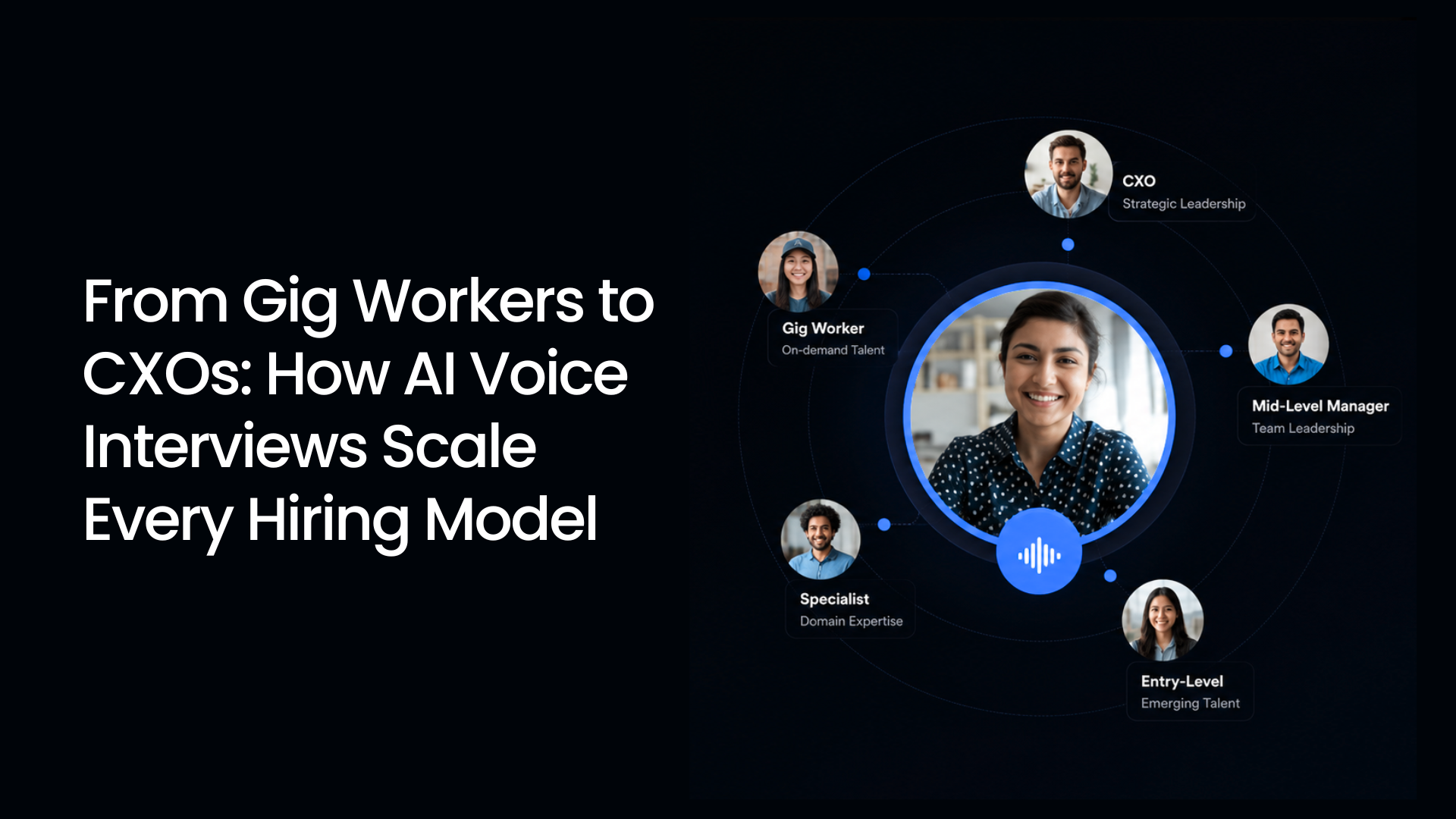
There is a persistent perception that AI voice interviews belong in one specific corner of the hiring world: high-volume, entry-level roles where the sheer number of applicants makes manual screening impractical. Customer service agents, delivery drivers, data entry clerks, warehouse associates. The logic seems sound — these roles have large applicant pools, standardized competency requirements, and tight hiring timelines where speed matters more than nuance. AI voice interviews were built for this, and they perform exceptionally well here. But limiting AI voice interviews to this use case misses the broader story. Across industries and role levels, organizations are discovering that the same technology that screens 500 retail applicants in an afternoon can also streamline the early stages of senior hiring, support contingent workforce management, and bring structure to the chaotic world of gig platform recruiting. The scalability of AI voice interviews is not just about volume. It is about adaptability.
Gig and Contingent: Where Speed and Volume Meet
The gig economy runs on speed. A delivery platform needs to onboard hundreds of drivers in a new city within weeks. A freelance marketplace needs to vet thousands of task-based workers before a seasonal surge. A hospitality staffing firm needs to fill event roles with qualified personnel days before a conference. In each of these scenarios, the bottleneck is not finding candidates — gig platforms have no shortage of applicants — it is verifying that candidates meet basic requirements before they are deployed. Traditional approaches to this problem are either slow or unreliable. Manual phone screens take too long to scale. Self-reported qualification checks are easy to game. Automated skill assessments
test competence but miss communication, reliability, and attitude — the soft dimensions that determine whether a gig worker actually shows up, follows instructions, and represents the platform well.
AI voice interviews solve this by adding a structured, consistent screening layer that evaluates both hard and soft criteria in a single conversation. The AI can verify language proficiency, assess communication clarity, evaluate problem-solving approach through scenario-based questions, and flag candidates whose responses suggest reliability or motivation concerns — all in a five-to-ten-minute conversation that the candidate completes at their convenience. The platform operator receives a scorecard for every candidate, can set automated pass-fail thresholds, and only invests human review time in candidates who meet the bar. According to McKinsey’s workforce research, contingent workforce platforms that have adopted structured screening technologies report 30 to 40 percent improvements in worker quality metrics and significant reductions in early-tenure attrition, because the initial screen catches the candidates who look good on paper but lack the communication and reliability attributes that predict success in gig work.
The operational advantage is equally important. Gig hiring is often managed by small teams or even solo operators who are simultaneously handling worker support, client relationships, and logistics. Asking these teams to conduct phone screens with hundreds of applicants is not a scaling problem — it is an impossibility. AI voice interviews remove this constraint entirely, turning screening from a human-limited operation into a technology-limited one. As the operation grows, the screening capacity grows with it, without adding headcount.
Mid-Level Hiring: Where Consistency Beats Charisma
Mid-level roles — marketing managers, software engineers, operations supervisors, financial analysts — present a different set of screening challenges than gig work. The applicant pools are smaller but still substantial, typically ranging from 30 to 80 candidates per requisition. The competency requirements are more nuanced, combining technical skills with leadership potential, cross-functional collaboration ability, and strategic thinking. The cost of a bad hire is higher, and the evaluation needs to be more thorough. In this context, AI voice interviews deliver a value proposition that is less about raw throughput and more about evaluation quality and fairness.
The core benefit at the mid-level is consistency. When three different recruiters are screening candidates for the same role, each one asks slightly different questions, weights different competencies differently, and brings different biases to the evaluation. One recruiter might be particularly impressed by articulate candidates, another by those with specific industry experience, and a third by candidates who ask good questions during the screen. None of these approaches is wrong, but they are not comparable — and when the hiring manager receives three shortlists curated by three different recruiters, the data is essentially apples and oranges. AI voice interviews eliminate this variability. Every candidate is asked the same questions, evaluated against the same criteria, and scored on the same
dimensions, producing a shortlist that the hiring manager can actually compare. Research from the Society for Industrial and Organizational Psychology has consistently demonstrated that structured, criterion-referenced evaluations — the kind AI voice interviews produce — have significantly higher predictive validity than the unstructured evaluations that characterize most recruiter phone screens.
For organizations hiring across multiple locations or business units, this consistency has a strategic dimension. When the same AI screening framework is used across the entire company, talent acquisition leaders can compare candidate quality across geographies, identify which sourcing channels produce the strongest shortlists, and build a data-driven understanding of what good looks like at each level. This kind of cross-organizational visibility is nearly impossible when screening is conducted by dozens of individual recruiters using their own judgment and their own informal criteria. The distinction between AI sourcing and AI recruiting becomes relevant here — as explored in What’s the Difference Between AI Sourcing and AI Recruiting?, sourcing identifies candidates, but it is the screening layer that determines whether the right candidates advance. When that layer is AI-powered and consistent, the entire downstream hiring process benefits from better data.
Senior and Executive: Where AI Augments Human Judgment
The idea of using AI voice interviews for senior and executive hiring triggers the strongest skepticism, and in some respects, that skepticism is warranted. A CEO or a senior vice president cannot be evaluated through a standardized five-question screening call in the same way a customer service representative can. Executive assessment requires adaptive conversations, strategic depth probes, and the kind of real-time judgment that experienced executive recruiters and hiring consultants provide. No AI voice interview platform currently available can replicate this. But that is not how AI is being used at the senior level — and understanding the actual use case is essential to evaluating its value.
In executive and senior hiring, AI voice interviews serve a preliminary triage function. Executive search firms and internal talent acquisition teams that handle leadership roles often receive 40 to 60 applications or nominations for a single senior position. Many of these candidates are not serious contenders — they may lack the required scope of experience, have misaligned career trajectories, or have applied speculatively without understanding the role’s demands. Conducting a thorough human conversation with every applicant is impractical, particularly when each senior screening call requires 45 to 60 minutes of a highly paid executive recruiter’s time. AI voice interviews provide a way to conduct an initial structured assessment that covers career history, leadership philosophy, strategic thinking approach, and communication style — giving the search team enough data to determine which 8 to 12 candidates deserve a full human-led evaluation. This is not replacing the executive recruiter’s judgment. It is protecting it by ensuring that judgment is applied only to candidates who have already cleared a meaningful threshold.
The compliance dimension is also relevant at the senior level. As executive hiring attracts more regulatory scrutiny — particularly in publicly traded companies where board
diversity requirements, ESG reporting obligations, and anti-discrimination enforcement are intensifying — the structured, documented nature of AI voice interviews provides an audit trail that manual screening does not. Every candidate is asked the same questions. Every response is recorded and scored. The evaluation criteria are explicit, not implicit. This documentation is valuable not only for compliance but for the search team’s own quality assurance, enabling them to review and refine their screening criteria over time. Deloitte’s workforce of the future research has noted that the organizations most advanced in AI-assisted hiring are those using the technology to create institutional knowledge about what predicts success at each level, rather than treating each hire as an isolated decision.
Seasonal and Project-Based: The Hidden Scaling Challenge
Seasonal hiring presents a unique scaling challenge that sits between gig and full-time models. Retailers hiring for the holiday season, tax firms staffing up for filing season, event companies ramping up for a conference season, and agricultural operations preparing for harvest all face the same fundamental problem: a massive, temporary spike in hiring demand that must be met within a narrow window, followed by a return to normal or near-zero hiring activity. The infrastructure built to handle the spike is wasted during the rest of the year. The recruiters hired for the season leave when the season ends. The processes and tools that worked during the surge are abandoned or forgotten by the next cycle. This boom-and-bust pattern makes seasonal hiring one of the most operationally expensive hiring models per hire, and it is where AI voice interviews deliver some of their most straightforward ROI.
The math is simple. If a retailer needs to hire 800 seasonal associates in six weeks, and each phone screen takes 25 minutes, that is 333 hours of recruiter time — roughly eight weeks of full-time work for a single recruiter. Most retailers do not have a dedicated seasonal recruiter sitting idle for ten months of the year, so they either pull existing recruiters off their regular work, hire temporary recruiting support at premium rates, or simply underscreen and accept the quality consequences. AI voice interviews collapse this timeline. The entire applicant pool can be screened in parallel, with candidates completing their interviews around the clock, and recruiters reviewing only the scorecards of candidates who meet the threshold. The same platform that handles the seasonal surge can then be used for regular hiring throughout the year, so the investment is not wasted during the quiet months.
One Platform, Every Hiring Model: Why the Integration Matters
The common thread across all of these hiring models — gig, mid-level, executive, seasonal, and project-based — is that AI voice interviews deliver value not by replacing human judgment but by ensuring that human judgment is applied where it matters most, on candidates who have already demonstrated basic qualifications through a consistent, objective evaluation. But realizing this value across multiple hiring models requires a platform that can handle the operational complexity of each model without requiring separate tools, separate workflows, or separate data systems. When a gig platform uses one AI screening
tool, the mid-level recruiting team uses another, and the executive search function relies on manual processes, the organization loses the cross-model visibility and data consistency that make AI screening strategically valuable in the first place.
This is the problem Huntlo was built to solve. Huntlo’s AI voice interview capability is not a standalone screening tool — it is a stage within a unified hiring operating system that supports sourcing across 50+ platforms, multi-channel outreach, automated scheduling, and recruiter workflow management. A gig operation using Huntlo can configure high-throughput, short-duration AI screens focused on communication and reliability. A mid-level team can configure more detailed competency-based screens with role-specific evaluation criteria. An executive search function can configure preliminary triage screens that capture leadership and strategic thinking indicators. All three hiring models run on the same platform, share the same candidate database, and feed into the same analytics dashboard. The recruiter managing a seasonal surge and the recruiter building a senior leadership pipeline are not using different tools — they are using different configurations of the same tool, each optimized for the hiring model they are operating within.
The practical implication is that organizations no longer need to evaluate, purchase, integrate, and maintain separate technology stacks for different hiring models. The platform that screens gig workers at scale also screens CXO candidates with the right configuration — and the data from both use cases contributes to a single, organization-wide understanding of hiring effectiveness. This is the difference between agentic AI recruiting platforms that adapt to the organization’s needs and the collection of point solutions that, as highlighted in More Tools. Same Hiring Problems., create more complexity than they resolve. AI voice interviews are not just scalable in volume. They are scalable in scope — and the platform that delivers them determines whether that scope translates into actual organizational capability.
Related Topics:
Why Do Some AI Recruiting Tools Have Outdated Candidate Data?
What’s the Best Way to Evaluate an AI Sourcing Tool Before Buying?
Agency Owners Are Solving Different Problems Than Recruiters Think