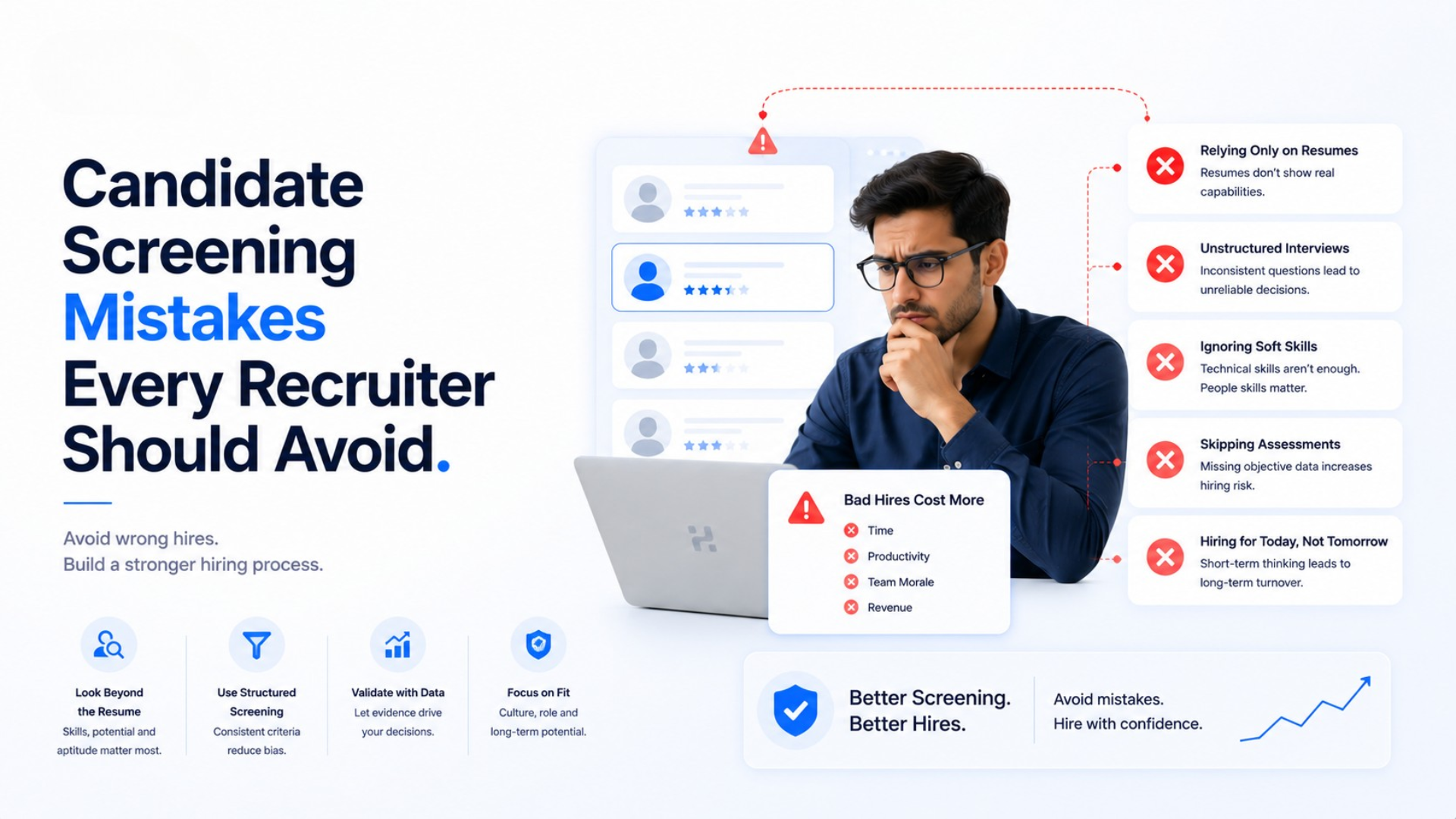
Every recruiter has a story about the one who got away: the candidate who looked perfect on paper, aced the interviews, got the offer, and then turned out to be a mediocre hire. Or, more painfully, the candidate who was rejected at the screening stage and went on to excel at a competitor. These stories are common because the mistakes that produce them are common. They are not rare edge cases or unlucky breaks. They are systematic errors that recur across organizations, industries, and experience levels, and they persist because the recruiting profession has historically lacked a rigorous, evidence-based framework for identifying and correcting them.
This article identifies the seven screening mistakes that cause the most damage to hiring quality, explains the cognitive and structural reasons why each one persists, and provides the specific corrective action that eliminates it. These are not theoretical problems. They are the mistakes that show up in every post-hire retrospective, every quality-of-hire analysis, and every candidate experience survey. The research from industrial-organizational psychology, decision science, and AI evaluation systems gives us a clear understanding of why these mistakes happen and what to do about them. The question is not whether your screening process contains these mistakes. It almost certainly does. The question is whether you will identify and fix them before they cost you the next great hire.
Mistake One: Treating Keywords as Evidence of Capability
The single most damaging screening mistake is also the most common: using keyword matching as a proxy for candidate evaluation. When a recruiter scans a resume for specific terms like “agile methodology” or “stakeholder management” and uses the presence or absence of those terms as a primary screening criterion, they are confusing a label with the thing it labels. The keyword “agile methodology” can appear on the resume of a candidate who has spent five years successfully leading agile transformations, and it can also appear on
the resume of a candidate who attended a two-day workshop and listed it under skills. The keyword is the same. The capability is not. This distinction is obvious when stated explicitly, yet it is the distinction that keyword-based screening systematically erases.
The problem is compounded by the way candidates have learned to optimize for keyword screening. Professional resume writers and career coaches advise candidates to include role-specific keywords in their resumes precisely because they know that most screening processes are keyword-driven. This means that keyword-rich resumes are not a reliable indicator of keyword-relevant capability. They are a reliable indicator that the candidate understands how the screening process works. The candidates who are best at getting past keyword filters are not necessarily the best candidates for the role. They are the candidates who are best at writing resumes that match keyword expectations, which is a different skill entirely.
The fix is to evaluate the substance behind the keyword rather than the keyword itself. What did the candidate actually do with the capability the keyword represents? What was the scale and impact of their work? Can the evidence be verified through public profiles, work samples, or career progression data? An AI screening platform that evaluates candidates on these deeper signals rather than on surface-level keyword matches is applying the correct evaluation method at scale. This is the distinction between an agentic AI recruiting platform that understands what keywords mean in context, and a simple automation tool that checks for their presence. The former produces accurate shortlists. The latter produces the same hiring problems you already have, just faster.
Mistake Two: Letting One Impressive Signal Overshadow Everything Else
The halo effect is one of the most thoroughly documented cognitive biases in psychology, and it is particularly destructive in candidate screening. The halo effect occurs when a single positive characteristic, such as a prestigious employer on the resume, an impressive educational credential, or a well-known brand name, causes the reviewer to form an overall positive impression that colors the evaluation of every other characteristic. A candidate who worked at Google is rated higher on communication skills, leadership potential, and cultural fit, even if the resume contains no evidence to support those ratings. The reviewer does not realize they are doing this. They feel like they are making a careful, objective assessment. But the research shows that the single salient positive signal has already set the anchor, and every subsequent evaluation is pulled toward it.
The opposite pattern, sometimes called the horn effect, works in the reverse direction. A single negative signal, such as a gap in employment, a career transition that looks like a step down, or a degree from a less recognized institution, causes the reviewer to downgrade the candidate on unrelated dimensions. A candidate who took a year off to care for a family member may be rated lower on technical skills, even though the employment gap has no logical connection to technical ability. These effects are not occasional. They are systematic, they operate unconsciously, and they affect every recruiter regardless of experience level. Training can reduce their impact but cannot eliminate them entirely, because they are rooted in
fundamental features of human cognitive architecture.
The most effective fix is to evaluate each criterion independently before forming an overall impression. Structured scoring frameworks, where the reviewer rates the candidate on each criterion separately and does not see the aggregate score until all individual ratings are complete, significantly reduce the halo and horn effects. This is a principle that SHRM recommends for all structured hiring processes, and it is a principle that AI screening platforms implement by design. Because the AI evaluates each signal independently and combines the scores algorithmically rather than impressionistically, the halo effect cannot influence the outcome. Every candidate is assessed on the same dimensions with the same weighting, and no single signal can overwhelm the others. This produces shortlists where the ranking reflects genuine, multi-dimensional candidate quality rather than the distorting influence of one salient signal.
Mistake Three: Using the Same Criteria for Every Role
The third mistake is applying a generic screening checklist to every role, regardless of the specific requirements of the position. Most recruiting teams have a standard set of criteria that they apply to all candidates: years of experience, relevant skills, education level, and perhaps industry background. This approach is administratively simple, but it produces poor screening outcomes because it ignores the reality that different roles require fundamentally different capabilities, and the same credential can indicate very different levels of capability depending on the context. Five years of product management experience at a startup building a consumer app from scratch requires a different set of capabilities than five years of product management at an enterprise company managing a mature product with an established user base. The title and the years are the same. The skills are not.
Generic criteria also fail to distinguish between must-have competencies and nice-to-have qualifications. In a generic screening process, everything is treated as equally important, which means that a candidate who excels on the one competency that is genuinely predictive of success in the role, but lacks a credential that is largely irrelevant, may be rejected in favor of a candidate who meets every checklist item but lacks the critical capability. This is a particularly costly mistake for specialized roles where the must-have competencies are rare and difficult to assess, and it is the reason why so many organizations struggle to hire effectively for niche and technical positions.
The fix is to define role-specific screening criteria before the screening process begins, ideally in collaboration with the hiring manager, identifying two to three genuinely predictive must-have competencies, a set of important-but-not-essential skills, and a list of positive differentiators. These criteria then become the framework for every evaluation decision, ensuring that the screening process is calibrated to the role rather than to a generic template. AI screening platforms that adapt their evaluation criteria to each specific role produce significantly better shortlists than those that apply a one-size-fits-all approach, because the science of predictive validity is clear: criteria that match the role predict performance. Criteria that do not match
the role predict nothing.
Mistake Four: Screening Against Stale Candidate Data
The fourth mistake is making screening decisions based on candidate data that is no longer current. Professionals change jobs, acquire new skills, complete new projects, and earn new credentials on an ongoing basis. A candidate’s LinkedIn profile, GitHub repository, portfolio, or publication record from six months ago may not reflect their current capabilities, particularly in fast-moving fields where the half-life of specific skills can be measured in months rather than years. Screening against stale data means screening against a version of the candidate that may no longer exist, and the resulting evaluation is inaccurate by definition.
This mistake is more common than most recruiters realize, because the tools they rely on for candidate data often have significant latency. ATS databases may contain profiles that are months or years out of date. Sourcing tools may cache candidate data at the point of initial extraction and not refresh it. Even LinkedIn profiles, which are generally the most current public data source, can be weeks or months out of date for candidates who are not actively maintaining them. The screening decision is only as good as the data it is based on, and data that was current when it was first collected but is no longer current when it is used for evaluation introduces a systematic error into the screening process.
As we have examined in our analysis of why some AI recruiting tools have outdated candidate data, the freshness of candidate data is not a nice-to-have feature. It is a prerequisite for accurate screening. The fix is to ensure that candidate data is refreshed at the point of evaluation, not at the point of collection. Platforms that enrich candidate profiles in real time, verifying and updating information before the screening assessment is performed, produce evaluations based on the most current available data. This is a non-negotiable requirement for any team that wants to make accurate screening decisions, and it is a capability that distinguishes serious AI screening platforms from those that produce more tools and the same hiring problems. If your screening tool cannot deliver current data, it cannot deliver accurate screening.
Mistake Five: Evaluating Candidates in a Vacuum Without Comparison
The fifth mistake is evaluating each candidate in isolation, without a systematic mechanism for comparing candidates against each other. In most screening processes, each candidate is reviewed individually, assigned a qualitative rating like “strong” or “maybe,” and then the recruiter assembles a shortlist from the candidates who received the highest ratings. The problem with this approach is that the qualitative ratings are not calibrated across candidates. The “strong” rating assigned to the first candidate reviewed on Monday morning may mean something very different from the “strong” rating assigned to the fiftieth candidate reviewed on Friday afternoon, because the reviewer’s internal standard drifts over the course of the screening process due to decision fatigue, context effects, and the implicit recalibration that occurs as the reviewer sees more candidates.
This lack of calibration means that the shortlist is not a ranked ordering of the best
candidates. It is a collection of individually positive assessments that were made using different implicit standards at different points in time. The candidate who was the fifteenth reviewed might have been rated “maybe” on Monday but “strong” on Friday, simply because the reviewer’s standard shifted after seeing a run of weaker candidates. This is not a minor source of error. It is a major source of random variation in screening outcomes, and it disproportionately affects the candidates in the middle of the review queue, who are the largest group.
The fix is to use a structured, quantitative scoring framework that applies the same numerical scale to every candidate, producing scores that are directly comparable regardless of when the evaluation was performed. AI screening platforms do this inherently, because they apply the same algorithm to every candidate and produce a numerical score that is consistent across the entire candidate pool. When you are evaluating an AI sourcing or screening tool, one of the most important questions to ask is whether it produces calibrated, comparable scores across all candidates. A system that gives each candidate a number on the same scale eliminates the drift and inconsistency that plague qualitative, isolated reviews. The result is a shortlist where the ranking actually reflects relative candidate quality, not the order in which candidates happened to be reviewed.
Mistake Six: Ignoring the Candidate’s Trajectory for Their Current State
The sixth mistake is evaluating candidates based on where they are right now without considering how they got there and where they are heading. A resume is a snapshot of a candidate’s current state: their current title, their current employer, their current skills. But the current state is only part of the picture. A candidate who has progressed from junior developer to team lead to engineering manager in five years demonstrates a trajectory of rapid growth and increasing responsibility that is at least as informative as their current title. A candidate who has held the same senior title for seven years at the same company may have deep domain expertise, or they may have plateaued. The current state alone cannot distinguish between these two very different profiles.
Career trajectory is one of the most underutilized signals in candidate screening, and it is one of the most predictive. Research on talent assessment consistently shows that the rate and pattern of a candidate’s career progression is a stronger predictor of future performance than their current credential level. A candidate who is accelerating, taking on progressively more complex challenges, and demonstrating the ability to learn and adapt quickly, is more likely to continue growing and contributing at a high level than a candidate who has reached a plateau, regardless of how impressive the current plateau looks on paper. The trajectory signal is particularly important for organizations that are hiring for growth roles, where the ability to take on new challenges and expand capabilities is more valuable than existing expertise in a narrow domain.
AI screening platforms that analyze career trajectory as a distinct evaluation signal, rather than just looking at current credentials, produce significantly more accurate shortlists for
roles where growth potential matters. This is one of the capabilities that distinguishes AI sourcing from AI recruiting, because sourcing is about finding candidates who match current criteria, while recruiting is about identifying candidates whose trajectory and potential align with the organization’s future needs. A screening process that only evaluates the present cannot identify the candidates who will be the best performers in the future.
Mistake Seven: Not Learning From Screening Outcomes
The seventh and most systemic mistake is treating the screening process as a one-way filter that produces shortlists but never learns from the results of those shortlists. In most organizations, the screening process runs, candidates are selected, offers are made, hires are made, and then the process starts over for the next role with no systematic connection between the outcomes of the previous cycle and the criteria for the next one. The screening criteria that were used to evaluate the last batch of candidates are the same criteria that will be used to evaluate the next batch, regardless of whether those criteria actually predicted the performance of the hires who resulted from them.
This failure to learn is costly because it means that screening accuracy never improves. If a particular criterion turns out to have low predictive validity in practice, a learning system would reduce its weighting. If a signal that was not being evaluated turns out to be strongly correlated with performance, a learning system would add it. But a static, set-and-forget screening process does neither. It applies the same criteria with the same weighting indefinitely, accumulating no knowledge from its outcomes and making no improvements over time. This is not just a missed opportunity for improvement. It is an active barrier to improvement, because the organization has no mechanism for identifying which aspects of its screening process are working and which are not.
According to McKinsey’s research on data-driven hiring, organizations that close the feedback loop between screening outcomes and screening criteria see continuous improvements in quality-of-hire that compound over time. The AI screening platforms that can track the correlation between screening scores and downstream performance data, and adjust their weighting accordingly, are the ones that get better with every hiring cycle rather than stagnating. This is also the clearest answer to the question of whether recruiters should worry about AI replacing their jobs: the AI that replaces the recruiter is the AI that can learn from outcomes. The AI that augments the recruiter is the AI that learns from outcomes and makes those learnings available to the recruiter as actionable insights. The latter is what Huntlo does.
How Huntlo Helps Recruiters Avoid All Seven Mistakes
Huntlo was built specifically to eliminate the screening mistakes described in this article. The platform evaluates candidates on the substance of their capabilities rather than on keyword matches. It applies structured, role-specific scoring criteria that eliminate the halo effect and ensure every candidate is assessed on the same dimensions. It refreshes candidate data in real time at the point of evaluation, ensuring that every screening decision is based on the most
current available information. It produces calibrated, comparable scores across the entire candidate pool, enabling accurate ranking regardless of review order. It analyzes career trajectory as a distinct evaluation signal, identifying candidates whose growth potential aligns with the role. And it continuously improves its screening accuracy by learning from the connection between screening scores and downstream hiring outcomes.
The practical result is a screening process where the seven most damaging mistakes are structurally impossible, not just discouraged by training and guidelines. Recruiters using Huntlo do not need to consciously resist the halo effect, because the platform does not have one. They do not need to remember to refresh candidate data, because the platform does it automatically. They do not need to calibrate their ratings across candidates, because the platform produces calibrated scores by design. According to LinkedIn’s talent solutions research, recruiting teams that adopt AI-native screening platforms report not just faster screening but significant improvements in quality-of-hire, because the systematic errors that manual screening introduces are eliminated at the structural level. The best time to fix a screening mistake is before it costs you a great candidate. Huntlo ensures that the most common mistakes never happen in the first place.