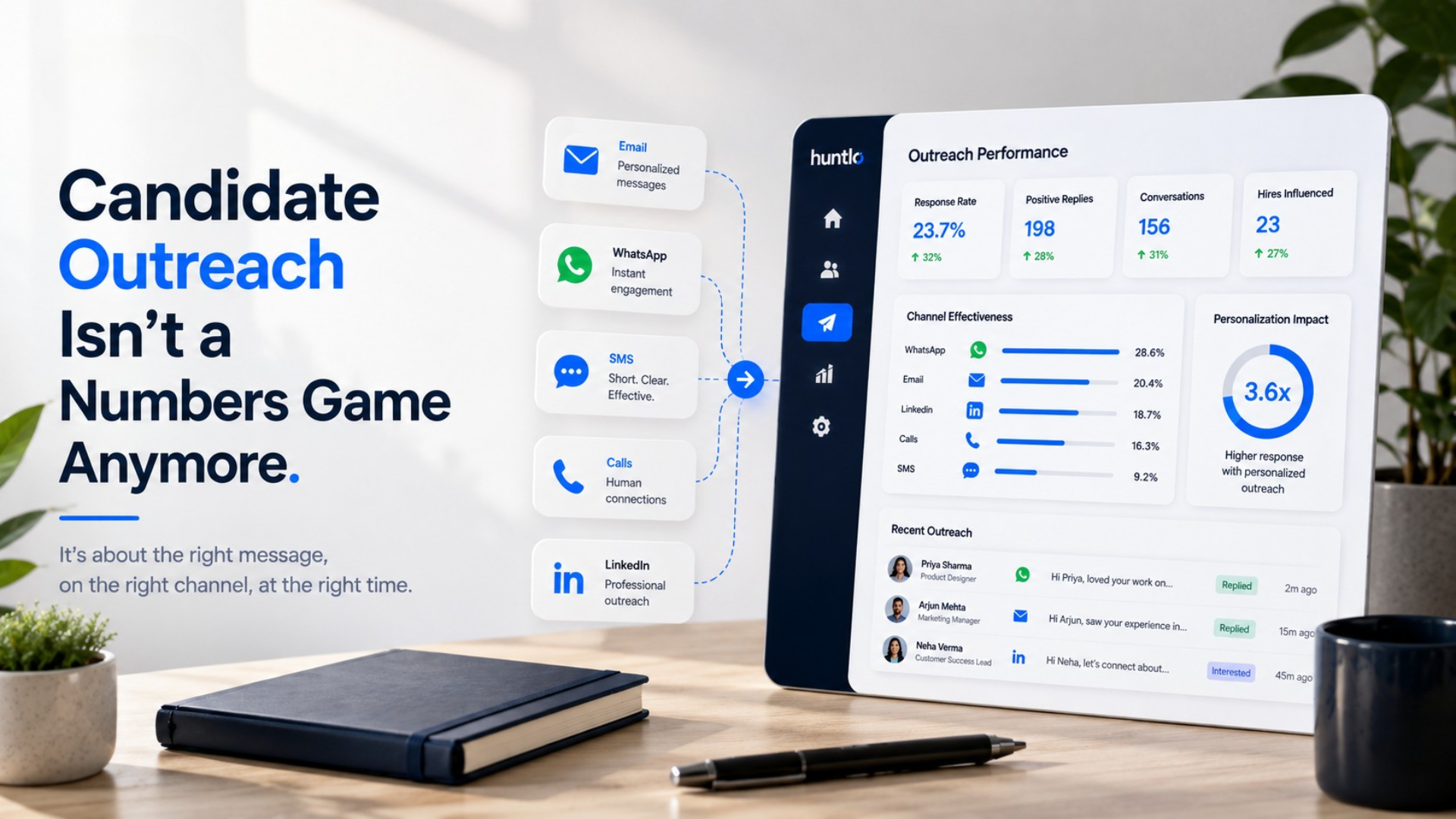
The most common question recruitment leaders ask about their outreach programs is also the most misleading one: how many messages are we sending? It is misleading because it frames outreach as a volume problem when it is fundamentally a quality and strategy problem. For most of the past decade, volume was a reasonable proxy for effort, and effort was a reasonable proxy for results. If a recruiter was sending two hundred messages per week, they were likely producing more conversations, more interviews, and more hires than a recruiter sending fifty. The relationship was imperfect but directionally consistent, and it gave recruitment leaders a simple, visible metric to track and optimize. That relationship has broken down. The teams that send the most messages in 2026 are often the teams that get the worst results. They generate more candidate fatigue, more negative brand associations, and more wasted recruiter hours than teams that send fewer, better-targeted messages. The old math of outreach — more messages equals more responses equals more hires — no longer holds, and the organizations that continue to operate by it are falling behind the ones that have moved to a fundamentally different model.
How the Volume Model Worked — And Why It Stopped
The volume model of candidate outreach emerged from a specific set of conditions that no longer exist. In the early 2010s, candidate email inboxes were less crowded, LinkedIn InMail was a relatively novel and attention-worthy channel, and the supply of qualified candidates on professional platforms was growing faster than the demand from recruiters. In that environment, a recruiter who could identify a large pool of
keyword-matching candidates and send them all a reasonably relevant message could expect a steady trickle of responses that converted into a manageable pipeline of conversations. The process was simple, scalable, and measurable. Recruitment leaders could track messages sent, response rates, and downstream conversions, and they could optimize each stage by increasing volume, refining keywords, or tweaking templates. The entire system was built around the assumption that the limiting factor was recruiter capacity — how many messages a recruiter could send in a day — and that technology should focus on removing that capacity constraint.
Technology delivered on that promise. Sourcing tools made it faster to find candidates. Outreach tools made it faster to send messages. Automation platforms made it faster to execute follow-ups. Each innovation increased the volume of messages a recruiter could produce, and for a period, the results scaled accordingly. But every increase in message volume also increased the noise level in candidate inboxes and messaging folders, and at some point — different for different candidate segments, but real and measurable for all of them — the noise exceeded the candidates’ willingness to tolerate it. Candidates developed faster filtering behaviors. Response rates declined. Recruitment teams responded to declining response rates by increasing volume, which further increased noise, which further accelerated the decline. The system entered a feedback loop where the cure was making the disease worse. According to LinkedIn’s talent solutions trend data, the total volume of recruiting InMails sent has increased by more than sixty percent over the past five years while average response rates have declined by approximately forty percent over the same period. The ratio of messages sent to responses received has deteriorated dramatically, and the trend shows no sign of reversing. The volume model has not just stopped working. It has started actively working against the teams that rely on it.
The Hidden Costs of Volume-First Outreach
The most visible cost of volume-first outreach is the low response rate. But response rates are only the surface-level symptom. The deeper costs are less visible, more persistent, and far more damaging to the recruitment function’s long-term effectiveness. The first hidden cost is employer brand erosion. Every generic, poorly targeted, irrelevant message that a recruiter sends to a candidate is a negative brand impression. The candidate may not respond, but they remember the company name, and they associate it with the experience of receiving unwanted, low-quality communication. Over time, these negative impressions accumulate. The company develops a reputation among candidates as a spammy, inconsiderate employer that does not respect people’s time. This reputation makes it progressively harder to recruit, because candidates who have had negative experiences with a company’s outreach are significantly less likely to respond to future messages from that company, even when those messages are better-targeted and more relevant. The damage compounds: each wave of volume-first outreach makes the next wave less effective, because the candidate population has been pre-conditioned to associate the company with low-quality communication.
The second hidden cost is recruiter burnout and quality degradation. Sending large
volumes of generic messages is not intellectually stimulating work. It is repetitive, mechanical, and divorced from the aspects of recruiting that most recruiters find rewarding: building relationships, understanding candidate motivations, making matches that create value for both the candidate and the organization. Recruiters who spend the majority of their time on volume-based outreach activities report lower job satisfaction, higher turnover, and lower engagement with strategic aspects of their role. The quality of their work degrades not because they are bad recruiters but because the system they operate in channels their time and energy toward low-value activities. The third hidden cost is the opportunity cost of all the strategic work that does not get done because the recruiter is occupied with volume metrics. When a recruiter is measured on messages sent and response rates, they optimize for messages sent and response rates. They do not invest time in understanding hiring manager needs more deeply, building relationships with passive candidates who might be future hires, or developing the sourcing strategies that would produce better candidates in the first place. As McKinsey’s organizational talent research has documented, the recruitment teams that produce the best hiring outcomes are not the ones that send the most messages. They are the ones that invest the highest proportion of their time in strategic activities like role scoping, candidate research, hiring manager advisory, and pipeline development — activities that produce no immediate volume metrics but generate significantly better hiring outcomes over time.
What Replaces the Numbers Game: The Quality-First Model
The alternative to volume-first outreach is not low-volume outreach. It is quality-first outreach, where the primary objective is not to reach as many candidates as possible but to create as many high-quality conversations as possible. The distinction is subtle but transformative. A quality-first recruiter might send fifty messages in a week and produce ten substantive conversations. A volume-first recruiter might send five hundred messages and produce eight. The quality-first recruiter sent one-tenth the volume and produced twenty-five percent more conversations, because each message was targeted at a candidate who had a genuine reason to be interested, written in a way that demonstrated understanding of that candidate’s specific situation, and delivered through a channel where the candidate was likely to be receptive. The quality-first approach does not measure success by messages sent. It measures success by qualified conversations created — conversations where the candidate is genuinely engaged, the role is a plausible fit, and the interaction has a realistic probability of leading to a hire.
The operational requirements of quality-first outreach are different from volume-first outreach in several important ways. First, it requires better targeting. Rather than casting a wide net and hoping for the best, quality-first outreach invests significant effort in pre-qualifying candidates before the first message is sent. This means analyzing career trajectories, checking for signals of openness, evaluating genuine fit beyond keyword matching, and filtering out candidates whose current situation makes them unlikely to be receptive regardless of how good the opportunity is. The result is a smaller but much higher-quality candidate list, which means fewer messages need to be sent and each message can receive
more attention and personalization. Second, quality-first outreach requires better messaging. Each message is crafted to demonstrate genuine understanding of the candidate’s work, to offer something specific and valuable, and to create a reason for the candidate to engage that goes beyond “we have a job opening.” This level of message quality is impossible to achieve at scale through manual effort alone, which is why the most effective quality-first outreach programs use AI to generate personalized messages that are grounded in the candidate’s specific profile and context. Third, quality-first outreach requires better measurement. The metrics that matter are not messages sent and open rates but qualified response rate, conversation-to-interview conversion, and downstream quality of hire. These are harder to measure than volume metrics, but they are the metrics that actually predict hiring success. As discussed in What Makes an AI Recruiting Platform Agentic vs. Just Automated?, the shift from task-based metrics to outcome-based metrics is one of the defining characteristics of mature AI-driven recruiting operations, because it reflects a focus on what the organization is actually trying to achieve rather than how busy the recruiting team appears to be.
The Data Quality Foundation: Why Quality Outreach Requires Quality Data
One of the most underappreciated enablers of quality-first outreach is candidate data quality. A recruiter cannot send a high-quality, personalized message to a candidate if the data they have about that candidate is outdated, incomplete, or inaccurate. A message that references a project the candidate left two years ago, a role they no longer hold, or a skill they have moved away from is not personalized — it is wrong. And wrong personalization is worse than no personalization, because it signals to the candidate that the sender did not actually do their research and is simply automating a veneer of personalization over a generic approach. The quality-first model demands a data foundation that the volume-first model never required, because volume-first outreach could tolerate imperfect data. When you are sending a generic message to a large list, it does not matter much if some of the data is wrong, because the message does not reference specific data points. But when your entire approach is built around demonstrating understanding of each candidate’s specific situation, every data point you reference must be accurate and current.
This is why the quality of the candidate data that feeds the outreach process is not a secondary concern but a primary strategic capability. Organizations with the most effective outreach programs invest in sourcing tools and data infrastructure that provide real-time, multi-source candidate profiles rather than static snapshots from a single platform. They understand that candidate data degrades quickly — people change roles, learn new skills, take on new responsibilities, and shift their career interests on a timescale of months, not years. A candidate profile that was accurate six months ago may be significantly outdated today, and a message based on that outdated profile will miss the mark. As explored in Why Do Some AI Recruiting Tools Have Outdated Candidate Data?, the tools that recruitment organizations rely on for candidate data vary dramatically in their ability to provide fresh, accurate, and comprehensive profiles, and the quality of the outreach that flows
from those tools is directly proportional to the quality of the data they provide. A quality-first outreach strategy built on stale data is a quality-first strategy in name only.
From Activity Metrics to Outcome Metrics: Redefining Recruiter Performance
Perhaps the most significant barrier to the transition from volume-first to quality-first outreach is not technology or data but organizational measurement and incentive structures. Most recruitment organizations measure recruiter performance using activity metrics: messages sent, calls made, candidates sourced, response rates generated. These metrics are easy to track, easy to compare across recruiters, and easy to report to leadership. They are also the metrics that incentivize volume-first behavior. A recruiter who is measured on messages sent will send more messages. A recruiter who is measured on qualified conversations created will invest more time in targeting and personalization and may send fewer messages as a result. The metric drives the behavior, and the current metrics in most organizations drive the wrong behavior. Changing the metrics is a leadership decision, not a technology decision, but technology can help by making outcome metrics easier to track and more visible. A platform that can track the full journey from first touch to qualified conversation to interview to hire — with clear attribution of which outreach activities contributed to each outcome — makes it possible to measure recruiter performance on the metrics that actually matter.
The transition from activity metrics to outcome metrics is not without risk. Activity metrics provide a real-time signal of recruiter effort, which is useful for identifying underperformance and ensuring accountability. Outcome metrics are lagging indicators: the full impact of today’s outreach may not be visible for weeks or months, because the candidate journey from first touch to hire involves multiple stages and extended timelines. The practical solution is not to abandon activity metrics entirely but to reweight them relative to outcome metrics, progressively shifting the balance toward outcomes as the organization’s data infrastructure and tracking capabilities mature. In the early stages of the transition, activity metrics can serve as a proxy for effort while outcome metrics are being developed. In the mature stage, outcome metrics should be the primary measure of recruiter performance, with activity metrics used as diagnostic tools rather than performance targets. Gallup’s workforce analytics research has found that recruitment teams that have successfully transitioned to outcome-based performance measurement report higher recruiter satisfaction, lower turnover, and significantly better hiring outcomes than teams that remain on activity-based measurement, because the new metrics align recruiter incentives with organizational goals rather than rewarding behavior that produces visible activity but limited results.
Huntlo: Quality at Scale Through Intelligent Orchestration
The case for quality-first outreach is compelling, but the practical challenge has always been scaling it. A recruiter can deliver quality outreach to ten or twenty candidates per week through manual effort. Delivering quality outreach to two hundred or five hundred candidates per week — the volumes that modern hiring demands — requires
system-level capabilities that manual processes cannot provide. This is the specific problem that Huntlo was built to solve. Huntlo’s AI sourcing engine does not just find candidates who match keyword criteria. It evaluates candidates across more than fifty platforms for genuine role fit, career trajectory alignment, and signals of openness, producing a shorter but higher-quality candidate list that is the foundation of quality-first outreach. Its AI-generated outreach messages are not template variations. They are contextually unique messages grounded in the specific details of each candidate’s professional profile, providing the kind of genuine personalization that quality-first outreach demands. Its multi-channel delivery ensures that each message reaches the candidate through the channel where they are most likely to be receptive, which maximizes the probability of engagement for every message sent. And its automated follow-up sequences execute multi-touch campaigns with differentiated content at each stage, maintaining the persistence and progressive engagement that converts initial interest into substantive conversations.
What makes Huntlo particularly effective for quality-first outreach is its ability to apply quality principles at a scale that would be impossible through manual effort. Every candidate in the pipeline receives the same level of research, analysis, and personalized attention that a skilled recruiter would give to their top five candidates. The difference is that Huntlo does this for every candidate, not just a select few, because the AI handles the research and message generation that a human recruiter could only do for a handful of people per day. This is not about replacing the recruiter’s judgment. It is about amplifying it, ensuring that the recruiter’s strategic insights about what makes a good candidate and what makes a compelling outreach message are applied consistently across the entire pipeline rather than being diluted across a volume-first process. Before adopting any outreach platform, recruitment leaders should evaluate whether the tool is designed to enable quality at scale or simply to increase volume. The practical evaluation framework in What’s the Best Way to Evaluate an AI Sourcing Tool Before Buying? provides a structured approach to this assessment, with specific criteria for distinguishing platforms that enable quality-first outreach from those that simply automate the volume-first model. The distinction matters because the volume-first model is not going to recover. The response rates will continue to decline, the candidate fatigue will continue to grow, and the organizations that keep playing the numbers game will find that the numbers are working increasingly against them.
The recruiting industry is at an inflection point in how it approaches candidate outreach. The volume-first model served a purpose in an era when candidate attention was abundant and recruiter tools were limited. That era is over. Candidates are more selective, more saturated, and more skilled at filtering noise than ever before, and the tools available to recruiters are now sophisticated enough to enable a fundamentally different approach. The organizations that recognize this shift and move decisively to a quality-first model — backed by the right data, the right technology, and the right metrics — will build a sustainable competitive advantage in talent acquisition. The ones that keep sending more messages and hoping for better results will find that hope is not a strategy. Quality is.
Related Topics:
Agency Owners Are Solving Different Problems Than Recruiters Think
The ATS Mistake Companies Keep Repeating
What’s the Difference Between AI Sourcing and AI Recruiting?