Every recruiting technology vendor in the last fifteen years has promised to revolutionize candidate screening. ATS platforms introduced keyword-based resume filtering and called it intelligent matching. Job boards developed algorithmic recommendations and called them AI-powered. Sourcing tools built Boolean search interfaces and called them precision targeting. Each generation of technology made screening faster and more automated, but none of them fundamentally changed what screening evaluated. They all operated on the same underlying signal: the keywords, credentials, and surface-level markers that appear on a candidate’s resume. The processing got faster. The evaluation did not get smarter.
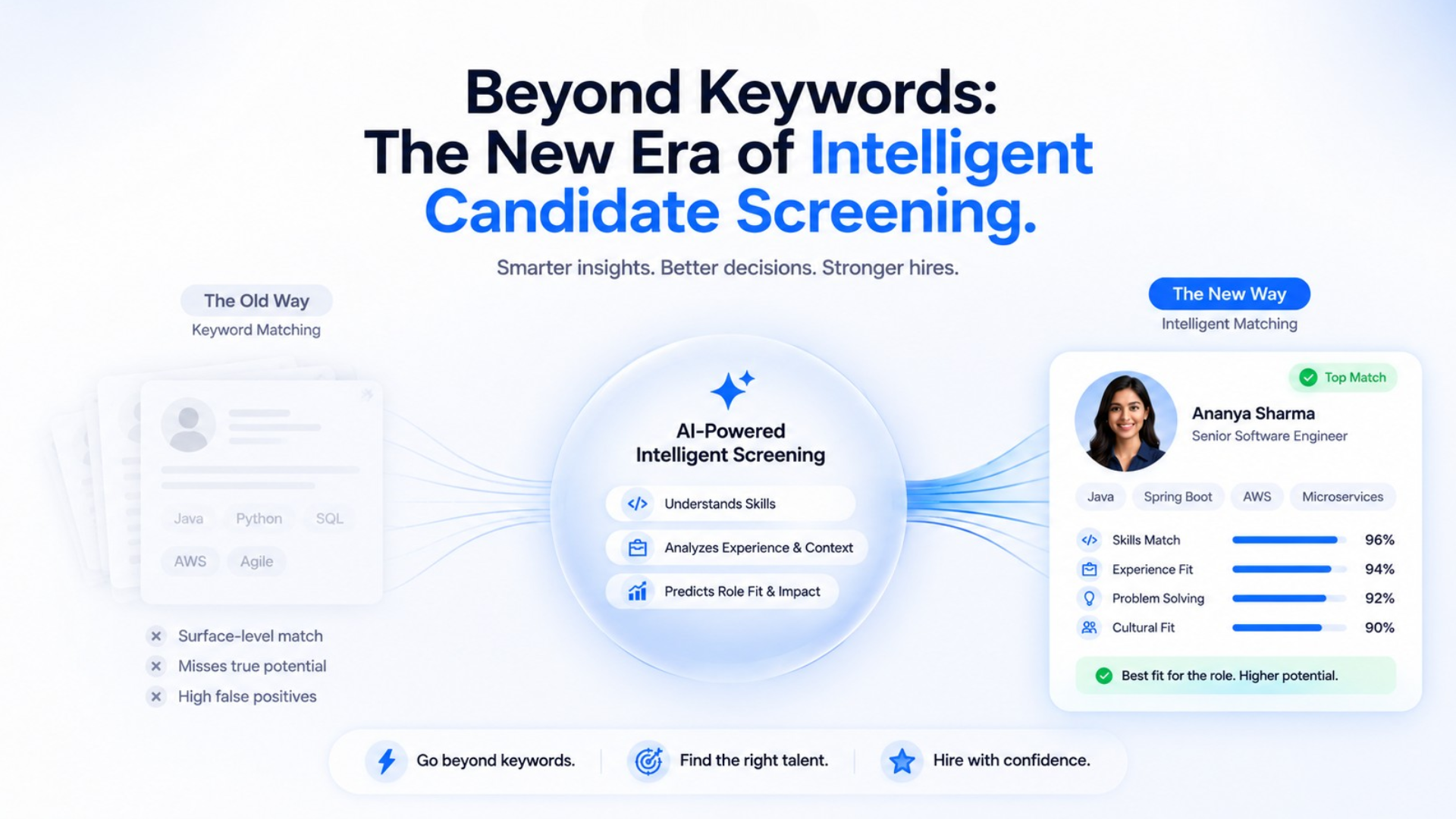
We are now at the point where that is changing. A new generation of AI screening platforms is emerging that evaluates candidates on fundamentally different signals than keyword matching. Instead of asking whether the candidate’s resume contains the right words, these platforms ask whether the candidate has demonstrated the right capabilities. Instead of scanning for job titles and employer names, they analyze career trajectories and evidence of impact. Instead of treating every candidate as a bag of keywords to be compared against a job description, they build a multi-dimensional assessment of each candidate’s actual suitability for the role. This article explains what this new era of intelligent screening looks like, why it produces dramatically better shortlists than keyword-based methods, and how recruiting teams can make the transition. The organizations that move first will gain a structural advantage in the competition for talent. The ones that continue screening by keyword will find that their best candidates are being identified and hired by competitors who have moved beyond keywords entirely.
Why Keywords Were Never a Screening Strategy
Keyword matching was never designed to be a screening methodology. It was a technical
convenience that emerged when digital resumes made text-based search possible, and it persisted because it was the only scalable option available. When a recruiter searches for “Python” and “machine learning” in a resume database, they are not performing a skills assessment. They are performing a text search that may or may not correlate with the candidate’s actual ability to do machine learning work in Python. The correlation is weak because the presence of a keyword on a resume tells you nothing about the depth of the candidate’s expertise, the context in which they applied the skill, or the quality of the outcomes they produced.
The weaknesses of keyword matching are compounded by the fact that candidates have learned to optimize for it. Professional resume writers, career coaches, and AI-powered resume builders all advise candidates to include relevant keywords in their resumes precisely because they know that most screening processes are keyword-driven. This means that the keyword-rich resumes that rise to the top of a keyword-based screening process are not necessarily the resumes of the most capable candidates. They are the resumes of the candidates who are best at writing resumes that match keyword expectations. The signal has been gamed, and the screening process that relies on it is selecting for resume-writing skill rather than job-relevant capability.
The result is a screening process that looks productive, because it processes large volumes of candidates and produces a shortlist, but that produces shortlists with weak predictive validity. The candidates who advance to the interview stage may or may not be the strongest performers. The screening process cannot distinguish between them, because it is not evaluating the signals that predict performance. It is evaluating the signals that predict keyword density. This is the dynamic that produces the frustration so many recruiting teams experience: large volumes of candidates, sophisticated technology, and hiring outcomes that do not improve. It is also the dynamic that leads to the accumulation of more tools and the same hiring problems, because each new tool applies the same flawed evaluation logic at higher speed. The solution is not better keyword matching. It is a fundamentally different approach to candidate evaluation.
What Intelligent Screening Evaluates Instead of Keywords
Intelligent screening replaces keyword matching with a multi-dimensional evaluation of each candidate’s demonstrated capabilities. The first dimension is evidence of impact. Instead of checking whether the candidate claims to have a skill, intelligent screening looks for evidence of what the candidate accomplished using that skill. A candidate who claims proficiency in data pipeline optimization is evaluated on whether they can demonstrate that they actually optimized a pipeline: what was the scale, what was the performance improvement, and can the evidence be verified through public profiles, work samples, or career progression data? This evidence-based approach produces a fundamentally different assessment than keyword matching, because it evaluates the quality and context of the candidate’s capability rather than just its claimed existence.
The second dimension is career trajectory. Intelligent screening analyzes the pattern and rate of a candidate’s career progression, identifying signals that keyword matching cannot detect. A candidate who progressed from junior analyst to senior data scientist in four years demonstrates a trajectory of rapid capability growth that is highly relevant for roles requiring adaptability and learning velocity. A candidate who has held the same title for seven years may have deep domain expertise, or they may have plateaued. The resume alone cannot distinguish between these two profiles, but an analysis of career trajectory, responsibility growth, and the nature of role transitions can. This trajectory signal is one of the strongest predictors of future performance, and it is entirely invisible to keyword-based screening.
The third dimension is domain-specific depth. For specialized roles, intelligent screening evaluates the candidate’s expertise in the specific domain the role requires, not just whether they have the right keywords on their resume. This is especially critical for niche and technical roles, where the difference between a candidate who has used a technology in production and a candidate who has completed a tutorial in that technology is the difference between a strong hire and a failed one. Intelligent screening evaluates the depth and recency of the candidate’s domain expertise, drawing on multiple data sources to build a richer picture than any single document can provide. According to Gartner’s HR technology research, the AI screening platforms that evaluate candidates on these deeper dimensions produce shortlists with 35% to 50% higher interview-to-offer conversion rates than keyword-based systems, because the candidates being presented have been evaluated on signals that actually predict job performance.
How AI Makes Intelligent Screening Possible at Scale
The reason keyword matching has persisted for so long, despite its known limitations, is that the alternative, evaluating candidates on demonstrated capability, evidence of impact, career trajectory, and domain-specific depth, requires processing multiple data sources per candidate and making nuanced assessments that go far beyond text matching. For a human recruiter reviewing ten candidates, this kind of deep evaluation is feasible. For a recruiter reviewing five hundred candidates for a single role, it is impossible. The recruiter does not have the time, and even if they did, the decision fatigue research shows that the quality of their evaluations would degrade well before they reached the end of the pile.
AI eliminates this constraint by performing the deep, multi-signal evaluation that intelligent screening requires, but doing it in seconds per candidate rather than hours. An AI platform can examine a candidate’s resume, professional profile, work history, and domain-specific evidence simultaneously, assessing the depth of their capabilities and the quality of their evidence against role-specific criteria. It can evaluate five hundred candidates with the same level of thoroughness that a human recruiter would apply to ten, and it can do so without the degradation in accuracy that decision fatigue introduces. The data freshness of the evaluation is equally critical. As we have examined in our analysis of why some AI recruiting tools have outdated candidate data, an intelligent screening system must evaluate candidates based on their current state, not their state from the last time their profile was updated. Real-time data
enrichment ensures that the multi-signal assessment reflects who the candidate is today. According to McKinsey’s talent management research, the AI screening platforms that combine deep multi-signal evaluation with real-time data enrichment are the ones delivering the most significant quality-of-hire improvements.
The Recruiter’s Role in Intelligent Screening
Intelligent screening does not eliminate the recruiter. It changes what the recruiter does and when they do it. In a keyword-based screening process, the recruiter spends the majority of their time on the highest-volume, lowest-nuance task in the hiring funnel: scanning resumes for keyword matches and making binary advance-or-reject decisions. In an intelligent screening process, this task is handled by the AI, and the recruiter’s time is reallocated to the tasks where human judgment creates the most value: validating the AI’s shortlist, assessing the nuances of the top candidates, conducting the second-tier evaluation that the AI cannot perform, and building the relationships with candidates that determine whether the best ones accept the offer.
This reallocation is not a reduction in the recruiter’s role. It is an elevation of it. The recruiter who spends their time evaluating the ten best candidates rather than scanning five hundred resumes makes better hiring decisions and delivers more value to the organization. This is the distinction between an agentic AI recruiting platform that amplifies the recruiter’s expertise and an automated tool that merely replaces one form of manual work with another. According to SHRM’s guidance on AI in talent acquisition, the recruiting teams that adopt this model report higher job satisfaction, lower burnout, and better hiring outcomes than teams that continue to perform manual screening. The recruiter’s role in intelligent screening is not smaller. It is more impactful, because it is focused entirely on the decisions where human judgment makes a measurable difference.
Making the Transition: From Keywords to Intelligence
The transition from keyword-based to intelligent screening does not require abandoning your existing technology stack overnight. It requires selecting the right AI screening platform and deploying it alongside your existing process, comparing the quality of the shortlists it produces with the quality of the shortlists your current process produces. In most organizations, the intelligent screening shortlists outperform the keyword-based shortlists on every quality metric: higher interview-to-offer conversion, stronger new-hire performance ratings, and lower early-tenure turnover. These outcome differences build organizational confidence in the new approach and create momentum for broader adoption.
The critical factor in the transition is selecting a platform that performs genuinely intelligent evaluation, not just faster keyword matching. The evaluation criteria are straightforward. Does the platform assess candidates on demonstrated capability and evidence of impact, or does it check for keyword presence? Does it analyze career trajectory and domain-specific depth, or does it match job titles and years of experience? Does it refresh candidate data in
real time, or does it rely on cached profiles? These questions are the basis for evaluating an AI screening tool before buying, and they distinguish the platforms that will define the next era of recruitment from the ones that will automate the current era into obsolescence. According to LinkedIn’s talent solutions research, the recruiting teams that complete the transition to intelligent screening within the next two years will gain a compounding advantage, because their platforms will improve with every hiring cycle while their competitors continue to screen by keyword.
How Huntlo Delivers Intelligent Screening Today
Huntlo is built to operate beyond keywords. Every candidate evaluation assesses demonstrated capability, evidence of impact, career trajectory, and domain-specific depth, drawing on multiple data signals with real-time enrichment. It applies role-specific criteria calibrated to the requirements of each position, producing assessments tailored to what the role demands. It produces consistent, calibrated scores across the entire candidate pool, enabling accurate ranking regardless of size. And its outcome feedback loop continuously improves screening accuracy by connecting evaluations to downstream hiring performance. Huntlo does not match keywords faster. It evaluates candidates more intelligently. The distinction between AI sourcing and AI recruiting is the distinction between finding candidates and evaluating their actual capability. Huntlo does both, producing shortlists where the ranking reflects genuine candidate quality rather than resume optimization skill. The era of keyword-based screening is ending. The era of intelligent screening has begun.