Kenji Nakamura, a senior recruiter at a technology consultancy in Singapore, had been messaging the same passive candidate on and off for fourteen months. The candidate, a principal data scientist at a competitor firm, had expressed interest in the consultancy's work on three separate occasions but had never been ready to make a move. Kenji's spreadsheet tracked the basics: date of last contact, role discussed, and a brief note about the candidate's current priorities. What it did not track was the evolving context that made each conversation different. The candidate's team had been restructured twice. Her manager had left. The consultancy had won a major client in her domain area. Each of these developments changed the relevance of the opportunity, but Kenji had no systematic way to connect them to his outreach. When the candidate finally went active and accepted a role at a different firm, Kenji learned about it on LinkedIn. The consultancy had lost a top-tier hire not because the opportunity was wrong but because the timing of the conversation never aligned with the candidate's shifting readiness. The problem was not Kenji's recruiting skill. It was that human memory and spreadsheets cannot maintain the rich, evolving understanding of hundreds of candidates over months and years. AI memory systems can.
What AI Memory Actually Means in a Recruiting Context
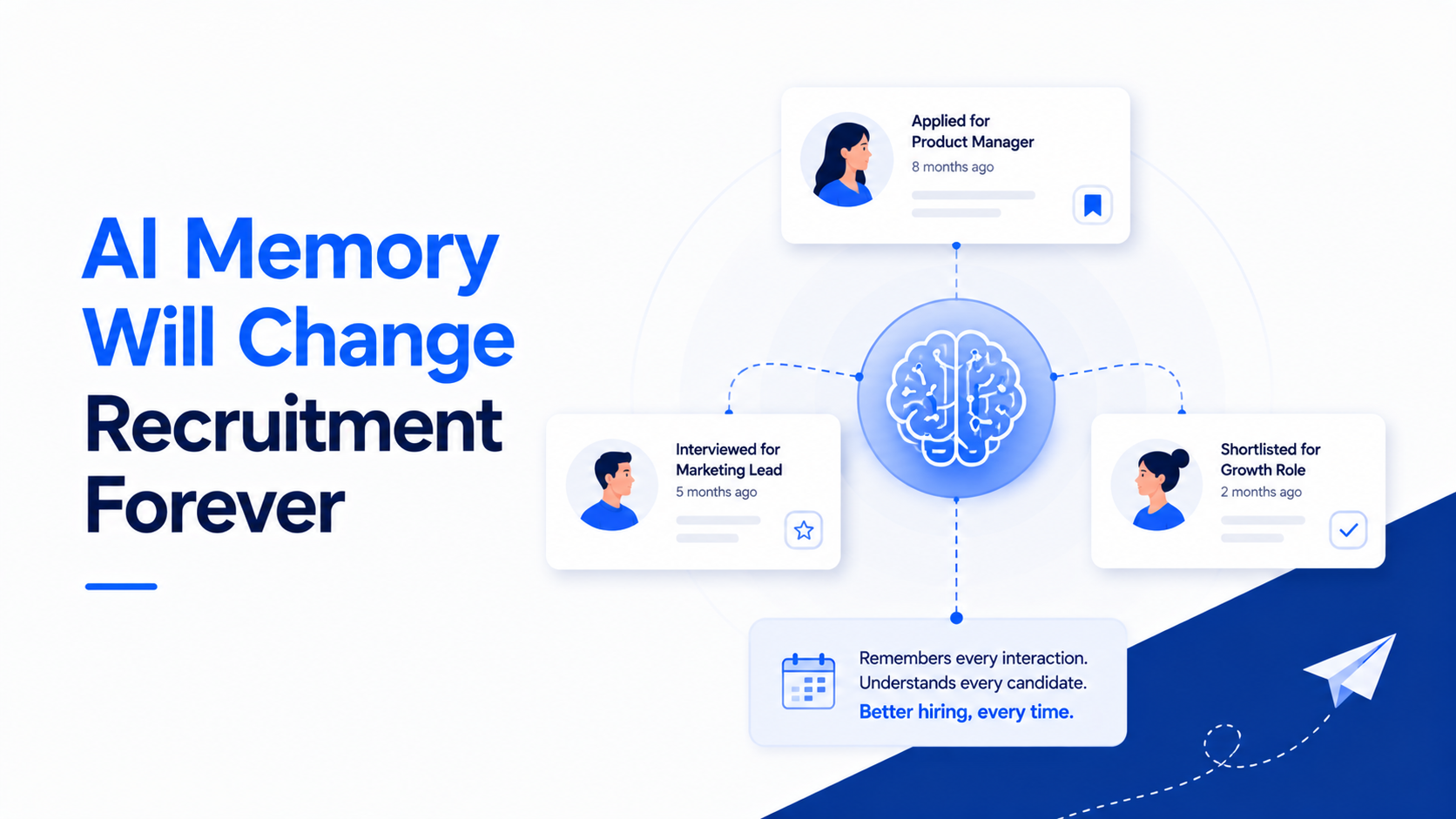
AI memory in recruitment refers to the ability of an AI system to retain, organize, and continuously update a rich contextual understanding of every candidate it has ever encountered. This is fundamentally different from what traditional applicant tracking systems and recruiting CRMs offer. A CRM stores discrete data points about candidate interactions, a log entry recording that an email was sent on a specific date, a note summarizing a phone call, a status field marking a candidate as passive or active. These data points are static. Once entered, they do not change unless a human manually updates them. AI memory, by contrast, maintains a
living, evolving model of each candidate that integrates information from every interaction, infers candidate priorities and readiness signals from behavioral patterns, and continuously updates its understanding as new information becomes available. The distinction is not merely technical. It changes what recruiters can know about their talent pipeline and when they can act on that knowledge.
The technical foundation of AI memory is a combination of long-term context storage, information extraction, and temporal reasoning. When a recruiter has a conversation with a candidate, whether through email, chat, or an AI-conducted screening interview, the system extracts the key information from that interaction, including the candidate's current role, stated career interests, timing constraints, compensation expectations, and any personal factors that might influence their decision-making. This extracted information is integrated into the candidate's persistent profile, not by overwriting previous information but by adding to it with temporal annotations that allow the system to reconstruct how the candidate's situation has evolved over time. According to McKinsey, organizations using AI memory systems report that their recruiters can recall and act on candidate context from twelve to eighteen months prior, compared to two to three months for recruiters using traditional CRM systems, because the AI maintains the context that human memory and manual notes cannot.
The practical implication is that AI memory transforms recruiting from a series of disconnected interactions into a continuous relationship. Every touchpoint with a candidate, whether it leads to an immediate hire or not, contributes to an understanding that makes future interactions more effective. A candidate who was not ready to move six months ago may be ready now, and the AI memory system can detect the signals of changing readiness, such as a shift in LinkedIn activity, a change in the candidate's stated priorities, or the emergence of a role that better matches the candidate's evolving interests. The recruiter does not need to remember the details of the previous conversation or manually review old notes. The AI surfaces the relevant context at the right moment, enabling the recruiter to engage with the candidate in a way that feels personally informed rather than generic. how many follow-ups one hire needs explores how many follow-up interactions a single hire typically requires, and AI memory systems make each of those interactions more effective by ensuring that no context from previous touches is lost.
Why CRM Notes and Spreadsheets Are Not Memory
The tools that recruiters currently use to track candidate information, applicant tracking systems, CRM platforms, spreadsheets, and personal notes, are storage systems, not memory systems. The difference is critical. Storage records what happened. Memory understands what it means. When a recruiter types a note saying that a candidate is open to new opportunities but wants to stay in their current city until their child finishes school in two years, a CRM stores that note as text. An AI memory system extracts the key facts, the candidate is open but geographically constrained, the constraint has a timeline of approximately two years, and the driver is family circumstances, and builds those facts into a predictive model of
when and where the candidate might be receptive to specific opportunities. When a role opens in the candidate's city eighteen months later, the AI can proactively alert the recruiter and suggest outreach that references the candidate's previously stated timeline, creating a conversation that feels remarkably well-timed from the candidate's perspective.
The storage-versus-memory distinction also matters for information decay. CRM notes decay in value the moment they are written because they capture a snapshot that becomes increasingly outdated. A note from six months ago describing a candidate's role and priorities may be partially or fully inaccurate today, but the CRM has no way to update it without manual intervention. AI memory systems, by contrast, continuously ingest new signals, updated LinkedIn profiles, new publications, job changes, conference appearances, and use those signals to refresh the candidate's profile automatically. This continuous updating means that the AI's understanding of a candidate improves over time rather than degrading. The concern about why AI tools have outdated candidate data candidate data is directly addressed by AI memory systems, because memory is not a static record but a continuously refreshed model that incorporates new information as it becomes available. According to Gartner, organizations that deploy AI memory systems alongside their existing CRM infrastructure report that candidate data freshness improves by forty to sixty percent, because the AI automates the updating process that recruiters previously had to perform manually or not at all.
There is also a scalability difference that becomes decisive at any meaningful recruiting volume. A recruiter managing relationships with two hundred passive candidates can maintain reasonable context through diligent note-taking and regular review. A recruiter managing relationships with two thousand candidates, which is the scale at which modern sourcing tools operate, cannot. At that scale, information is inevitably lost, candidates fall through the cracks, and outreach becomes generic because the recruiter does not have the capacity to maintain personalized context for every person in the pipeline. AI memory systems do not have this scalability constraint. They can maintain rich, evolving profiles for tens of thousands of candidates simultaneously, surfacing the right context to the right recruiter at the right time. This is not a marginal efficiency improvement. It is a qualitative change in what is possible in talent acquisition. more tools same hiring problems explains why organizations that add more tools without adding AI memory capabilities find that their candidate data becomes fragmented across systems, making it impossible to maintain the continuous contextual understanding that effective relationship-based recruiting requires.
The Three Layers of AI Memory in Recruitment
AI memory in recruitment operates across three distinct layers, each adding a different type of contextual understanding. The first layer is episodic memory, the record of specific interactions with specific candidates. This includes the content of emails, chat conversations, interview transcripts, and phone call summaries. Episodic memory allows the AI to recall exactly what was discussed, what commitments were made, and what the candidate's stated position was at each point in time. The second layer is semantic memory, the general knowledge the
AI has built about a candidate's professional profile, including their skills, career trajectory, industry expertise, and professional network. Semantic memory is constructed by aggregating and abstracting information from multiple episodic interactions and from public data sources, creating a comprehensive picture that no single conversation could provide. The third layer is predictive memory, the AI's model of what a candidate is likely to do next based on the patterns it has observed across all candidates and all interactions.
Predictive memory is the layer that delivers the most strategic value but is also the most technically challenging to implement. It requires the AI to identify behavioral patterns across the entire candidate population, such as the signals that indicate a passive candidate is about to go active, the factors that predict whether a candidate will respond to outreach at a particular moment, and the characteristics of opportunities that are most likely to convert a long-term passive candidate into an applicant. These patterns are often too subtle and too numerous for human recruiters to identify, but AI systems can detect them by analyzing thousands of candidate journeys simultaneously. According to Deloitte, AI memory systems with mature predictive memory capabilities can identify candidate readiness signals two to four weeks before the candidate actively applies for roles, giving organizations a critical first-mover advantage in engaging top talent. The practical impact is that recruiters can reach candidates with the right message at the right time, rather than relying on timing luck or high-volume outreach that generates low response rates.
The three memory layers work together to create a recruiting capability that is fundamentally different from anything available with traditional tools. Episodic memory ensures that every conversation builds on previous ones rather than starting from scratch. Semantic memory ensures that the recruiter's understanding of the candidate's capabilities is comprehensive and current. Predictive memory ensures that outreach is timed to moments of maximum candidate receptivity. When all three layers are operating effectively, the result is a recruiting operation that maintains deep, continuously updated relationships with thousands of candidates simultaneously, engaging each one with the relevance and timing that previously only the best human recruiters could achieve for a small handful of prospects. agentic AI platforms vs automated ones describes how the most advanced AI platforms use autonomous agents to maintain all three memory layers continuously, updating candidate profiles, detecting readiness signals, and initiating outreach without requiring manual triggers from recruiters.
How AI Memory Changes the Candidate Experience
From the candidate's perspective, AI memory transforms the recruiting experience from a series of repetitive, forgetful interactions into a relationship that demonstrates genuine understanding. Candidates consistently report frustration with recruiting processes that ask them to repeat information they have already provided, that suggest roles unrelated to their stated interests, or that contact them at moments when they have explicitly communicated they are not available. These frustrations are not minor inconveniences. They signal to candidates that the organization does not value their time or their individual circumstances, and they directly
affect the candidate's perception of the employer brand and their willingness to engage. According to LinkedIn, candidate experience research shows that seventy-three percent of professional candidates say they have withdrawn from a hiring process at least once because the recruiter demonstrated that they did not remember or understand the candidate's previously stated preferences or constraints.
AI memory eliminates these frustrations by ensuring that every interaction is informed by everything that came before. When a candidate tells a recruiter in March that they are not looking to move until after their product launches in the fall, an AI memory system stores that constraint, sets a temporal trigger for re-engagement after the expected launch date, and when that date approaches, surfaces the full context to the recruiter along with a suggestion for outreach that acknowledges the candidate's previous commitment and references the completed launch. The candidate's experience is that the organization remembered their situation, respected their timeline, and re-engaged at the appropriate moment. This is the kind of experience that builds candidate loyalty even when the candidate does not ultimately accept the role, because it demonstrates the kind of organizational attentiveness that top candidates value in an employer. EY has found that candidates who experience AI-memory-informed outreach are forty to fifty percent more likely to respond positively compared to candidates receiving standard outreach, because the personalization is not superficial template customization but genuine contextual relevance.
The candidate experience improvement also has a compounding effect on talent pipelines. Candidates who feel understood and respected, even when they are not ready to accept a role, become advocates who refer peers and respond positively to future outreach. Candidates who feel forgotten or misunderstood become ghosts who ignore messages and discourage others from engaging. The difference between these two outcomes is not determined by the recruiter's skill or effort in any single interaction but by the system's ability to maintain continuity across interactions over time. AI memory provides that continuity at a scale that human memory cannot match, turning every candidate touchpoint into an investment in a long-term relationship rather than a transactional event. why referrals outperform cold outreach demonstrates why this relational approach is so valuable, because candidates who feel genuinely understood are dramatically more likely to provide referrals, creating a network effect that amplifies the value of AI memory far beyond any single candidate interaction.
Building an AI Memory Strategy for Your Talent Acquisition Team
For talent acquisition leaders considering AI memory systems, the implementation approach matters as much as the technology itself. The first consideration is data integration. AI memory is only as good as the data that feeds it. Organizations that implement AI memory on top of fragmented data sources, where candidate information is scattered across an applicant tracking system, a CRM, email archives, and recruiter personal notes, will get limited results because the AI cannot build a complete picture. The most effective implementations start with a
data integration effort that consolidates candidate interaction history into a unified feed that the AI memory system can consume continuously. This does not necessarily mean replacing existing systems. It means ensuring that the AI memory system has access to the same data streams that recruiters currently use, supplemented by public data sources that provide additional candidate signals. According to SHRM, organizations that invest in data integration before deploying AI memory systems report twenty-five to thirty-five percent faster time-to-value compared to organizations that deploy AI memory without first unifying their candidate data.
The second consideration is recruiter adoption and workflow design. AI memory systems change how recruiters work by providing them with more information and more suggestions than they are accustomed to receiving. If the system surfaces too much information, recruiters experience cognitive overload and ignore the AI's inputs. If it surfaces too little, the AI's value is marginal. The organizations that achieve the best results design their AI memory interfaces to provide the right amount of context at the right moment in the recruiter's workflow, prioritizing the information most likely to be actionable and deferring the rest. They also invest in training that helps recruiters understand what AI memory can and cannot do, setting realistic expectations and building the trust needed for adoption. AI sourcing vs AI recruiting highlights why the value of AI memory differs between the sourcing stage, where it enables persistent candidate discovery, and the recruiting stage, where it enables deeply personalized engagement, and workflow design should reflect these different use cases.
The third consideration is governance and candidate privacy. AI memory systems accumulate detailed information about candidates over extended periods, and this accumulation creates both opportunity and obligation. Organizations must be transparent with candidates about what information is being retained, how it is used, and how long it is kept. They must provide candidates with the ability to review, correct, and request deletion of their information. And they must ensure that the insights derived from AI memory are used to improve the candidate experience, not to manipulate candidates into making decisions against their interests. The organizations that build strong governance frameworks for AI memory, treating candidate data as a trust asset rather than a surveillance tool, will build the candidate relationships that sustain long-term competitive advantage. According to Deloitte, organizations with mature AI data governance practices for recruiting report not only stronger candidate trust but also higher quality of hire, because candidates who trust the organization's data practices are more forthcoming and honest in their interactions, providing the AI with better information to work with.