Sarah Chen, a senior recruiter at a mid-size staffing firm in Chicago, noticed the anxiety spreading through her team during their quarterly meeting when the firm's leadership announced a new AI sourcing platform. Within days, the rumor mill was buzzing with three recruiters already polishing their resumes, convinced that the new tool would make them redundant. Sarah had seen this pattern before in other industries, where technology adoption was equated with job elimination. But her experience told her a different story. The best recruiters she knew were not threatened by tools that could search faster or screen more efficiently, because they understood that their real value was not in finding candidates but in building relationships, understanding human motivations, and making judgment calls that no algorithm could replicate. The firms that adopted AI thoughtfully would not need fewer recruiters. They would need recruiters who operated at a higher level, focusing on the human dimensions of hiring while AI handled the repetitive, data-intensive tasks that consumed most of their day.
The Fear That AI Will Replace Recruiters Is Misguided
The anxiety that AI will eliminate recruiting jobs is understandable but misplaced. Recruitment has always evolved alongside technology, and each wave of innovation was supposed to render recruiters obsolete. When job boards emerged in the late 1990s, industry observers predicted the end of agency recruiting because candidates could find jobs themselves. When applicant tracking systems became widespread in the 2000s, analysts argued that automated workflow management would eliminate the need for human coordinators. When LinkedIn and social recruiting arrived in the 2010s, the prediction was that direct access to candidates would make third-party recruiters irrelevant. In every case, the technology changed how recruiters worked but expanded the profession rather than shrinking it. AI is the latest iteration of this pattern, and the evidence suggests the outcome will be similar:
technology will eliminate specific tasks, not the profession itself. The recruiters who thrive will be those who adapt their skills to the new landscape, while those who define their value entirely by the tasks AI automates will indeed find their roles diminished.
The employment data supports this view. Despite rapid AI adoption across the recruiting industry over the past three years, demand for skilled recruiters continues to grow. Organizations are adding recruiter headcount even as they deploy AI tools, because the fundamental challenge of talent acquisition, connecting the right person with the right opportunity in a market characterized by talent scarcity, remains a human problem that technology assists with but does not solve. According to SHRM, the most in-demand recruiting roles in 2024 and 2025 are not entry-level sourcers or resume screeners, the tasks most susceptible to AI automation, but senior recruiters and talent consultants who combine deep market knowledge with strong relationship skills and strategic thinking. This demand pattern confirms that the market values the human capabilities AI cannot replicate, even as it eagerly adopts AI for the tasks it can automate.
What is genuinely changing is the nature of recruiting work and the skills that define a successful recruiter. Recruiters who spend the majority of their day posting jobs to boards, scanning resumes for keyword matches, sending templated outreach emails, and updating spreadsheets are indeed vulnerable, because AI performs each of these tasks faster, more consistently, and at lower cost. But recruiters who invest their time in understanding client businesses deeply, building trust with passive candidates, providing strategic talent market intelligence to hiring managers, and managing the complex emotional and logistical dynamics of the hiring process are becoming more valuable, not less. The distinction is critical: AI replaces tasks, not roles, and the recruiters whose roles are defined by the tasks being automated will need to evolve, while the recruiters whose roles are defined by human judgment and relationship skills will find that AI amplifies their impact. should recruiters worry about AI replacing jobs explores this distinction in detail, explaining why the recruiters who view AI as a threat are typically those whose daily work consists entirely of the operational tasks that AI handles best, while recruiters who embrace AI as an amplifier are those who already spend most of their time on higher-value activities.
What AI Actually Does: Automating the Work Behind Recruiting
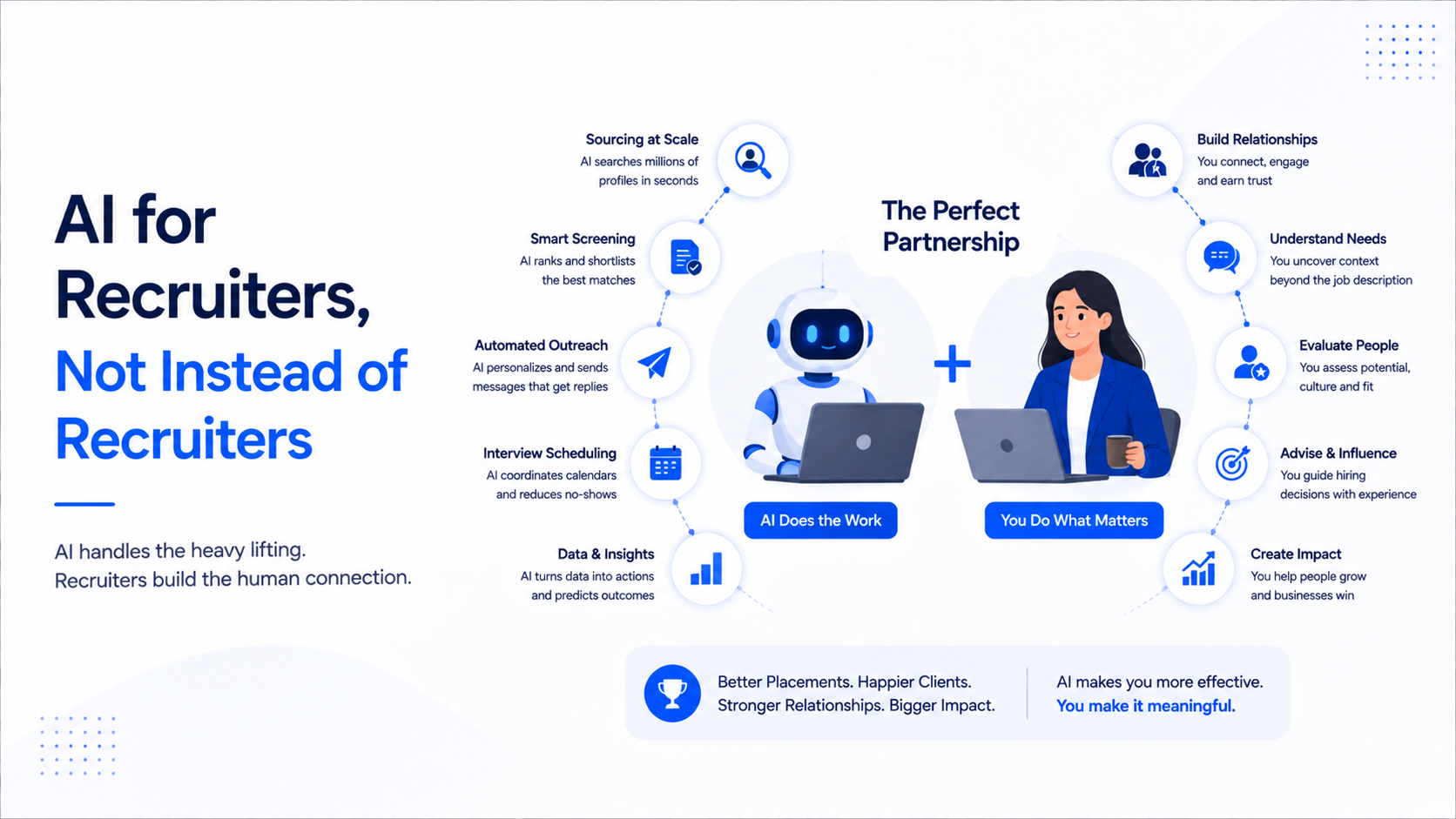
To understand why AI empowers rather than replaces recruiters, it is essential to be specific about what AI in recruiting actually does. The AI tools currently deployed across the staffing and talent acquisition industry automate a well-defined set of tasks: sourcing candidates from databases and professional networks using intelligent search queries, screening resumes and profiles against job requirements using natural language understanding, scheduling interviews by coordinating calendars across multiple participants, sending personalized follow-up messages based on candidate status and timeline, generating status reports and pipeline analytics, and maintaining candidate engagement through automated nurture sequences. These tasks are necessary for recruiting to function, but they are not the activities that create value for clients
or candidates. No candidate ever chose an employer because the recruiter's scheduling tool was efficient. No hiring manager ever attributed a successful hire to the screening algorithm. The value creation happens in the interactions, judgments, and relationships that occur alongside and on top of these operational tasks.
By automating these operational tasks, AI frees recruiters to reallocate their time toward activities that directly impact hiring quality and client satisfaction. Instead of spending two hours scanning fifty resumes, a recruiter can spend two hours having a detailed conversation with a hiring manager about the team culture, the actual day-to-day challenges of the role, and the personality traits that have made previous hires successful in that team. Instead of sending fifty templated InMail messages and hoping for responses, a recruiter can spend that time crafting ten highly personalized messages to carefully selected passive candidates, drawing on the research and insights that AI has already assembled. Instead of manually updating a spreadsheet to track where each candidate stands in the process, the recruiter can review AI-generated pipeline analytics and immediately identify which candidates need attention, which requisitions are falling behind, and where intervention will have the greatest impact. The recruiter's day shifts from data processing and administrative coordination to relationship management and strategic advisory, which are the activities that clients pay for and candidates respond to. more tools same hiring problems explains why organizations that deploy AI tools without redefining what recruiters should do with their freed capacity often see minimal improvement in hiring outcomes, because the time saved through automation gets absorbed by other low-value activities rather than being redirected toward the high-touch interactions that drive better hiring.
The automation also improves consistency and reduces the errors that inevitably occur when humans perform repetitive tasks at scale. AI screening applies the same evaluation criteria to every candidate, eliminating the inconsistency that creeps in when a recruiter reviews two hundred resumes across a long afternoon and unconsciously applies different standards to the fiftieth resume than to the first. AI follow-up sequences ensure that no candidate is forgotten due to human oversight, which is one of the most common complaints candidates have about their experience with recruiters. AI scheduling eliminates the multi-day email exchanges that delay interview processes and cause candidates to lose interest. According to McKinsey, organizations that deploy AI for these operational recruiting tasks report thirty to forty percent reductions in time-to-fill and twenty to twenty-five percent improvements in recruiter productivity, measured by the number of qualified candidates advanced per recruiter per week. These improvements are not achieved because recruiters are working longer hours or processing more volume. They are achieved because recruiters are spending a larger share of their time on activities that directly contribute to successful hiring outcomes rather than on the operational infrastructure that supports those outcomes.
The Human Skills That AI Cannot Replicate
The most important recruiting skill that AI cannot replicate is the ability to build genuine trust
with both candidates and hiring managers. Trust is not a data point, a pattern match, or a probability score. It is built through conversation, empathy, honesty, consistency, and the demonstrated understanding of another person's situation, concerns, and aspirations. A recruiter who has earned a candidate's trust can convince a passive candidate to explore a career opportunity they would otherwise ignore, because the candidate believes the recruiter understands their goals and would not waste their time with an irrelevant pitch. A recruiter who has earned a hiring manager's trust can influence the hiring criteria to focus on what truly matters for success in the role rather than on an unrealistic wish list of qualifications, because the hiring manager believes the recruiter understands the market and has the organization's interests at heart. These trust-based influence dynamics are the engine of effective recruiting, and they operate entirely in the domain of human relationship. AI can provide the data that supports these conversations, but it cannot have them.
Strategic judgment is another irreducibly human recruiting capability. When a hiring manager says they need a senior developer with ten years of experience in a specific technology stack, an AI sourcing tool can efficiently find candidates who match that description. But an experienced recruiter can tell the hiring manager that what they actually need is a mid-level developer who is a strong learner, because the specific technology they use will be obsolete in two years and the candidate's adaptability and learning velocity matter far more than their current proficiency in a soon-to-be-legacy framework. This kind of strategic talent advising requires business understanding, market knowledge, awareness of technology trends, and the interpersonal credibility to challenge a client's assumptions without damaging the relationship. It requires reading between the lines of a job description to understand the underlying business problem the hiring manager is trying to solve. AI can provide market data, salary benchmarks, and candidate availability statistics that inform these conversations, but it cannot initiate the strategic dialogue or make the nuanced judgment calls that redefine what the organization should be looking for. AI sourcing vs AI recruiting explores why the distinction between sourcing, which AI handles exceptionally well, and recruiting, which requires human judgment and relationship skills, is critical for organizations deciding how to deploy AI tools without undermining the strategic value their recruiting function provides.
Negotiation and influence represent equally human recruiting domains that resist automation. When a top candidate receives competing offers and the hiring organization's compensation package is not the most competitive, the recruiter's ability to articulate the non-monetary value of the opportunity, to understand and address the candidate's specific concerns about role scope or team dynamics, and to create genuine excitement about the organization's mission and trajectory can make the difference between acceptance and rejection. This negotiation is not a formulaic process. It requires reading the candidate's emotional state during a phone call, sensing hesitation about a particular aspect of the opportunity that the candidate has not explicitly stated, and adapting the conversation in real time to address concerns the candidate may not even be fully aware of. AI can generate compensation benchmark data and benefits comparison matrices, but it cannot perceive the subtle shift in a candidate's tone when they mention their current manager's leadership style, or recognize that a candidate's apparent hesitation about salary is actually a hesitation about relocation. According to LinkedIn, the
recruiters who consistently close the highest-caliber candidates, those with multiple competing offers and therefore the most choices, are those who invest the most time in personal relationship building and the least time in transactional process management. The data is clear: at the most competitive end of the talent market, where the difference between hiring an exceptional candidate and a good one can determine a team's performance for years, the human recruiter's relationship and negotiation skills are the decisive factor.
How AI-Augmented Recruiters Outperform Both AI Alone and Recruiters Alone
The evidence from organizations that have deployed AI in their recruiting functions points consistently to one conclusion: the best hiring outcomes come from combining AI capabilities with human recruiter skills, not from substituting one for the other. Organizations that deploy AI sourcing and screening tools without skilled recruiters to interpret the AI's outputs, build relationships with the candidates the AI identifies, and exercise judgment about fit beyond what the algorithm can assess, often find that the technology produces high volume but low quality. The AI surfaces many candidates, but without a skilled recruiter to evaluate cultural fit, assess motivation, and manage the candidate's experience through the hiring process, conversion rates from sourced candidate to accepted offer remain stubbornly low. Conversely, organizations that have talented recruiters but no AI tools often find that their recruiters are individually productive but collectively capacity-constrained, unable to serve all the hiring needs of the organization because so much of their time is consumed by sourcing, screening, and administrative tasks that leave insufficient time for the relationship building and strategic advisory that drive hiring quality.
The combination of AI and human recruiters creates a genuine multiplier effect that exceeds the sum of its parts. The AI expands the recruiter's reach and operational efficiency, enabling them to consider a wider pool of candidates, engage more prospects simultaneously, and manage more active requisitions without sacrificing quality. The human recruiter provides the judgment, relationship skills, emotional intelligence, and strategic thinking that convert the AI's efficient output into successful, lasting hires. Together, they achieve outcomes that neither could produce in isolation: higher quality of hire, faster time to fill, better candidate experience, more strategic talent acquisition, and stronger hiring manager partnerships. According to Gartner, organizations that combine AI tools with skilled human recruiters report thirty-five to forty-five percent higher quality-of-hire scores and twenty-five to thirty percent lower cost-per-hire compared to organizations that rely on either AI or human recruiters alone, because the combination leverages the strengths of each while compensating for the respective weaknesses. agentic AI platforms vs automated ones describes how agentic AI platforms are designed specifically to enable this multiplier effect, coordinating sourcing, screening, and engagement activities while keeping the human recruiter in the loop for the judgment-intensive decisions that require human intuition and relationship context.
The practical implications for recruiting team design and capacity planning are significant.
AI-augmented recruiters can typically manage twenty to thirty active requisitions simultaneously, compared to ten to fifteen for non-augmented recruiters, because the AI handles the sourcing, initial screening, scheduling, and routine communication that previously limited their capacity. This increased capacity does not come at the expense of quality. In fact, quality typically improves because the recruiter has more time to spend on the high-touch activities that drive good hiring decisions, such as thorough candidate assessments, detailed hiring manager consultations, and thoughtful offer management. The recruiting function delivers more value with the same headcount, not by making individual recruiters redundant but by enabling each recruiter to operate at a significantly higher level of effectiveness. For staffing firms, this multiplier effect translates directly to improved margins, because each recruiter generates more placements without proportional increases in cost. For internal talent acquisition teams, it means serving more hiring managers with higher quality without requesting additional headcount, which strengthens the team's strategic position within the organization.
Building an AI-First Recruiting Team Without Losing the Human Touch
Building a recruiting team that effectively combines AI capabilities with human recruiter skills requires deliberate organizational design, not just technology deployment. The first and most fundamental step is to clearly define which tasks the AI will own and which tasks the recruiter will own, based on a rigorous assessment of what each does best. AI should own candidate sourcing from databases and networks, initial resume and profile screening against defined criteria, interview scheduling and calendar coordination, routine candidate communication and status updates, data collection and pipeline reporting, and candidate nurture sequences for long-term talent pools. Recruiters should own candidate relationship building and trust development, hiring manager consultation and needs analysis, offer negotiation and candidate closing, candidate coaching and preparation, strategic talent advisory and market intelligence sharing, and stakeholder management across the hiring process. This task allocation should be explicit, documented, and regularly reviewed as AI capabilities expand, because the boundary between what AI can do and what requires human judgment will continue to shift.
The second step is to invest deliberately in recruiter training and development that focuses on the skills that become more valuable in an AI-augmented environment. These skills include consultative selling, where the recruiter positions themselves as a talent advisor rather than a candidate vendor; stakeholder management, where the recruiter navigates the complex internal dynamics of hiring decisions; market intelligence, where the recruiter develops deep knowledge of talent markets, compensation trends, and competitive dynamics; and candidate experience design, where the recruiter crafts an engaging, respectful, and differentiated experience that attracts top talent. Many experienced recruiters developed their careers in an environment where technical skills like Boolean search construction, ATS navigation, and resume formatting were the primary differentiators between good and great recruiters. In an
AI-augmented environment, these technical skills are table stakes that the AI handles by default. The new differentiators are the human skills that AI cannot replicate, and training programs must help recruiters develop these capabilities while shifting their professional identity from candidate finder to talent advisor. According to Deloitte, organizations that invest in upskilling recruiters for AI-augmented roles report fifty to sixty percent higher recruiter retention and engagement scores compared to organizations that deploy AI tools without targeted upskilling, because recruiters who understand how AI enhances their work and have developed the skills to leverage it effectively are more confident, more productive, and more motivated than recruiters who feel threatened by technology they do not understand. how to evaluate an AI sourcing tool provides a framework for evaluating whether a recruiting team is ready for AI augmentation, because the assessment covers not only technology readiness but also the skills, processes, and cultural factors that determine whether AI deployment will amplify or undermine recruiter effectiveness.
The third step is to evolve the performance measurement and incentive system to reward the outcomes that AI-augmented recruiters are uniquely positioned to deliver. In a traditional recruiting function, performance metrics often emphasize activity volume: number of calls made, resumes reviewed, interviews scheduled, and candidates submitted. In an AI-augmented function, these activity metrics will naturally decline as AI handles more operational tasks, but this decline is a sign of progress, not a sign of reduced recruiter effort or commitment. Organizations that continue measuring recruiter performance primarily with activity metrics create perverse incentives that discourage recruiters from leveraging AI, because using AI to automate tasks will reduce their activity scores and potentially affect their compensation. The metrics that matter in an AI-augmented recruiting function are quality of hire, measured by new hire performance and retention at six and twelve months; hiring manager satisfaction, measured by systematic feedback on recruiter partnership quality; candidate experience scores, measured by survey data at key touchpoints in the hiring process; and strategic contribution, measured by the recruiter's impact on workforce planning, employer branding, and talent market intelligence. These outcome-based metrics align recruiter incentives with organizational goals and reward the human capabilities that AI amplifies rather than the operational tasks that AI automates. how many follow-ups one hire needs explains why the transition to outcome-based recruiter measurement is essential for AI adoption to succeed, because recruiters will not embrace tools that reduce their measured performance unless the measurement system itself evolves to reflect the new value they create.