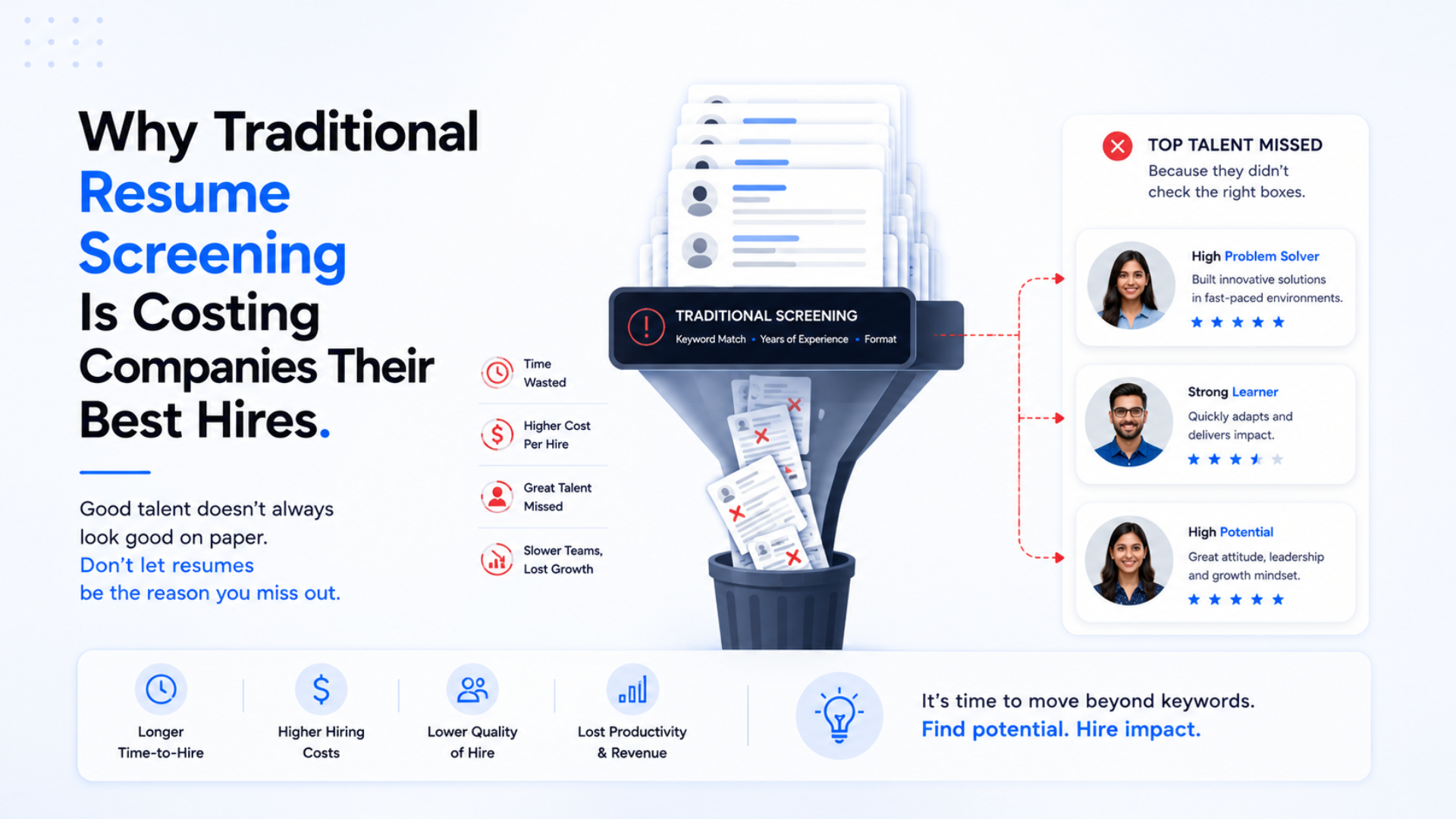
The hiring funnel in most organizations works like this: a role opens, applications arrive, and the very first thing that happens is that a screening process eliminates the majority of those applicants before any human being ever looks at them. The company never sees those candidates. The candidates never know they were rejected. And in many cases, the best person for the job was in the eliminated group. This is not a hypothetical scenario or an edge case. It is the structural outcome of a screening system that was designed for a different era of recruiting, and it is costing companies their best hires every single day. The problem is not that recruiters are bad at their jobs. The problem is that the tools they have been given are fundamentally incapable of identifying the candidates who would make the biggest impact.
The scale of the loss is staggering when you look at the data. According to research from McKinsey’s talent acquisition practice, traditional screening processes eliminate 50% to 75% of applicants before any human evaluation. Within that eliminated group are career changers with highly transferable skills, self-taught professionals who have built exceptional capability through non-traditional paths, returning parents who took career breaks and are re-entering at full capability, veterans transitioning to corporate roles, and specialists whose resumes simply use different terminology than the screening system expects. These are not unqualified candidates. They are the candidates that keyword-based screening is specifically designed to miss, and they represent the very talent that most companies say they cannot find.
The Keyword Filter: A System Designed to Miss Exceptional Candidates
The cornerstone of traditional resume screening is the keyword filter. The recruiter or hiring manager specifies a set of required skills, qualifications, or experiences, and the applicant tracking system scans each resume for those terms. Resumes that contain enough matches advance. Resumes that do not are filtered out. The system is simple, fast, and scalable. It is also, by design, incapable of recognizing capability that is expressed in different language than the
keyword list expects. A candidate who writes “user-centric product development” instead of “product management” is filtered out, even though they are describing the same function. A candidate who lists “distributed systems engineering” instead of “backend development” is penalized for precision. The keyword filter does not evaluate whether a candidate can do the job. It evaluates whether they use the same words as the job description.
The problem compounds with every additional keyword requirement. A role that lists ten required skills will filter out candidates who meet nine of them but describe the tenth using a synonym. It will advance candidates who mention all ten keywords but lack depth in any of them. The result is a shortlist optimized for keyword density rather than actual capability. In competitive talent markets where the difference between a good hire and a great hire can determine the trajectory of an entire team, this is an enormously costly tradeoff. Companies are not just missing some good candidates. They are systematically favoring mediocre keyword matchers over exceptional non-standard candidates, and the cumulative effect on hiring quality is severe.
This dynamic is a direct consequence of the broader pattern we have described as more tools, same hiring problems. The recruiting industry has spent two decades layering features onto keyword-based screening without changing the underlying assumption that a candidate’s worth can be determined by scanning a document for specific terms. Every new ATS feature, every AI-powered keyword suggestion, every resume-parsing improvement is an iteration on the same flawed premise. The result is a screening process that is faster and more automated than ever before, but no more intelligent in the ways that actually determine whether a company identifies and hires its best candidates.
The Non-Traditional Candidate Penalty
Traditional screening does not penalize all candidates equally. It penalizes non-traditional candidates disproportionately, and these are often the candidates who bring the most value. Consider the career changer: a consultant who spent five years at a top firm and is now transitioning into product management. Their resume does not say “product manager” anywhere, but their consulting experience involved defining product strategy, conducting market analysis, and driving cross-functional execution for client companies. A keyword filter for a product management role will filter them out. A recruiter who understands that consulting develops the exact capabilities a product manager needs will see their value, but they will only see it if the candidate survives the initial screening, which they probably will not.
The same penalty applies to self-taught developers, candidates who learned to code through bootcamps, online courses, and personal projects rather than through a computer science degree. Their GitHub profiles may be exceptional. Their ability to build production-quality software may be demonstrably superior to candidates with formal degrees. But their resumes do not contain the keywords that the screening system expects, either because they did not attend the right university or because they describe their experience in terms of projects rather than credentials. The screening system was built for a world where the path from education to
employment was linear and standardized. That world no longer exists, and the screening system’s inability to adapt is one of the primary reasons companies struggle to find talent that is clearly available in the market.
The non-traditional candidate penalty is especially damaging for specialized roles. As we have analyzed in our exploration of whether AI recruiting tools work for niche or technical roles, the candidates who are hardest to evaluate through traditional screening, career changers, self-taught specialists, people with non-standard backgrounds, are often the ones who bring the most innovative thinking and the deepest domain expertise. A screening system that cannot recognize their value is not just an operational problem. It is a strategic one, because it limits the company’s access to the very talent that would give it the greatest competitive advantage.
Bias by Design: How Traditional Screening Reduces Diversity and Quality Simultaneously
Traditional resume screening is not just inaccurate. It is systematically biased in ways that reduce both the diversity and the quality of the hiring pipeline. The bias operates through multiple channels. At the keyword level, the screening system encodes the assumptions of the person who wrote the keyword list. If the hiring manager specifies “Ivy League preferred” or “Fortune 500 experience required,” the system will systematically rank candidates from those backgrounds higher, regardless of whether those credentials are actually predictive of success in the role. At the format level, candidates who have access to professional resume writing services, which correlates with socioeconomic background, produce documents that are easier for both humans and algorithms to parse, giving them an advantage that has nothing to do with capability.
At the human review level, even after candidates pass the keyword filter, unconscious bias continues to shape outcomes. Research has consistently shown that reviewers are influenced by name-based signals, institutional prestige, and formatting quality, all of which correlate with demographic characteristics rather than job performance. The result is shortlists that are both less diverse and lower quality than they should be. According to SHRM’s research on hiring bias, screening processes that rely on keyword matching and rigid criteria produce 20% to 40% less diverse shortlists than processes that incorporate holistic evaluation. The critical insight is that this is not a diversity-for-quality tradeoff. The homogeneous shortlists produced by biased screening are also lower quality on average, because they are drawn from a narrower segment of the talent pool. Bias and quality are not opposing forces. They are the same force viewed from different angles. A screening process that eliminates non-traditional candidates eliminates both diversity and the capability those candidates would have brought.
The Speed-Quality Trap: Why Faster Screening Produces Worse Outcomes
One of the most perverse dynamics of traditional screening is the speed-quality trap. As companies face pressure to fill roles quickly, they optimize their screening process for speed
rather than accuracy. They tighten keyword filters to reduce the shortlist faster. They reduce the time per resume review. They skip the second-pass evaluation that would catch candidates who were unfairly filtered out. Each of these speed optimizations reduces screening quality, which means the shortlist is worse, which means more interview rounds are needed to find the right candidate, which extends the time-to-hire, which increases the pressure to screen faster next time. The cycle is self-reinforcing and systematically degrades hiring outcomes.
The speed-quality trap also creates a false sense of productivity. A recruiter who processes 200 resumes in a day and advances 20 candidates to the phone screen appears to be highly productive. But if 15 of those 20 candidates are not genuinely strong fits, the recruiter has not produced value. They have generated work for hiring managers and interviewers that will not lead to a hire. According to EY’s workforce analytics, the average company spends approximately 40% of its total recruiting budget on interview stages for candidates who were screened through incorrectly. This is not a small inefficiency. It is a structural waste problem that exists because the screening process was optimized for speed of processing rather than accuracy of evaluation, and no amount of process improvement within the traditional paradigm will fix it.
The root cause is data. When screening decisions are based on a single, static document, the information available to make those decisions is inherently limited. As we have examined in our analysis of why some AI recruiting tools have outdated candidate data, the problem is compounded when the data is not just limited but also stale. A resume that is six months old may not reflect a candidate’s current capabilities, recent achievements, or changed career direction. Screening based on stale data produces stale shortlists, and stale shortlists lead to hiring decisions that do not reflect the current talent market. The speed-quality trap cannot be resolved within a system that relies on single-source, static data inputs. It requires a fundamentally different approach to candidate evaluation.
What Companies Lose When They Keep Using Traditional Screening
The cumulative cost of traditional screening extends far beyond the hiring funnel. When a company systematically eliminates its best candidates at the screening stage, the effects ripple through every subsequent part of the business. Roles stay open longer because the shortlist quality is low, forcing more interview rounds and delaying hiring decisions. The candidates who do get hired are less likely to be exceptional, which means team performance, product quality, and innovation all suffer relative to what they could have been with better screening. The employer brand takes a hit because the candidates who were unfairly filtered out share their negative experience, reducing the quality and size of future applicant pools.
Perhaps most damagingly, traditional screening creates a talent acquisition culture that is optimized for risk avoidance rather than talent maximization. Hiring managers learn to expect shortlists full of candidates who look the same, so they stop asking for diverse or unconventional profiles. Recruiters learn to optimize for keyword matches rather than candidate quality, so they stop developing the evaluation skills that distinguish great recruiters from good
ones. The entire organization settles for a lower standard of talent because the screening system makes it impossible to achieve a higher one. This cultural entropy is the most expensive cost of traditional screening, because it is compounding and self-reinforcing. As we have discussed in our analysis of whether recruiters should worry about AI replacing their jobs, the recruiters who are most at risk are not those who embrace AI. They are those who remain trapped in workflows that do not allow them to exercise the judgment and expertise that would make them irreplaceable.
How Huntlo Eliminates the Costs of Traditional Screening
Huntlo replaces the traditional keyword-based screening process with a candidate intelligence system that evaluates every applicant on multiple dimensions, using real-time data from multiple sources. Instead of scanning resumes for keywords, Huntlo builds a holistic understanding of each candidate’s capabilities, career trajectory, demonstrated impact, and fit for the specific role. The platform evaluates non-traditional candidates on the same basis as traditional ones, recognizing that a career changer with transferable skills may be a stronger fit than a candidate with direct but shallow experience. It assesses impact evidence rather than just responsibility claims, so candidates who have genuinely driven results rise to the top regardless of how they format their resume.
Because Huntlo operates as an agentic AI platform, its screening adapts to each specific role rather than applying a static filter. It identifies the signals that are most predictive of success for the particular position, seniority level, and company context, and evaluates candidates against those role-specific criteria. This adaptive evaluation means that the same candidate can be ranked differently for different versions of the same role, because the system understands that fit is not absolute but contextual. The practical impact is a screening process that produces more diverse, higher-quality shortlists in a fraction of the time, while eliminating the false negatives that cause companies to lose their best hires. Traditional screening is not just costing companies time and money. It is costing them the talent that would determine their competitive future. The companies that recognize this and act on it first will have a significant and lasting advantage in the war for talent.