Every recruiter has experienced the timing paradox: a brilliant, personalized message sent at 11 PM on a Friday gets ignored, while a decent-but-unspectacular message sent on a Tuesday morning generates a warm response. The message quality was not the variable. The timing was. And yet, when recruiters analyze their outreach performance, they obsess over subject lines, personalization depth, and template structure while treating timing as a scheduling detail that deserves no more thought than picking a calendar slot. This is a mistake of the first order, because timing is not a minor variable in the outreach equation. In many cases, it is the variable.
Data from multiple recruiting benchmarks in 2025–2026 consistently shows that the same outreach message, sent to equivalent candidate segments, can produce a 3–5× difference in response rate depending on when it is delivered. Not 10–20% improvement. A multiple. According to research compiled by McKinsey’s workforce insights, organizations that treat candidate engagement timing as a strategic decision rather than an administrative one consistently outperform their peers in both response rates and quality of hire. The question is not whether timing matters. It is how to get it right, at scale, for every candidate in your pipeline.
This article breaks down the science of outreach timing across four dimensions: the optimal windows for initial contact, the cadence and spacing of follow-up sequences, the career and lifecycle moments that make candidates receptive, and the emerging role of AI in making timing intelligence practical at scale. The goal is not to give you a rigid schedule to follow. It is to give you a framework for thinking about timing that you can adapt to your specific market, candidate segment, and hiring context.
The Science of Send Windows: When Candidates Are Actually Receptive
The most studied dimension of outreach timing is the send window: the specific day of the week and time of day when candidates are most likely to see, read, and respond to a recruiter
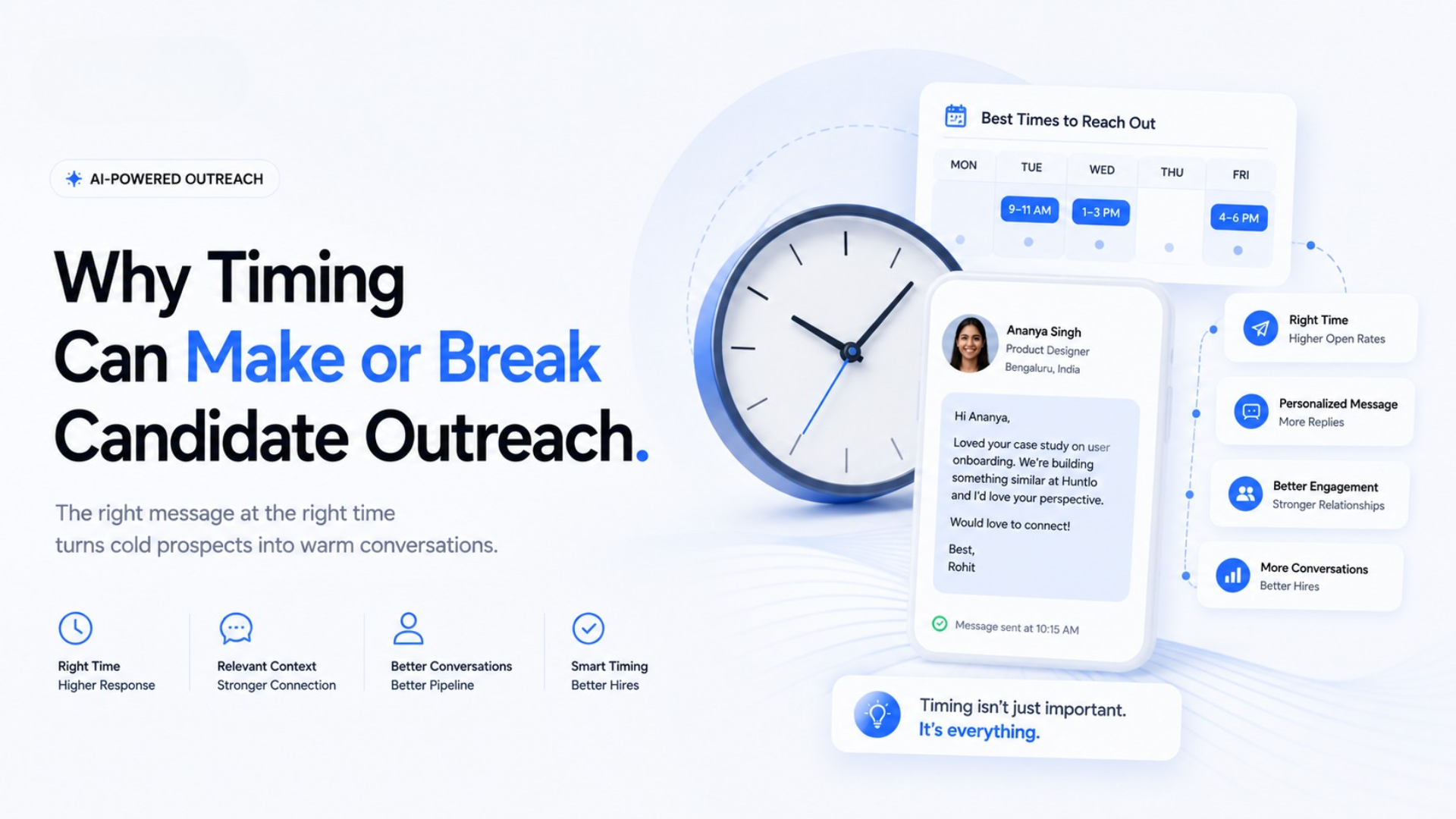
message. The data on this is surprisingly consistent across studies and platforms, though with important nuances by geography and candidate segment. For professional and technical candidates in Western markets, the highest response rates consistently occur on Tuesday, Wednesday, and Thursday mornings between 8:30 AM and 11:00 AM local time. Monday mornings are crowded with meeting backlogs and weekend email triage. Friday afternoons are a dead zone for professional outreach, as candidates have already mentally transitioned to the weekend. Saturday and Sunday messages are effective only for very specific segments, primarily early-career candidates and gig workers who check messages on weekends.
But these aggregate patterns hide critical segment-level variations. Senior executives, for example, show a bimodal response pattern: early morning (before 8 AM) and late evening (after 8 PM). These are the windows when they are processing email without the interruption of meetings and direct reports. Mid-level managers, by contrast, respond best during standard business hours because their days are more structured and they tend to batch-process messages between meetings. Software engineers show elevated response rates in the early evening (6–8 PM), which correlates with the post-work wind-down period when many developers browse professional content and catch up on messages they deprioritized during the workday.
The practical implication is that a one-size-fits-all send schedule is leaving response potential on the table for most candidate segments. A batch of 50 outreach messages sent at 9 AM Tuesday will perform well on average but will systematically underperform for the senior leaders and engineers in the batch who would have responded better at different times. As we discussed in our analysis of the secret to getting passive candidates to reply, the candidates who are hardest to reach are also the ones whose timing preferences matter most, because they receive the most inbound messages and have the most refined filtering habits. Hitting their optimal window is not a nice-to-have—for these candidates, it is often the difference between being seen and being archived.
Follow-Up Timing: The Cadence That Keeps Candidates Engaged Without Annoying Them
If initial send timing is about maximizing the chance of a first response, follow-up timing is about maintaining the candidate’s attention across a multi-touch sequence without crossing the line into persistence that feels aggressive. The data here is less about specific times of day and more about the spacing between touches. The consensus from 2025–2026 recruiting benchmarks is that the optimal gap between the first and second touch is 3–4 business days. Shorter intervals feel pushy. Longer intervals allow the candidate to forget the original message entirely, and the follow-up ends up functioning as a de facto cold outreach rather than a warm continuation.
The second-to-third touch should be spaced slightly longer, typically 5–7 business days. This is counterintuitive for many recruiters, who assume that more frequent follow-ups signal enthusiasm. In practice, the opposite is true. A well-spaced follow-up sequence signals respect
for the candidate’s time and suggests that the recruiter has a genuine reason for re-engaging, not just a quota to meet. The best follow-ups at this stage add new information—a relevant industry development, a new detail about the role, or a timely observation about the candidate’s company—which gives the follow-up inherent value rather than making it feel like a reminder to respond.
The third and subsequent touches can be spaced 7–10 business days apart, and the total sequence should extend over roughly 4–6 weeks. As we covered in our research on how many follow-ups one hire actually needs, the majority of successful placements from cold outreach involve between four and seven touches, and the most successful sequences are the ones that space those touches strategically rather than clustering them in the first week. The cadence itself is a trust signal: it communicates that the recruiter is organized, patient, and invested in a genuine conversation rather than a transactional exchange.
Career Timing: Matching Your Outreach to the Candidate’s Lifecycle Moment
There is a dimension of outreach timing that has nothing to do with clocks or calendars and everything to do with the candidate’s career trajectory. Every professional goes through periodic windows of heightened receptivity to career opportunities—moments when they are psychologically more open to considering a change, even if they are not actively job searching. These windows are predictable if you know what to look for, and they represent the single highest-leverage timing opportunity in candidate outreach.
The most obvious lifecycle signal is a job change anniversary. Professionals who have been in their current role for 18–36 months are statistically far more likely to be receptive to outreach than those in the first 12 months of a new role or those who have been in the same position for more than four years. The 18–36 month window is the sweet spot where the novelty of the current role has faded but the inertia of long tenure has not yet set in. Other powerful lifecycle signals include a recent promotion or title change (which often triggers a reassessment of career direction), a company acquisition or merger (which creates uncertainty and openness to external options), a leadership change at the candidate’s company (which can disrupt reporting relationships and team dynamics), and a significant project completion or product launch (which creates a natural reflection point).
The challenge with career-timing optimization is that it requires up-to-date information about each candidate’s professional situation. A candidate who changed roles six months ago is in a very different receptivity window than one whose profile data still shows their previous employer. This is precisely where outdated candidate data becomes a silent killer of outreach performance. Recruiters who rely on static databases or infrequently refreshed profiles are not just sending messages with wrong job titles—they are sending them at the wrong career moment. A tool that identifies a candidate as a “Senior Engineer at Company X” when they actually moved to a new role three months ago will not only produce an inaccurate message, it will miss the timing window entirely. The candidate may have been highly receptive three months ago, during their transition, but is now settled in and much less likely to respond.
Channel Timing: Why the Best Time Depends on Where You Are Sending
Each communication channel has its own timing dynamics, and the optimal send time for email is not the optimal send time for LinkedIn, WhatsApp, or SMS. Email response patterns follow a relatively predictable weekday curve, peaking in the mid-morning and dipping sharply after 5 PM. LinkedIn messages have a broader responsive window that extends into the early evening and even weekends for some candidate segments, because LinkedIn is a platform that candidates browse both professionally and semi-casually. WhatsApp and SMS are fundamentally different: they are push-notification-driven, real-time channels where the concept of a “send window” is less about the time of day and more about the candidate’s context and relationship to the sender.
For WhatsApp and SMS, timing is less about the clock and more about the sequence. These channels work best when they follow an initial connection made through email or LinkedIn. Sending a WhatsApp message as the very first touch—to a candidate who has no prior relationship with you—is intrusive in most markets and violates the candidate’s expectation that more personal channels require some prior rapport. But a WhatsApp message sent two days after a positive email exchange, perhaps to share a relevant article or confirm a scheduled conversation, feels natural and maintains the conversational momentum in a way that a second email would not.
The multi-channel timing challenge is one of the reasons why adding more tools to the recruiting stack often fails to improve outcomes. As we explored in our piece on more tools, same hiring problems, each new channel adds not just a new medium but a new timing dimension that the recruiter has to manage. Without a system that orchestrates channel timing as part of a unified sequence, multi-channel outreach becomes multi-channel noise—messages arriving on different platforms at random intervals, creating the impression of a disorganized process rather than a thoughtful one. The timing across channels needs to be as intentional as the timing within each channel.
Why Most AI Outreach Tools Get Timing Wrong
Given how much timing matters, you might expect that AI recruiting tools would have solved this problem comprehensively by 2026. Most have not. The reason is a fundamental architectural limitation. The majority of AI outreach tools operate on a batch-processing model: the recruiter selects a list of candidates, the tool generates messages, and those messages are sent either immediately or at a time the recruiter manually specifies. This model treats timing as a manual setting, not as an intelligent decision. The AI is optimizing the message content, which is valuable, but it is ignoring the delivery timing, which in many cases has equal or greater impact on whether the candidate responds.
Even the tools that offer “optimal send time” features typically do so by analyzing aggregate response data for a candidate’s time zone or industry. This is better than nothing, but it is a
crude approximation. It tells you that software engineers in Bangalore tend to respond in the evening, but it does not tell you that this specific engineer, based on their LinkedIn activity pattern, is most active on Tuesday and Thursday evenings. The difference between population-level timing and individual-level timing is the difference between a message that arrives during a generally good window and a message that arrives at the exact moment the candidate is most likely to be receptive.
This is where the distinction between agentic AI and simple automation becomes practically important. An agentic system does not just generate the message and hand it back to the recruiter for manual scheduling. It considers the candidate’s likely schedule, their recent platform activity, the channel being used, the spacing from the previous touch (if any), and the career-timing signals discussed earlier. It then recommends or executes the send at the time it calculates as optimal for that specific candidate. This is not a “send at 9 AM” feature. It is a timing intelligence layer that operates alongside message intelligence, and the two together produce results that neither could achieve alone.
How Huntlo Turns Timing Intelligence Into a Competitive Advantage
Huntlo was built with timing as a first-class concern, not an afterthought. When the platform generates outreach for a candidate, it evaluates multiple timing dimensions simultaneously: the candidate’s time zone and likely daily schedule, their recent activity patterns on professional platforms, the optimal channel for this candidate and the channel’s own timing dynamics, the spacing from any previous touchpoints, and the career-timing signals that suggest how receptive the candidate is likely to be right now. The result is not a message sent at a “good enough” time. It is a message sent at the time most likely to generate a response from that specific candidate.
Crucially, Huntlo’s timing intelligence extends across the entire follow-up sequence, not just the first touch. The platform calculates optimal spacing between touches, adapts the follow-up schedule based on whether the candidate has opened or engaged with previous messages, and adjusts the channel mix based on which channels the candidate has responded to. This creates a timing-optimized sequence that evolves based on the candidate’s actual behavior, not a static cadence applied uniformly to every candidate. Because Huntlo also ensures that messages are grounded in accurate, up-to-date candidate data, the career-timing signals it uses are reliable, not stale. The system knows the candidate changed roles two months ago, not two years ago, and it factors that into both the message content and the delivery timing.
The practical impact for recruiting teams is significant. Recruiters using Huntlo report that their outreach sequences generate higher response rates not because the messages are dramatically different from what they would write themselves, but because the messages arrive at the right moment on the right channel. As we have noted in our guide on transitioning from cold outreach to meaningful conversations, the difference between outreach that converts and outreach that does not is often a combination of small advantages compounded across the sequence. Timing is one of the most powerful of those advantages, and with Huntlo, it is one
that no longer requires manual planning for every candidate. The system handles the complexity. The recruiter reaps the results.
Related reading:
How Many Follow-Ups Does One Hire Need? | The Secret to Getting Passive Candidates to Reply | More Tools, Same Hiring Problems
AI Sourcing Tool Comparison Framework: How to Evaluate Before You Buy