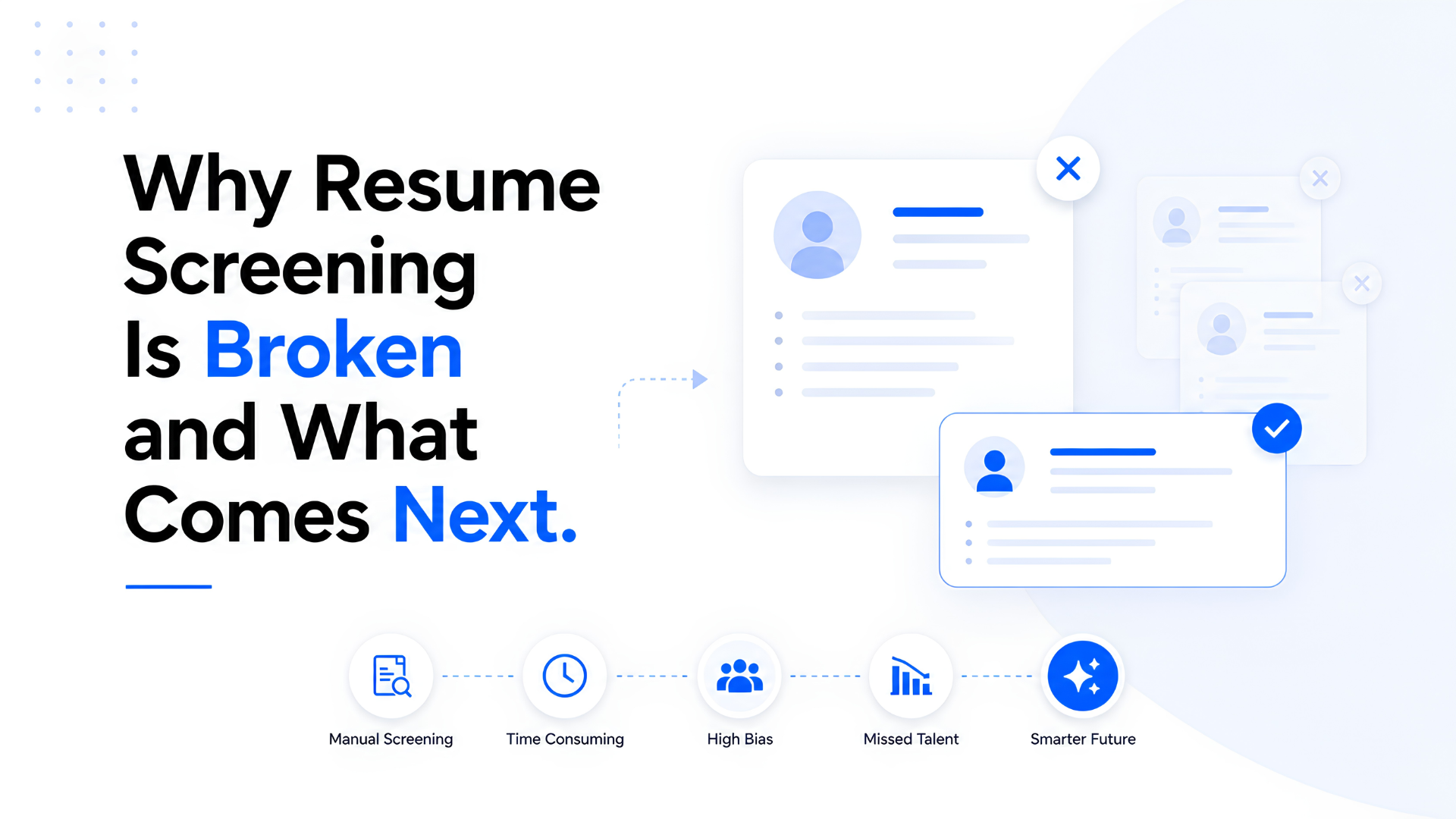
Every year, companies collectively spend billions of dollars on recruitment, and a significant portion of that investment flows into the earliest stage of the hiring funnel: resume screening. This is the process by which a pool of applicants is narrowed down to a shortlist of candidates who will receive further evaluation. It is also, by almost every measure, the most flawed stage in the entire recruiting pipeline. The tools most companies use to screen resumes have not fundamentally changed in two decades. Keyword-matching algorithms look for specific terms in the document. Rule-based filters eliminate candidates who do not meet rigid criteria like years of experience or degree type. Human recruiters, when they review resumes at all, spend an average of six to eight seconds per document. The system is fast, it is scalable, and it is failing in ways that directly damage hiring outcomes.
The scale of the failure is not marginal. Research from Harvard Business School and Accenture estimates that as many as 70% of the available talent pool is invisible to traditional screening processes. These are not unqualified candidates—they are people whose resumes do not conform to the formats, keywords, and career patterns that screening systems are designed to recognize. They are career changers, self-taught developers, returning parents, veterans transitioning to civilian roles, and professionals from non-traditional backgrounds. The screening system was built to process volume, and it does. But in processing volume, it systematically eliminates the very candidates who might bring the most value. This article explains why the current approach is broken, what the alternatives look like, and how the shift from resume screening to candidate intelligence is already underway.
The Keyword Matching Problem: Why ATS Filters Create False Negatives
The backbone of most resume screening systems is keyword matching. The recruiter or hiring manager defines a set of required skills, technologies, or qualifications, and the ATS scans each resume for those terms. If the resume contains enough matches, it advances. If not, it is
filtered out. This approach seems logical, and in a narrow sense it is: if a role requires experience with Python, then a resume that mentions Python is more likely to represent a qualified candidate than one that does not. But the logic breaks down rapidly when you move from individual keywords to the complex reality of professional capability.
The first problem is synonymy and variation. A candidate who lists “Python, Django, REST APIs, PostgreSQL” matches a different set of keywords than one who lists “Python, Flask, GraphQL, MongoDB,” even though both may be equally capable of doing the job. A candidate who writes “lead cross-functional teams of 15+” is expressing the same capability as one who writes “managed interdisciplinary squads,” but a keyword filter will only recognize one of them. The more specialized the role, the more severe this problem becomes, because specialized terminology has more variation and the cost of a false negative is higher.
The second problem is gaming. Candidates have learned that ATS systems reward keyword density, so they optimize their resumes accordingly. The result is a signal-to-noise problem: the system cannot distinguish between a candidate who genuinely has deep experience with a technology and one who has learned to include the right words. As we discussed in our analysis of why some AI recruiting tools have outdated candidate data, the data quality problem in recruiting is not limited to contact information—it extends to the entire signal chain, from sourcing through screening. When the screening system itself is processing degraded inputs, the false positive and false negative rates compound.
The Bias Built Into Every Screening Stage
Resume screening is not just inaccurate—it is systematically biased in ways that reduce both the quality and diversity of the hiring pipeline. The bias operates at multiple levels. At the human level, research has consistently demonstrated that reviewers are influenced by name-based signals (ethnicity, gender), institutional prestige (which university the candidate attended), and formatting quality (which correlates with socioeconomic background and access to professional development resources). These influences are largely unconscious, which makes them resistant to training and awareness programs. A reviewer who genuinely believes they are evaluating candidates purely on merit is often the most susceptible to unconscious bias, because they do not recognize the need to compensate for it.
At the algorithmic level, the bias is more subtle but no less damaging. Keyword-matching systems encode the preferences and assumptions of the people who designed the keyword lists. If the hiring manager specifies “Ivy League degree preferred,” the system will systematically rank candidates from those institutions higher, even if the degree institution has no causal relationship with job performance. If the keyword list reflects the jargon of a specific company culture or technical subculture, candidates from different backgrounds who use different terminology will be filtered out, not because they lack capability but because they lack the specific linguistic markers the system was trained on.
The practical consequence is that traditional screening does not just miss good candidates—it misses good candidates from specific backgrounds at disproportionate rates. According to
SHRM’s research on hiring bias, structured screening processes that rely heavily on keyword matching and rigid criteria produce 20–40% less diverse shortlists than processes that incorporate holistic evaluation. This is not a diversity-for-quality tradeoff. The homogeneous shortlists produced by traditional screening are also lower quality on average, because they are drawn from a narrower segment of the talent pool. The bias problem in screening is simultaneously a fairness problem and a performance problem, and solving one requires solving the other.
Why Adding ‘AI’ to a Broken Process Does Not Fix It
The most common response to the screening problem has been to layer AI on top of the existing process. ATS vendors have added “AI-powered” features: automated resume ranking, smart keyword suggestions, and machine learning models that predict candidate fit based on historical hiring data. These features are marketed as transformative, but most of them suffer from the same fundamental limitation as the systems they are meant to improve: they are optimizing within a broken framework. If your screening process is based on matching resumes to job descriptions, making the matching algorithm more sophisticated does not change the fact that you are still matching resumes to job descriptions—a proxy-based evaluation that is several steps removed from actual capability assessment.
The deeper problem is that most “AI screening” tools are trained on historical hiring decisions, which means they learn and perpetuate the biases and inefficiencies of those decisions. If a company has historically hired mostly from a small set of universities, the AI will learn that candidates from those universities are “better fits.” If a hiring manager has historically preferred candidates with a specific career trajectory, the AI will learn to rank those candidates higher. The AI is not evaluating candidates on their merits. It is evaluating them on how closely they resemble the candidates the company has hired in the past, which is a very different thing.
This is a classic case of the phenomenon we have described as more tools, same hiring problems. The industry keeps adding AI features to existing workflows without changing the underlying logic of those workflows. The result is a screening process that is faster and more automated but no more intelligent in the ways that matter. True intelligence in screening would mean evaluating candidates based on their actual capabilities, not on how well their resume matches a keyword list or resembles past hires. That requires a fundamentally different approach to candidate evaluation, not a better version of the same approach.
What Comes Next: From Resume Screening to Candidate Intelligence
The emerging alternative to resume screening is what might be called candidate intelligence: a holistic, multi-signal approach to evaluating whether a candidate is likely to succeed in a specific role. Instead of asking “does this resume contain the right keywords?”, a candidate intelligence approach asks “what do we know about this person’s actual capabilities, trajectory, and fit for this role?” The difference is not just semantic. It represents a shift from
document-level evaluation to person-level understanding, and it requires a fundamentally different set of data inputs and analytical capabilities.
A candidate intelligence system draws on multiple signals beyond the resume: the candidate’s professional history and career progression, their publicly available work (code repositories, publications, presentations, patents), their professional network and the quality of their endorsements, their activity and engagement on professional platforms, and their demonstrated impact in previous roles (not just what they were responsible for, but what they achieved). It synthesizes these signals into a multi-dimensional candidate profile that captures capability, trajectory, and potential in ways that a flat document like a resume cannot. The resume becomes one input among many, not the sole basis for evaluation.
The candidate intelligence approach is especially powerful for niche and technical roles where traditional resumes are often the worst indicator of actual capability. A software engineer’s GitHub profile, open-source contributions, and technical writing reveal far more about their ability than a bulleted list of past titles. A data scientist’s publications, Kaggle competitions, and blog posts provide evidence of analytical depth that no resume can capture. The candidate intelligence approach does not just evaluate these signals more broadly—it evaluates them more accurately, because it is looking at evidence of capability rather than claims of capability.
The Role of AI Voice Interviews in the Post-Resume World
One of the most significant developments in the shift away from resume-centric screening is the rise of AI-conducted voice interviews as a preliminary evaluation tool. Rather than filtering candidates based on document analysis and then waiting weeks for a human phone screen, companies are using AI voice interviews to assess communication ability, technical knowledge, cultural alignment, and role fit in a structured, consistent, and scalable format. The candidate records a 15–30 minute AI-guided interview on their own schedule, and the platform generates a detailed evaluation that goes far beyond what any resume can convey.
The advantage of this approach is that it evaluates the candidate directly rather than evaluating a document about the candidate. Communication skills, problem-solving approach, depth of domain knowledge, and enthusiasm for the role are all assessed through actual performance rather than inferred from resume bullet points. This dramatically reduces the false negative rate that plagues keyword-based screening, because candidates who might have been filtered out for non-standard resume formats or missing keywords now have an opportunity to demonstrate their capability directly. It also reduces bias, because the AI evaluates each candidate’s responses on their own merits rather than being influenced by name, institution, or format.
Critically, AI voice interviews also serve as a powerful engagement tool. Candidates who are invited to complete an AI interview feel that the company is investing in understanding them as a person, not just processing their resume. This perception of investment is a trust signal, and as we have explored in our work on how recruiters can build trust before the first
interview, trust is the currency that converts passive candidates into engaged ones. The AI interview is not just a screening mechanism—it is a relationship-building touchpoint that happens to generate rich evaluation data as a byproduct.
How Huntlo Reimagines Screening From the Ground Up
Huntlo’s approach to candidate screening reflects the shift from document processing to candidate intelligence. Rather than asking recruiters to upload job descriptions and match them against resumes, Huntlo builds a multi-dimensional understanding of each candidate that goes far beyond what any resume can capture. The platform researches each candidate’s professional background in real time, synthesizing signals from multiple sources to create a holistic profile that reflects actual capability, not just resume claims.
Because Huntlo uses agentic AI rather than rule-based filtering, the screening process adapts to each role and each candidate. It does not apply the same keyword list to every candidate for a given role. Instead, it evaluates each candidate against the specific requirements of the role while also considering the broader context of their career trajectory, demonstrated impact, and potential for growth. This produces shortlists that are not only more diverse but also higher quality, because the system is casting a wider net and evaluating candidates on what they can actually do, not on how well their resume conforms to a template.
For recruiting teams, the practical impact is straightforward: better candidates, faster. The hours spent manually screening resumes are replaced by AI-powered evaluation that is both more thorough and more consistent. The recruiters who are concerned about AI displacing their roles should note that the opposite is happening—as we have discussed in our analysis of whether recruiters should worry about AI replacing their jobs, the technology frees recruiters from the lowest-value work in the pipeline so they can focus on what only humans can do: building relationships, advising hiring managers, and making the nuanced judgment calls that define great recruiting. The screening process of the future does not eliminate the recruiter. It elevates them.
Related reading:
More Tools, Same Hiring Problems
Do AI Recruiting Tools Work for Niche or Technical Roles? | Should Recruiters Worry About AI Replacing Their Jobs?