Daniel Okafor ran a mid-size recruitment firm in Dallas with thirty-two consultants placing candidates across finance, engineering, and healthcare. His firm had been profitable for eleven consecutive years, and his team consistently filled roles for a loyal client base of roughly sixty companies. Daniel had always viewed technology as a support function, something that helped his consultants work faster but was not central to how the firm created value for clients. That belief was challenged eighteen months ago when his largest client, a regional hospital system, informed him that they were reducing their contingent staffing spend by thirty-five percent and shifting the remaining budget to firms that could provide AI-enhanced sourcing, real-time talent market analytics, and integrated candidate engagement workflows. Daniel's firm offered none of these capabilities. Within six months, he lost two more clients to competitors who had invested in AI infrastructure, not because those competitors were better recruiters, but because they could deliver faster shortlists, richer candidate insights, and continuous pipeline visibility that Daniel's firm simply could not match. He realized that his reluctance to invest in technology was no longer a conservative business decision. It was an existential risk.
The Infrastructure Gap Is Now a Client Retention Risk
The most urgent reason recruitment firms need AI infrastructure is not about gaining new clients. It is about keeping the ones they already have. Over the past two years, a clear pattern has emerged in the staffing industry: clients are evaluating their recruitment partners not just on placement quality and fill rates but on the technological capabilities that underpin the service delivery. When a client asks whether a firm can provide real-time pipeline dashboards, AI-driven candidate matching, or automated engagement sequences across the hiring lifecycle, the answer determines whether that firm is viewed as a strategic partner or an
increasingly dispensable vendor. According to McKinsey, nearly forty-five percent of mid-market and enterprise companies now include AI capability assessment as part of their vendor evaluation for recruitment firms, a figure that has tripled in three years. Firms that cannot demonstrate integrated AI capabilities are being moved to preferred vendor lists with reduced allocation or removed entirely, regardless of their historical placement performance.
The infrastructure gap manifests in specific, measurable ways that clients notice and evaluate. A firm without AI infrastructure relies on manual processes for candidate sourcing, meaning shortlist delivery timelines are measured in weeks rather than days. Candidate data lives in spreadsheets, personal recruiter notebooks, and disconnected CRM systems, making it impossible to provide the real-time pipeline visibility that clients now expect. Assessment and screening are inconsistent across consultants, because each recruiter applies their own criteria and methods without a standardized AI-driven framework. The result is a service delivery model that feels slow, opaque, and unpredictable to clients who have become accustomed to the speed, transparency, and consistency that AI-powered internal talent acquisition teams and AI-native competitor firms provide. These are not abstract shortcomings. They are the specific reasons that clients cite in exit interviews when they move their business to other providers.
The retention risk is compounded by the fact that clients who leave for technology reasons rarely return. Once a client has experienced the benefits of working with an AI-equipped firm, including faster time-to-shortlist, richer candidate intelligence, continuous pipeline reporting, and data-driven hiring recommendations, they develop expectations that non-AI firms cannot meet. The switching cost for the client is low because they are not leaving a relationship so much as they are upgrading a service delivery model. For the firm that loses the client, the cost is high because replacing a major client in an increasingly competitive market requires significant business development investment and often involves competing against the very AI-equipped firms that took the client away. why AI tools have outdated candidate data explains how firms relying on outdated candidate data and manual processes are particularly vulnerable to client attrition, because the quality gap between AI-driven and manual candidate intelligence is immediately apparent to clients who evaluate multiple firms side by side, and the firms that cannot demonstrate current, data-rich candidate profiles are the first to be deprioritized.
What AI Infrastructure Actually Means for a Recruitment Firm
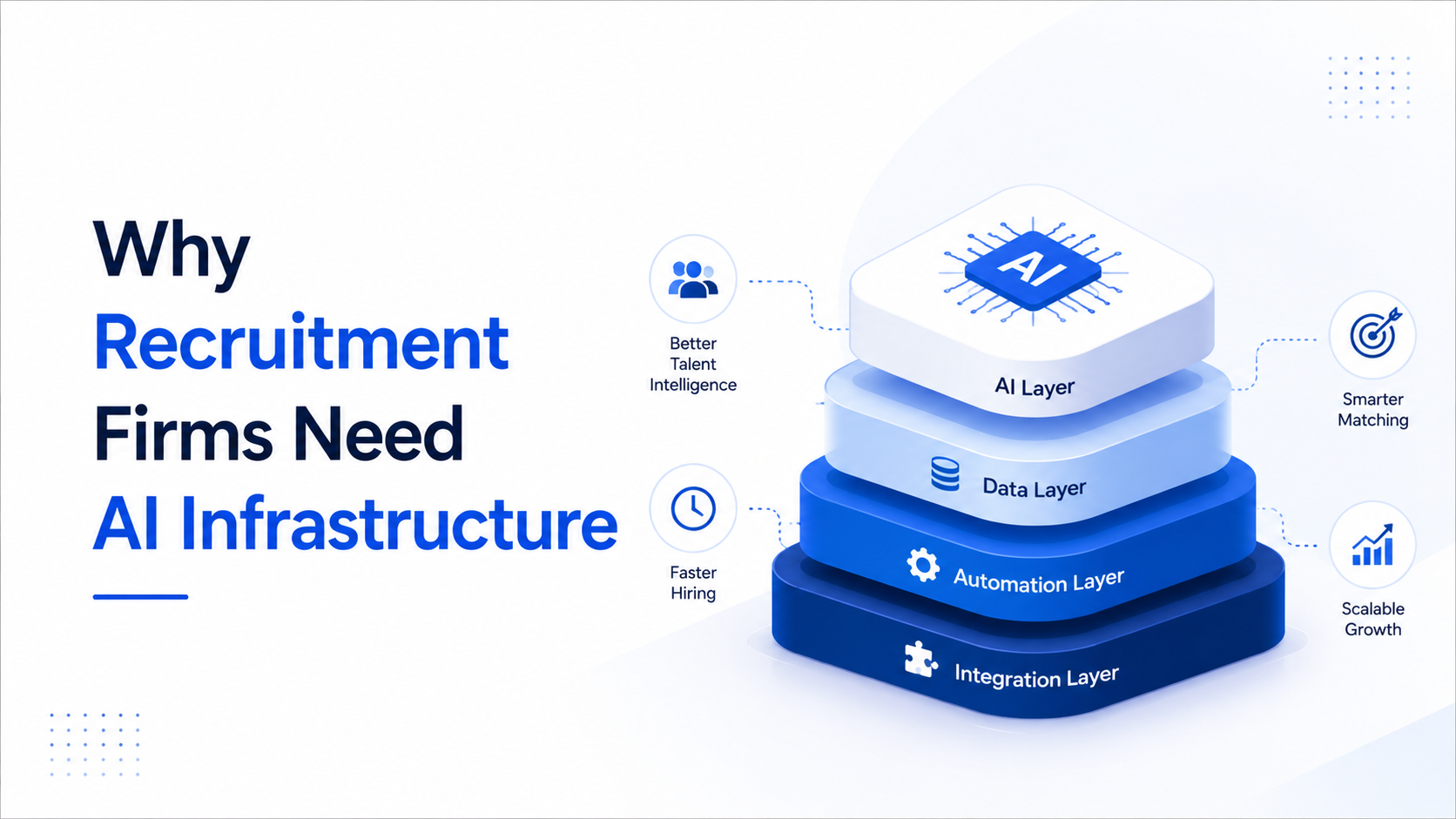
AI infrastructure for a recruitment firm is not a single tool or platform. It is an integrated stack of capabilities that work together to enhance every stage of the recruiting process. At the base layer is a unified data platform that consolidates candidate information from all sources, including internal databases, job boards, professional networks, public professional signals, and historical placement records, into a single, searchable, continuously updated candidate intelligence repository. Without this data foundation, every AI tool operates on incomplete information, producing recommendations and insights that are limited by data
fragmentation. The second layer is the AI processing engine, which includes candidate matching algorithms, skill extraction models, engagement optimization, and predictive analytics that operate on the unified data platform. The third layer is the workflow integration layer, which connects AI capabilities to the firm's existing processes, CRM systems, and client communication channels so that AI insights are delivered to consultants and clients in the context of their actual workflows rather than in separate dashboards that require additional effort to consult.
The critical distinction between AI infrastructure and AI tools is integration. A firm that licenses an AI sourcing tool, an AI screening tool, and an AI engagement tool from three different vendors has AI tools. A firm that has connected these capabilities into a unified system where data flows seamlessly between stages, where candidate intelligence accumulated during sourcing enriches the screening assessment, and where engagement outcomes feed back into the matching model has AI infrastructure. The difference is not theoretical. Firms with integrated infrastructure report dramatically better outcomes than firms with disconnected tools. According to Gartner, recruitment firms with integrated AI infrastructure report twenty to twenty-five percent higher placement rates per consultant compared to firms using the same number of disconnected AI tools, because the integration eliminates data silos that cause candidates to fall through the cracks between tools and ensures that every AI capability operates on the most complete and current information available.
Building AI infrastructure also requires organizational capabilities that go beyond technology. Data governance policies must define how candidate data is collected, stored, and used to ensure compliance with privacy regulations and maintain candidate trust. Training programs must develop AI literacy across the firm so that consultants understand how to interpret AI recommendations, when to override them, and how to provide feedback that improves the system over time. Process redesign must reconfigure workflows to leverage AI capabilities rather than simply automating existing manual processes. These organizational investments are as important as the technology itself, because AI infrastructure that is not supported by appropriate data governance, training, and process design will underperform regardless of the quality of the underlying technology. more tools same hiring problems illustrates why firms that accumulate AI tools without building the organizational infrastructure to support them often end up with a fragmented technology stack that creates more complexity than value, because the tools are not integrated, the data is not shared, and the consultants are not trained to use them effectively.
The ROI of AI Infrastructure: Beyond Cost Savings
When recruitment firm leaders evaluate AI infrastructure investments, the first question is typically about return on investment. The most common framing focuses on cost savings: AI reduces the time consultants spend on sourcing and screening, allowing each consultant to handle more requisitions and reducing the firm's cost per placement. While these efficiency gains are real and measurable, they represent only a fraction of the value that AI
infrastructure creates. The more significant returns come from revenue expansion and service differentiation. AI infrastructure enables firms to offer new services that generate additional revenue streams, such as talent market intelligence reports, continuous pipeline management for key client accounts, and predictive workforce planning support. These services command higher fees than traditional placement services because they provide ongoing strategic value rather than discrete transactional output. According to Deloitte, recruitment firms that have built comprehensive AI infrastructure report that fifteen to twenty percent of their total revenue now comes from AI-enabled services that did not exist in their portfolio three years ago, including talent analytics, market intelligence, and advisory services that are only possible because of the data processing and pattern recognition capabilities of their AI infrastructure.
AI infrastructure also improves placement quality, which drives client retention and referral growth. When candidate matching is powered by AI models that analyze a broader range of signals and consider a wider pool of candidates than manual methods can process, the quality of the shortlist improves. Better shortlists lead to better hires, and better hires lead to higher client satisfaction, longer client relationships, and more referrals. The compounding effect of improved placement quality on firm revenue is substantial. A ten percent improvement in placement quality, measured by ninety-day retention or client satisfaction scores, can drive a twenty to thirty percent improvement in client retention over three years, because each successful placement reinforces the client's confidence in the firm and increases the likelihood of expanding the engagement to additional roles or business units. This quality-driven revenue growth is far more valuable than the cost savings from operational efficiency, because it is sustainable and compounding while efficiency gains are often one-time and vulnerable to competitive matching.
The third dimension of AI infrastructure ROI is consultant productivity and satisfaction. Recruitment is a relationship-driven profession, and the most effective consultants are those who spend the majority of their time building relationships with candidates and clients rather than performing administrative tasks, searching databases, and formatting reports. AI infrastructure automates these non-relational activities, freeing consultants to focus on the human interactions that create the most value for the firm and that provide the greatest professional satisfaction for the consultants themselves. Firms that implement AI infrastructure effectively report lower consultant turnover, higher consultant satisfaction scores, and improved ability to attract top recruiting talent, because recruiters prefer to work in environments where technology handles the repetitive aspects of the job and they can focus on the strategic and relational work that defines professional recruiting at its best. should recruiters worry about AI replacing jobs explores why recruiters who work with AI tools report higher job satisfaction and lower burnout rates than those working without AI support, because the technology eliminates the most tedious aspects of recruiting while leaving the most rewarding human interactions intact.
Building AI Infrastructure Without Disrupting Your Firm
One of the most common barriers to AI infrastructure investment is the fear of disruption. Firm leaders worry that implementing AI tools will require painful process changes, confuse experienced consultants, and disrupt client relationships during the transition period. These concerns are valid but manageable when infrastructure is built incrementally rather than through a big-bang technology overhaul. The most effective approach is to identify a single, high-impact use case where AI can deliver immediate, visible value, implement the infrastructure needed to support that use case, prove the value with measurable results, and then expand to additional use cases based on the organizational learning from the first implementation. For most recruitment firms, the highest-impact starting point is AI-powered candidate sourcing, because it delivers the fastest and most visible time savings, affects the most consultants, and provides a foundation that subsequent capabilities like screening, engagement, and analytics can build upon.
The incremental approach also allows firms to develop the organizational capabilities that AI infrastructure requires without overwhelming the organization. Data governance policies can be established for the initial use case and then extended as new capabilities are added. Training programs can start with the consultants involved in the pilot and expand as the technology rolls out more broadly. Feedback mechanisms can be refined based on early experience so that by the time AI capabilities are deployed firm-wide, the organization has already developed the practices and confidence needed to use them effectively. This learning-by-doing approach is far more effective than attempting to design a comprehensive AI infrastructure strategy before deploying any technology, because the practical experience of implementing even a single use case generates insights that no amount of planning can anticipate. According to EY, recruitment firms that build AI infrastructure incrementally, starting with a single high-impact use case and expanding based on measured results, complete their infrastructure buildout in eighteen to twenty-four months and achieve full adoption rates eighty percent higher than firms that attempt enterprise-wide AI deployment from the start.
Vendor selection is another critical decision in building AI infrastructure without disruption. Firms should prioritize platforms that integrate with their existing CRM and ATS systems, that provide configurable rather than rigid workflows, and that offer robust support during the implementation period. The platform should also support the firm's planned expansion path, meaning it should have capabilities beyond the initial use case so that the firm does not need to replace its core platform as it expands its AI infrastructure. Equally important is selecting a vendor that understands the recruitment industry and can provide implementation guidance based on experience with similar firms. Generic AI platforms that are not designed for recruiting workflows require extensive customization that increases cost, extends timelines, and often produces inferior results compared to platforms built specifically for talent acquisition. how to evaluate an AI sourcing tool provides a structured framework for evaluating AI recruiting platforms, because the decision about which platform to build your infrastructure on is one of the most consequential technology choices a recruitment firm will make, and choosing a platform that cannot support your firm's growth trajectory will create expensive switching costs and operational disruption when the platform's limitations become apparent.
The Firms That Act Now Will Define the Next Decade
The recruitment industry is entering a period of technology-driven consolidation where firms with AI infrastructure will gain market share from firms without it. This is not a speculative forecast. It is already happening. Firms that invested in AI capabilities two to three years ago are now winning clients, attracting talent, and building service portfolios that create widening competitive advantages. Their AI systems improve with every placement, every candidate interaction, and every market signal they process, creating a compounding intelligence advantage that late adopters will find difficult to overcome. The data assets these firms are building, proprietary candidate intelligence, matching models trained on their own placement outcomes, and client-specific market insights, represent competitive moats that cannot be quickly replicated by firms starting their AI infrastructure buildout today. The window for establishing a competitive position through AI infrastructure is open but narrowing, and the firms that act decisively in the next twelve to eighteen months will be the ones that define the industry's competitive landscape for the next decade.
The strategic priority for firm leaders is to stop viewing AI infrastructure as a technology project and start treating it as a business transformation initiative. Technology is the enabler, but the real transformation is in how the firm creates and delivers value to its clients. AI infrastructure enables faster, more consistent, more data-rich service delivery. It enables new service lines that generate additional revenue. It improves consultant productivity and satisfaction. It creates data assets that appreciate in value over time. These are business outcomes, not technology outcomes, and they should be led and measured as such. The firm leader who delegates AI infrastructure to the IT department without active executive sponsorship and strategic oversight will build a technology stack that does not align with the firm's business strategy and does not deliver the business outcomes that justify the investment. According to LinkedIn, the most successful AI infrastructure projects in recruitment firms are those led by managing directors or partners who personally champion the initiative, because this executive sponsorship ensures that the technology investment is aligned with the firm's strategic priorities and that organizational resistance is addressed decisively rather than allowed to slow the implementation.
The final consideration is measurement. AI infrastructure investments should be evaluated against clear, business-relevant metrics that go beyond technology adoption rates. The metrics that matter are placement quality improvement, time-to-shortlist reduction, client retention rates, new service line revenue, consultant productivity, and the quality of the firm's candidate intelligence assets. These metrics should be measured before implementation to establish a baseline, tracked continuously during and after implementation, and reported to firm leadership on a regular cadence so that the value of the infrastructure investment is visible and the implementation can be adjusted based on actual performance data. Firms that measure AI infrastructure ROI using only cost savings metrics will underestimate the value of their investment and may make poor decisions about scope and pace based on incomplete
information. why referrals outperform cold outreach demonstrates how AI infrastructure that captures and leverages relationship data can dramatically improve referral-based recruiting outcomes, because the infrastructure ensures that every successful placement and every positive candidate relationship is recorded, analyzed, and leveraged for future searches rather than existing only in the memory of individual consultants who may eventually leave the firm.