Rebecca Okonkwo, managing director of a boutique financial services recruitment firm in London, had just lost her second major client in six months to a competitor that was not offering lower fees or faster delivery. What the competitor was offering was something she could not match: detailed talent market intelligence that gave the client's hiring managers a strategic advantage in their planning. The competitor's proposals included compensation benchmarking across twenty peer companies, candidate availability heat maps for specialized roles, workforce mobility analysis showing which firms were losing talent and why, and predictive models estimating how long specific searches would take based on the firm's own historical data. Rebecca's proposals, by contrast, included candidate profiles, fee structures, and timeline estimates based on her recruiters' experience. The difference was not in the quality of candidates or the competence of the recruiting team. The difference was that the competitor had invested two years in building a proprietary talent intelligence capability that transformed their client value proposition from candidate delivery to strategic insight. Rebecca's clients were not leaving because they were unhappy with her service. They were leaving because the competitor was offering a fundamentally different and more valuable service that Rebecca's firm could not replicate without building its own intelligence infrastructure.
What Proprietary Talent Intelligence Actually Means
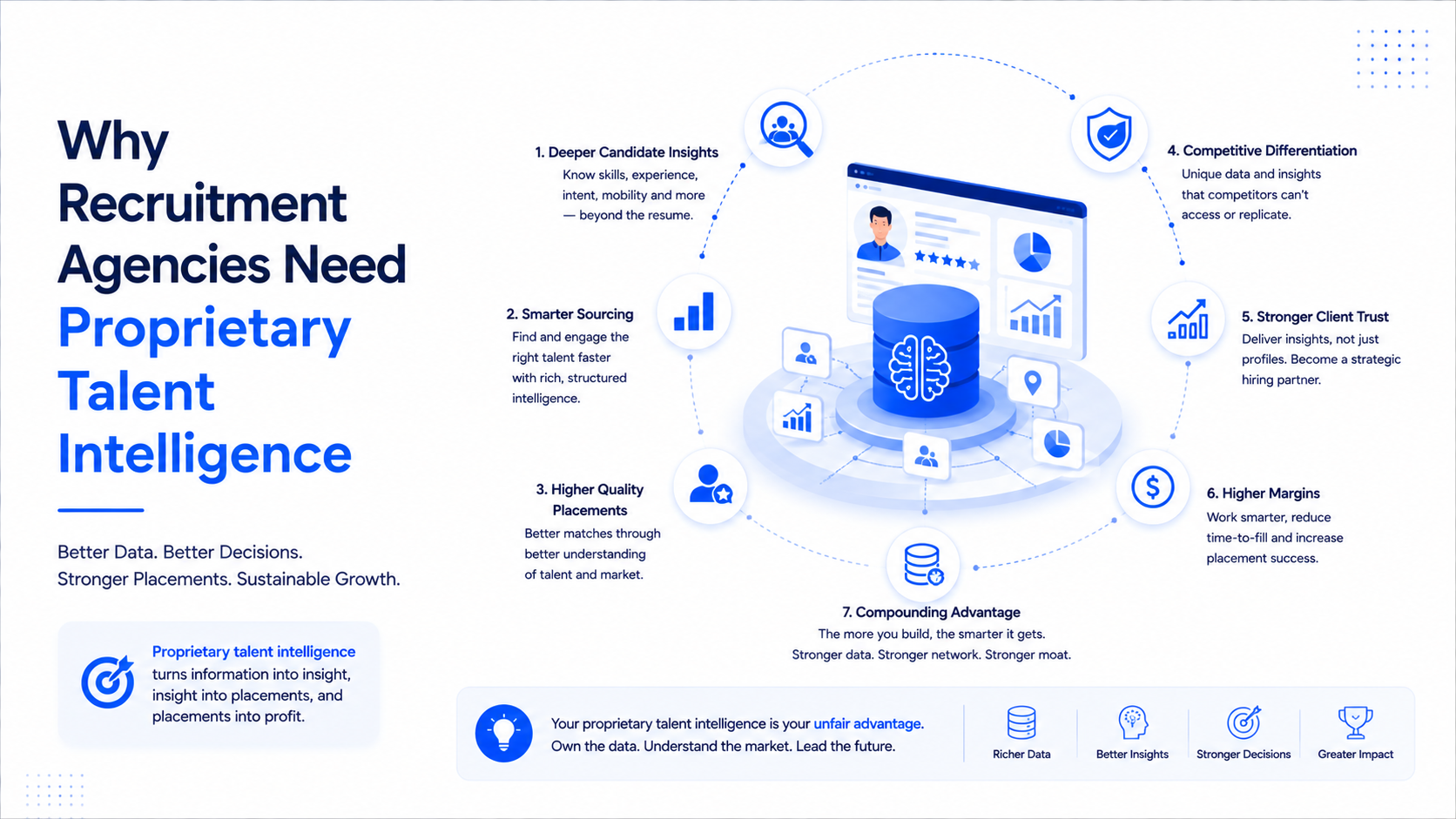
Proprietary talent intelligence is the structured knowledge that a recruitment firm derives from its own operational data, its own client engagements, and its own market interactions, organized and analyzed to produce insights that no competitor can access or replicate. It is distinct from generic market intelligence, which includes published salary surveys, industry employment reports, and publicly available labor market data, in that it reflects the specific
patterns, relationships, and outcomes that the firm has directly observed and documented through its recruiting activity. A salary survey from a research firm can tell you the average compensation for a product manager in London. Proprietary talent intelligence can tell you that product managers at Company A are leaving at three times the industry average rate, that they are being recruited primarily by Company B which is offering fifteen percent above market, and that the candidates who accept roles at Company B have a sixty-five percent probability of leaving within eighteen months based on the firm's own placement history. The difference in strategic value between these two types of intelligence is not incremental. It is categorical.
The concept of proprietary intelligence is well established in other professional services. Management consultancies like McKinsey and BCG built their competitive positions not on the quality of individual consultants but on the proprietary knowledge bases, frameworks, and benchmarking datasets that their consultants access and contribute to with every engagement. Investment banks maintain proprietary deal databases and market models that give them information advantages in advising clients. Law firms build proprietary knowledge of regulatory interpretation through their accumulated case experience. In each case, the intelligence asset is the firm's primary competitive moat, more defensible than any individual practitioner's expertise because it accumulates across hundreds or thousands of engagements and would take years for a competitor to reconstruct. Recruitment agencies have been slow to adopt this model, historically competing on recruiter talent and relationship quality rather than on proprietary data assets. But the firms that are now winning the largest and most strategically important client relationships are those that have made the shift from relationship-only competition to intelligence-based competition.
The urgency of this shift is being amplified by AI. AI recruiting tools are commoditizing the operational capabilities of sourcing, screening, and candidate engagement that were once the primary differentiators between agencies. When every agency can deploy AI that searches millions of profiles and engages candidates at scale, the operational differences between agencies narrow to the point of irrelevance for most clients. In this environment, proprietary data and the insights derived from it become one of the few remaining bases for genuine differentiation. An agency that can tell a client, based on its own data from two hundred similar searches, that the average time to fill for a specific role type is forty-two days, that the primary reason candidates decline offers is compensation structure rather than base salary, and that the three most effective sourcing channels for this role generate candidates with thirty percent higher retention rates, offers a depth of insight that no off-the-shelf AI tool can match. agentic AI platforms vs automated ones explains how agentic AI platforms serve as the collection and analysis engine for proprietary talent intelligence, automatically capturing data from every recruiting interaction and transforming it into structured insights that compound over time, because the platform ensures that every candidate conversation, every placement outcome, and every client interaction contributes to an intelligence asset that grows more valuable with use.
Why Generic Data Is No Longer Enough
Generic market data, the salary surveys, labor market reports, and industry benchmarks that recruitment agencies have traditionally relied on for market intelligence, suffers from three fundamental limitations that make it increasingly inadequate for client advisory purposes. First, generic data is backward-looking. Published salary surveys typically reflect data that is six to twelve months old by the time it reaches the market, and in fast-moving talent markets, particularly in technology, financial services, and healthcare, compensation can shift significantly within a single quarter. A client making a hiring decision based on last year's salary survey may find that the market has moved fifteen to twenty percent since the data was collected, rendering the benchmark irrelevant and potentially causing the client to lose candidates to better-informed competitors who have access to more current intelligence.
Second, generic data lacks the granularity that clients increasingly require. A published salary survey might report that the median total compensation for a senior data scientist in the United Kingdom is ninety-five thousand pounds. But a hiring manager at a fintech company in London competing for AI specialists does not need the UK median. They need to know what specific competitors are paying for candidates with similar skill profiles, what the compensation trajectory looks like for this role type, which benefits and equity structures are most effective in closing candidates, and what the candidate's current employer is likely to offer as a counter-retention package. This level of specificity cannot come from generic data because it is derived from the micro-interactions of the recruiting process, the actual offers made, the actual counteroffers received, and the actual acceptance and rejection decisions that only the firms directly involved in these transactions can observe. According to McKinsey, organizations that rely primarily on generic benchmarking data for talent decisions make compensation errors of ten to fifteen percent in either direction compared to organizations that supplement generic data with proprietary transaction intelligence, because the generic data cannot capture the role-specific, company-specific, and candidate-specific factors that determine actual market dynamics.
Third, generic data provides no competitive differentiation because every agency has access to the same sources. When a recruitment firm presents a client with data from a published salary survey or a widely available labor market report, the client recognizes that the same data is available to every other agency they could engage. The intelligence has no exclusivity and therefore no strategic value beyond demonstrating that the agency can read published reports. Proprietary intelligence, by contrast, is by definition exclusive to the firm that collected it. When an agency presents client-specific talent market analysis drawn from their own placement data, their own candidate interactions, and their own market observations, the client recognizes that this intelligence is unique and cannot be obtained from any other source. This exclusivity transforms the agency's value proposition from interchangeable service provider to strategic intelligence partner, which is a fundamentally different and more defensible market position. more tools same hiring problems explains why agencies that present clients with insights drawn from generic tools and public data sources remain vulnerable to competitive displacement, because the client can access the same data directly and does not need the agency as an intermediary.
The Components of a Proprietary Talent Intelligence System
A proprietary talent intelligence system for a recruitment agency comprises four interconnected components. The first is the data foundation: the structured, consistent collection of data from every recruiting interaction the firm conducts. This includes candidate profiles with detailed skill assessments and career histories, compensation data from actual offers made and accepted, hiring manager feedback and interview assessments, time-to-fill metrics broken down by role type, geography, and seniority, candidate decision outcomes including offers accepted, declined, and counteroffers received, and post-hire performance and retention data tracked over six, twelve, and twenty-four month horizons. The data foundation must be comprehensive enough to support meaningful analysis and consistent enough to enable reliable comparison across searches, clients, and time periods. Most agencies collect some of this data already, but typically in fragmented systems, inconsistent formats, and without the discipline needed to make it analytically useful.
The second component is the analytics layer that transforms raw data into actionable intelligence. This layer includes descriptive analytics that summarize historical patterns, such as average fill rates by role type and geographic market; diagnostic analytics that identify the drivers of outcomes, such as which sourcing channels produce the highest-quality candidates for specific role types; predictive analytics that forecast future outcomes, such as estimated time-to-fill for a new search based on historical patterns for similar roles; and prescriptive analytics that recommend specific actions, such as which candidates to prioritize based on predicted fit and likelihood of acceptance. The analytics layer does not require a dedicated data science team. Modern AI and analytics platforms provide the analytical capabilities that agencies need, and the most important requirement is not technical expertise but rather the discipline to collect data consistently and the curiosity to ask the right questions of it. According to Gartner, recruitment agencies that implement even basic descriptive and diagnostic analytics on their placement data report fifteen to twenty percent improvements in fill rates and ten to fifteen percent reductions in time-to-fill within the first year, because the analytics reveal process inefficiencies and candidate market dynamics that experienced recruiters intuitively sense but cannot systematically quantify.
The third component is the distribution mechanism that delivers intelligence to clients and recruiters in formats that drive decision-making. Talent intelligence that lives in a database or a dashboard that nobody looks at creates no competitive value. The intelligence must be embedded in the firm's client interactions, candidate presentations, and strategic proposals. This means developing standardized intelligence products, such as market overview reports for specific role types, compensation benchmarking analyses for client planning cycles, candidate availability assessments for workforce planning, and competitive talent dynamics reports that show how competitors are hiring and what that means for the client's talent strategy. These products should be produced systematically and delivered proactively, not just when a client asks. The fourth component is the feedback loop that continuously improves the intelligence
system based on outcomes. Every placement, every candidate rejection, and every client feedback interaction should be captured and used to calibrate the analytical models, refine the market assessments, and improve the predictive accuracy of the system. This feedback loop is what makes the intelligence proprietary and cumulative, because the system gets smarter with every engagement. how to evaluate an AI sourcing tool provides a framework for assessing the maturity of a recruitment agency's talent intelligence capability, because the assessment identifies which of the four components are in place and which gaps are preventing the agency from converting its operational data into a defensible competitive advantage.
How Talent Intelligence Changes the Client Conversation
The most immediate impact of proprietary talent intelligence is on the quality and depth of client conversations. When a recruitment agency approaches a client with intelligence rather than just candidate profiles, the conversation shifts from transactional execution to strategic partnership. Instead of asking the client what role they need to fill and what budget they have, the intelligence-equipped recruiter can open the conversation with relevant market context. They can tell the client that three of their key competitors have increased hiring for the role type they are considering, that the available talent pool for this role has contracted by twenty percent over the past two quarters, and that based on the firm's recent placements in this space, the compensation range the client is considering may need adjustment by ten to fifteen percent to be competitive. This intelligence-led approach positions the recruiter as a strategic advisor who brings unique market knowledge to the relationship, rather than as a service provider who executes searches based on the client's specifications.
The intelligence advantage also transforms the proposal and pricing conversation. When a recruitment agency's proposal includes proprietary talent intelligence, the client evaluates the agency not on fee rates or delivery timelines alone but on the strategic value of the intelligence the agency provides. An agency that includes a talent market analysis showing current candidate availability, compensation benchmarks drawn from actual transaction data, and a predictive timeline based on the firm's own fill-rate data for similar roles is offering something that no fee discount can replicate. The client's procurement team may still negotiate on price, but the comparison is no longer between interchangeable service providers. It is between an agency that delivers candidates and an agency that delivers candidates plus strategic intelligence. According to Deloitte, professional services firms that embed proprietary data and analytics in their client proposals win thirty-five to forty-five percent more competitive engagements than firms that present solely on capability and price, because the intelligence demonstrates depth of expertise, provides immediate value regardless of whether the engagement proceeds, and creates a differentiation that pricing cannot overcome.
Talent intelligence also fundamentally changes client retention dynamics. Clients who receive ongoing intelligence from their recruitment partner, market updates, compensation trend reports, competitor hiring analyses, and talent pool assessments, develop a dependency on the intelligence itself, not just on the recruiting outcomes. This dependency creates genuine
switching costs because replacing the recruitment partner means losing access to a stream of strategic intelligence that the client has incorporated into their own talent planning processes. The client's internal talent acquisition team begins to rely on the agency's market reports for planning purposes, the hiring managers begin to reference the agency's compensation benchmarks in their budget requests, and the HR leadership begins to use the agency's competitive intelligence in their workforce strategy discussions. When the intelligence is this deeply embedded in the client's decision-making, switching agencies is not just a matter of finding a new recruiting partner. It means rebuilding an intelligence infrastructure that the client has come to depend on. This is the most defensible form of client retention, because it is based on operational integration rather than interpersonal loyalty. why AI tools have outdated candidate data explains why agencies that continue competing solely on candidate delivery without providing embedded intelligence services remain exposed to client churn, because clients can and will switch to providers who offer both candidates and the strategic insights that help them make better talent decisions.
Building Your Intelligence Advantage Without a Data Science Team
The most common misconception about proprietary talent intelligence is that it requires a large data science team and a multi-million-dollar technology investment. In practice, the most effective intelligence systems at recruitment agencies are built incrementally, starting with the data the agency already has and layering analytical capabilities on top of it as the value of the intelligence becomes apparent. The first step is to audit the data the agency currently collects and identify the gaps that prevent meaningful analysis. Most agencies discover that they collect far more data than they realize, but that the data is fragmented across their applicant tracking system, customer relationship management platform, email archives, recruiter notes, and financial systems, with no integration and inconsistent formatting. The audit identifies what data exists, where it lives, and what it would take to bring it into a unified, queryable format. This step alone often reveals immediate analytical opportunities, because simply aggregating data that the agency already collects into a single view can produce insights that were previously invisible.
The second step is to establish a disciplined data collection process that ensures every new recruiting engagement contributes consistently to the intelligence system. This means defining standard data fields for every placement, every candidate interaction, and every client engagement, and ensuring that recruiters populate these fields completely and accurately. The biggest barrier to building a proprietary intelligence system is not technology but discipline. Recruiters who are measured and rewarded on placement volume often view data entry as administrative overhead that takes time away from revenue-generating activity. Overcoming this resistance requires aligning performance metrics and incentives with data quality, making the intelligence system valuable enough to recruiters that they want to contribute to it, and automating data capture wherever possible so that the burden on recruiters is minimized.
According to LinkedIn, recruitment agencies that automate data capture through AI-powered platforms, where candidate interactions, assessment outcomes, and placement data are captured automatically rather than entered manually, report sixty to seventy percent higher data completeness scores and three to four times faster intelligence accumulation compared to agencies relying on manual data entry, because automation eliminates the trade-off between recruiting productivity and data quality.
The third step is to start producing and distributing intelligence products before the system is perfect. Too many agencies delay launching their intelligence capability until they have accumulated years of perfectly clean data, which means they never start. The right approach is to begin producing intelligence products as soon as the data supports even basic analysis, and to improve the quality and depth of those products over time. A simple monthly talent market summary for key client sectors, a quarterly compensation benchmarking report, or a candidate availability assessment for the agency's most common role types are all valuable intelligence products that can be produced with relatively basic data. The key is consistency and distribution, delivering the same type of intelligence on a regular schedule so that clients begin to rely on it and integrate it into their planning. As the data accumulates and the analytical capabilities mature, the intelligence products become more sophisticated, more predictive, and more differentiated. AI sourcing vs AI recruiting explains why the agencies that build the strongest intelligence advantages are those that start with the data from their sourcing and recruiting operations and systematically transform it into market insight, because the operational data that agencies generate every day is the raw material of a proprietary intelligence asset that competitors cannot access or replicate.