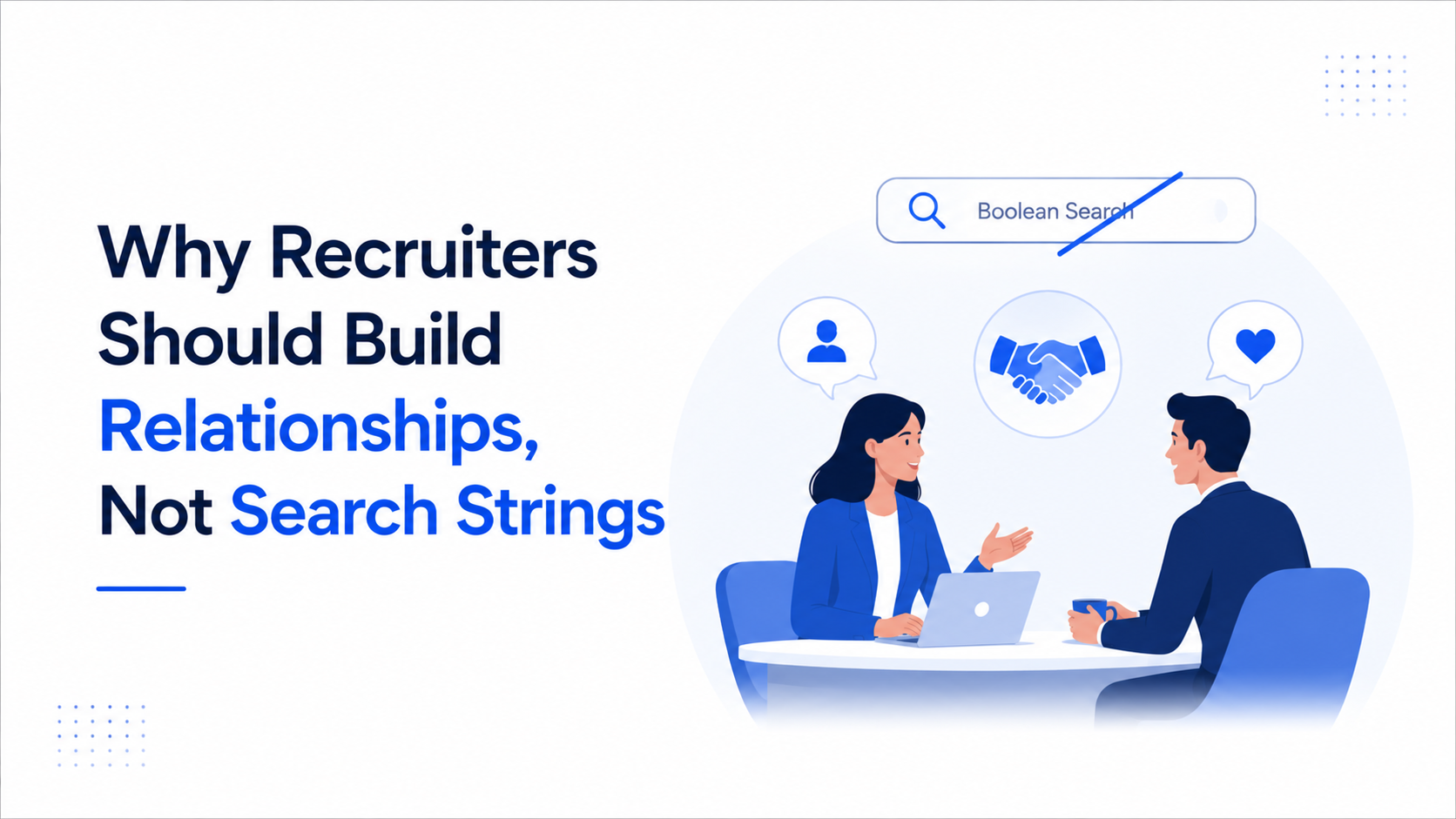
James Okonkwo was the top biller at his Minneapolis recruiting firm for three consecutive years, and he achieved that distinction with a practice that his colleagues found almost absurdly old-fashioned. While other recruiters spent their mornings building elaborate Boolean search strings, iterating through keyword combinations, and scrolling through pages of search results, James spent his first forty-five minutes each day sending personal messages to candidates he had placed, candidates he had interviewed but not placed, and hiring managers he had worked with in the past. He asked about their projects, their team changes, their career frustrations, and their hiring plans. He kept detailed notes on every conversation and followed up on specific details weeks or months later. His colleagues teased him for being a social worker rather than a recruiter. But James closed placements at nearly double the rate of his peers, and his candidate retention at twelve months was thirty-five percent higher than the firm average. When the firm adopted an AI sourcing platform that automated the search process his colleagues spent hours on, James's colleagues suddenly had more time but did not know what to do with it. James, who had never relied on search as his primary activity, was already doing the thing that AI could not replace, and his performance advantage widened further.
The Sourcing Commodity Trap
For most of the past two decades, the primary technical skill that differentiated great recruiters from average ones was the ability to construct effective search strings. Boolean logic, keyword optimization, and platform-specific search syntax were the recruiter's craft, and
recruiters who mastered these skills could identify candidates that less skilled colleagues could not find. This skill was genuinely valuable when candidate databases were fragmented, search tools were primitive, and the ability to navigate complex queries provided a genuine information advantage. AI has eliminated this advantage entirely. Modern AI sourcing tools can search across multiple data sources simultaneously, understand semantic meaning rather than requiring exact keyword matches, and identify candidates whose profiles match a role's requirements even when the candidate has not used the specific keywords the recruiter would have searched for. The AI can do in seconds what used to take a skilled recruiter thirty to sixty minutes, and it can do it across a data universe that no manual search could cover. Sourcing has become a commodity, and recruiters who continue to define their value by their search expertise are defending a moat that no longer exists.
The commodity trap is dangerous because it feels productive. Building and refining search strings, running searches, and reviewing results are tangible activities that produce a sense of accomplishment. A recruiter who spends three hours constructing and iterating searches feels busy and effective, even though the AI could have produced equivalent or better results in minutes. This activity bias, the tendency to gravitate toward tasks that feel productive regardless of their actual impact, is one of the biggest barriers to recruiter effectiveness in an AI-enabled environment. Recruiters who redirect the time they currently spend on search toward relationship-building activities will see a dramatic improvement in their placement outcomes, but making this shift requires overcoming the psychological comfort of familiar, measurable tasks. According to LinkedIn, recruiters who spend less than twenty percent of their time on sourcing and more than sixty percent on candidate and hiring manager interactions report forty to fifty percent higher placement rates than recruiters who spend the majority of their time on search and administrative tasks, because the interactions, not the searches, are what actually close placements.
The shift from search expertise to relationship excellence is not just a strategic recommendation. It is an economic imperative. When AI handles sourcing, the recruiter's time becomes the firm's most expensive variable cost. Every hour a recruiter spends on a task that AI can do is an hour of expensive human capacity that is not being used for the high-value activities that justify the recruiter's compensation. The firms that will thrive in the AI era are those that treat their recruiters' time as a scarce strategic resource and deploy it exclusively on activities where human judgment, empathy, and relationship skill create value that technology cannot replicate. This means that the recruiter's job description must be rewritten, not by HR but by the recruiters themselves, who must take ownership of redefining their role around relationship building rather than resisting the shift because it threatens their familiar identity as search experts. AI sourcing vs AI recruiting explains why the industry's conflation of sourcing with recruiting has obscured the distinction between finding candidates and placing them, and why AI's automation of sourcing makes this distinction critically important for recruiters who want to remain relevant in a technology-enabled industry.
The Relationship Skills That AI Cannot Replicate
The specific relationship skills that create irreplaceable recruiter value fall into three categories: trust building, motivation understanding, and negotiation navigation. Trust building goes far beyond maintaining regular contact with candidates. It requires the recruiter to demonstrate genuine understanding of the candidate's career context, provide honest and sometimes uncomfortable feedback about opportunities, and act as an advisor rather than a salesperson. When a recruiter tells a candidate that a particular opportunity is not the right fit for their long-term goals, even though referring the candidate would generate a placement fee, the recruiter earns a level of trust that no AI interaction can create. The candidate remembers that the recruiter prioritized their interests over the recruiter's own revenue, and this memory creates a relationship that persists across multiple job searches, career transitions, and industry changes. Trust built through honest, candidate-centric advisory behavior is the most durable asset a recruiter can possess, because it generates referrals, repeat business, and candidate loyalty that no technology platform can replicate.
Motivation understanding is the ability to discern not just what a candidate says they want in their next role but what they actually need, which are often different things. A candidate may say they want a higher salary when what they actually need is a role with more autonomy, or they may say they want to work at a larger company when what they actually need is a manager who will invest in their professional development. Discovering the real motivation requires the kind of nuanced conversation, active listening, and follow-up questioning that depends on interpersonal skill and emotional intelligence. An AI can analyze a candidate's resume and career trajectory to suggest what they might be looking for, but it cannot have a twenty-minute conversation that reveals the candidate's unspoken frustration with their current manager's micromanagement style or their growing interest in transitioning to a different functional area. These motivational insights, which emerge from human conversation rather than data analysis, are what enable a recruiter to match a candidate with an opportunity that addresses their actual needs rather than their stated preferences, producing placements that are more satisfying for the candidate and more successful for the employer. why referrals outperform cold outreach demonstrates how recruiters who understand candidate motivations at a deep level generate significantly more referral-based placements, because candidates refer their network to recruiters they trust to understand and advocate for their contacts' real career interests rather than simply trying to fill a requisition.
Negotiation navigation is the third irreplaceable relationship skill, and it operates on both the candidate side and the hiring manager side. Compensation negotiation is not a simple matter of matching a number to a market rate. It involves understanding the candidate's priorities, which may include equity, title, remote work flexibility, or reporting structure alongside base salary. It involves understanding the hiring manager's constraints, including budget limitations, internal equity considerations, and approval processes. And it involves navigating the interpersonal dynamics of the offer stage, where candidate anxiety, employer urgency, and the natural tension between what the candidate wants and what the employer is willing to provide must be managed with sensitivity and skill. A recruiter who has built genuine relationships with both the candidate and the hiring manager can navigate these dynamics far more effectively than an AI system that lacks access to the interpersonal context, the emotional
intelligence, and the trust that enable creative problem-solving. When a candidate trusts their recruiter to represent their interests, they are more likely to share their real constraints and priorities, enabling the recruiter to construct offers that satisfy both parties. According to SHRM, the offer negotiation stage is where the highest concentration of placement failures occurs, with fifteen to twenty percent of accepted offers resulting in candidates who back out before their start date, a failure rate that is almost entirely driven by insufficient trust and communication between the candidate and the employer during the negotiation period.
A Relationship-Driven Daily Practice
Moving from a search-centric to a relationship-centric recruiting practice requires a structured daily routine that prioritizes human interactions over screen time. The most effective relationship-driven recruiters organize their day around three blocks of activity. The first block, typically in the morning, is dedicated to outreach and re-engagement. This is not mass messaging but personalized communication with a targeted set of candidates and hiring managers. The recruiter reviews their notes from previous conversations and reaches out with a specific, relevant reason for contact, such as a market trend relevant to the contact's industry, a role that matches a previously discussed career interest, or a follow-up on a project the contact mentioned in a past conversation. The specificity and personalization of this outreach is what distinguishes relationship building from spam, and it is what generates the response rates and trust that lead to placements. Each morning outreach session should target five to ten contacts with messages that demonstrate the recruiter's knowledge of and investment in each individual relationship.
The second daily block is dedicated to conversations, not screening calls but genuine relationship-building conversations that go beyond the requirements of a specific open role. These conversations serve multiple purposes simultaneously. They deepen the recruiter's understanding of the contact's career trajectory and motivations. They generate market intelligence about hiring trends, compensation shifts, and organizational dynamics that inform the recruiter's advisory work with other contacts. And they maintain the warmth and responsiveness of the relationship so that when a placement opportunity arises, the recruiter can reach out with confidence that the contact will respond positively. The key discipline is to have these conversations even when there is no immediate placement opportunity, because the relationship's value is built during the periods between transactions, not during the transactions themselves. A recruiter who only contacts candidates when they have a role to fill has a transactional relationship that produces transactional loyalty, meaning the candidate will work with any recruiter who has a relevant opportunity. A recruiter who maintains the relationship during the gaps builds a partnership that generates candidate exclusivity, referrals, and long-term engagement. how many follow-ups one hire needs highlights why the frequency and quality of follow-up communications is the single strongest predictor of recruiter placement success, because consistent, value-adding follow-up is the mechanism through which professional relationships are maintained and deepened over time.
The third daily block is dedicated to reflection and relationship strategy. At the end of each day, the most effective relationship-driven recruiters spend fifteen to twenty minutes reviewing their conversations, updating their notes, and planning their outreach for the following day. This reflection period serves a critical function that most recruiters skip: it transforms individual conversations into a strategic relationship network. When a recruiter reviews their notes systematically, they begin to see patterns, which candidates are approaching career inflection points, which hiring managers are likely to have upcoming needs, and which relationships are ready to be deepened with an in-person meeting or a more substantive conversation. This strategic view of the relationship network enables the recruiter to be proactive rather than reactive, reaching out to contacts before they are actively looking for a change and positioning themselves as a trusted advisor rather than a vendor who appears only when a transaction is possible. According to McKinsey, recruiters who maintain structured relationship notes and review them regularly report thirty percent higher conversion rates from candidate engagement to placement, because the systematic approach ensures that no relationship opportunity is forgotten and every interaction builds on previous conversations rather than starting from scratch.
What Hiring Managers Actually Pay Recruiters For
When hiring managers are asked why they work with external recruiters rather than relying solely on internal talent acquisition teams, their answers consistently point to relationship value rather than sourcing capability. The three reasons hiring managers cite most frequently are market insight, candidate influence, and process reliability. Market insight means the recruiter provides a window into talent market dynamics that the hiring manager cannot access through internal channels alone. The recruiter knows which companies are scaling and which are contracting, which skill sets are becoming scarce and which are becoming commoditized, and what compensation packages are required to attract passive candidates away from their current employers. This market intelligence is valuable precisely because it comes from the recruiter's relationships with candidates and other hiring managers, not from publicly available data that the hiring manager could access independently. The recruiter's network of relationships is the sensor network that generates this intelligence, and no AI tool can substitute for a human relationship network that provides candid, context-rich market information.
Candidate influence is the second reason hiring managers value recruiters, and it is entirely a relationship function. When a recruiter presents a candidate to a hiring manager, the candidate is not a cold applicant responding to a job posting. The candidate is someone the recruiter has built a relationship with, understands at a personal level, and has motivated to consider the opportunity. This relational context changes the candidate's engagement fundamentally. A candidate who is personally introduced by a trusted recruiter arrives at the interview with a positive disposition toward the opportunity, a willingness to engage seriously, and a commitment to the process that cold applicants rarely demonstrate. Hiring managers recognize this difference, and it is the primary reason they are willing to pay recruiter fees. They are not paying for a list of names. They are paying for a pipeline of candidates who are
genuinely interested, properly prepared, and actively engaged because a human recruiter has invested in the relationship. According to Gartner, hiring managers rate candidate engagement quality as the most important factor in their satisfaction with external recruiters, more important than time-to-fill or cost per hire, because engaged candidates produce better interviews, faster decisions, and higher acceptance rates, all of which reduce the hiring manager's workload and improve the quality of the hire.
Process reliability is the third reason, and it reflects the recruiter's ability to manage the human dynamics of the hiring process in ways that internal teams often cannot. The hiring process involves multiple stakeholders with different priorities, timelines, and evaluation criteria. The hiring manager wants to move fast. The interviewing team wants to be thorough. The compensation team wants to stay within budget. The candidate wants clarity and responsiveness. Managing these competing demands requires the kind of interpersonal navigation, expectation setting, and real-time problem solving that depends on relationship skill. A recruiter who has relationships with all the stakeholders can anticipate conflicts before they escalate, set expectations that prevent misunderstandings, and find creative solutions when competing priorities collide. This process management function is invisible when it works well and painfully obvious when it fails, which is why it is underappreciated but critically valuable. agentic AI platforms vs automated ones explains why the most effective recruiters combine relationship skills with AI-powered process management, because AI handles the data processing and scheduling coordination while the recruiter focuses on the human dynamics that determine whether a complex, multi-stakeholder hiring process succeeds or stalls.
The Relationship-First Recruiter's Playbook
For recruiters ready to make the shift from search-centric to relationship-centric practice, the transition begins with three concrete changes. First, reallocate time. Audit your current weekly activity and identify the hours spent on sourcing, resume formatting, ATS updates, and other tasks that AI can handle. Redirect at least sixty percent of that time toward candidate conversations, hiring manager check-ins, and relationship-nurturing activities. This reallocation will feel uncomfortable at first, because search activities produce immediate visible output while relationship activities produce deferred, less tangible results. The discomfort is temporary. Within four to six weeks, the relationship investment will begin producing placements, and the results will validate the new approach. Second, build a relationship tracking system that goes beyond the standard CRM contact record. For each key contact, track not just their current role and skills but their career aspirations, personal motivations, family considerations that affect relocation or travel preferences, and the specific details of every conversation. This depth of tracking transforms individual interactions into a relationship history that enables the kind of personalized, informed outreach that distinguishes relationship-driven recruiters from transactional ones.
Third, measure relationship health alongside placement metrics. Traditional recruiting dashboards track requisitions, submissions, interviews, and placements. These metrics are
important but incomplete. Add relationship health indicators such as the number of active candidate relationships maintained, the frequency of meaningful interactions per relationship, the percentage of placements generated through existing relationships versus cold outreach, and the referral rate from candidates in your network. These metrics provide early warning signals about the health of your relationship pipeline and help you identify relationships that need attention before they decay. A recruiter who measures relationship health can proactively invest in at-risk relationships and double down on relationships that are generating the most value, creating a self-reinforcing cycle of relationship quality and placement success. According to Deloitte, recruiters who track relationship health metrics alongside traditional placement metrics report twenty-five percent higher year-over-year placement growth, because the relationship metrics enable proactive management that prevents pipeline deterioration before it affects placement numbers.
The ultimate strategic advantage of relationship-first recruiting is that it creates a career asset that no technology disruption can take away. Search skills become obsolete when better search tools emerge. Platform expertise becomes irrelevant when platforms change. But the ability to build trust, understand human motivation, and navigate complex interpersonal dynamics is a capability that appreciates in value over time and that becomes more valuable, not less, as technology commoditizes the technical aspects of recruiting. The recruiters who invest in relationships today are building the professional capital that will sustain their careers through every technology cycle that the industry experiences. They are also building the kind of deep, trust-based professional network that generates opportunities beyond individual placements, including advisory work, consulting engagements, and career transitions that are only possible when your professional value is rooted in human relationships rather than technical skills that can be automated. why AI tools have outdated candidate data makes clear that the skills recruiters need are not outdated, but the emphasis on search and sourcing as primary skills is, and recruiters who redirect their energy toward relationship building will find that the demand for genuine human connection in the hiring process is growing, not shrinking, as AI handles more of the technical work.